
ovipositor
Flask link-shortening service and database system

credits
name by Ellis Kay
introduction
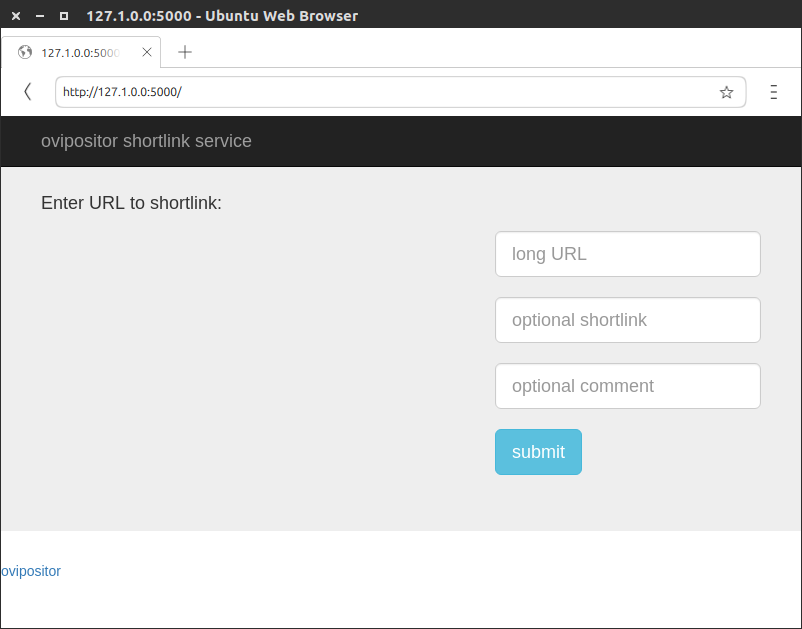
Ovipositor is a link-shortener web program. A long URL is entered, together with an optional shortlink and an optional comment. When creating a shortlink, the long URL and the shortlink are saved to a database. When an attempt is made to use a shortlink, the specified shortlink is searched for in the database and, if the shortlink is in the database, there is a redirect to its corresponding long URL.
setup
sudo apt install sqlite
sudo pip install ovipositor
Flask
while true; do
    ovipositor --home="index.html"
done
Gunicorn
sudo gunicorn --workers=1 "ovipositor.__init__:WSGI(argv=['--home=index.html'])" --bind=0.0.0.0:443 --certfile=/home/user/certificates/fullchain.pem --keyfile=/home/user/certificates/privkey.pemovipositor database structure
There is one table in an ovipositor database called “shortlinks”. This table has 6 fields:
field |
description |
|---|---|
comment |
shortlink descriptive comment |
count |
shortlink usage count |
IP |
IP address that created the shortlink |
URL |
long URL to which the shortlink corresponds |
shortlink |
shortlink text |
timestamp |
shortlink creation timestamp |
changing from YOURLS to ovipositor
An export dump should be made of the YOURLS MySQL database and the dump should be converted to an SQLite3 database. This can be done using mysql2sqlite.
The YOURLS SQLite database then can be converted to an ovipositor database using the script convert_YOURLS_SQLite_database_to_ovipositor_database.py.
convert_YOURLS_SQLite_database_to_ovipositor_database.py --help

convert_YOURLS_SQLite_database_to_ovipositor_database.py \
    --database_YOURLD=linkdb.db                          \
    --database_ovipositor=ovipositor.db
The YOURLS database contains three tables, “yourls_url”, “sqlite_sequence” and “yourls_options”. These tables have the following fields:
yourls_url
clicks
ip
keyword
timestamp
title
url
sqlite_sequence
name
seq
yourls_options
option_id
option_name
option_value
In changing from YOURLS to ovipositor, the following database table and field conversions are made:
YOURLS |
ovipositor |
|---|---|
yourls_url |
shortlinks |
clicks |
count |
ip |
IP |
keyword |
shortlink |
url |
URL |
timestamp (datetime.datetime) |
timestamp (datetime.datetime) |
title |
comment |
1 maintainer

Metadata
1 maintainer
Release files for ovipositor 2018.8.14.1819
For a detailed explanation of source distributions (sdists) and built distributions (wheels), please see the package formats documentation.
Source distribution (sdist)
| File | Size | Uploaded | Provenance | Actions |
|---|---|---|---|---|
| ovipositor-2018.8.14.1819.tar.gz | 12.8 kB | Without provenance | Details for ovipositor-2018.8.14.1819.tar.gz |
Release files / ovipositor-2018.8.14.1819.tar.gz
| Download URL | ovipositor-2018.8.14.1819.tar.gz |
|---|---|
| Size | 12.8 kB |
| Tags | Source |
|
SHA-256 checksum How to use checksums |
c90ed281fa509f88c869a80f28dd49497e64f16a8788a4457f33b12c1ba071c0
|
|
BLAKE2b-256 checksum How to use checksums |
30a9140ef748c701cedd6e01550998710f4761415aa720f39aa6c95eb327b1df
|
| Upload date | |
|
Uploaded using Trusted Publishing? What is trusted publishing? |
No |
| Uploaded via |
Python-urllib/2.7
|
Security for ovipositor 2018.8.14.1819
Provenance
Provenance describes where a file came from. On PyPI, provenance is shared via attestations, which provide a verifiable record of the build or publishing details. View details, limitations and caveats.
No provenance found
None of the files in this release were uploaded with provenance metadata.
A note on package security
PyPI is a repository for distributing packages, not a service for auditing them. While third-party security researchers and our staff do their best to detect and remove malicious packages, PyPI cannot guarantee the quality, security or suitability of any given package.
To learn more about protecting yourself from malicious actors, visit our package security documentation.














