


Ozon MCP Server



Run your Ozon stores straight from a chat with an AI assistant: prices, promos,
advertising, orders, returns, reviews, finances — 156 tools on top of the Ozon
Seller API and Performance API (Ozon is Russia's largest marketplace; the Seller
API covers catalogue and operations, the Performance API covers paid ads).
Built for sellers who run more than one store: every call takes a shop_id,
and API keys stay encrypted on your own server — nothing leaves it.
What sets it apart from other Ozon MCP servers: it covers advertising as well as
the Seller API, and its built-in diagnostics tell you which Ozon endpoints broke
before your assistant runs into them.
Selling on Wildberries too? There is the same server for WB — wb-mcp-server.
This is the author's own working tool: more than five months of daily use, around twenty seller accounts, 156 tools. It gets updated when he needs it updated — see Updates and support for what that means for you.
The per-client installation guides in
docs/are currently Russian only. The configuration in them is ready-to-paste JSON, which reads the same in any language: file paths, the URLhttp://localhost:8000/sse, and the headerAuthorization: Bearer <MCP_AUTH_TOKEN>.
You: Which of my products is Ozon planning to pull into a promo?
You: Show ad campaign spend for the week and stop the ones burning money.
You: Which products have a worse price index than their competitors?
You: Reply with a thank-you to every new 5-star review.
What it does
| Group | Tools | What's inside |
|---|---|---|
| Promotions and discounts | 14 | Ozon promotions (list, candidates, join/leave), seller's own promotions, "I want a discount" buyer requests |
| Prices and pricing strategies | 14 | setting prices and the minimum price, price index, minimum-price timer, automatic strategies that track competitors |
| Advertising (Performance API) | 22 | "Trafarety" CPC campaigns (Ozon's sponsored-placement format), bids and budgets, "Pay per order" (CPO), per-product and daily statistics |
| Products | 21 | listings and cards, attributes, stock, import and bulk updates, media, archive, certificates |
| FBS and FBO orders | 17 | unfulfilled orders, packing (v4), labels, cancellations, handover acts, country of origin |
| Returns and cancellations | 10 | unified FBO+FBS returns list, rFBS claims that need a seller decision, cancellation requests |
| Reviews, questions, chats | 13 | reviews and replies, buyer questions, chat conversations (v3) |
| Warehouses and reports | 8 | FBS warehouses, delivery methods, generating and downloading reports |
| Finances | 7 | balance, transactions, accruals, realization report, mutual settlements, cash flow |
| Categories, brands, certificates | 7 | category tree, attributes and their allowed values, certificates |
| Analytics | 5 | SKU analytics, stock and turnover, product positions in Ozon search, top search queries |
| FBO supplies | 4 | supply orders (v3), counters, timeslots |
| Rating | 2 | current seller rating and its history |
| Diagnostics | 2 | self-check of Ozon API availability, degradation detector |
| Notifications | 2 | push webhook subscriptions and the event-type reference |
| Company | 2 | seller details and tariffs |
| Stores | 1 | list of connected stores and their shop_id |
FBO and FBS are Ozon's fulfilment models: FBO ships from Ozon's warehouses, FBS from yours, rFBS is FBS with your own delivery.
The full numbered list, with a description and the parameters of every tool, is in
docs/tools.md. It is generated from ozon_mcp/server.py (the
TOOLS constant) — the same thing tools/list returns to any MCP client.
Quick start
Option 1: one command, no Docker
The server speaks stdio, which is how Claude Desktop, Cursor, VS Code and other MCP clients connect to it. Nothing to build:
uvx ozon-mcp-server
Or via pip:
pip install ozon-mcp-server
ozon-mcp
Client configuration (for example claude_desktop_config.json):
{
  "mcpServers": {
    "ozon": {
      "command": "uvx",
      "args": ["ozon-mcp-server"],
      "env": {
        "OZON_CLIENT_ID": "your Client-Id",
        "OZON_API_KEY": "your API key",
        "DATA_DIR": "~/.ozon-mcp"
      }
    }
  }
}
Point DATA_DIR at any writable directory — it holds stores, keys and statistics.
The default is /data, which is the path used inside Docker.
Option 2: Docker with the web dashboard
Use this if you want the dashboard, Ozon API diagnostics and browser-based store management. Five commands:
git clone https://github.com/DeviceIngineering/ozon-mcp-server.git
cd ozon-mcp-server
cp .env.example .env               # fine as-is for a trusted local network
docker compose up -d --build       # builds the image, serves on port 8000
open http://localhost:8000/shops   # add a store and its Ozon API keys
What each step does:
.env— every variable is optional. Store keys are easier to enter in the web UI than here. The one thing worth setting up front, if the server is reachable by anyone but you, isMCP_AUTH_TOKEN(generate one withopenssl rand -hex 32).docker compose up -d --build— builds the image from theDockerfile, maps port8000:8000and creates theozon_datavolume for stores, keys, call statistics and diagnostics history.restart: unless-stoppedbrings the container back up after a reboot./shops— the add-store form:shop_id(the handle you'll use in chat), a display name, Client-Id + Api-Key for the Seller API, and Client-Id + Client-Secret for the Performance API. The "Проверить" (Test) button makes a live request to Ozon and tells you whether the keys were accepted.
Once it's running:
| Address | What it is |
|---|---|
http://localhost:8000/ |
dashboard: call counters, errors, degradations |
http://localhost:8000/shops |
stores and keys |
http://localhost:8000/diagnostics |
Ozon API diagnostics |
http://localhost:8000/api/health |
health endpoint, JSON |
http://localhost:8000/sse |
the MCP endpoint — this is what clients point at |
Note that the web UI is in Russian.
To stop: docker compose down (the data stays in the ozon_data volume).
Logs: docker compose logs -f.
Without Docker
python3 -m venv .venv && source .venv/bin/activate
pip install .
DATA_DIR=./data PORT=8000 ozon-mcp-web
DATA_DIR defaults to /data, so when running locally be sure to point it at a
directory you can write to.
Installing into clients
The transport is SSE at http://<host>:8000/sse. SSE support differs between
clients: some speak it directly, others need the mcp-remote bridge. There is one
guide per client, with config paths for macOS, Linux and Windows and ready-made
JSON — in Russian, but the JSON blocks are language-neutral:
| Client | SSE directly | Guide |
|---|---|---|
| Claude Code | yes | docs/install-claude-code.md |
| Claude Desktop | no, mcp-remote bridge |
docs/install-claude-desktop.md |
| Cursor | yes | docs/install-cursor.md |
| Windsurf / Devin Desktop | yes | docs/install-windsurf.md |
| VS Code (GitHub Copilot) | yes | docs/install-vscode-copilot.md |
| Cline | yes | docs/install-cline.md |
| Continue.dev | yes | docs/install-continue.md |
| Zed | unconfirmed, bridge recommended | docs/install-zed.md |
| JetBrains AI Assistant / Junie | yes | docs/install-jetbrains.md |
| Gemini CLI | yes | docs/install-gemini-cli.md |
| OpenAI Codex CLI | no, mcp-remote bridge |
docs/install-codex.md |
The shortest example, Claude Code:
claude mcp add --transport sse ozon http://localhost:8000/sse \
  --header "Authorization: Bearer <MCP_AUTH_TOKEN>"
Client summary and the bridge reference: docs/README.md.
Multi-store and security
Stores are added in the web UI, and every tool takes a required shop_id;
ozon_list_shops tells you which ones exist. In chat it looks like this:
"show me the stock in store alpha".
The real gain is not the switching itself but that a strategy is written once and rolled out to every account: a rule about prices, review replies or ad bids applies to all stores at once — no logging in and out of seller accounts, no copying keys between client configs.
The price you pay is a shared IP. Every account talks to Ozon from one address: the server the MCP runs on. Ozon's rate limits are counted per address among other things, so the more accounts you have and the harder your strategies work them, the closer the combined traffic gets to the threshold where throttling or a block kicks in.
- there is no limit on the number of stores in the code;
- the real ceiling comes from Ozon's per-IP limits, not from this server;
- around twenty accounts is the author's own estimate of where the traffic still stays in the safe zone;
- beyond that, spread the stores across several servers with different addresses.
You can see the limit approaching, and the place to see it is the web UI: failed pings and diagnostics warnings start piling up, and the error share in the call statistics jumps. The dashboard also tells the two cases apart — mass throttling looks like many tools degrading at once, a broken endpoint like a single one.
How keys are stored:
- on first use,
.encryption_key— a Fernet key — is created inDATA_DIR; - store keys are encrypted with it and kept in
DATA_DIR/shops.json; - the web UI shows keys masked (
abc***xyz), and saving a masked value does not overwrite the real one; - under Docker all of this lives in the
ozon_datavolume. To move to another machine, copy the whole volume — otherwise you lose the encryption key (see DEPLOY.md, Russian).
What to know about access:
MCP_AUTH_TOKENprotects only/sse. Pass it as theAuthorization: Bearer …header or as a?token=…query parameter.- An empty
MCP_AUTH_TOKENmeans no authentication at all. Only acceptable on a trusted network. - The web UI (
/,/shops,/diagnostics) and/api/*are not behind the token: anyone who can reach the port sees the dashboard and can add stores. - Do not expose port 8000 to the internet directly. For remote access use Tailscale or a VPN.
- The server does not terminate HTTPS. If you need TLS from outside, put a reverse proxy in front.
The web UI: every call is visible
With a typical MCP server, calls vanish into the void: the assistant did something, but what exactly, how long it took and what error it hit is known only to the assistant. Here every call gets a line in the log, and every broken tool gets a marker on the dashboard. For a tool that moves real money in a store, that is not decoration — it is the condition for trusting it.
The call statistics and check history are not synthetic: they come from more than five months of daily use across roughly twenty seller accounts. The list of caught Ozon API changes in the limitations section comes from the same place — it was read off the degradation log, not copied from the documentation.
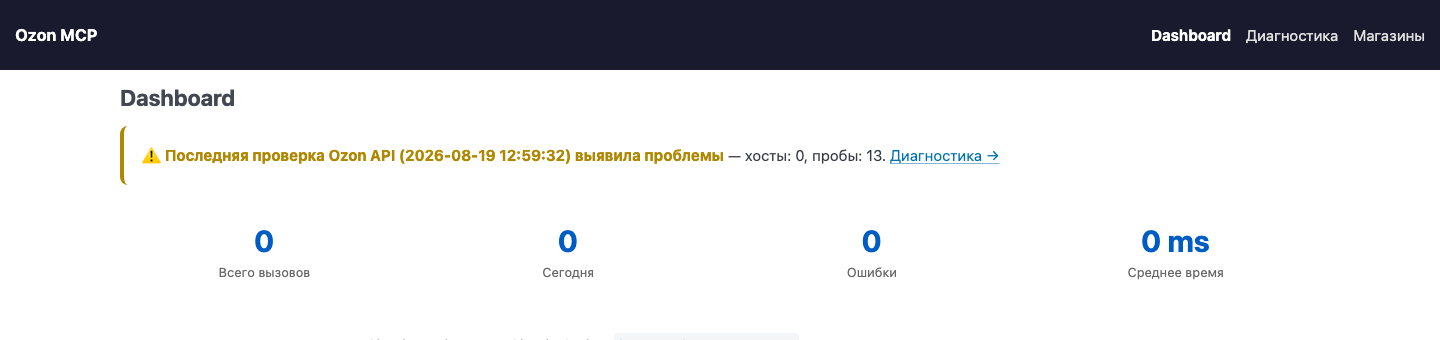
Dashboard /
The screenshot is at the top of this page.
- Four counters at the top: total calls, calls today, errors, and average call duration in milliseconds.
- Top 10 tools: call count, average duration, and how many of those calls failed.
- A feed of the last 50 calls: timestamp,
shop_id, tool name, duration, success or failure, and the error text. - A per-store filter (
/?shop=alpha) — the same figures for a single account. - Two banners surface at the top: degraded tools, and "the last Ozon API check found problems".
Stores /shops
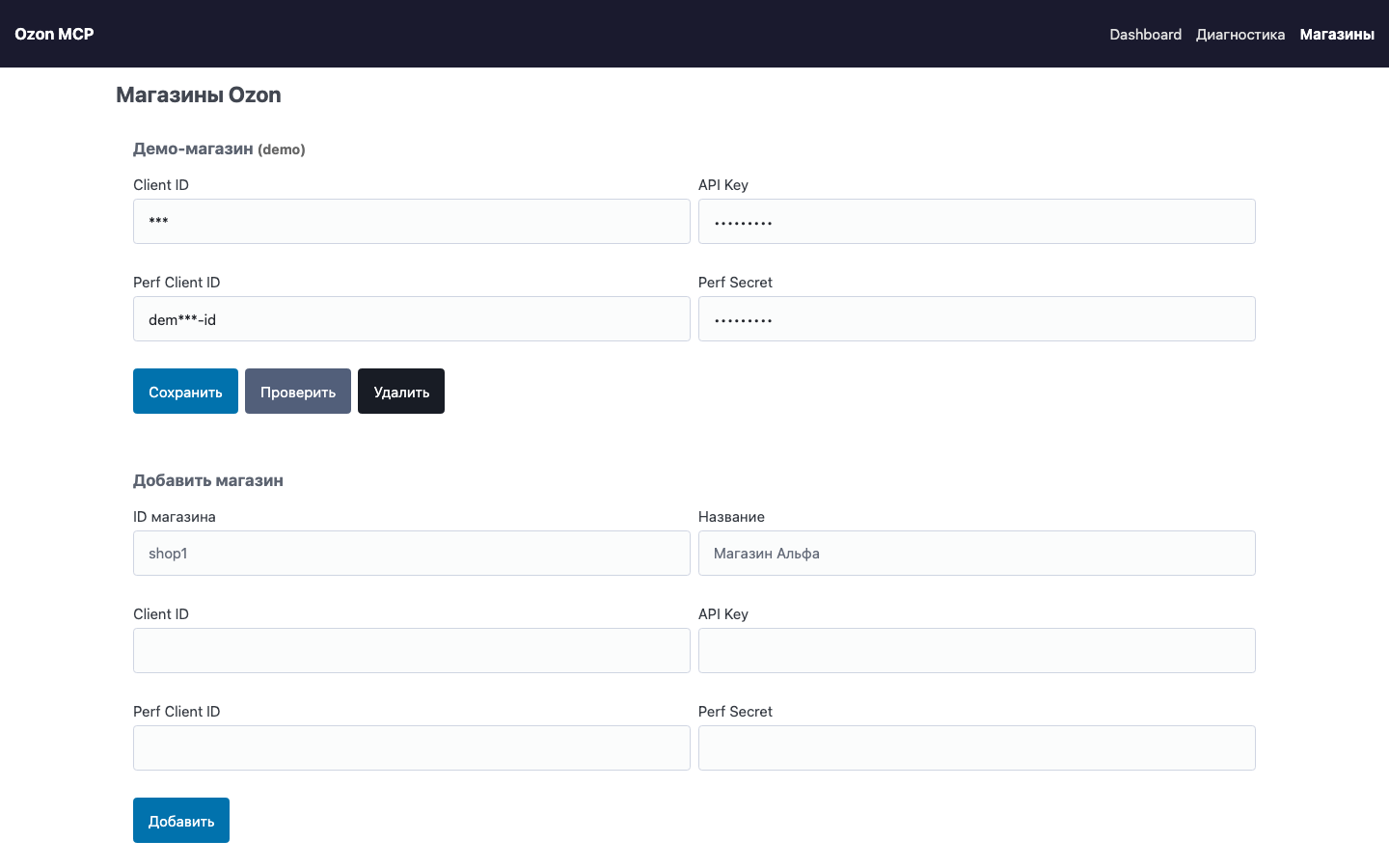
Accounts are added and removed right in the browser, with no file editing and no
container restart. The "Проверить" (Test) button makes a live request to both APIs
(POST /api/shops/{shop_id}/test), so keys are verified when you add them rather
than during the first real call in the middle of a task. Tokens are encrypted with
Fernet, the encryption key lives in DATA_DIR/.encryption_key, and the UI shows
keys masked.
Diagnostics /diagnostics
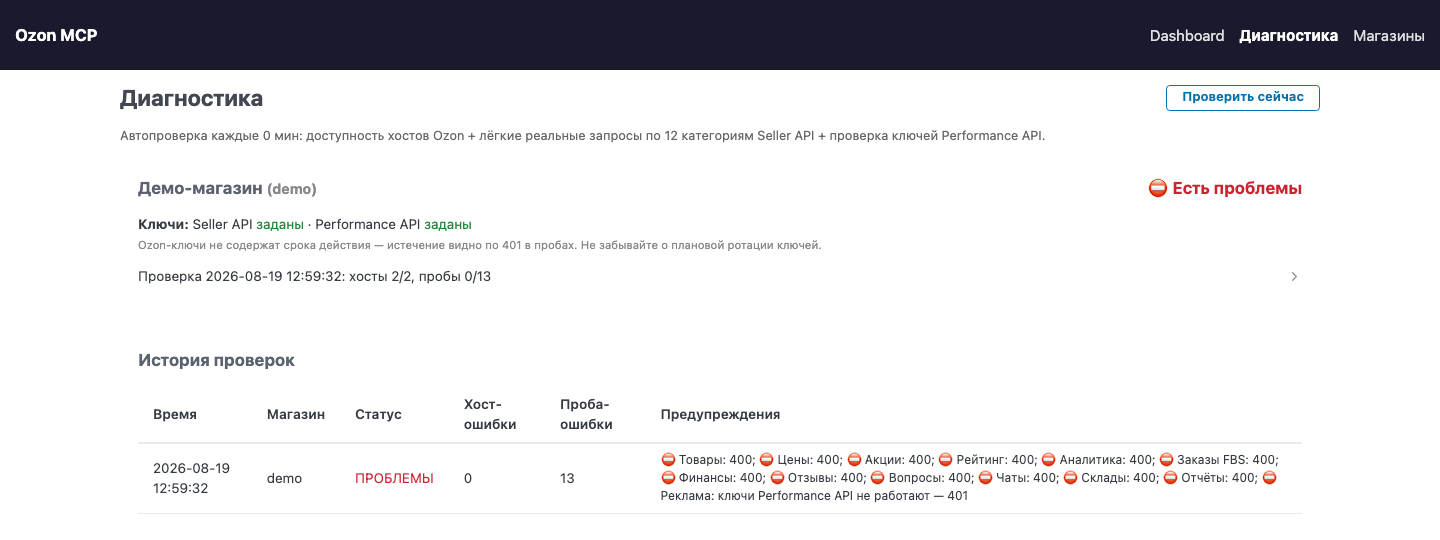
(the screenshot shows a demo store with deliberately invalid keys, which is why every probe is red)
- Per store: whether keys are set, Ozon host availability, 12 Seller API category probes, and a Performance API key check.
- A background check every
HEALTH_CHECK_INTERVAL_MINminutes (30 by default,0disables it), plus a "Проверить сейчас" (Check now) button for an immediate run (POST /api/diagnostics/run). - Check history: time, store, status, number of failed pings, number of failed probes, and the warning texts. The UI shows the last 30 entries; up to 1000 are kept in the database with automatic rotation.
- The same data is available from chat through the
ozon_diagnosticstool.
Degradation detector
The server notices on its own that Ozon broke or switched off an endpoint — not from the documentation and not from work that failed, but from its own statistics. A tool whose last three calls in a row failed while earlier calls succeeded lands in the degradation list, which shows the tool name, the time of the last successful call, the number of consecutive errors, and the text of the latest one. On the dashboard that is a red banner; on the diagnostics page, a table.
What this buys you: a change on Ozon's side becomes visible the day it happens,
not a week later when you discover prices haven't been updating. The same list is
available from chat via ozon_degradations.
JSON for external monitoring
All of the above can be scraped programmatically, not just looked at:
| Endpoint | What it returns |
|---|---|
GET /api/health |
service status, whether authentication is on, recent checks, degraded tools |
GET /api/stats |
the same summary as the dashboard; ?shop= narrows it to one store |
GET /api/diagnostics/{shop_id} |
a full live diagnostic run for one store |
That is enough to wire the server into Zabbix, Uptime Kuma, or a plain curl in cron.
Context budget
Two things are paid in tokens: tool definitions, loaded once per session, and tool
responses, paid on every call. Both were measured on a live seller account rather
than estimated — scripts/collect_corpus.py takes a snapshot of read-only tools
(PII masked before anything is written to disk, the corpus stays out of the repo),
scripts/measure_corpus.py reports what it costs.
Definitions. 156 tools cost 12 300 tokens with a single store configured,
down from 18 386: one-sentence descriptions, shop_id dropped from the schemas when
only one store exists, no empty schema fields.
Responses. The real problem turned out to be a handful of giant payloads:
| tool | before | after |
|---|---|---|
ozon_category_tree — a 9 797-node tree |
266 324 | 979 |
ozon_get_prices — 93 % of the weight is promo history |
52 879 | 8 679 |
ozon_returns_fbo — 50 returns with full logistics |
24 277 | 8 458 |
ozon_warehouse_list — 99 % of the weight is a year of timetables |
20 132 | 370 |
| corpus of 16 live responses | 476 158 | 63 845 |
What the server does about it:
view: compact | full. Heavy tools return the fields they are called for;view="full"gives the raw API response, and the answer states which fields were hidden so the model knows what it can ask for.- Truncation signal. When exactly
limitrecords come back, the answer says the data is partial — otherwise the model reasons about a slice and presents it as the whole catalogue. - Size guard. A response that would not fit the client's output ceiling
(
MAX_MCP_OUTPUT_TOKENS, 25 000 by default in Claude Code) is cut server-side with a count of what was left out, instead of being silently truncated on arrival. - Search and depth for the category tree. The API has neither and returns all
9 797 nodes;
searchfinds a category,depthcontrols the level, and the default is the top level only.
Notes arrive as separate content blocks rather than a field inside the JSON: several Ozon endpoints return an array at the top level, and wrapping it would break every path into the data.
Tool profiles. A client without tool search pays for the whole catalogue on every
request. OZON_TOOLSETS keeps only the profiles you use, cut along working tasks
rather than documentation sections:
OZON_TOOLSETS |
tools | tokens |
|---|---|---|
| empty (default) | 151 | 12 686 |
pricing,ads |
57 | 5 425 |
orders |
33 | 2 611 |
The core profile — stores, diagnostics, degradations, company — is always on:
diagnostics are needed exactly when something is broken. Disabled profiles are listed
in the ozon_list_shops description, and calling a disabled tool answers which profile
contains it, so the assistant names the reason instead of saying "this is not possible".
Claude Code needs none of this: it has tool search enabled by default. Cursor, Cline,
Continue and Claude Desktop fetch tools/list whole — profiles are for them.
Design decisions
- 151 narrow tools, not a few generic ones. Collapsing them into
action-style endpoints would save definition tokens and change the class of failure: instead of "no such tool" you get a wrong call with a side effect, and some of these tools set prices and start ad campaigns. - The server diagnoses itself.
ozon_diagnosticschecks host availability and runs a light real request across 12 Seller API categories plus the Performance API keys;ozon_degradationsreports which tools used to work and now fail steadily. Ozon retires endpoints without notice, so "is it my keys or did the API move" has to be answerable in one call. compactis the default for heavy tools. The corpus showed the hidden fields are promo history, warehouse timetables and logistics internals — not the data decisions are made from — and the response says what was hidden.- Response shaping hangs on a contextvar. The dispatcher here is one long if-chain
with 150
_jsoncalls; threading the tool name and arguments through every branch by hand would be 150 edit sites and 150 chances to miss one. shop_iddisappears from schemas with one store, and comes back the moment a second one appears.mcp<2is pinned deliberately — the 2.0 low-level API drops the decorator handlers this server is built on; the pin is documented where it is set.- Keys are encrypted at rest (Fernet, key in the data volume) and masked in the UI; the corpus collector masks personal data before writing a file.
How it works
A single Docker container running a FastAPI application that is both the MCP server and the web UI.
ozon_mcp/server.py— the MCP server itself. TheTOOLSlist describes all 156 tools (name, description, JSON schema for the arguments) and thecall_toolhandler routes each call to the right Ozon client method. Clients are pooled pershop_id, so switching stores reconnects nothing.ozon_mcp/client.py— two HTTP clients:OzonSellerClient(Client-Id/Api-Keyheaders) andOzonPerformanceClient(aclient_credentialstoken that lives 30 minutes and refreshes itself).ozon_mcp/app.py— FastAPI: the/sseendpoint on top ofSseServerTransport, Bearer-token checking, the dashboard/stores/diagnostics pages, and the background health-check task.ozon_mcp/settings.py— stores and keys: Fernet encryption, masking for the UI, picking up keys from environment variables as a store calleddefault, and migrating the old single-storesettings.jsonintoshops.json.ozon_mcp/diagnostics.py— probes: pinging Ozon hosts plus lightweight real requests across 12 Seller API categories, and a Performance API key check.ozon_mcp/stats.py— SQLite viaaiosqlite: every tool call with its duration and outcome, health-check history, degradation calculation.
The hosts the server talks to:
| API | Base URL | Authorization |
|---|---|---|
| Seller API | api-seller.ozon.ru | Client-Id and Api-Key headers |
| Performance API (ads) | api-performance.ozon.ru | OAuth client_credentials, 30-minute token |
Non-obvious things:
- Ozon returns ad bids and budgets in micro-rubles:
1000000= 1 ₽. Don't be surprised by seven-digit numbers. - A
403on reviews and questions is not a breakage — it means no Premium Plus subscription. Diagnostics does not count those as errors. - Ozon API keys became time-limited after the 2026-02-13 rotation — 180 days. The
expiry is exposed explicitly:
POST /v1/rolesreturnsexpires_at, so you can warn ahead of time instead of catching a401in the probes. - Asynchronous ad statistics: one report at a time, ≤10 campaigns, ≤62 days. The tool waits up to about 2 minutes for the report to be ready.
- Supply-order statuses in API v3 are integers 1–8, not strings.
Environment variables
| Variable | Default | Purpose |
|---|---|---|
MCP_AUTH_TOKEN |
empty | Bearer token for /sse. Empty = no authentication |
HEALTH_CHECK_INTERVAL_MIN |
30 |
background diagnostics interval, 0 disables it |
PORT |
8000 |
HTTP server port |
OZON_TOOLSETS |
empty | comma-separated tool profiles: pricing, ads, catalog, orders, analytics, feedback, finance; empty means all 156 |
OZON_MAX_RESPONSE_CHARS |
60000 |
size-guard threshold for a single response |
DATA_DIR |
/data |
directory holding shops.json, stats.db, .encryption_key |
OZON_CLIENT_ID, OZON_API_KEY |
empty | Seller API keys for the default store, if you'd rather not use the UI |
OZON_PERF_CLIENT_ID, OZON_PERF_CLIENT_SECRET |
empty | the same for the Performance API |
Known Ozon API limitations (as of August 2026)
-
Advertising: the API can only create "Trafarety" CPC campaigns; budgets and bids are in micro-rubles; there is no official way to read the ad account balance.
-
"Pay per order": bids have been fixed since February 2025 — you can only turn the promotion on or off.
-
Reviews, questions and part of analytics require a Premium Plus subscription (error code 7).
-
Funnel metrics in
ozon_analyticsare marked deprecated by Ozon — useozon_product_queriesfor search positions. -
Endpoints Ozon is switching off in autumn 2026. Dates from the official @OzonSellerAPI channel, verified against live seller accounts (issue #6, thanks to @standlord-prog):
path goes dark replacement /v3/posting/fbs/list2026-08-31 /v4/posting/fbs/list— done in v2.1.0/v2/posting/fbo/list2026-08-31 /v3/posting/fbo/list— done in v2.1.0/v3/posting/fbs/unfulfilled/list2026-08-31 no replacement: filtered out of /v4/posting/fbs/listby status — done in v2.1.0/v2/posting/fbs/act/create2026-09-07 /v1/carriage/create+/v1/carriage/approve— in progress/v3/finance/transaction/list2026-09-08 /v1/finance/accrual/by-day— in progress/v3/finance/transaction/totals2026-09-08 same — in progress /v4/posting/fbs/listis not a rename of v3:postingssit at the top level rather than underresult, and pagination is cursor-based (has_next+cursor) instead ofoffset. -
ozon_finance_cash_flowandozon_finance_accrualsalready run on the new paths (/v1/finance/cash-flow-statement/list,/v1/finance/accrual/by-day). -
ozon_product_stocks_by_warehouseuses v2 because v1 is switched off on 2026-04-07. -
Digital FBS handover acts were removed by Ozon on 2026-03-22 — the regular act is used instead.
-
The Ozon API has no "edit a review reply" method: the reply is deleted and written again.
This list is not a rewrite of the reference: it comes from the degradation log and five months of daily calls, cross-checked against docs.ozon.ru as of August 2026.
What changed in version 2.0
A full revision against the June 2026 Ozon API, verified by running real requests rather than reading docs: the unified returns list, cancellations v2, realization v2, ship v4, supply-order v3, real pricing strategies and "I want a discount", the seller's own promotions, the new advertising model (Trafarety CPC + "Pay per order"), diagnostics with a degradation detector, and authentication on the MCP endpoint.
Project layout
ozon-mcp-server/
├── docker-compose.yml   # port 8000, ozon_data volume
├── Dockerfile           # python:3.12-slim, uvicorn
├── DEPLOY.md            # deploying to a dedicated machine, moving data
├── docs/                # client connection guides + tool reference
└── ozon_mcp/
    ├── server.py        # MCP server: 156 tools, multi-store
    ├── client.py        # Seller API + Performance API
    ├── app.py           # FastAPI: SSE, web, auth, health loop
    ├── diagnostics.py   # category probes, degradation detector
    ├── settings.py      # stores and keys (Fernet)
    ├── stats.py         # call statistics and check history (SQLite)
    └── templates/       # dashboard, diagnostics, shops
Deploying to a dedicated machine and moving stores across: DEPLOY.md (Russian).
The same server for Wildberries
wb-mcp-server is the same
tool for the other marketplace (Wildberries is the other large Russian
marketplace): same architecture, same web UI with dashboard and diagnostics, same
multi-store model via shop_id, same SSE transport, same ways of connecting
clients.
| Ozon MCP Server | WB MCP Server | |
|---|---|---|
| Port | 8000 | 8001 |
| Tools | 151 | 202 |
| API | Ozon Seller API + Performance API (ads) | Wildberries Seller API |
In practice that means two things:
- The second server takes no new learning. Once you have set up one, the other starts the same way; only the port (8001 instead of 8000) and the tool set differ.
- You can run both on one machine. Different ports, data in separate Docker
volumes, no conflict. In your client they are simply two MCP servers:
ozonathttp://localhost:8000/sseandwbathttp://localhost:8001/sse.
Sharing one machine does not hurt on rate limits either: both go out from the same IP, but Ozon and Wildberries count limits on their own side — they are different marketplaces. The cap on the number of seller accounts described in the multi-store section applies within each marketplace separately.
From API access to a working repricer
This server gives a model access to the seller account. Deciding what the price should be is a separate job, and ozon-wildberries-repricer does it: it holds a reference price, computes a break-even floor from each marketplace's real fees, pulls products out of promotions that would push them under cost, and can search for a better price by running a controlled experiment on live sales.
It covers Ozon, Wildberries and Yandex Market in one place, and it has its own HTTP control plane for LLM agents — with the rails a model needs: a price move that would trigger Wildberries quarantine is walked over several runs, prices are read back three minutes later because marketplaces report success for changes they did not make, and several agents working the same catalogue cannot overwrite each other's decisions.
Run it without a marketplace account: npm run demo seeds a synthetic catalogue
and starts the app.
Updates and support
Ozon changes its API constantly: endpoints get added, renamed and switched off (the limitations section above lists what has been caught so far). This server is the author's working tool, and it gets updated when he needs it updated — that is, when a change breaks something in his own stores. More than five months of daily use, and commits appear when Ozon breaks something, not on a schedule: a gap between commits usually means everything is working. The upside is that the code is proven by real daily use rather than published and forgotten; the downside is that there is no release schedule and no commitment on turnaround.
If you need a fix urgently, write to d0371153@gmail.com. Issues and pull requests are welcome too, and they do get read.
Acknowledgements
- @standlord-prog:
- issue #6 — the breakdown
of Ozon endpoints being switched off, verified against live seller accounts: dates,
replacements and three gotchas in the move to
/v4. Separately — the warning that/v1/carriage/createhas no required fields and an empty{}body creates a real shipment, and the correction aboutPOST /v1/rolesreturningexpires_at. Version v2.1.0 is built on that work. - PR #7 — found and fixed
blind diagnostics: in stdio mode call statistics were never initialised, so
ozon_degradationsanswered "no degradations" to every question — even when every single call was failing. The tool is marked [P0] and is asked precisely when something has broken, which makes a silent false negative worse than having no tool at all. The PR does not just fix the wiring: it also separates "no data" from "no degradations" and adds an integration test over stdio with a real MCP client. Shipped in v2.1.2.
- issue #6 — the breakdown
of Ozon endpoints being switched off, verified against live seller accounts: dates,
replacements and three gotchas in the move to
Version history: CHANGELOG.md.
License
MIT — see LICENSE.
MCP Registry
Published in the official MCP Registry:
mcp-name: io.github.DeviceIngineering/ozon-mcp-server
1 maintainer

Metadata
1 maintainer
Release files for ozon-mcp-server 2.5.2
For a detailed explanation of source distributions (sdists) and built distributions (wheels), please see the package formats documentation.
Source distribution (sdist)
| File | Size | Uploaded | |
|---|---|---|---|
| ozon_mcp_server-2.5.2.tar.gz | 348.7 kB | Details |
Built distribution (wheel)
| File | Interpreter | ABI | Platform | Reset |
|---|---|---|---|---|
| ozon_mcp_server-2.5.2-py3-none-any.whl | Python 3 | none | any | Details |
Total release size: 427.3 kB
Release files / ozon_mcp_server-2.5.2.tar.gz
| Download URL | ozon_mcp_server-2.5.2.tar.gz |
|---|---|
| Size | 348.7 kB |
| Tags | Source |
|
SHA-256 checksum How to use checksums |
b01c51b919cbe8f87a4226bbeb185cbb32ebb13097be4fa9877c7bc271fec39d
|
|
BLAKE2b-256 checksum How to use checksums |
4cf31cc207626950e3cd63d10f94104b3efcbd9992b61a491ccfa5ca12c1defb
|
| Upload date | |
|
Uploaded using Trusted Publishing? What is trusted publishing? |
Yes |
| Uploaded via |
twine/7.0.0 CPython/3.13.14
|
Provenance
Provenance describes where a file came from. On PyPI, provenance is shared via attestations, which provide a verifiable record of the build or publishing details. View details, limitations and caveats.


PyPI Publish Attestation
PyPI verified that this artifact, at this checksum, originated from the publisher listed below.
Signed by GitHub Actions, verified by PyPI on Sep 5, 2026.
Transparency logRelease files / ozon_mcp_server-2.5.2-py3-none-any.whl
| Download URL | ozon_mcp_server-2.5.2-py3-none-any.whl |
|---|---|
| Size | 78.7 kB |
| Tags | Python 3 |
|
SHA-256 checksum How to use checksums |
b41627831ee762f192c05db5f36b2d690cd0780078ae08aaaa399ee9da65ad70
|
|
BLAKE2b-256 checksum How to use checksums |
a1569b5f9de0b1c2dd05682b8f16f6949fa6e21c9251295c239577dedc8ca9c1
|
| Upload date | |
|
Uploaded using Trusted Publishing? What is trusted publishing? |
Yes |
| Uploaded via |
twine/7.0.0 CPython/3.13.14
|
Provenance
Provenance describes where a file came from. On PyPI, provenance is shared via attestations, which provide a verifiable record of the build or publishing details. View details, limitations and caveats.
PyPI Publish Attestation
PyPI verified that this artifact, at this checksum, originated from the publisher listed below.
Signed by GitHub Actions, verified by PyPI on Sep 5, 2026.
Transparency log













