
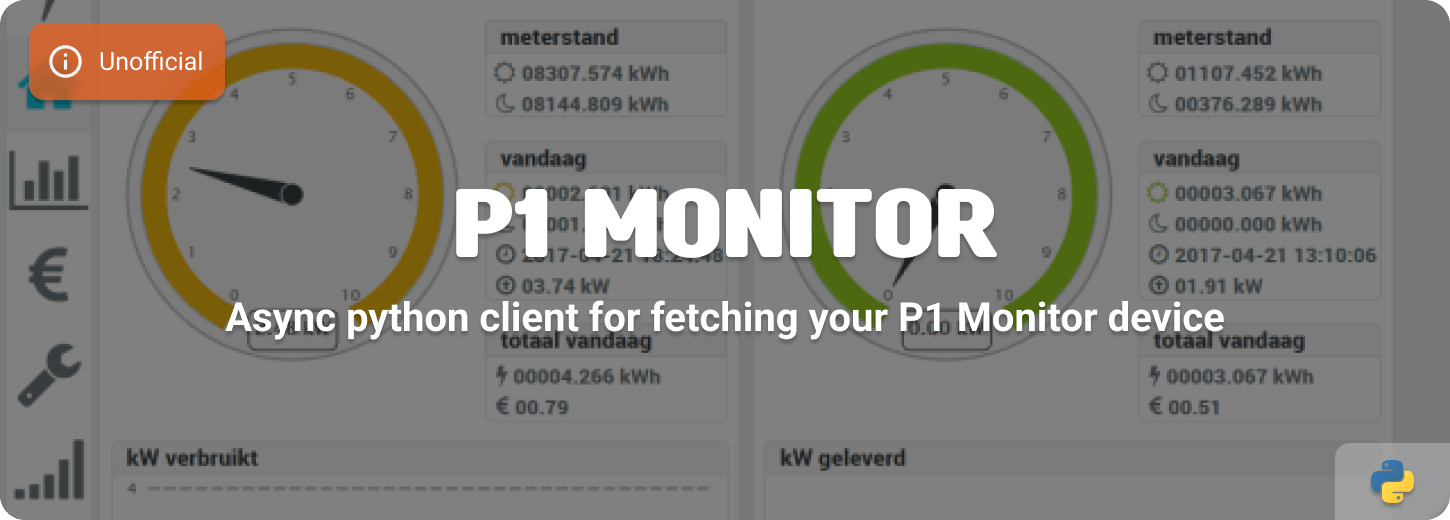













Asynchronous Python client for the P1 Monitor API.
About
There are many ways to read the serial port (P1) of your smart meter and what you do with the data that comes out. With this python library your platform can read P1 Monitor via the API and use the data for example for an integration in Home Assistant.
Installation
pip install p1monitor
Usage
import asyncio

from p1monitor import P1Monitor


async def main():
    """Show example on getting P1 Monitor data."""
    async with P1Monitor(host="192.168.1.2", port=80) as client:
        smartmeter = await client.smartmeter()
        watermeter = await client.watermeter()
        settings = await client.settings()
        phases = await client.phases()
        print(smartmeter)
        print(watermeter)
        print(settings)
        print(phases)


if __name__ == "__main__":
    asyncio.run(main())
More examples can be found in the examples folder.
Class: P1Monitor
This is the main class that you will use to interact with the P1 Monitor.
| Parameter | Required | Description |
|---|---|---|
host |
True |
The IP address of the P1 Monitor. |
port |
False |
The port of the P1 Monitor. Default is 80. |
Data
There is a lot of data that you can read via the API:
SmartMeter
- Gas Consumption
- Power Consumption / Production
- Energy Consumption Low/High
- Energy Production Low/High
- Energy Tariff Period
Phases
- Voltage phases L1/2/3
- Current Phases L1/2/3
- Power consumed phases L1/2/3
- Power Produced phases L1/2/3
WaterMeter
- Day Consumption (liters)
- Total Consumption (m3)
- Day Pulse count
Settings
- Gas Consumption Price
- Energy Consumption Price Low/High
- Energy Production Price Low/High
Contributing
This is an active open-source project. We are always open to people who want to use the code or contribute to it.
We've set up a separate document for our contribution guidelines.
Thank you for being involved! 😍
Setting up development environment
The simplest way to begin is by utilizing the Dev Container feature of Visual Studio Code or by opening a CodeSpace directly on GitHub. By clicking the button below you immediately start a Dev Container in Visual Studio Code.
This Python project relies on Poetry as its dependency manager, providing comprehensive management and control over project dependencies.
You need at least:
- Python 3.11+
- Poetry
Installation
Install all packages, including all development requirements:
poetry install
Poetry creates by default an virtual environment where it installs all necessary pip packages.
Pre-commit
This repository uses the pre-commit framework, all changes are linted and tested with each commit. To setup the pre-commit check, run:
poetry run pre-commit install
And to run all checks and tests manually, use the following command:
poetry run pre-commit run --all-files
Testing
It uses pytest as the test framework. To run the tests:
poetry run pytest
To update the syrupy snapshot tests:
poetry run pytest --snapshot-update
License
MIT License
Copyright (c) 2021-2025 Klaas Schoute
Permission is hereby granted, free of charge, to any person obtaining a copy of this software and associated documentation files (the "Software"), to deal in the Software without restriction, including without limitation the rights to use, copy, modify, merge, publish, distribute, sublicense, and/or sell copies of the Software, and to permit persons to whom the Software is furnished to do so, subject to the following conditions:
The above copyright notice and this permission notice shall be included in all copies or substantial portions of the Software.
THE SOFTWARE IS PROVIDED "AS IS", WITHOUT WARRANTY OF ANY KIND, EXPRESS OR IMPLIED, INCLUDING BUT NOT LIMITED TO THE WARRANTIES OF MERCHANTABILITY, FITNESS FOR A PARTICULAR PURPOSE AND NONINFRINGEMENT. IN NO EVENT SHALL THE AUTHORS OR COPYRIGHT HOLDERS BE LIABLE FOR ANY CLAIM, DAMAGES OR OTHER LIABILITY, WHETHER IN AN ACTION OF CONTRACT, TORT OR OTHERWISE, ARISING FROM, OUT OF OR IN CONNECTION WITH THE SOFTWARE OR THE USE OR OTHER DEALINGS IN THE SOFTWARE.
1 maintainer

Metadata
1 maintainer
Release files for p1monitor 3.2.0
For a detailed explanation of source distributions (sdists) and built distributions (wheels), please see the package formats documentation.
Source distribution (sdist)
| File | Size | Uploaded | |
|---|---|---|---|
| p1monitor-3.2.0.tar.gz | 8.3 kB | Details |
Built distribution (wheel)
| File | Interpreter | ABI | Platform | Reset |
|---|---|---|---|---|
| p1monitor-3.2.0-py3-none-any.whl | Python 3 | none | any | Details |
Total release size: 17.4 kB
Release files / p1monitor-3.2.0.tar.gz
| Download URL | p1monitor-3.2.0.tar.gz |
|---|---|
| Size | 8.3 kB |
| Tags | Source |
|
SHA-256 checksum How to use checksums |
25cb62be02db80b32f3d5bcd8f43f1650aa45c0d52888290e8d9f6d64096e278
|
|
BLAKE2b-256 checksum How to use checksums |
f064cc066df78e3f91044e87991d40a3f9e0770dac77532953d624e63ec45ac4
|
| Upload date | |
|
Uploaded using Trusted Publishing? What is trusted publishing? |
Yes |
| Uploaded via |
twine/6.1.0 CPython/3.13.7
|
Provenance
Provenance describes where a file came from. On PyPI, provenance is shared via attestations, which provide a verifiable record of the build or publishing details. View details, limitations and caveats.


PyPI Publish Attestation
PyPI verified that this artifact, at this checksum, originated from the publisher listed below.
Signed by GitHub Actions, verified by PyPI on Sep 15, 2025.
Transparency logRelease files / p1monitor-3.2.0-py3-none-any.whl
| Download URL | p1monitor-3.2.0-py3-none-any.whl |
|---|---|
| Size | 9.2 kB |
| Tags | Python 3 |
|
SHA-256 checksum How to use checksums |
2b194e83eab91bcdb51ee2bdae4697e739dd89f90e34f2244eec97dea4f2f794
|
|
BLAKE2b-256 checksum How to use checksums |
5885235586b973322030f8ffa2afcce2a76ac29ef462d409e6fd60c089107fcc
|
| Upload date | |
|
Uploaded using Trusted Publishing? What is trusted publishing? |
Yes |
| Uploaded via |
twine/6.1.0 CPython/3.13.7
|
Provenance
Provenance describes where a file came from. On PyPI, provenance is shared via attestations, which provide a verifiable record of the build or publishing details. View details, limitations and caveats.
PyPI Publish Attestation
PyPI verified that this artifact, at this checksum, originated from the publisher listed below.
Signed by GitHub Actions, verified by PyPI on Sep 15, 2025.
Transparency log













