
Pitchr
A python library and framework for composing music. Pitchr on PyPI
Targets most Linux environments.
Features
- Enables creation of music by composition of music objects (notes, chords, measures, and staffs)
- Unified interface for playing any music object (
note.play(),staff.play()) - Unified interface for showing any music object (
note.show(),staff.show())
- Spawns an image of the music object
- Unified interface for exporting any music object (
note.save('note.pdf'),staff.save('staff.pdf')) - Flexible manipulation of music
- easily access notes by indexing a measure by beat:
note0 = measure[0] - edit note attributes' pitch via methods
transpose,octave_up,augment
- Intelligently generates harmonies from your melodies
- Finalizes your composition as beautiful standard sheet music
- Enables interactive development in Jupyter Notebook
Installation
To install: pip3 install pitchr.
Other dependencies that must be installed (available via your package manager):
- libasound2
- lilypond
Pitchr downloads models to ~/.pitchr/. Set the PITCHR_PATH environment variable to change this behavior.
Documentation
Documentation is hosted on Github Pages here
Getting Started
from pitchr import *

# Instantiate notes
n = Note(pitch='C4', duration=1.0)

# Play them
n.play()

# Write music

m = Measure([
    Note('C', 1.0),
    Note('D', 1.0),
    Note('E', 1.0),
    Note('D', 1.0),
])

# See what you've written
m.show()

# Export to PDF
m.save('MySong.pdf')
Helper UI
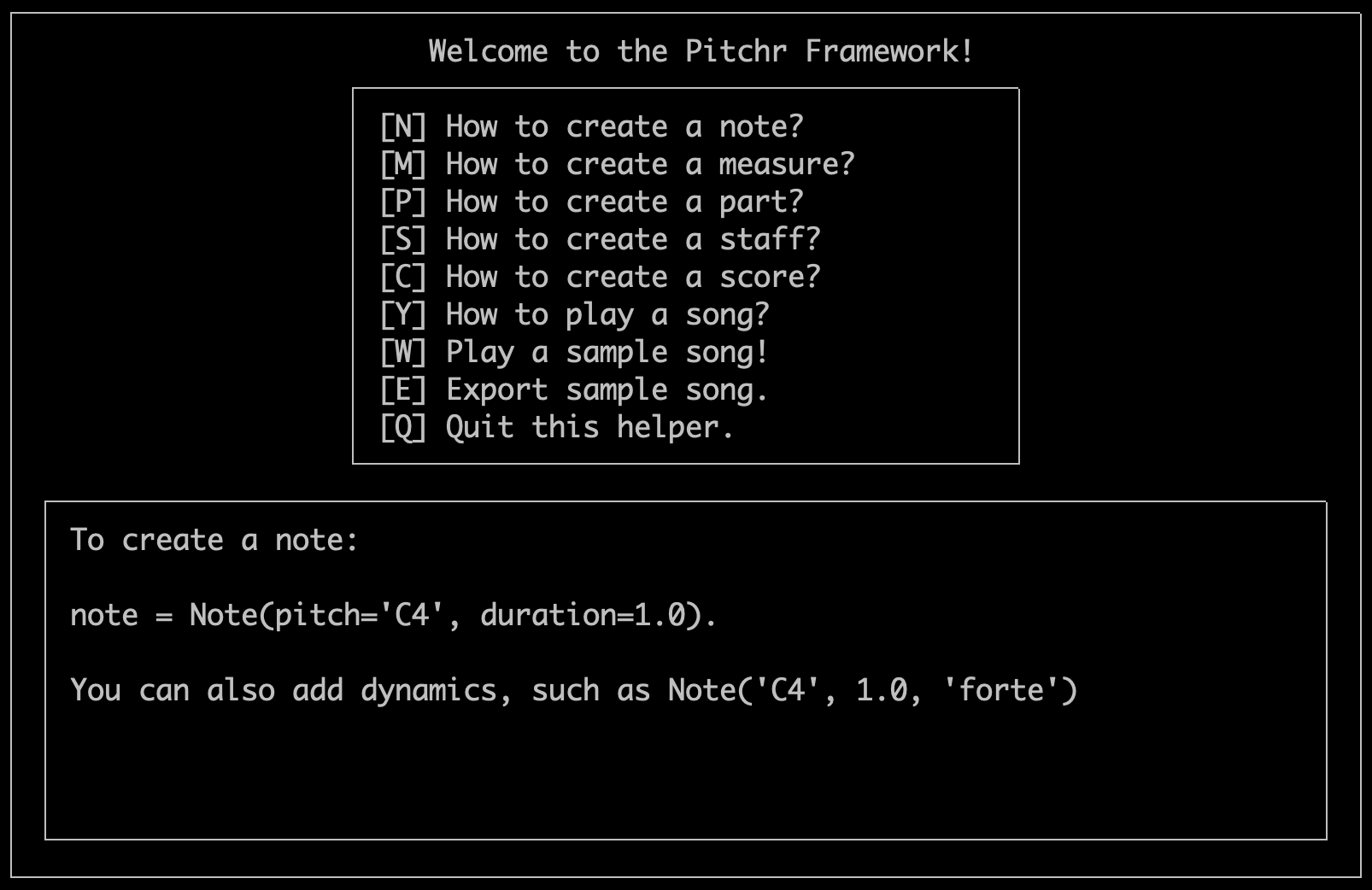
To access the helper UI, run from the command line: python3 -m pitchr.helper
More Detailed Notes
Note() class
Init:
pitch("C#6")durationin beatsdynamic(piano, forte, crescendo)articulation(staccato, accent, fermata)
Note()
from pitchr import *
note1 = Note("C4", 1, "forte")
note1.mingus_note # 'C-4'
note1.duration # 1
note1.dynamic # "forte"
note1.augment() or note1.diminish()
Chords
note2. = Note("E4", 1)
chord1 = Chord([note1, note2])
chord1.determine() # "Major third"
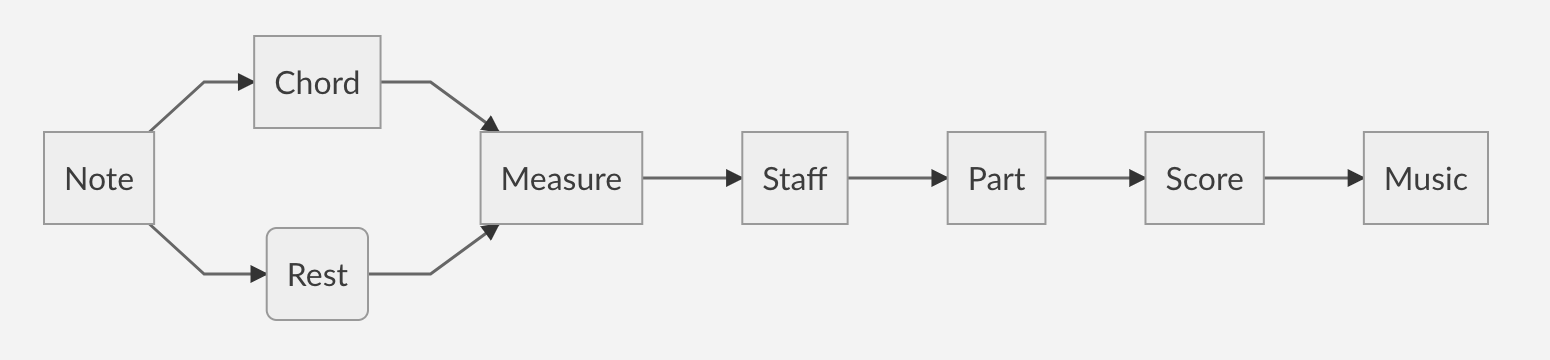
Measure is a collection of Notes
measure1 = Measure([note1, note2])
measure1.contains(note1) # True
measure1.append(note3)
Staff is a collection of Measures
Init:
measuresclefvoicehttps://thedpws.github.io/pitcher/
staff1 = music.Staff(measure1, Clef.TREBLE, Voice.PIANO)
Part is a collection of Staffs
part1 = Part(staff1, tempo, time_signature, key_signature)
part1.add_staff(staff2)
part1.time_signature = 3/4
Score is a collection of Parts
score1 = Score("My Song", "Wonderful Subtitle", "Author Me", "me@email.com")
score1.get_author() # "Author Me"
score1.get_title() # "My Song"
score1.add_part(part1)
Harmony generation
from pitchr.harmony_maker import build_harmony
my_melody = Staff(my_measures)
my_harmony = build_harmony(my_melody)

my_harmony.play()
Running all Pitchr tests
./run_pitchr_tests.sh
Contributing
Setting up dependencies
- python3.8 is required for pitchr and python3 should link to python3.8 to run the tests
ln -s /usr/bin/python3.8 /usr/bin/python3- To create the virtual environment,
cdinto the project directory andpython3 -m venv env - To install dependencies to the virtual environment,
source env/bin/activate && pip3 install -r requirements.txt - Install these dependencies using your local package manager (ex.
sudo apt install python3-dev python3-venv libasound2 libasound2-dev lilypond):python3-devpython3-venvlibasound2libasound2-devlilypond
Working on the project
- Before working, activate the environment by
source env/bin/activate - Deactivate by
deactivate
1 maintainer

Metadata
1 maintainer
Release files for pitchr 1.1.0
For a detailed explanation of source distributions (sdists) and built distributions (wheels), please see the package formats documentation.
Source distribution (sdist)
| File | Size | Uploaded | Provenance | Actions |
|---|---|---|---|---|
| pitchr-1.1.0.tar.gz | 30.6 kB | Without provenance | Details for pitchr-1.1.0.tar.gz |
Built distribution (wheel)
| File | Interpreter | ABI | Platform | Actions Reset |
|---|---|---|---|---|
| pitchr-1.1.0-py3-none-any.whl | Python 3 | none | any | Details for pitchr-1.1.0-py3-none-any.whl |
Total release size: 79.8 kB
Release files / pitchr-1.1.0.tar.gz
| Download URL | pitchr-1.1.0.tar.gz |
|---|---|
| Size | 30.6 kB |
| Tags | Source |
|
SHA-256 checksum How to use checksums |
fa10faf1b2c26bd7cfd99d994365f393baf839150f7a713d6018d3a96e483c82
|
|
BLAKE2b-256 checksum How to use checksums |
f6cf27b4e827185260b6e9201c969259e472b35af18cdad7b8b15aaec9716821
|
| Upload date | |
|
Uploaded using Trusted Publishing? What is trusted publishing? |
No |
| Uploaded via |
twine/3.2.0 pkginfo/1.5.0.1 requests/2.22.0 setuptools/47.3.1 requests-toolbelt/0.9.1 tqdm/4.47.0 CPython/3.8.2
|
Release files / pitchr-1.1.0-py3-none-any.whl
| Download URL | pitchr-1.1.0-py3-none-any.whl |
|---|---|
| Size | 49.2 kB |
| Tags | Python 3 |
|
SHA-256 checksum How to use checksums |
e9aaa5be0c3c08260232d67b0bd5f64dff9c77159b5cc7c0349747d7074a5b91
|
|
BLAKE2b-256 checksum How to use checksums |
25179d821e8b966da0188e2cc35012044f4fe190fa2f2a6cd51c73eb01563d26
|
| Upload date | |
|
Uploaded using Trusted Publishing? What is trusted publishing? |
No |
| Uploaded via |
twine/3.2.0 pkginfo/1.5.0.1 requests/2.22.0 setuptools/47.3.1 requests-toolbelt/0.9.1 tqdm/4.47.0 CPython/3.8.2
|
Security for pitchr 1.1.0
Provenance
Provenance describes where a file came from. On PyPI, provenance is shared via attestations, which provide a verifiable record of the build or publishing details. View details, limitations and caveats.
No provenance found
None of the files in this release were uploaded with provenance metadata.
A note on package security
PyPI is a repository for distributing packages, not a service for auditing them. While third-party security researchers and our staff do their best to detect and remove malicious packages, PyPI cannot guarantee the quality, security or suitability of any given package.
To learn more about protecting yourself from malicious actors, visit our package security documentation.














