
plover_cards
A Plover plugin which helps you make cards for flashcard programs like Anki.
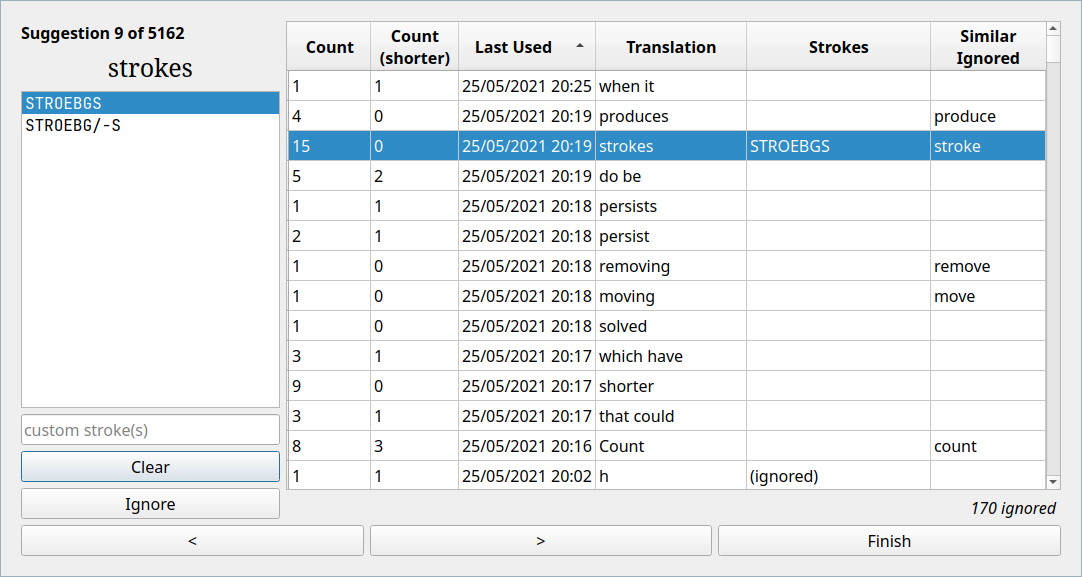
Table of Contents
Setup
- Enable "plover_cards_hook"
- Right click the Plover icon, "Configure", "Plugins" tab, check the box next to "plover_cards_hook", "Apply"
For Anki integration:
- Install the AnkiConnect plugin for Anki. You may need to restart Anki for the plugin to take effect
Plover Cards Hook
This part of the plugin listens to what you write and records the suggestions (you don't need to have the suggestion window open). It'll keep a count of how many times you use a stroke so you can focus on only the words you use often (or least often). Unlike the suggestions window, it'll also record suggestions for command, prefix and suffix strokes if you use them.
The data is stored in {your_plover_config_folder}/plover_cards/card_suggestions.pickle. This gets saved when you disable the extension, quit Plover and every 5 minutes.
Card Builder
This is where you can look at the suggestions and choose which ones to make into flashcards.
Usage
Anki Integration
- Make sure Anki is running in the background
Opening
- (from the menu) Right click the Plover icon, "Tools", "Card Builder"
- (from the gui) Click "Card Builder" icon in the top bar of the main Plover window
Settings
| Option | What it's used for |
|---|---|
| Use Ignore File | Whether to keep a file for words to ignore |
| Ignore File | Path to the ignore file, which is a text file with each word/phrase to ignore on a new line |
| Compare to Anki | Whether to find words/phrases to ignore from existing Anki cards |
| Query | Which cards to look at, for example deck:Plover and note:Steno. The syntax is the same as in the Anki browser. |
| Compare Field | Which field in the card to look at, for example "Translation" or "Front" |
| Output to CSV | Whether to output to CSV, which can be imported into Anki or other programs like Excel |
| Output File | Path to the output file, which is a CSV of Translation,Strokes |
| Write Method | Whether to append or overwrite the output file |
| Add to Anki | Whether to add cards to Anki at the end |
| Deck | Which deck to add to |
| Note Type | What type of note to add |
| Translation Field | Which field to put the translation in |
| Strokes Field | Which field to put the strokes in |
| Tags | Space separated list of tags to add to the new cards |
These options are saved in {your_plover_config_folder}/plover_cards.cfg.
Build Cards
Card list
You can click on any of the following columns to sort by that column. Click again to change the sort order.
You can hide columns by right clicking the header and selecting/deselecting columns.
You can change the column size by dragging the edges of the column title.
- Count: The number of times you typed this word and/or the number of times it was suggested to you
- Count (shorter): The number of times the program found a shorter suggestion for what you typed
- Last Used: The date and time you last used this word
- Translation: The word or phrase on the front of the Anki card
- Stroke: The stroke on the back of the Anki card
- Similar ignored: Similar words that are either already in the Anki deck or have been added to the ignore list
Stroke list
Pick which stroke you want on the back of the Anki card here. Alternatively, write your stroke in the box underneath to use something else.
Buttons
- Clear: Clear the chosen stroke. Useful if you want to skip this card, since by default it will choose the first stroke in the list
- Ignore: Add this word/phrase to the ignore list. It won't appear next time you use the card builder. This button is unavailable if "Use Ignore File" is not selected
- <: Go to previous card
- >: Go to next card
- Finish: Finish building cards. Depending on your settings, it will output to CSV and/or add cards to anki
ANKI_ADD_CARD Command
You can add dictionary entries to add cards to Anki.
{PLOVER:ANKI_ADD_CARD} will open up the Anki Add Cards window with the last used word and a list of stroke suggestions.
{PLOVER:ANKI_ADD_CARD:X} will do the same but for the last X words.
It will use the same settings as in the "Add to Anki" section in the card builder (deck, note_type, translation_field, strokes_field, tags).
1 maintainer

Metadata
1 maintainer
Release files for plover-cards 0.2.1.post2
For a detailed explanation of source distributions (sdists) and built distributions (wheels), please see the package formats documentation.
Source distribution (sdist)
| File | Size | Uploaded | Provenance | Actions |
|---|---|---|---|---|
| plover_cards-0.2.1.post2.tar.gz | 43.2 kB | Without provenance | Details for plover_cards-0.2.1.post2.tar.gz |
Built distribution (wheel)
| File | Interpreter | ABI | Platform | Actions Reset |
|---|---|---|---|---|
| plover_cards-0.2.1.post2-py3-none-any.whl | Python 3 | none | any | Details for plover_cards-0.2.1.post2-py3-none-any.whl |
Total release size: 79.0 kB
Release files / plover_cards-0.2.1.post2.tar.gz
| Download URL | plover_cards-0.2.1.post2.tar.gz |
|---|---|
| Size | 43.2 kB |
| Tags | Source |
|
SHA-256 checksum How to use checksums |
50b7279c66301fbce571fe074ea7340a512db98a6ba80259daa9d2643b8b6f6d
|
|
BLAKE2b-256 checksum How to use checksums |
5c7adfe8a02867a09c44bb56503af4196ea7dcc0e3e8905dc2b615ea6e4e12e1
|
| Upload date | |
|
Uploaded using Trusted Publishing? What is trusted publishing? |
No |
| Uploaded via |
twine/3.4.1 importlib_metadata/4.0.1 pkginfo/1.7.0 requests/2.25.1 requests-toolbelt/0.9.1 tqdm/4.61.0 CPython/3.9.5
|
Release files / plover_cards-0.2.1.post2-py3-none-any.whl
| Download URL | plover_cards-0.2.1.post2-py3-none-any.whl |
|---|---|
| Size | 35.8 kB |
| Tags | Python 3 |
|
SHA-256 checksum How to use checksums |
1c1f97a4cefa5d42085550845ec6a783bf1e4f88e5e4fa9b91b7000b45dffe38
|
|
BLAKE2b-256 checksum How to use checksums |
b78aef1fe378e818a7d00b3a2cc3e32717ca4d7013c463b818f451f0f2e33601
|
| Upload date | |
|
Uploaded using Trusted Publishing? What is trusted publishing? |
No |
| Uploaded via |
twine/3.4.1 importlib_metadata/4.0.1 pkginfo/1.7.0 requests/2.25.1 requests-toolbelt/0.9.1 tqdm/4.61.0 CPython/3.9.5
|
Security for plover-cards 0.2.1.post2
Provenance
Provenance describes where a file came from. On PyPI, provenance is shared via attestations, which provide a verifiable record of the build or publishing details. View details, limitations and caveats.
No provenance found
None of the files in this release were uploaded with provenance metadata.
A note on package security
PyPI is a repository for distributing packages, not a service for auditing them. While third-party security researchers and our staff do their best to detect and remove malicious packages, PyPI cannot guarantee the quality, security or suitability of any given package.
To learn more about protecting yourself from malicious actors, visit our package security documentation.














