
🌳 iTree - an Interval Tree library

In computer science, an interval tree is a tree data structure to hold intervals. Every node in itree has a start and an end value.
Installation
itree supports Linux, MacOS and Windows operating systems.
Installation With pip
You can install itree by running:
pip install py-itree
Build From Source With cmake
🍀 For MacOS with M1 Chip, some Windows OS, embedded systems, or different python versions where the method above doesn't work, please use the following workaround.
- Install cmake (version>3.4)
- Run the following command to build it locally:
pip install https://github.com/juncongmoo/itree/archive/refs/tags/v0.0.18.tar.gz
Quick Start
- Symbol For Node And Tree
  🟢  - normal node;
  🔵  - zero interval node;
  🍁  - leaf node, which means no child node
  🌳  - a tree
- Create Some Nodes
  >>> import itree
  >>> itree.Node('fruit', 0, 40)
  [🍁 n=fruit,s=0.00,e=40.00,x=0,c=0]
  >>> itree.Node('fruit')
  [🔵 n=fruit]
  >>> a=itree.Node('fruit', 0, 200)
  >>> b=itree.Node('apple', 10, 20)
  >>> print(a)
  [🍁 n=fruit,s=0.00,e=40.00,x=0,c=0]
  >>> a.append(b)
  >>> print(a)
  [🟢 n=fruit,s=0.00,e=200.00,x=0,c=1]
  >>> print(b)
  [🍁 n=apple,s=10.00,e=20.00,x=0,c=0]
  >>> print(a.nodes)
  [[🍁 n=apple,s=10.00,e=20.00,x=0,c=0]]
  >>>
- Create And Render A Tree
  >>> from itree import Tree
  >>> def demo_tree():
        t = Tree(tid="123", extra={"img": "1241241313.png"})
        t.start("root", 1, {"name": "itree"})
        t.start("math", 2, {"age": 10})
        t.start("music", 3, {"location": [1, 2, 3]})
        t.end("music", 4, {"price": 12.3})
        t.end("math", 16284000, {"memory": (1, 2, 3)})
        t.start("music", 122840057.8713503)
        t.end("music", 1228400500)
        t.start("music", 32840057.8713503)
        t.start("egg", 3284.8713503)
        t.start("icecream", 32843.8713503)
        t.start("pizza", 32843.8713503)
        t.end("pizza", 62845003)
        t.end("icecream", 62845003)
        t.end("egg", 6284500)
        t.end("music", 628400500)
        t.start("piggy", 3284.8713503)
        t.start("unicorn", 32843.8713503)
        t.start("monkey", 32843.8713503)
        t.end("monkey", 62845003)
        t.end("unicorn", 62845003)
        t.end("piggy", 6284500)
        t.end("root", 1628400570.8713503)
        print(f"{t.count},{t.depth}")
        t.consolidate()
        img_path = t.to_img()
        return img_path, t
  >>> img_path, t = demo_tree()
  >>> t
  (🌳 id=123,c=11,x=1,d=6,m=0,o=1)
Run the demo_tree() function, a tree digraph will be generated:
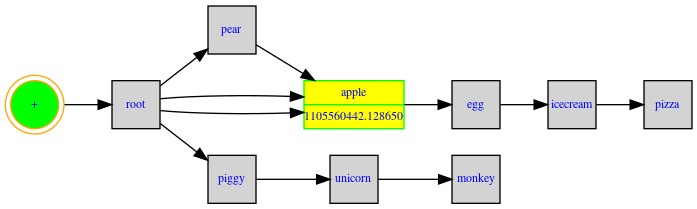
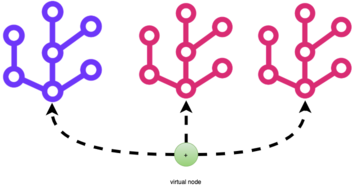
The green circle node is a virtual node. The yellow record box is the node with the longest interval.
A virtual node is a conceptual node which could have many subnodes/subtrees.
Development
Turn on local build to ON in itree/CMakeLists.txt:
option(LOCAL_BUILD "build locally" OFF)
- Test
$python -m unittest discover
...............
----------------------------------------------------------------------
Ran 15 tests in 1.209s

OK
- Format
find itree -path itree/pybind11 -prune -o -iname *.h -o -iname *.cpp | xargs clang-format -i
black -S . --exclude '(\.history|\.vscode|\.git|\.VSCodeCounter|venv|workspace|pybind11)'
- Build
rm -fr itree/build/ && ./release.sh && yes | cp itree/build/_itree.* itree/
pip install --editable .
License
Tree is licensed under the Apache 2.0 License.
1 maintainer

Metadata
1 maintainer
Release files for py-itree 0.0.21
For a detailed explanation of source distributions (sdists) and built distributions (wheels), please see the package formats documentation.
Source distribution (sdist)
| File | Size | Uploaded | Provenance | Actions |
|---|---|---|---|---|
| py_itree-0.0.21.tar.gz | 486.0 kB | Without provenance | Details for py_itree-0.0.21.tar.gz |
Release files / py_itree-0.0.21.tar.gz
| Download URL | py_itree-0.0.21.tar.gz |
|---|---|
| Size | 486.0 kB |
| Tags | Source |
|
SHA-256 checksum How to use checksums |
7a00e1ba221b72f9f239eb336dbc7422e957fb8a8d026fc07e2d99b52327cf01
|
|
BLAKE2b-256 checksum How to use checksums |
a281df4ca915d83cbaccea7d68e3e137bb46d5fd71c7df682c5817ef41c10d88
|
| Upload date | |
|
Uploaded using Trusted Publishing? What is trusted publishing? |
No |
| Uploaded via |
twine/5.1.1 CPython/3.12.4
|
Security for py-itree 0.0.21
Provenance
Provenance describes where a file came from. On PyPI, provenance is shared via attestations, which provide a verifiable record of the build or publishing details. View details, limitations and caveats.
No provenance found
None of the files in this release were uploaded with provenance metadata.
A note on package security
PyPI is a repository for distributing packages, not a service for auditing them. While third-party security researchers and our staff do their best to detect and remove malicious packages, PyPI cannot guarantee the quality, security or suitability of any given package.
To learn more about protecting yourself from malicious actors, visit our package security documentation.














