
Pyturbo Package



Author: Lijun Yu
Email: lijun@lj-y.com
A pipeline system for efficient execution.
Installation
pip install py-turbo
Introduction
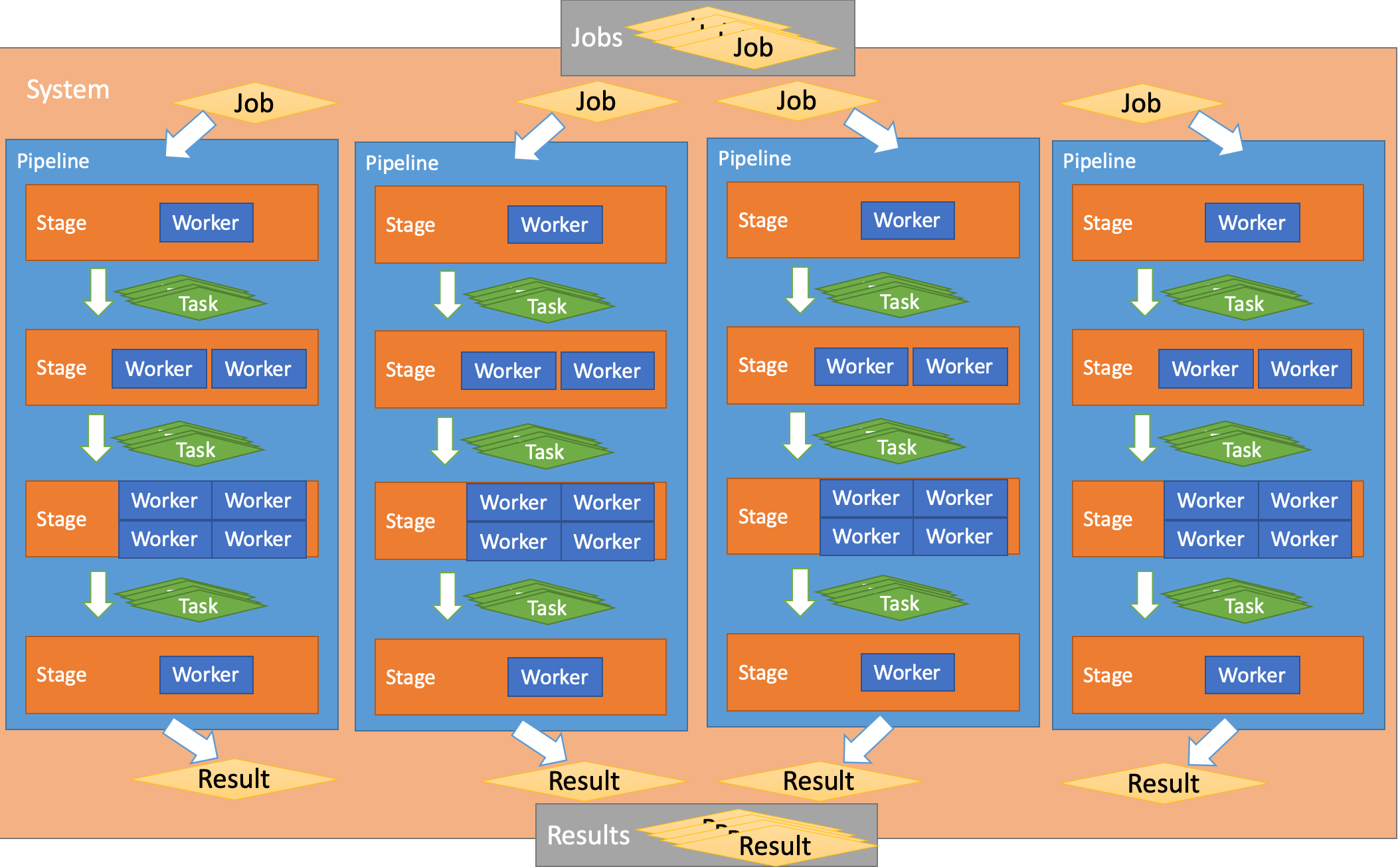
Pyturbo utilizes multiple level of abstract to efficiently execute parallel tasks.
- Worker: a process.
- Stage: a group of peer workers processing the same type of tasks.
- Task: a data unit transferred between stages. At each stage, a task is processed by one worker and will result in one or multiple downstream tasks.
- Pipeline: a set of sequential stages.
- Job: a data unit for a pipeline, typically a wrapped task for the first stage.
- Result: output of a job processed by one pipeline, typically a set of output tasks from the last stage.
- System: a set of peer pipelines processing the same type of jobs.
Get Started
from pyturbo import ReorderStage, Stage, System

class Stage1(Stage): # Define a stage

    def allocate_resource(self, resources, ...):
        ... # Optional: split resources and determine number of workers.

    def process(self, task):
        ... # Process function for each worker process. Returns one or a series of downstream tasks.

... # Repeat for Stage2, Stage3

class Stage4(ReorderStage): # Define a reorder stage, typically for the final stage

    def get_sequence_id(self, task):
        ... # Return the order of each task. Start from 0.

    def process(self, task):
        ...

class MySystem(System):

    def get_stages(self, resources):
        ... # Define the stages in a pipeline with given resources.

    def get_results(self, results_gen):
        ... # Define how to extract final results from output tasks.

def main():
    system = MySystem(num_pipeline) # Set debug=True to run in a single process
    system.start() # Build and start system
    jobs = [...]
    system.add_jobs(jobs) # Submit jobs
    for job in system.wait_jobs(len(jobs)):
        print(job.results) # Process result
    system.end() # End system
Options
See options.md
Demo

See demo.py for an example implementation.
Version History
See version.md.
1 maintainer

Metadata
1 maintainer
Release files for py-turbo 0.7.0
For a detailed explanation of source distributions (sdists) and built distributions (wheels), please see the package formats documentation.
Source distribution (sdist)
| File | Size | Uploaded | Provenance | Actions |
|---|---|---|---|---|
| py-turbo-0.7.0.tar.gz | 22.7 kB | Without provenance | Details for py-turbo-0.7.0.tar.gz |
Built distribution (wheel)
| File | Interpreter | ABI | Platform | Actions Reset |
|---|---|---|---|---|
| py_turbo-0.7.0-py3-none-any.whl | Python 3 | none | any | Details for py_turbo-0.7.0-py3-none-any.whl |
Total release size: 48.1 kB
Release files / py-turbo-0.7.0.tar.gz
| Download URL | py-turbo-0.7.0.tar.gz |
|---|---|
| Size | 22.7 kB |
| Tags | Source |
|
SHA-256 checksum How to use checksums |
0754171c638979b6fdf5be7bee157431cafb2465bea5bf4671986856b7336527
|
|
BLAKE2b-256 checksum How to use checksums |
1ad13b3886d86f701e86de78516f39cb748037debd17ac1cceb7a33f70d7902d
|
| Upload date | |
|
Uploaded using Trusted Publishing? What is trusted publishing? |
No |
| Uploaded via |
twine/4.0.1 CPython/3.10.6
|
Release files / py_turbo-0.7.0-py3-none-any.whl
| Download URL | py_turbo-0.7.0-py3-none-any.whl |
|---|---|
| Size | 25.5 kB |
| Tags | Python 3 |
|
SHA-256 checksum How to use checksums |
eb2f6125c1ea82f9a65cdeaf91e9531a941c8c77783e678c27f40abb05c754d8
|
|
BLAKE2b-256 checksum How to use checksums |
79935f6185182cd0760d86b055ce1629046e05ae53e14805cee2a5cf42e190ce
|
| Upload date | |
|
Uploaded using Trusted Publishing? What is trusted publishing? |
No |
| Uploaded via |
twine/4.0.1 CPython/3.10.6
|
Security for py-turbo 0.7.0
Provenance
Provenance describes where a file came from. On PyPI, provenance is shared via attestations, which provide a verifiable record of the build or publishing details. View details, limitations and caveats.
No provenance found
None of the files in this release were uploaded with provenance metadata.
A note on package security
PyPI is a repository for distributing packages, not a service for auditing them. While third-party security researchers and our staff do their best to detect and remove malicious packages, PyPI cannot guarantee the quality, security or suitability of any given package.
To learn more about protecting yourself from malicious actors, visit our package security documentation.














