
pygtc.py
What is a Giant Triangle Confusogram?
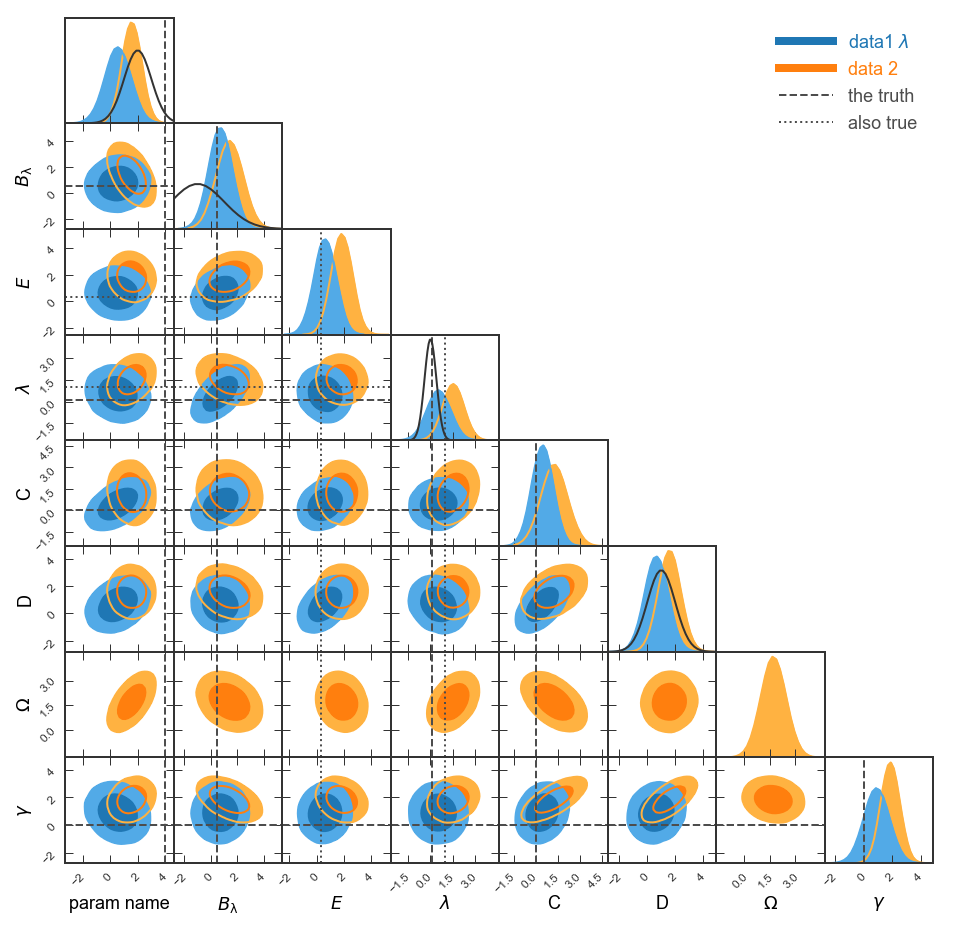
A Giant-Triangle-Confusogram (GTC, aka triangle plot) is a way of displaying the results of a Monte-Carlo Markov Chain (MCMC) sampling or similar analysis. (For a discussion of MCMC analysis, see the excellent emcee package.) The recovered parameter constraints are displayed on a grid in which the diagonal shows the one-dimensional posteriors (and, optionally, priors) and the lower-left triangle shows the pairwise projections. You might want to look at a plot like this if you are fitting a model to data and want to see the parameter covariances along with the priors.
Here’s an example of a GTC with some random data and arbitrary labels:
pygtc.plotGTC(chains=[samples1,samples2],
              paramNames=names,
              chainLabels=chainLabels,
              truths=truths,
              truthLabels=truthLabels,
              priors=priors,
              paramRanges=paramRanges,
              figureSize='MNRAS_page')
But doesn’t this already exist in corner.py, distUtils, etc…?
Although several other packages exists to make such a plot, we were unsatisfied with the amount of extra work required to massage the result into something we were happy to publish. With pygtc, we hope to take that extra legwork out of the equation by providing a package that gives a figure that is publication ready on the first try! You should try all the packages and use the one you like most; for us, that is pygtc!
Installation
For a quick start, you can install with either pip or conda. Either will install the required dependencies for you (packaging, numpy, and matplotlib):
$ pip install pygtc
or, if you use conda:
$ conda install pygtc -c conda-forge
For more installation details, see the documentation.
Documentation
Documentation is hosted at ReadTheDocs. Find an exhaustive set of examples there!
Citation
If you use pygtc to generate plots for a publication, please cite as:
@article{Bocquet2016,
  doi = {10.21105/joss.00046},
  url = {http://dx.doi.org/10.21105/joss.00046},
  year  = {2016},
  month = {oct},
  publisher = {The Open Journal},
  volume = {1},
  number = {6},
  author = {Sebastian Bocquet and Faustin W. Carter},
  title = {pygtc: beautiful parameter covariance plots (aka. Giant Triangle Confusograms)},
  journal = {The Journal of Open Source Software}
}
Copyright 2016, Sebastian Bocquet and Faustin W. Carter

1 maintainer

Metadata
1 maintainer
Release files for pyGTC 0.5.0
For a detailed explanation of source distributions (sdists) and built distributions (wheels), please see the package formats documentation.
Source distribution (sdist)
| File | Size | Uploaded | Provenance | Actions |
|---|---|---|---|---|
| pyGTC-0.5.0.tar.gz | 3.2 MB | Without provenance | Details for pyGTC-0.5.0.tar.gz |
Built distribution (wheel)
| File | Interpreter | ABI | Platform | Actions Reset |
|---|---|---|---|---|
| pyGTC-0.5.0-py2.py3-none-any.whl | Python 3, Python 2 | none | any | Details for pyGTC-0.5.0-py2.py3-none-any.whl |
Total release size: 6.3 MB
Release files / pyGTC-0.5.0.tar.gz
| Download URL | pyGTC-0.5.0.tar.gz |
|---|---|
| Size | 3.2 MB |
| Tags | Source |
|
SHA-256 checksum How to use checksums |
179dd20e99142bb2f351c64d2a5b0a4c9d5e6245c746888cd406e1c0aaf79400
|
|
BLAKE2b-256 checksum How to use checksums |
c138e6608b22473066aa9a640affcd81cc5524f772d1b8edd34f9e1c013bd5a6
|
| Upload date | |
|
Uploaded using Trusted Publishing? What is trusted publishing? |
No |
| Uploaded via |
twine/4.0.2 CPython/3.9.18
|
Release files / pyGTC-0.5.0-py2.py3-none-any.whl
| Download URL | pyGTC-0.5.0-py2.py3-none-any.whl |
|---|---|
| Size | 3.2 MB |
| Tags | Python 2 Python 3 |
|
SHA-256 checksum How to use checksums |
40895a41f83cca81dc565b649bbc6ccb214fa664dc1dbdc8f0aad70844c3e79c
|
|
BLAKE2b-256 checksum How to use checksums |
10f64c2c19e12434be59fa1b9fae53fc9302d9430d876a868d9272821d8d4df0
|
| Upload date | |
|
Uploaded using Trusted Publishing? What is trusted publishing? |
No |
| Uploaded via |
twine/4.0.2 CPython/3.9.18
|
Security for pyGTC 0.5.0
Provenance
Provenance describes where a file came from. On PyPI, provenance is shared via attestations, which provide a verifiable record of the build or publishing details. View details, limitations and caveats.
No provenance found
None of the files in this release were uploaded with provenance metadata.
A note on package security
PyPI is a repository for distributing packages, not a service for auditing them. While third-party security researchers and our staff do their best to detect and remove malicious packages, PyPI cannot guarantee the quality, security or suitability of any given package.
To learn more about protecting yourself from malicious actors, visit our package security documentation.














