
PyByntic


PyByntic extends Pydantic with binary-typed fields and automatic byte-level serialization. Define models using familiar Pydantic syntax and turn them into compact binary payloads with full control over layout and numeric precision.
Features
- Binary Serialization: Convert Pydantic models to compact binary format
- Type Safety: Full type annotations with custom binary types
- Nested Models: Support for nested models and lists
- Custom Encoders: Support for compression and custom encoding
- Size Efficiency: Significantly smaller than JSON serialization
Installation
pip install pybyntic
Benchmark
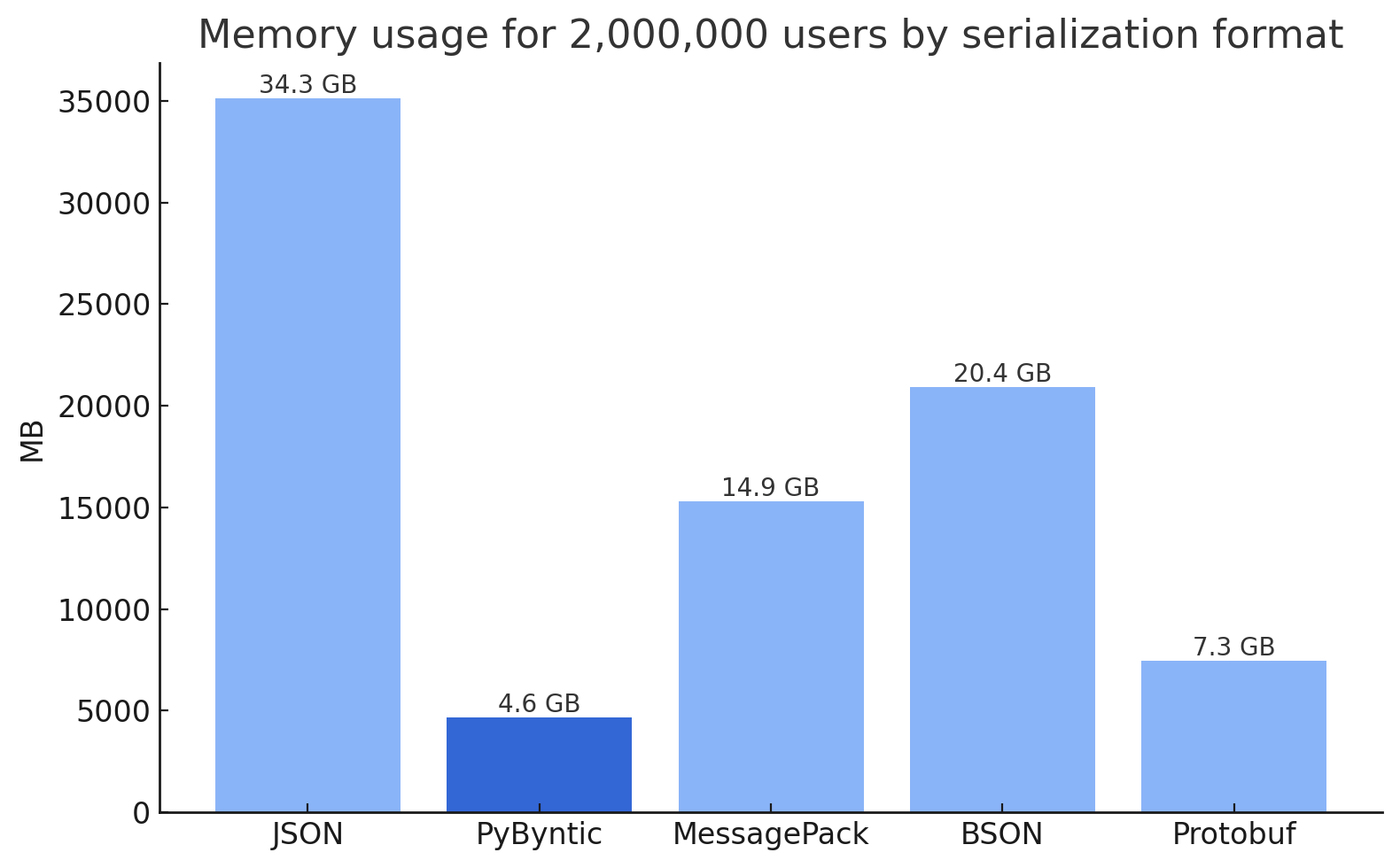
For comparison is based on 2 million user records. Users contain various types such as UInt16, UInt32, Int32, Int64, Bool, Float32, String, and DateTime32. Each user also includes nested objects — roles and permissions, and in some cases, there can be hundreds of permissions. PyByntic gives the smallest memory usage of all tested solutions.
Development
# Install dev dependencies
poetry install --with dev

# Run tests
poe test

# Format code
poe autoformat
Usage
from pybyntic import AnnotatedBaseModel
from pybyntic.types import UInt32, String, Bool, Date
from typing import Annotated
import datetime


class User(AnnotatedBaseModel):
	user_id: Annotated[int, UInt32]
	username: Annotated[str, String]
	is_active: Annotated[bool, Bool]
	join_date: Annotated[datetime.date, Date]


# Create and serialize
user = User(
	user_id=123,
	username='admin',
	is_active=True,
	join_date=datetime.date.today()
)

# Serialize to bytes
serialized = user.serialize()

# Deserialize from bytes
deserialized = User.deserialize(serialized)
Examples
See the examples/ directory for more comprehensive examples including:
- Basic serialization
- List handling
- Nested models
- Compression
- Benchmarking
Types
| Type Name | Format / Encoding | Python Type Returned | Notes |
|---|---|---|---|
Skip |
— (no-op) | None |
Skips field |
Bool |
b (1 byte) |
bool |
Writes 1 or 0 |
Int8 |
b |
int |
Signed 8-bit integer |
Int16 |
h |
int |
Signed 16-bit integer |
Int32 |
i |
int |
Signed 32-bit integer |
Int64 |
q |
int |
Signed 64-bit integer |
UInt8 |
B |
int |
Unsigned 8-bit integer |
UInt16 |
H |
int |
Unsigned 16-bit integer |
UInt32 |
I |
int |
Unsigned 32-bit integer |
UInt64 |
Q |
int |
Unsigned 64-bit integer |
UInt128 |
2× Q (hi/lo) |
int |
128-bit unsigned integer, stored as 2×64-bit |
Float32 |
f |
float |
IEEE754 single precision |
Float64 |
d |
float |
IEEE754 double precision |
String |
varint + bytes |
str |
UTF-8 string, with varint length prefix |
FixedString[n] |
bytes |
str |
A fixed-length string of N bytes (not characters). |
StringJson |
varint + bytes |
dict |
UTF-8 JSON, decoded via json.loads |
DateTime32 |
I |
datetime (UTC) |
Seconds since epoch |
DateTime64[p] |
Q |
datetime (UTC) |
Timestamp in 10^-p seconds precision (default p=3) |
Date |
H |
date |
Days since 1970-01-01 |
Implementing Custom Types
Example of a type implementation:
from pybyntic.buffer import Buffer


class Bool:
	@classmethod
	def read(cls, buf: Buffer):
		return bool(buf.read_formated("b"))

	@classmethod
	def write(cls, buf: Buffer, value):
		buf.write_formated("b", 1 if value else 0)
Type classes must implement read and write class methods to handle serialization and deserialization.
Read methods receive a Buffer instance for byte operations, and write methods receive a Buffer and the value to serialize.
Testing
The project includes comprehensive tests covering:
- Basic serialization/deserialization
- List handling
- Nested models and lists
- Dictionary serialization with JSON
- Compression functionality
- Individual type testing
Run tests with:
poetry run pytest
1 maintainer

Metadata
1 maintainer
Release files for PyByntic 0.1.6
For a detailed explanation of source distributions (sdists) and built distributions (wheels), please see the package formats documentation.
Source distribution (sdist)
| File | Size | Uploaded | Provenance | Actions |
|---|---|---|---|---|
| pybyntic-0.1.6.tar.gz | 21.2 kB | Without provenance | Details for pybyntic-0.1.6.tar.gz |
Built distribution (wheel)
| File | Interpreter | ABI | Platform | Actions Reset |
|---|---|---|---|---|
| pybyntic-0.1.6-py3-none-any.whl | Python 3 | none | any | Details for pybyntic-0.1.6-py3-none-any.whl |
Total release size: 43.0 kB
Release files / pybyntic-0.1.6.tar.gz
| Download URL | pybyntic-0.1.6.tar.gz |
|---|---|
| Size | 21.2 kB |
| Tags | Source |
|
SHA-256 checksum How to use checksums |
b39318dcc448a93bf07db7b1baa511babf3359960cedc0734fcab3e01ef79214
|
|
BLAKE2b-256 checksum How to use checksums |
c5fdfc9f9e005b2f8d5ab171bec35f88256f8a43380c910e62cd62d7821adc9e
|
| Upload date | |
|
Uploaded using Trusted Publishing? What is trusted publishing? |
No |
| Uploaded via |
poetry/2.2.1 CPython/3.13.9 Linux/6.11.0-1018-azure
|
Release files / pybyntic-0.1.6-py3-none-any.whl
| Download URL | pybyntic-0.1.6-py3-none-any.whl |
|---|---|
| Size | 21.8 kB |
| Tags | Python 3 |
|
SHA-256 checksum How to use checksums |
2973162c1ffda0a4052c23507c4e38e2cb78218de36c3e3ff3bca3a708be61d8
|
|
BLAKE2b-256 checksum How to use checksums |
706799003de4762497866c7f838fd44de11009ce8c23cbe73f59038fd98de54d
|
| Upload date | |
|
Uploaded using Trusted Publishing? What is trusted publishing? |
No |
| Uploaded via |
poetry/2.2.1 CPython/3.13.9 Linux/6.11.0-1018-azure
|
Security for PyByntic 0.1.6
Provenance
Provenance describes where a file came from. On PyPI, provenance is shared via attestations, which provide a verifiable record of the build or publishing details. View details, limitations and caveats.
No provenance found
None of the files in this release were uploaded with provenance metadata.
A note on package security
PyPI is a repository for distributing packages, not a service for auditing them. While third-party security researchers and our staff do their best to detect and remove malicious packages, PyPI cannot guarantee the quality, security or suitability of any given package.
To learn more about protecting yourself from malicious actors, visit our package security documentation.














