

Electromagnetics simulation library for moving point charges built on JAX




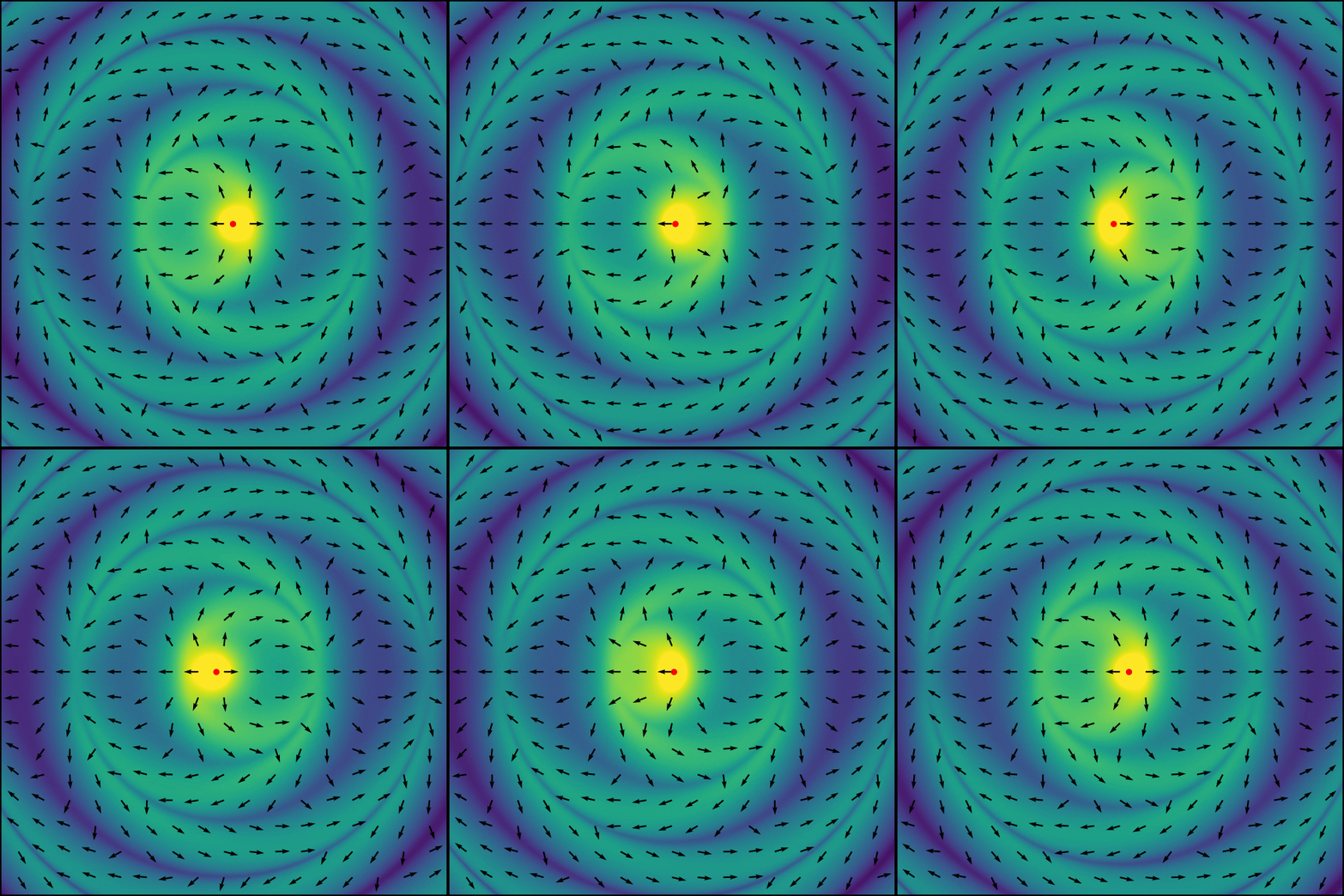
[!IMPORTANT] Major update (v2): PyCharge has been rewritten in JAX with significant API changes. The legacy NumPy-based version remains available under the
v1.1.0tag.
Key Features
- ⚡️ Point Charge Electrodynamics: Compute relativistically-correct electromagnetic potentials and fields generated by moving point charges.
- ⚛️ Self-Consistent N-Body Electrodynamics: Simulate the dynamics of electromagnetic sources—such as free charges and dipoles—interacting through their self-generated fields.
- 🔥 Powered by JAX: Leverage JAX's just-in-time (XLA) compilation for GPU/TPU acceleration, vectorization, and scalable parallel execution.
- 🛠️ Fully Differentiable: End-to-end differentiability enables gradient-based optimization, control, and inverse design workflows.
Learn more about PyCharge in our research paper published in Computational Physics Communications and available on arXiv
Installation
PyCharge is available on PyPI and can be installed with:
pip install pycharge
Documentation
Read the full documentation at pycharge.readthedocs.io.
Usage
This example shows how to simulate an oscillating charge using PyCharge, computing and visualizing the scalar potential along the x-y axis at z=0 and t=0:
import jax
import jax.numpy as jnp
import matplotlib.pyplot as plt
from scipy.constants import e

from pycharge import Charge, potentials_and_fields

# Define an oscillating point charge with charge +e.
oscillating_charge = Charge(lambda t: [2e-9 * jnp.sin(7.5e16 * t), 0.0, 0.0], e)

# Define 1D axes for the observation points (x, y) and fix z, t.
lim, grid_size = 50e-9, 1000
x = jnp.linspace(-lim, lim, grid_size)
y = jnp.linspace(-lim, lim, grid_size)
z = jnp.array([0.0])
t = jnp.array([0.0])

# Form the full 4D spacetime grid (X, Y, Z, T).
X, Y, Z, T = jnp.meshgrid(x, y, z, t, indexing="ij")

# Build and JIT-compile a function that returns potentials and fields.
quantities_fn = potentials_and_fields([oscillating_charge])
jit_quantities_fn = jax.jit(quantities_fn)

# Evaluate all quantities on the grid (returns a `Quantities` object).
quantities = jit_quantities_fn(X, Y, Z, T)

# Extract and plot the scalar potential on the x–y plane at z=0, t=0.
scalar_2d = quantities.scalar[:, :, 0, 0]
plt.imshow(scalar_2d.T, vmax=0.2)
plt.colorbar(label="Scalar Potential (V)")
For more examples and detailed usage, please refer to the documentation.
Contributing
We welcome contributions! See our Contributing Guide for details.
Citing PyCharge
If you use PyCharge in your research, please cite our paper.
  @article{filipovich2022pycharge,
     title={PyCharge: An open-source Python package for self-consistent electrodynamics simulations of Lorentz oscillators and moving point charges},
     author={Matthew J. Filipovich and S. Hughes},
     year={2022},
     journaltitle = {Computer Physics Communications},
     volume = {274},
     pages = {108291},
     issn = {00104655},
     doi = {10.1016/j.cpc.2022.108291},
     url={https://doi.org/10.1016/j.cpc.2022.108291},
   }
License
PyCharge is distributed under the MIT License. See the LICENSE file for more details.
1 maintainer

Metadata
1 maintainer
Release files for pycharge 2.0.1
For a detailed explanation of source distributions (sdists) and built distributions (wheels), please see the package formats documentation.
Source distribution (sdist)
| File | Size | Uploaded | Provenance | |
|---|---|---|---|---|
| pycharge-2.0.1.tar.gz | 4.0 MB | With provenance | Details |
Built distribution (wheel)
| File | Interpreter | ABI | Platform | Reset |
|---|---|---|---|---|
| pycharge-2.0.1-py3-none-any.whl | Python 3 | none | any | Details |
Total release size: 4.0 MB
Release files / pycharge-2.0.1.tar.gz
| Download URL | pycharge-2.0.1.tar.gz |
|---|---|
| Size | 4.0 MB |
| Tags | Source |
|
SHA-256 checksum How to use checksums |
81969ac7c68c4b069cc8bc711bd48d8285cb3fffa4cd8cbe4f35f70e219cfde2
|
|
BLAKE2b-256 checksum How to use checksums |
851df5c9aacc4152affa84fde3c7afa0e1118c2d90fa61180c47a76e803b3f27
|
| Upload date | |
|
Uploaded using Trusted Publishing? What is trusted publishing? |
Yes |
| Uploaded via |
twine/6.1.0 CPython/3.13.7
|
Provenance
Provenance describes where a file came from. On PyPI, provenance is shared via attestations, which provide a verifiable record of the build or publishing details. View details, limitations and caveats.


PyPI Publish Attestation
PyPI verified that this artifact, at this checksum, originated from the publisher listed below.
Signed by GitHub Actions, verified by PyPI on Jan 13, 2026.
Transparency logRelease files / pycharge-2.0.1-py3-none-any.whl
| Download URL | pycharge-2.0.1-py3-none-any.whl |
|---|---|
| Size | 14.0 kB |
| Tags | Python 3 |
|
SHA-256 checksum How to use checksums |
4b91ae216cc00a4ad69559171e9d23be417174c555417b2329f0c01b990334c9
|
|
BLAKE2b-256 checksum How to use checksums |
066427995be6ad3a3b9b2b1d1a0a6a06a11f9e3fccbb2bce2cdbd8a25e8db5d3
|
| Upload date | |
|
Uploaded using Trusted Publishing? What is trusted publishing? |
Yes |
| Uploaded via |
twine/6.1.0 CPython/3.13.7
|
Provenance
Provenance describes where a file came from. On PyPI, provenance is shared via attestations, which provide a verifiable record of the build or publishing details. View details, limitations and caveats.
PyPI Publish Attestation
PyPI verified that this artifact, at this checksum, originated from the publisher listed below.
Signed by GitHub Actions, verified by PyPI on Jan 13, 2026.
Transparency logSecurity for pycharge 2.0.1
Provenance
Provenance describes where a file came from. On PyPI, provenance is shared via attestations, which provide a verifiable record of the build or publishing details. View details, limitations and caveats.
Full provenance
All 2 files in this release have been uploaded with provenance metadata.
Attestation for pycharge-2.0.1.tar.gz
PyPI Publish Attestation
PyPI verified that this artifact, at this checksum, originated from the publisher listed below.
Signed by GitHub Actions, verified by PyPI on Jan 13, 2026.
Transparency logA note on package security
PyPI is a repository for distributing packages, not a service for auditing them. While third-party security researchers and our staff do their best to detect and remove malicious packages, PyPI cannot guarantee the quality, security or suitability of any given package.














