
PyGL: statistical field theory in Python 




About | Documentation | News | Installation | Examples | Publications | Support | License
About
PyGL is a numerical library for statistical field theory in Python. The name GL corresponds to the Ginzburg–Landau theory. The library has been specifically designed to study field theories without time-reversal symmetry. The library can be used to study models of statistical physics of various symmetries and conservation laws. In particular, we allow models with mass and momentum conservations. The library constructs differentiation matrices using finite-difference and spectral methods. To study the role of momentum conservation, the library also allows computing fluid flow from the solution of the Stokes equation.

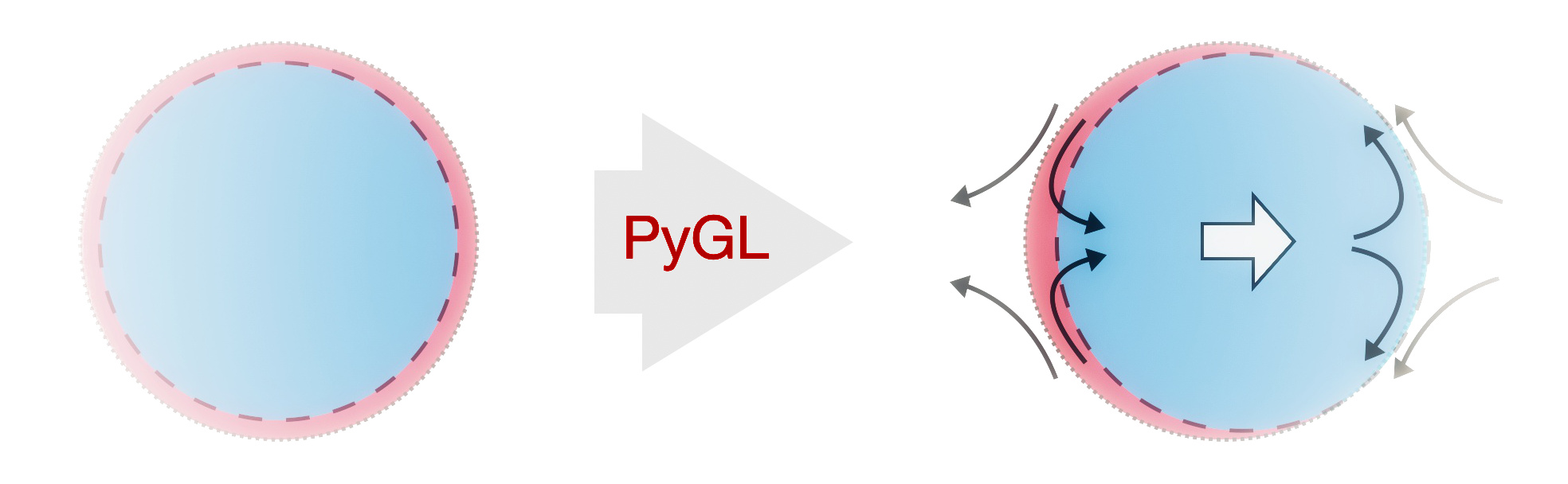
The above simulation is done using PyGL. It shows steady-state microphase separation (phase separation arrested to a length-scale) in an active scalar field theory. A self-shearing instability interrupts the growth of droplets by splitting them. Read more: https://arxiv.org/abs/1907.04819
Installation
From a checkout of this repository
Install PyGL and required dependencies using
>> git clone https://github.com/rajeshrinet/pygl.git
>> cd pygl
>> pip install -r requirements.txt
>> python setup.py install
Install PyGL and its dependencies in a pygl environment:
>> git clone https://github.com/rajeshrinet/pygl.git
>> cd pygl
>> make env
>> conda activate pygl
>> make
Pip
Alternatively, install the latest PyPI version
>> pip install pygl
Examples
See the examples folder for a list of examples.
Publications
-
Hydrodynamically interrupted droplet growth in scalar active matter. Rajesh Singh and Michael E. Cates. Phys. Rev. Lett. 123, 148005 (2019).
-
Self-propulsion of active droplets without liquid-crystalline order. Rajesh Singh, Elsen Tjhung, and Michael E. Cates. Phys. Rev. Research 2, 032024(R) (2020).
News
- Our paper has been highlighted in the Journal Club for Condensed Matter Physics with a commentary.
Support
Please use the issue tracker on GitHub.
License
We believe that openness and sharing improves the practice of science and increases the reach of its benefits. This code is released under the MIT license. Our choice is guided by the excellent article on Licensing for the scientist-programmer.
1 maintainer

Metadata
1 maintainer
Release files for pygl 2.2.0
For a detailed explanation of source distributions (sdists) and built distributions (wheels), please see the package formats documentation.
Source distribution (sdist)
| File | Size | Uploaded | Provenance | |
|---|---|---|---|---|
| pygl-2.2.0.tar.gz | 563.5 kB | Without provenance | Details |
Release files / pygl-2.2.0.tar.gz
| Download URL | pygl-2.2.0.tar.gz |
|---|---|
| Size | 563.5 kB |
| Tags | Source |
|
SHA-256 checksum How to use checksums |
480f0b4abe851f58aa1db5c00f4f29cbbb299a6d5100e4e06d9093bdefd2be93
|
|
BLAKE2b-256 checksum How to use checksums |
9e72209a33f4f7cb2f95fb944c9ac0f824c79fd29b2fb520b3cf1c68aa68608e
|
| Upload date | |
|
Uploaded using Trusted Publishing? What is trusted publishing? |
No |
| Uploaded via |
twine/6.1.0 CPython/3.12.4
|
Security for pygl 2.2.0
Provenance
Provenance describes where a file came from. On PyPI, provenance is shared via attestations, which provide a verifiable record of the build or publishing details. View details, limitations and caveats.
No provenance found
None of the files in this release were uploaded with provenance metadata.
A note on package security
PyPI is a repository for distributing packages, not a service for auditing them. While third-party security researchers and our staff do their best to detect and remove malicious packages, PyPI cannot guarantee the quality, security or suitability of any given package.














