



pyinfraformat
Python library for reading, writing and analyzing Finnish borehole format Infraformat (version 2.5). Well suited for scientific and research applications.
Installation
Latest (stable) pyinfraformat can be installed with pip
python -m pip install pyinfraformat
The latest (unstable) version can be installed from git with pip (needs git-tools).
python -m pip install git+https://github.com/ahartikainen/pyinfraformat
Library can be installed also by git clone / downloading zip.
git clone https://github.com/ahartikainen/pyinfraformat
cd pyinfraformat
python -m pip install .
To install inplace for development work, use -e command.
python -m pip install -e .
Quickstart
Basic usage
import pyinfraformat as pif
pif.set_logger_level(50) # Suppress non-critical warnings, recommended for large files
holes = pif.from_infraformat("*.tek")
holes = holes.project("TM35FIN")
bounds = holes.bounds
holes.to_infraformat("holes_tm35fin.tek")

bounds = [6672242-200 ,  385795-200, 6672242 +200,  385795+200]
gtk_holes = pif.from_gtk_wfs(bounds, "TM35Fin")
print(gtk_holes) # View holes object
#Infraformat Holes -object:
#  Total of 203 holes
#    - PO ......... 161
#    - HP .........  13
#    - PA .........  12
#    - NO .........   2
#    - NE .........   1
#    - KE .........   5
#    - KR .........   9


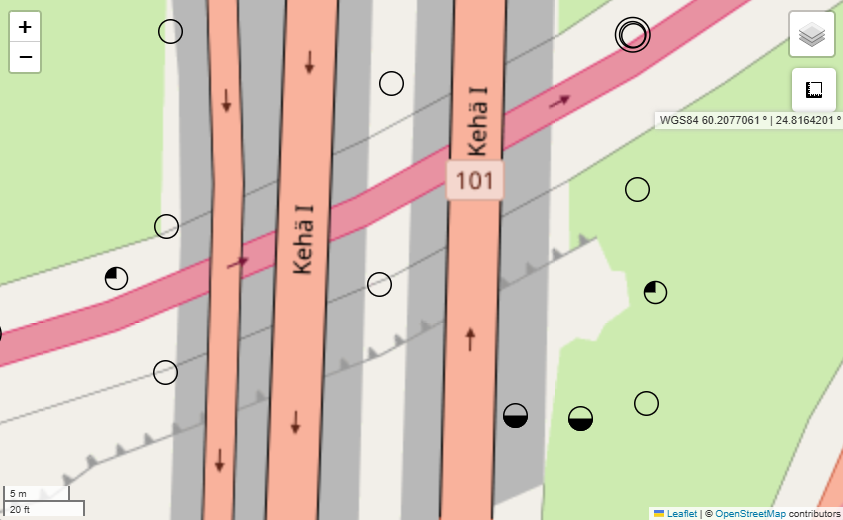
html_map = gtk_holes.plot_map()
html_map.save("soundings.html")
html_map # View map in jupyter
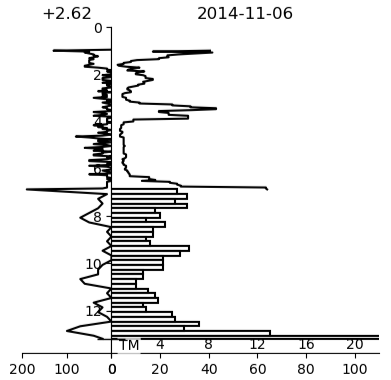
hole_figure = gtk_holes[10].plot()
hole_figure # View hole in jupyter
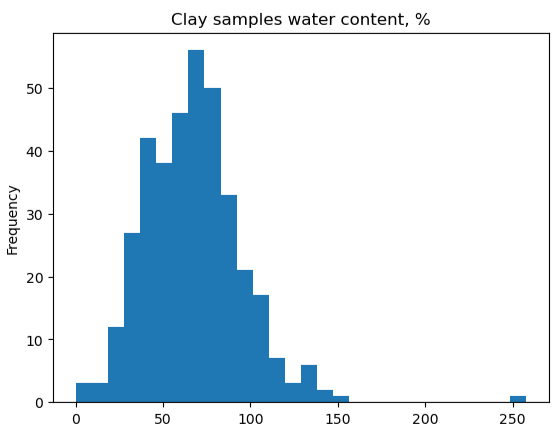
Plot histograms from laboratory tests
import pandas as pd
bounds = [6672242-2000 ,  385795-2000, 6672242 +2000,  385795+2000]
gtk_holes = pif.from_gtk_wfs(bounds, "TM35FIN", maxholes=25_000)
laboratory_tests = gtk_holes.filter_holes(hole_type=["NO", "NE"], start="1990-01-01")
df = laboratory_tests.get_dataframe()
df['data_Soil type'] = df['data_Soil type'].astype("string")
clay_samples = df[df['data_Soil type'].str.endswith("Sa", na=False)].reset_index()
clay_samples['data_Laboratory w'] = pd.to_numeric(clay_samples['data_Laboratory w'])
fig = clay_samples['data_Laboratory w'].plot.hist(bins='fd')
fig.set_title("Clay samples water content, %")
fig
1 maintainer

Metadata
1 maintainer
Release files for pyinfraformat 25.7.10
For a detailed explanation of source distributions (sdists) and built distributions (wheels), please see the package formats documentation.
Built distribution (wheel)
| File | Interpreter | ABI | Platform | Reset |
|---|---|---|---|---|
| pyinfraformat-25.7.10-py3-none-any.whl | Python 3 | none | any | Details |
Release files / pyinfraformat-25.7.10-py3-none-any.whl
| Download URL | pyinfraformat-25.7.10-py3-none-any.whl |
|---|---|
| Size | 49.6 kB |
| Tags | Python 3 |
|
SHA-256 checksum How to use checksums |
135ea8f16abc05e77ddf03a1f3644774c800d2de721db2c40b4231fa3a9fd033
|
|
BLAKE2b-256 checksum How to use checksums |
77deb19821524c6d4192f39b49aed88fb23df644db2ff55eed716392f722c37e
|
| Upload date | |
|
Uploaded using Trusted Publishing? What is trusted publishing? |
No |
| Uploaded via |
twine/6.1.0 CPython/3.12.11
|
Security for pyinfraformat 25.7.10
Provenance
Provenance describes where a file came from. On PyPI, provenance is shared via attestations, which provide a verifiable record of the build or publishing details. View details, limitations and caveats.
No provenance found
None of the files in this release were uploaded with provenance metadata.
A note on package security
PyPI is a repository for distributing packages, not a service for auditing them. While third-party security researchers and our staff do their best to detect and remove malicious packages, PyPI cannot guarantee the quality, security or suitability of any given package.
To learn more about protecting yourself from malicious actors, visit our package security documentation.














