
PyMoDAQ Data



Linux |
Windows |
|
|---|---|---|
Python 3.10 |
||
Python 3.11 |
||
Python 3.12 |
||
Python 3.13 |


PyMoDAQ, Modular Data Acquisition with Python, is a set of python modules used to interface any kind of experiments. It simplifies the interaction with detector and actuator hardware to go straight to the data acquisition of interest.
PyMoDAQ data is a set of utilities (constants, methods and classes) that are used for Data Management. It is heavily used with the PyMoDAQ framework but can also be used as a standalone package for data management in another context.
What are Data?
Data are objects with many characteristics able to properly describe real data taken on an experiment or calculated from theory:
a type: float, int, …
a dimensionality: Data0D, Data1D, Data2D and higher
units (dealt with the pint python package)
axes
actual data as numpy arrays
uncertainty/error bars
…
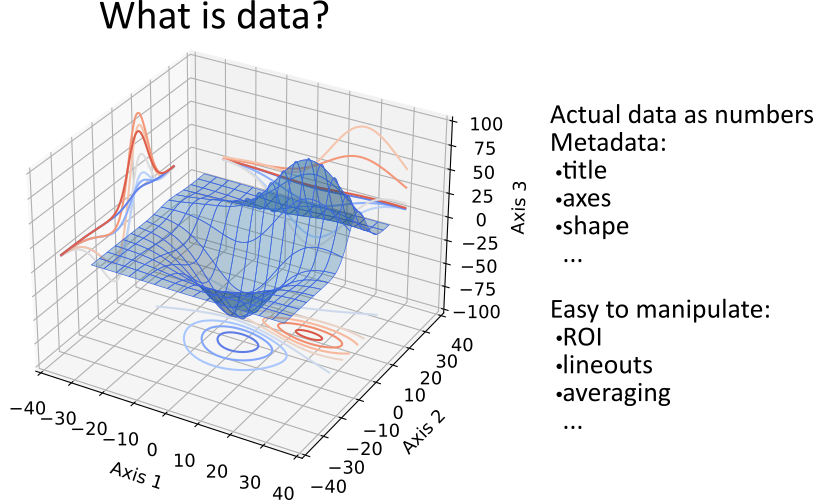
What is PyMoDAQ’s data?.
The PyMoDAQ Data package
Because of this variety, PyMoDAQ Data introduce a set of objects including metadata (for instance the time of acquisition) and various methods and properties to manipulate them during analysis for instance (getting name, slicing, concatenating…), save them and plot them (given you installed one of the available backend: matplotlib or Qt ( through the pymodaq_gui package)
To learn more, check the documentation.
Published under the MIT FREE SOFTWARE LICENSE
GitHub repo: https://github.com/PyMoDAQ
Documentation: http://pymodaq.cnrs.fr/
Metadata
Release files for pymodaq_data 5.3.11
For a detailed explanation of source distributions (sdists) and built distributions (wheels), please see the package formats documentation.
Source distribution (sdist)
| File | Size | Uploaded | Provenance | Actions |
|---|---|---|---|---|
| pymodaq_data-5.3.11.tar.gz | 188.9 kB | Without provenance | Details for pymodaq_data-5.3.11.tar.gz |
Built distribution (wheel)
| File | Interpreter | ABI | Platform | Actions Reset |
|---|---|---|---|---|
| pymodaq_data-5.3.11-py3-none-any.whl | Python 3 | none | any | Details for pymodaq_data-5.3.11-py3-none-any.whl |
Total release size: 386.4 kB
Release files / pymodaq_data-5.3.11.tar.gz
| Download URL | pymodaq_data-5.3.11.tar.gz |
|---|---|
| Size | 188.9 kB |
| Tags | Source |
|
SHA-256 checksum How to use checksums |
90d90e09e59e152eeb6b6ab42238ff691b8803ef545e77f1e3ea153a91b923f3
|
|
BLAKE2b-256 checksum How to use checksums |
1db7ae54f45c0a79892e6d93117efa840e445b25e4fa87acd833a557977bef0e
|
| Upload date | |
|
Uploaded using Trusted Publishing? What is trusted publishing? |
No |
| Uploaded via |
Hatch/1.18.2 {"ci":true,"cpu":"x86_64","distro":{"id":"resolute","libc":{"lib":"glibc","version":"2.43"},"name":"Ubuntu","version":"26.04"},"implementation":{"name":"CPython","version":"3.12.16"},"installer":{"name":"hatch","version":"1.18.2"},"openssl_version":"OpenSSL 3.5.5 27 Jan 2026","python":"3.12.16","system":{"name":"Linux","release":"7.0.0-1016-aws"}} HTTPX2/2.16.0
|
Release files / pymodaq_data-5.3.11-py3-none-any.whl
| Download URL | pymodaq_data-5.3.11-py3-none-any.whl |
|---|---|
| Size | 197.5 kB |
| Tags | Python 3 |
|
SHA-256 checksum How to use checksums |
0a8963b9564f2f56752c5fd3cff023c99699a171c3fede6d1d43ce09f42f64e2
|
|
BLAKE2b-256 checksum How to use checksums |
26f3a8ce13146c3a3635f4ba65a43163490ce01d3a81db5ef6ba66ef4d907185
|
| Upload date | |
|
Uploaded using Trusted Publishing? What is trusted publishing? |
No |
| Uploaded via |
Hatch/1.18.2 {"ci":true,"cpu":"x86_64","distro":{"id":"resolute","libc":{"lib":"glibc","version":"2.43"},"name":"Ubuntu","version":"26.04"},"implementation":{"name":"CPython","version":"3.12.16"},"installer":{"name":"hatch","version":"1.18.2"},"openssl_version":"OpenSSL 3.5.5 27 Jan 2026","python":"3.12.16","system":{"name":"Linux","release":"7.0.0-1016-aws"}} HTTPX2/2.16.0
|
Security for pymodaq_data 5.3.11
Provenance
Provenance describes where a file came from. On PyPI, provenance is shared via attestations, which provide a verifiable record of the build or publishing details. View details, limitations and caveats.
No provenance found
None of the files in this release were uploaded with provenance metadata.
A note on package security
PyPI is a repository for distributing packages, not a service for auditing them. While third-party security researchers and our staff do their best to detect and remove malicious packages, PyPI cannot guarantee the quality, security or suitability of any given package.
To learn more about protecting yourself from malicious actors, visit our package security documentation.














