
PySDKit: signal decomposition in Python





A Python library for signal decomposition algorithms 🥳
Installation | Example Script | Target | Acknowledgements
Installation 🚀
You can install PySDKit through pip:
pip install pysdkit
We only used NumPy, Scipy and matplotlib when developing the project.
Example Script ✨
This project integrates simple signal processing methods, signal decomposition and visualization, and builds a general interface similar to Scikit-learn. It is mainly divided into three steps:
- Import the signal decomposition method;
- Create an instance for signal decomposition;
- Use the
fit_transformmethod to implement signal decomposition; - Visualize and analyze the original signal and the intrinsic mode functions IMFs obtained by decomposition.
import numpy as np
from pysdkit import EMD
from pysdkit.plot import plot_IMFs

t = np.linspace(0, 1, 1000)
signal = np.sin(2 * np.pi * 5 * t) + 0.7 * np.sin(2 * np.pi * 25 * t) + 0.45 * np.sin(2 * np.pi * 80 * t)

emd = EMD()
IMFs = emd.fit_transform(signal, max_imfs=3)
plot_IMFs(signal, IMFs, view="2d_freq", fs=1000, freq_max=150)
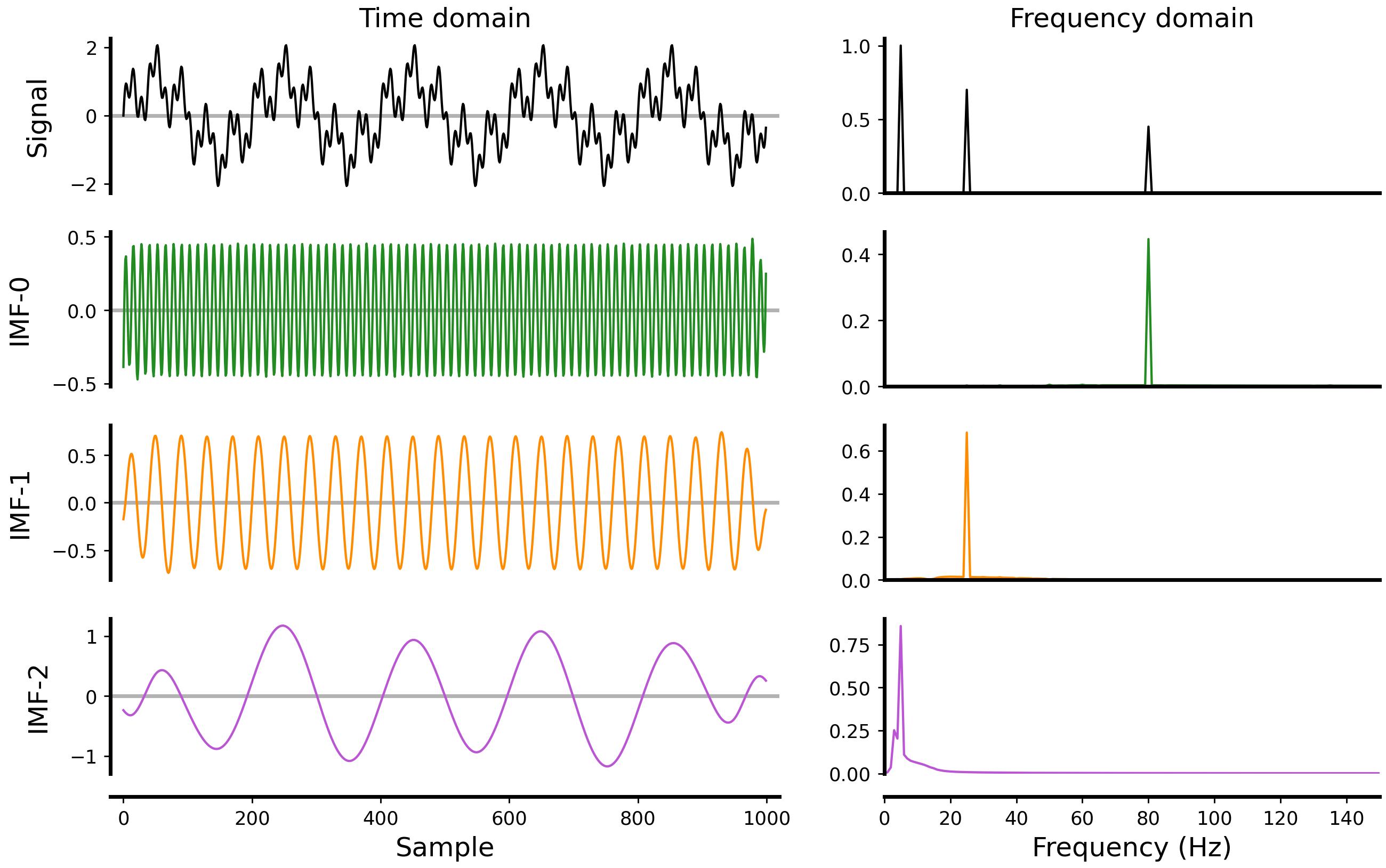
The EMD in the above example is the most classic empirical mode decomposition algorithm in signal decomposition. For more complex signals, you can try other algorithms such as variational mode decomposition (VMD).
from pysdkit import VMD
from pysdkit.data import test_vmd
from pysdkit.plot import plot_IMFs

t, signal, fs = test_vmd()

vmd = VMD(alpha=2000, K=4, tau=0.0, tol=1e-7)
IMFs = vmd.fit_transform(signal)
plot_IMFs(signal, IMFs, view="2d_freq", fs=fs, freq_max=fs / 2)
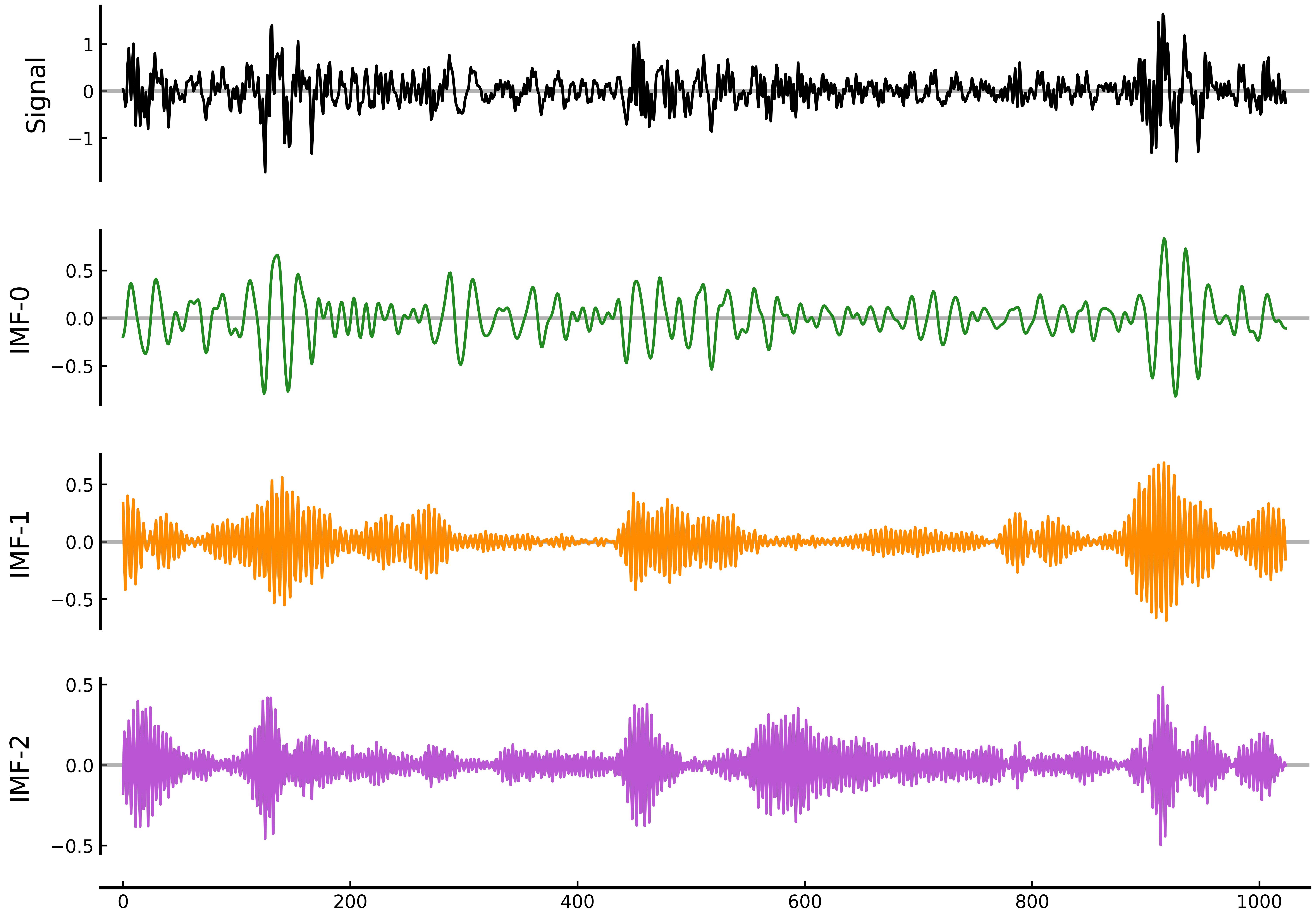
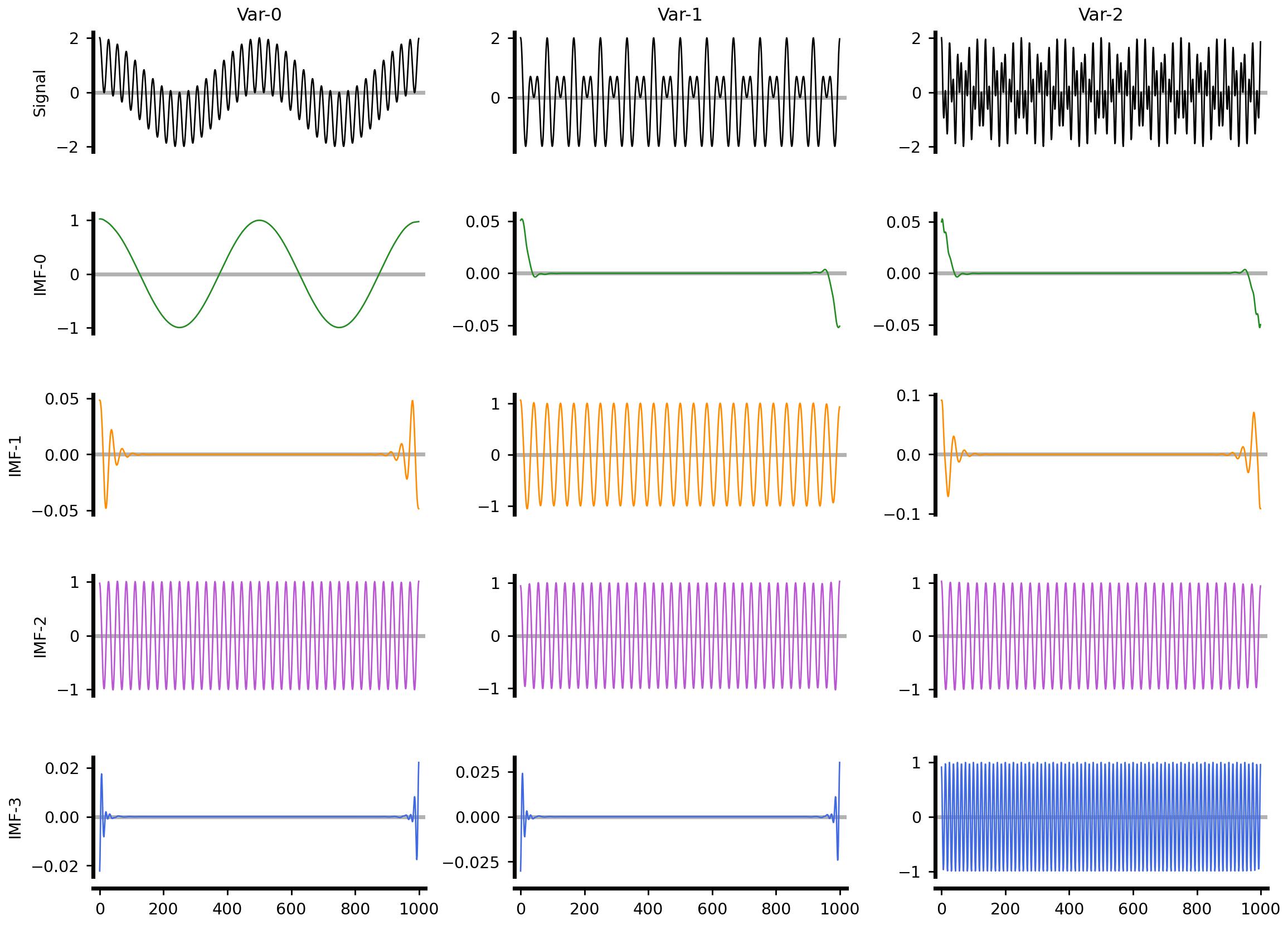
For multichannel recordings, algorithms such as multivariate VMD (MVMD) keep shared oscillations mode-aligned across channels:
import numpy as np
from pysdkit import MVMD
from pysdkit.plot import plot_IMFs

t = np.arange(0, 1, 0.001)
# ch1: 2+36 Hz, ch2: 24+36 Hz, ch3: 80+36 Hz (36 Hz shared)
signal = np.vstack([
    np.cos(2*np.pi*2*t) + np.cos(2*np.pi*36*t),
    np.cos(2*np.pi*24*t) + np.cos(2*np.pi*36*t),
    np.cos(2*np.pi*80*t) + np.cos(2*np.pi*36*t),
])

mvmd = MVMD(alpha=2000, K=4, tau=0.0, init="uniform")
IMFs = mvmd.fit_transform(signal)   # shape: (K, T, C)
plot_IMFs(signal, IMFs)             # per-channel panels
Target 🎯
PySDKit is still under development. We are currently working on reproducing the signal decomposition algorithms in the table below, including not only common decomposition algorithms for univariate signals such as EMD, VMD, OVMD, AVNCMD, ALIF and APMD, but also decomposition algorithms for multivariate signals such as MEMD and MVMD. We will also further reproduce the decomposition algorithms for two-dimensional images to make PySDKit not only suitable for signal processing, but also for image analysis and understanding. See Mission for the reasons why we developed PySDKit.
| Algorithm | Paper | Source | State |
|---|---|---|---|
EMD (Empirical Mode Decomposition) |
[paper] | [code] | ✔️ |
MEMD (Multivariate Empirical Mode Decomposition) |
[paper] | [code] | ✔️ |
BEMD (Bidimensional Empirical Mode Decomposition) |
[paper] | [code] | ✔️ |
EEMD (Ensemble Empirical Mode Decomposition) |
[paper] | [code] | ✔️ |
REMD (Robust Empirical Mode Decomposition) |
[paper] | [code] | ✔️ |
EMD2D (Empirical Mode Decomposition 2D for images) |
[paper] | [code] | ✔️ |
BMEMD (Bidimensional Multivariate Empirical Mode Decomposition) |
[paper] | [code] | ✔️ |
CEEMDAN (Complete Ensemble EMD with Adaptive Noise) |
[paper] | [code] | ✔️ |
TVF_EMD (Time Varying Filter Based EMD) |
[paper] | [code] | ✔️ |
EFD (Empirical Fourier Decomposition) |
[paper] | [code] | ✔️ |
FAEMD (Fast and Adaptive EMD) |
[paper] | [code] | ✔️ |
FAEMD2D (Two-Dimensional Fast and Adaptive EMD) |
[paper] | [code] | ✔️ |
FAEMD3D (Three-Dimensional Fast and Adaptive EMD) |
[paper] | [code] | ✔️ |
HVD (Hilbert Vibration Decomposition) |
[paper] | [code] | ✔️ |
ITD (Intrinsic Time-Scale Decomposition) |
[paper] | [code] | ✔️ |
ALIF (Adaptive Local Iterative Filtering) |
[paper] | [code] | ✔️ |
IMD (Impulsive Mode Decomposition) |
[paper] | [code] | ✔️ |
APMD (Adaptive Polymorphic Mode Decomposition) |
[paper] | [code] | ✔️ |
LMD (Local Mean Decomposition) |
[paper] | [code] | ✔️ |
RLMD (Robust Local Mean Decomposition) |
[paper] | [code] | ✔️ |
FMD (Feature Mode Decomposition) |
[paper] | [code] | ✔️ |
SSA (Singular Spectral Analysis) |
[paper] | [code] | ✔️ |
EWT (Empirical Wavelet Transform) |
[paper] | [code] | ✔️ |
EWT2D (2D Empirical Wavelet Transform) |
[paper] | [code] | ✔️ |
VMD (Variational Mode Decomposition) |
[paper] | [code] | ✔️ |
MVMD (Multivariate Variational Mode Decomposition) |
[paper] | [code] | ✔️ |
VMD2D (Two-Dimensional Variational Mode Decomposition) |
[paper] | [code] | ✔️ |
CVMD2D (Two-Dimensional Compact Variational Mode Decomposition) |
[paper] | [code] | ✔️ |
VME (Variational Mode Extraction) |
[paper] | [code] | ✔️ |
OVMD (Orthogonalized Variational Mode Decomposition) |
[paper] | [code] | ✔️ |
SVMD (Successive Variational Mode Decomposition) |
[paper] | [code] | ✔️ |
STVMD (Short Time Variational Mode Decomposition) |
[paper] | [code] | ✔️ |
VNCMD (Variational Nonlinear Chirp Mode Decomposition) |
[paper] | [code] | ✔️ |
INCMD (Iterative Nonlinear Chirp Mode Decomposition) |
[paper] | [code] | ✔️ |
MNCMD (Multivariate Nonlinear Chirp Mode Decomposition) |
[paper] | [code] | ✖️ |
AVNCMD (Adaptive Variational Nonlinear Chirp Mode Decomposition) |
[paper] | [code] | ✔️ |
ACMD (Adaptive Chirp Mode Decomposition) |
[paper] | [code] | ✔️ |
BA-ACMD (Bandwidth-aware Adaptive Chirp Mode Decomposition) |
[paper] | [code] | ✔️ |
DD-ACMD (Data-driven Adaptive Chirp Mode Decomposition) |
[paper] | [code] | ✔️ |
GDMD (Generalized Dispersion Mode Decomposition) |
[paper] | [code] | ✔️ |
VGNMD (Variational Generalized Nonlinear Mode Decomposition) |
[paper] | [code] | ✔️ |
IVGNMD (Improved Variational Generalized Nonlinear Mode Decomposition) |
[paper] | [code] | ✔️ |
AGNCMD (Adaptive Generalized Dispersive Mode Decomposition) |
[paper] | [code] | ✔️ |
JMD (Jump Plus AM-FM Mode Decomposition) |
[paper] | [code] | ️✔️ |
MJMD (Multivariate Jump Plus AM-FM Mode Decomposition) |
[paper] | [code] | ✔️ |
SJMD / SMJMD (Successive Jump and Mode Decomposition) |
[paper] | [code] | ✔️ |
ESMD (Extreme-Point Symmetric Mode Decomposition) |
[paper] | [code] | ✔️ |
STNBMD (Short-Time Narrow-Band Mode Decomposition) |
[paper] | [code] | ✔️ |
VTFMTD (Variational TF Mode Tracking Decomposition) |
[paper] | [code] | ✔️ |
SWD (Swarm Decomposition) |
[paper] | [code] | ✔️ |
OSD (Optimization-based Signal Decomposition) |
[paper] | [code] | ✔️ |
STL (Seasonal-Trend decomposition using LOESS) |
[paper] | [code] | ✔️ |
MSTL (Multivariate Seasonal-Trend decomposition using LOESS) |
[paper] | [code] | ✔️ |
Acknowledgements 🎖️
We would like to thank the researchers in signal processing for providing us with valuable algorithms and promoting the continuous progress in this field. However, since the main programming language used in signal processing is Matlab, and Python is the main battlefield of machine learning and deep learning, the usage of signal decomposition in machine learning and deep learning is far less extensive than wavelet transformation. In order to further promote the organic combination of signal decomposition and machine learning, we developed PySDKit. We would like to express our gratitude to PyEMD, Sktime, Scikit-learn, Scikit-Image, statsmodels, vmdpy, MEMD-Python-, ewtpy, EWT-Python, PyLMD, pywt, SP_Lib, dsatools and signal-decomposition.
Contributing 🤗
This project exists thanks to all the people who contribute.



Release files for PySDKit 0.4.49
For a detailed explanation of source distributions (sdists) and built distributions (wheels), please see the package formats documentation.
Source distribution (sdist)
| File | Size | Uploaded | Provenance | Actions |
|---|---|---|---|---|
| pysdkit-0.4.49.tar.gz | 1.6 MB | With provenance | Details for pysdkit-0.4.49.tar.gz |
Built distribution (wheel)
| File | Interpreter | ABI | Platform | Actions Reset |
|---|---|---|---|---|
| pysdkit-0.4.49-py3-none-any.whl | Python 3 | none | any | Details for pysdkit-0.4.49-py3-none-any.whl |
Total release size: 3.3 MB
Release files / pysdkit-0.4.49.tar.gz
| Download URL | pysdkit-0.4.49.tar.gz |
|---|---|
| Size | 1.6 MB |
| Tags | Source |
|
SHA-256 checksum How to use checksums |
3dd9002cb03eb7008a7789b4647b3a11d4ec99e16f1071abad9f980f7ad3a95e
|
|
BLAKE2b-256 checksum How to use checksums |
6932a17e0508f028ecc315735fcde0f563fb7efa8e5f6514f1b3988adec0662c
|
| Upload date | |
|
Uploaded using Trusted Publishing? What is trusted publishing? |
Yes |
| Uploaded via |
twine/7.0.0 CPython/3.13.14
|
Provenance
Provenance describes where a file came from. On PyPI, provenance is shared via attestations, which provide a verifiable record of the build or publishing details. View details, limitations and caveats.


PyPI Publish Attestation
PyPI verified that this artifact, at this checksum, originated from the publisher listed below.
Signed by GitHub Actions, verified by PyPI on Aug 15, 2026.
Transparency logRelease files / pysdkit-0.4.49-py3-none-any.whl
| Download URL | pysdkit-0.4.49-py3-none-any.whl |
|---|---|
| Size | 1.7 MB |
| Tags | Python 3 |
|
SHA-256 checksum How to use checksums |
772a27c4e2c926c743c013a8c03067f7a8db29fe094f625ac19152fec0b0029c
|
|
BLAKE2b-256 checksum How to use checksums |
89be499b31170ee7a8b00e365b4f40ad7c80b7eaacc2a009523eec5bf958baf6
|
| Upload date | |
|
Uploaded using Trusted Publishing? What is trusted publishing? |
Yes |
| Uploaded via |
twine/7.0.0 CPython/3.13.14
|
Provenance
Provenance describes where a file came from. On PyPI, provenance is shared via attestations, which provide a verifiable record of the build or publishing details. View details, limitations and caveats.
PyPI Publish Attestation
PyPI verified that this artifact, at this checksum, originated from the publisher listed below.
Signed by GitHub Actions, verified by PyPI on Aug 15, 2026.
Transparency logSecurity for PySDKit 0.4.49
Provenance
Provenance describes where a file came from. On PyPI, provenance is shared via attestations, which provide a verifiable record of the build or publishing details. View details, limitations and caveats.
Full provenance
Both files in this release have been uploaded with provenance metadata.
Attestation for pysdkit-0.4.49.tar.gz
PyPI Publish Attestation
PyPI verified that this artifact, at this checksum, originated from the publisher listed below.
Signed by GitHub Actions, verified by PyPI on Aug 15, 2026.
Transparency logA note on package security
PyPI is a repository for distributing packages, not a service for auditing them. While third-party security researchers and our staff do their best to detect and remove malicious packages, PyPI cannot guarantee the quality, security or suitability of any given package.
To learn more about protecting yourself from malicious actors, visit our package security documentation.














