

Parallel pytest for suites that cannot be made concurrency-safe: one subprocess per declared lane, so tests only overlap across environment boundaries you choose.

Project description

pytest-lanes

tests PyPI Python versions License: MIT Ruff

Parallel pytest for suites that cannot be made concurrency-safe.

One pytest subprocess per declared lane, so your tests only ever overlap across environment boundaries you chose. The name is the mental model: lanes run alongside each other and never merge.

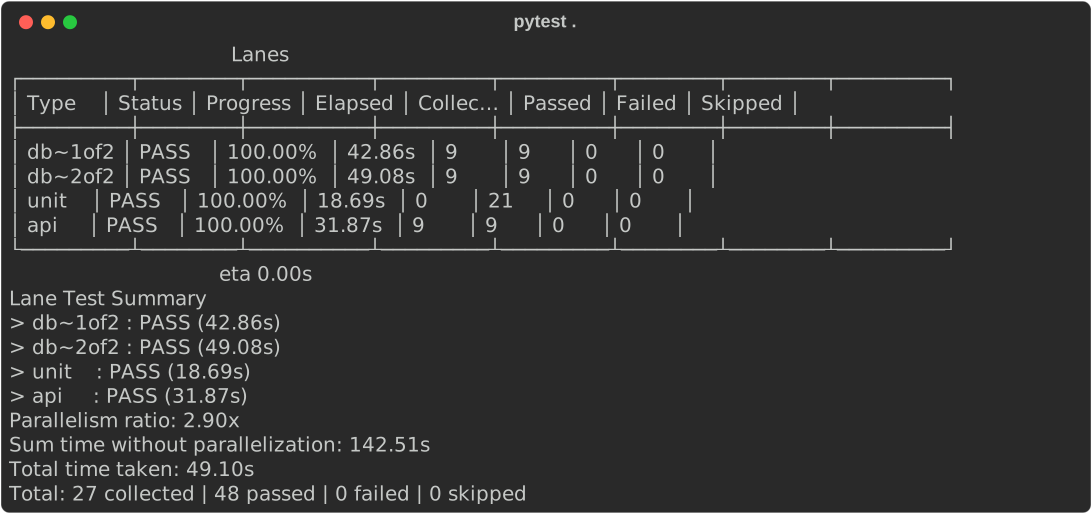
pytest-lanes running four lanes in parallel: db~1of2, db~2of2, unit and api, finishing in 49.10s against 142.51s of serial subprocess time — a 2.90x parallelism ratio

A lane is a group of tests that share a marker and an execution environment. Each lane starts its environment once, runs its own tests in declaration order inside one clean process, and overlaps only with other lanes — so nothing inside a lane ever needs to be made concurrency-proof. (The run above is examples/bench; db~1of2 and db~2of2 are one declared lane that the planner split in two because the measured durations said it would pay.)
Is this for you?

Your situation What to reach for
Homogeneous, independent, CPU-bound unit tests pytest-xdist. It will beat this, and it is one dependency you probably already have.
Grouping needs fit --dist loadfile / loadscope / loadgroup pytest-xdist. Try it first — genuinely.
Tests share fixed ports, one DB schema, OS state, a licensed simulator — and retrofitting them all is not happening pytest-lanes. Safe orderings become structural instead of a per-test obligation.
You need setup/teardown per group, not per worker pytest-lanes. A lane is the process, so its session fixtures wrap exactly its own tests.
Expensive setup can't be duplicated or serialized cheaply (a 4 GB model, an in-process index, one container) pytest-lanes.
Most of your suite's time sits in one huge test file pytest-xdist. A file is a lane's atomic unit, so that file is your floor.

The honest version of this table, with the reasoning and the xdist limitations that are structural rather than incidental, is in Should you use this?.

Quickstart

pip install pytest-lanes[rich]     # rich gives the live progress table above

Then pick a partition. You do not have to write one by hand:

pytest --lanes-suggest    # propose a lane config from your layout, run nothing
pytest . --lanes-auto     # zero config: one lane per test subdirectory
pytest . --lanes-explain  # show which lane claims each test, run nothing
pytest .                  # fan out: one subprocess per lane, in parallel

Paste the suggestion into pytest.ini or pyproject.toml when you are happy with it, and pytest . is your parallel command from then on. Run the suite once with lanes and --lanes-suggest starts proposing a duration-balanced partition from what it measured, instead of guessing from your directory names.

Install without extras if you prefer plain-text progress output; rich is optional. Nothing changes for anyone who runs pytest -k foo, pytest -m unit, or pytest path/to/test.py — orchestration steps aside for targeted runs, and with no lane config the plugin is completely dormant.

Two runnable examples: examples/demo (no Docker, 30 seconds) and examples/containers (real Postgres testcontainers, with a benchmark script).

Contents

Should you use this?

Use pytest-xdist if your tests are homogeneous, independent and CPU-bound; or if the grouping you need fits --dist loadfile / --dist loadscope / --dist loadgroup with @pytest.mark.xdist_group. That last mode covers a lot of ground — named groups that never run concurrently with themselves — and it is one dependency you probably already have. Try it first. Honestly.

Consider pytest-lanes when one of these actually applies:

  • Retrofitting your tests for concurrency-safety is not on the table. Any test touching a process-global resource — a fixed port, a shared schema, a config file, OS registry state, a hardware device — can be scheduled alongside any other test under a worker pool. Either you audit and fix every one of them, or you accept scheduling-dependent failures. Lanes make the safe orderings structural instead: tests only ever overlap with tests from other lanes, and nothing inside a lane needs to be made concurrency-proof.
  • You need a fixture lifecycle per group, not per worker. xdist's unit of isolation is the worker, and groups are assigned to workers round-robin, so several unrelated groups share one process and its session state. A lane is the process: its session fixtures set up and tear down around exactly its own tests.
  • The expensive setup cannot be shared or duplicated cheaply. The documented xdist recipe for a single shared fixture (tmp_path_factory + FileLock) can only hand a small serialized value between workers — it cannot share a 4 GB model, an in-process index, or a daemon holding a fixed port. Note that Python's testcontainers has no container-reuse support at all (open since 2020).
  • You want -s and --pdb to keep working. xdist's own docs list both as unsupported, because worker stdout cannot be transferred. A lane is a plain pytest subprocess, so -s streams live; and pytest --lane=<name> runs one lane in-process, where --pdb behaves normally.
  • Every worker collects everything. Each xdist worker imports and collects the full suite before running anything (~8s per process on the suite below); lane subprocesses collect only their own paths.

A cost worth stating plainly: the boot time of containers is usually not the problem people assume it is. Eight workers starting eight Postgres containers start them concurrently — roughly one container's wall-clock latency, not eight. Per-worker duplication genuinely hurts when setup is serialized CPU work (migrations, fixture seeding, loading a model or index), when it exhausts a resource (memory, connection limits, disk), or when the resource is irreducibly singleton (one licensed simulator, one fixed port, one piece of hardware). If your containers just boot fast and your tests are independent, xdist will serve you fine.

Measured results

Speed is not the argument for this plugin, but it should at least not cost you any — so here is the data, including the cases where it loses.

Measured 2026-07 on the ~2,430-test production suite this plugin was extracted from (five lanes: two Docker-container database lanes, an acceptance lane, an HTTP adapter lane, and a unit fallback lane). Three timed rounds per mode, interleaved, after one untimed warm-up per mode; serial baseline measured once. Windows 11, AMD Ryzen 5 7600 (6C/12T), 16 GB RAM, NVMe SSD, Docker Desktop.

Mode Median (s) Mean (s) Min (s) Max (s) Stdev Failures
pytest-lanes (pytest .) 32.3 32.7 32.3 33.4 0.7 0
xdist -n auto --dist loadfile 37.3 38.5 36.1 42.2 3.2 0
xdist -n auto --dist loadscope 41.0 41.2 40.2 42.5 1.2 0
xdist -n auto (default) 41.9 42.3 41.9 43.2 0.7 0
xdist --dist loadgroup + per-lane group marks 54.1 54.9 53.3 57.4 2.2 2–16
serial pytest (single process) 68 0

Read it honestly:

  • Lanes: ~2.1x over serial, and on this suite a modest 1.15x–1.3x over pytest-xdist depending on how well xdist's --dist mode is tuned. Treat that second number as "no worse", not as a selling point: it is one suite, on one machine, and the public-suite results below include a case where xdist wins outright. What is consistent here is the low variance and the absence of worker-count tuning.
  • The "make xdist do lanes" configuration is the interesting row. Auto-applying an xdist_group mark per lane (the closest xdist equivalent of this plugin) was the slowest parallel mode — atomic groups serialize on single workers while the rest of the pool idles and every worker still pays full collection — and the only one that failed, with 2–16 scheduling-dependent database-schema failures per run. Group scheduling is per-test, so two tests from the same file can land in different groups on different workers; lane subprocesses are per-path and preserve the suite's natural ordering.
  • The gap depends on how concurrency-safe your suite already is. An earlier (2026-05) snapshot of this same suite used fixed ZeroMQ ports in its e2e tests: xdist then posted 31 collision failures and lost by 2.2x (medians 59s vs 129s vs 155s serial, n=10). Two months of incremental work made those tests concurrency-safe (dynamic ports), and xdist's gap closed to the table above. That is the trade in one sentence: you can buy xdist's speed by auditing and retrofitting every test that touches shared state — lanes give you parallel speed on the suite you have today, and stay correct when the next port-binding test lands.

Where the speedup comes from

Decomposed, using the run above:

  1. Environment-level concurrency — the five lanes sum to 86s of subprocess time but wall-clock is 32s (2.70x overlap). This is the bulk of the win over serial pytest, and any parallel scheme gets some of it.
  2. Infrastructure paid once per environment, not once per worker — the lane model starts one Postgres and one Timescale container per run; worker pools start one per worker that touches them. On this suite the cost of that duplication is memory and connection pressure rather than boot latency (containers boot concurrently), so do not expect this term to dominate on every suite.
  3. Scoped collection — a full collection pass costs ~8s of the ~32s budget on this suite. Every xdist worker performs it; each lane subprocess collects only its own paths (0.8s of pytest time for the 317-test HTTP lane).
  4. Ordering preserved inside a lane — not a speedup, a correctness property the speed depends on: no failures means no reruns. See the loadgroup row above for what happens when the ordering is almost — but not exactly — preserved.

The honest caveats: maximum parallelism equals your lane count; a single slow lane bounds the wall-clock (the 32s postgres lane above is the wall time); the atomic unit is a file, so a suite whose weight sits in one huge test file has a floor lanes cannot get under (xdist's test-level distribution can, if your suite tolerates it); and on a suite that is already fully concurrency-safe and well-balanced, a tuned xdist lands within ~15% — sometimes ahead. The advantage concentrates where suites actually live: partially concurrency-safe, with a few expensive singletons. To see the mechanics on a small scale, run examples/containers — real Postgres testcontainers, lanes vs serial vs xdist, on your own machine.

Validated on public suites

The same protocol (medians of 3 timed rounds after warm-up, identical test populations and per-repo environment exclusions across every mode, Windows 11, 6C/12T) run against four well-known pytest suites, chosen to cover the spectrum from container-heavy to pure-CPU. "best xdist" is the best-performing safe --dist mode for that suite. "lanes-balanced" is the config --lanes-suggest generates from recorded durations, with shared-service tests co-located by hand as its header instructs.

Suite serial best xdist lanes lanes tuned Verdict
testcontainers-python (7 container modules) 237.1 131.0 121.9 lanes wins. Container-per-module is the natural lane shape; their own Makefile runs modules serially, so lanes is a drop-in 1.9x.
litestar (tests/unit, docker-coupled tests excluded everywhere) 59.1 33.4 54.0 20.2 (balanced) lanes wins, but only the measured config. The naive 5-lane split leaves one dominant lane (54.0); the duration-balanced partition beats their tuned loadgroup setup 1.65x.
flask-admin (postgres/mongo/azurite services) 44.3 29.8 (loadfile) / 14.4 (load) 30.3 23.4 (sharded) split. At file granularity lanes wins (23.4 vs 29.8). One 19.2s test file is 43% of the suite — test-granular --dist load is the only way past that floor, if your suite tolerates it (theirs has no concurrency-safety marks; it happened to pass here).
pydantic (pure CPU control) 17.9 12.7 12.2 11.7 wash, by design. Homogeneous CPU-bound units are xdist's home turf; lanes matching it is the interesting part (xdist needed PYTHONHASHSEED pinned to collect deterministically at all; lanes ran the suite unmodified).

What the four quadrants say in one paragraph: lanes wins where the suite's cost lives in environments (containers per module, service singletons) or where measured rebalancing can fix a lopsided partition — and the win comes without retrofitting a single test. xdist wins when weight concentrates in single files (lanes' granularity floor is the file) and test-granular distribution is safe for the suite. On pure CPU suites the two are within noise of each other. Full tables, exclusion lists, and methodology notes per suite are in the repo history.

Defining lanes

No config file

The fastest way in needs no INI section at all. --lanes-auto turns the directory layout most projects already have into the partition — one lane per immediate subdirectory of the rootdir that holds tests:

pytest . --lanes-auto

Or name lanes inline with --lane-def name=path[,path...] (repeatable), handy for tox commands and one-off runs. Ad-hoc lanes are a partition and fan-out instruction only — markers stay an INI feature:

pytest . --lane-def db=tests/integration --lane-def api=tests/api,tests/contracts

Either way, check the partition before trusting it: --lanes-explain prints which lane claims each test and exits without running anything.

Don't want to write the INI at all? pytest --lanes-suggest reads your directory layout and conftest.py files statically — fixture scopes and infrastructure imports, running no test code — and prints a commented [pytest-lanes] block to review and paste in, then exits without running tests:

pytest --lanes-suggest
# pytest-lanes suggestion - generated by --lanes-suggest from static
# analysis (directory layout + conftest.py imports and fixture scopes).
# Review and adjust, then verify the partition with:
#     pytest . --lanes-explain

[pytest-lanes]
lanes = db_tests unit_tests other
subprocess_order_standard = db_tests unit_tests

[pytest-lanes:db_tests]
# detected: session/module-scoped fixtures: daemon_port
marker = db_tests
classifier_path_prefixes = db_tests/
# ... one section per lane, above a [pytest] markers block (elided)

It is a starting point from static structure, not an oracle: verify with --lanes-explain before trusting it, and with fewer than two test-bearing subdirectories it says so instead of guessing.

Once recorded per-file durations exist (any lane-config run records them), --lanes-suggest stops guessing from structure and prints a duration-balanced partition instead: files pack longest-first into up to min(CPU count, 8) lanes so the lanes finish at roughly the same time, whole directories preferred, with projected seconds on every lane and a rest catch-all so tests added after recording still run:

# pytest-lanes balanced suggestion - generated by --lanes-suggest from
# recorded per-file durations, not from static analysis.
# Measured: 77.0s across 197 files; the
# balance is only as current as that recording.

[pytest-lanes:serialization]
# projected: 9.8s
marker = serialization
divisible = files
classifier_path_prefixes = tests/unit/serialization/
subprocess_paths = tests/unit/serialization
# ... one section per lane, then a tolerant [pytest-lanes:rest] catch-all

The balance sees durations only, not coupling: files that talk to the same shared external service (one container, one database, one compose project) must be moved into the same lane by hand, or the lanes race each other's setup and teardown.

Declaring lanes in INI

For durable, marker-aware lanes, declare them in pytest.ini (or tox.ini / setup.cfg) next to your pytest markers:

[pytest]
markers =
    postgres_integration: postgres-backed integration tests
    unit: fast unit tests

[pytest-lanes]
lanes = postgres other
subprocess_order_standard = postgres other

[pytest-lanes:postgres]
marker = postgres_integration
classifier_path_prefixes = tests/integration/
subprocess_paths = tests/integration

[pytest-lanes:other]
marker = unit
classifier_fallback = true
subprocess_ignore_other_lanes = true

If no lane configuration exists, the plugin is dormant and pytest behaves as if it were not installed — safe to keep in a shared environment.

Command-line reference

Command What it does
pytest . Fan out: one subprocess per lane, in parallel.
pytest . --lanes-auto Zero config — one lane per test subdirectory.
pytest . --lane-def db=tests/db Define a lane inline, no config file. Repeatable.
pytest --lanes-suggest Print a suggested lane config and exit. Duration-balanced once data exists.
pytest . --lanes-explain Print which lane claims each test and exit.
pytest . --lanes-full Standard lanes plus every optional lane.
pytest . --lanes-max-workers=2 Cap concurrent lanes (default: CPU count).
pytest . --lanes-no-shard Disable shard planning for this run.
pytest . --lanes-show-output Stream every lane's output live, not just failures.
pytest --lane=postgres Run one lane in-process, no fan-out — where --pdb works.
pytest --lane=postgres,timescale Several lanes in-process.
pytest . -s Disables capture, so lane output streams live.
pytest -m unit / pytest tests/test_foo.py Targeted run; orchestration steps aside.
pytest . -q --tb=long --junitxml=r.xml Unrecognized flags pass through to every lane.

Configuration reference

Lanes are declared under [pytest-lanes] and [pytest-lanes:<name>] sections. Adding a lane is a config edit, not a Python edit.

The [pytest-lanes] index section:

Field Meaning
lanes (required) All lane names in classification priority order — first matching rule wins.
subprocess_order_standard Lane names that produce a subprocess in pytest . (default) mode, in launch order.
subprocess_order_full Lane names that produce a subprocess in pytest . --lanes-full mode. Lanes here but not in subprocess_order_standard are "optional" (e.g. a slow build-verification lane).
max_workers Maximum lanes running concurrently; default: CPU count. Overridden by --lanes-max-workers.
shard_min_saving Minimum projected makespan improvement, in seconds, before a divisible lane is split into two shards; default 5. See Sharding.

Every [pytest-lanes:<name>] section accepts:

Field Meaning
marker (required) Pytest marker applied to every test claimed by this lane. Must be declared in [pytest].markers in the same file.
classifier_paths Exact relative paths this lane claims (whitespace-separated).
classifier_path_prefixes Path prefixes this lane claims (e.g. tests/integration/).
classifier_path_suffix A single filename suffix this lane claims (e.g. _performance.py).
classifier_class_base_names Test-class base names. Classes whose MRO includes any of these are claimed regardless of file path — used to promote container-backed tests into their container lane wherever they live.
classifier_fallback If true, this lane claims every item not claimed by an earlier rule. Exactly one lane should set this.
subprocess_paths Paths passed as positional argv to the lane's pytest subprocess.
subprocess_nodeids Specific test node IDs passed to the subprocess.
subprocess_ignore Paths emitted as --ignore=<path> to the subprocess.
subprocess_ignore_other_lanes If true, every other lane's paths are added to this lane's --ignore= list. The fallback lane uses this to "run everything not in another lane."
subprocess_env_set Whitespace-separated KEY=VALUE entries injected into the subprocess env and applied per-test in single-process mode.
lane_numprocesses If > 1, run this lane's subprocess under pytest-xdist (-n N --dist loadfile). For homogeneous lanes whose environment is cheap to duplicate; requires pytest-xdist. Reintroduces per-worker environment duplication inside this lane. See Sharding.
divisible Set to files to opt this lane into sharding — asserting its files are mutually independent and its environment tolerates a duplicate running alongside it. See Sharding.
tolerate_no_tests If true, this lane collecting zero tests counts as success instead of failing the run. Meant for catch-all lanes that may legitimately come up empty.

This schema is frozen for the whole 0.x series: keys will be added, never renamed or removed.

The same schema in pyproject.toml

Everything above can live in pyproject.toml instead, under [tool.pytest-lanes] — same keys, same meanings, TOML types instead of whitespace-delimited strings:

[tool.pytest.ini_options]
markers = ["postgres_integration: postgres-backed integration tests"]

[tool.pytest-lanes]
lanes = ["postgres", "other"]
subprocess_order_standard = ["postgres", "other"]
max_workers = 3

[tool.pytest-lanes.lane.postgres]
marker = "postgres_integration"
classifier_path_prefixes = ["tests/integration/"]
subprocess_paths = ["tests/integration"]
subprocess_env_set = { DATABASE_URL = "postgresql://localhost/test" }

[tool.pytest-lanes.lane.other]
marker = "unit"
classifier_fallback = true
subprocess_ignore_other_lanes = true

Markers are validated against [tool.pytest.ini_options].markers in the same file. Discovery follows pytest's own config precedence — pytest.ini, then pyproject.toml, then tox.ini, then setup.cfg; the first file declaring lane configuration wins. Because TOML carries real types, the pyproject loader is stricter than the INI one: a misspelled key, a string where an array belongs, or a float where an integer belongs is a config error naming the offending field, not something silently ignored.

Adding a new lane

  1. Declare a marker in [pytest].markers.
  2. Add the lane name to [pytest-lanes].lanes (priority order matters).
  3. Write one [pytest-lanes:<name>] section with at minimum marker and one classifier.
  4. (Optional) Add the lane to subprocess_order_standard and/or subprocess_order_full if it should get its own subprocess.

How it works

pytest .
  ├── pytest_cmdline_main (plugin hook)
  │     ├── orchestration_mode(config) -> "standard" | "full" | None
  │     ├── (if None: custom -k/-m/--lane/path selection, or we are a child)
  │     │     return None; pytest runs as usual
  │     ├── build_lane_commands(mode, passthrough_args, lane_config)
  │     │     -> N argv lists, one per subprocess lane
  │     └── run_lane_commands(commands, max_workers)
  │           ├── launch up to max_workers `python -m pytest <argv>` subprocesses;
  │           │     remaining lanes queue longest-first from recorded durations
  │           │     (declared order on the first run), start as slots free
  │           ├── set PYTEST_LANES_CHILD=1 so children skip re-orchestration
  │           ├── reader threads stream child stdout into a shared queue
  │           ├── LaneProgressReporter parses progress, counts, failures
  │           ├── live display renders (rich table, or plain text fallback)
  │           └── return max(exit codes)
  └── (for in-process runs) pytest_collection_modifyitems
        ├── classify each item -> LaneSpec (class-base-name > path rules > fallback)
        ├── apply the lane's marker
        └── if --lane=X was passed, skip items whose lane is not selected

Those recorded durations persist to .pytest_cache/v/pytest-lanes/lane_durations.json between runs — each lane's record now holds per-file test times plus measured startup (collection end to first test, which captures container/fixture spin-up) and collect — and deleting that file resets scheduling to declared order.

Child processes detect the parent via PYTEST_LANES_CHILD=1 and run as plain pytest. That is the whole trick: each lane gets a clean interpreter, its own fixtures, its own containers, its own ports — parallelism without any shared mutable state. Setting PYTEST_LANES_CHILD=1 in your own shell disables the plugin entirely (useful for benchmarking the serial baseline).

-s (or --capture=no) works as it does in plain pytest: capture is off in the lane children and their output streams live, prefixed per lane. --lanes-show-output does the same without disabling capture, when you want to watch lanes progress rather than see print() output; the PYTEST_LANES_SHOW_OUTPUT=1 environment variable is equivalent, for CI jobs that cannot change the pytest command. A failing lane's full output is always printed after the run, and each failed row in the Lane Test Summary is followed by a reproduce: pytest --lane=<name> line — the exact command to re-run that lane in isolation. That command runs in-process, which is where --pdb works normally (a debugger cannot attach to a lane subprocess, and xdist has the same limitation with no in-process escape hatch).

Coverage and JUnit reports in CI

--junitxml and --cov work as they do in a single-process run, because each lane is staged to its own file and the parent aggregates afterwards:

pytest . --junitxml=report.xml --cov=src --cov-report=xml:coverage.xml

report.xml holds every lane's test cases, with correct totals on the root element; coverage.xml and the .coverage data file are combined across all lanes. Without this, each lane would write the same path — coverage's SQLite data file corrupts outright, and a JUnit report silently keeps only whichever lane finished last. If you have ever wired lanes up by hand with several pytest invocations, this is the part that is easy to get wrong.

To see the partition before committing to a run, --lanes-explain prints one line per collected test — the lane that claims it and the classifier rule that matched — then exits without running anything. Classification and explanation share one code path, so the listing cannot drift from what a real run would do:

$ pytest . --lanes-explain

Lane classification
io_tests/test_simulated_container.py::test_simulated_container_query_one -> slow_io (classifier_path_prefixes: io_tests/)
io_tests/test_simulated_container.py::test_simulated_container_query_two -> slow_io (classifier_path_prefixes: io_tests/)
unit_tests/test_fast_units.py::test_unit_alpha -> other (classifier_fallback)
unit_tests/test_fast_units.py::test_unit_beta -> other (classifier_fallback)
4 tests in 2 lanes

It inspects whatever would be collected, so it composes with the usual -k/-m/path selection. (Needs a [pytest-lanes] config — with none, it reports a usage error rather than guessing.)

When to use it (and when not to)

Good fit — your suite has clusters of tests bound to expensive, stateful environments: testcontainers (Postgres, TimescaleDB, Kafka, ...), daemons on fixed ports, OS-level state, packaging/build verification. Especially when those fixtures are process-wide singletons that were never designed for multi-worker access.

Poor fit — thousands of homogeneous, independent, CPU-bound unit tests with no shared infrastructure. That is exactly what pytest-xdist is for, and it will beat this. Also a poor fit when most of your suite's time sits in one very large test file: a file is a lane's atomic unit, so that file becomes your floor. The two tools are complementary — lanes for environment isolation, xdist for test-level spreading within an environment — and the built-in lane_numprocesses key does exactly that inside a single homogeneous lane (see Sharding: splitting a slow lane).

Prior art

Read this table as "what else to try first", not as a list of things this plugin beats.

Tool Granularity Difference
pytest-xdist per-test The default answer, and the fastest option for homogeneous CPU-bound suites. --dist loadgroup + xdist_group marks covers much of what lanes do for scheduling. What it cannot do: give each group its own process lifecycle (groups share workers round-robin), preserve grouping without per-test marks, or support -s/--pdb (its docs list both as unsupported).
pytest-isolated per-marked-group subprocess The closest design to this one — grouped subprocesses with per-group fixtures and ini config. It runs its groups serially, so it buys isolation but no parallelism.
pytest-shared-session-scope per-fixture Attacks the duplicated-session-fixture problem directly by sharing one fixture's value across xdist workers. Lighter than lanes if fixture duplication is your only problem and the value serializes.
pytest-split / pytest-shard per-CI-node Splits a suite across machines by timing; no local parallelism, no environment alignment. Composes with lanes: shard across nodes, lanes within a node.
tox -p / nox per-environment Parallel virtualenvs — genuinely overlapping subprocesses with aggregated exit codes today. Each env reinstalls dependencies, output is siloed per env, and selection lives outside pytest.
Pants / Bazel / Buck2 per-target batch Build systems that already do config-declared test batching in parallel, with resource slots to avoid port/DB collisions. Strictly more capable; vastly more adoption cost. If you are already on one, use it.
shell scripts / make -j per-command No classification, no marker application, no passthrough args, no unified failure report.

Hardware requirements

The speedup is bought with CPU cores. Wall-clock gain is bounded by min(concurrent lanes, physical cores): a lane is a full pytest process that can keep a core busy, so the working guideline is roughly one core per concurrent lane.

Lanes beyond max_workers (default: CPU count) queue and launch as slots free, so on a 1–2 core machine a multi-lane suite degrades toward serial execution plus subprocess overhead — the plugin schedules the parallelism you declared, but it cannot create parallelism the hardware does not have.

Memory scales the same way: each concurrent lane costs a full Python interpreter plus that lane's own infrastructure — one Postgres container per database lane running at the same time, and so on.

For CI, size the runner to the concurrency you want. GitHub Actions' ubuntu-latest gives 4 vCPUs, so more than ~4 concurrent lanes will not pay off there. And os.cpu_count() (the max_workers default) reports logical cores; the honest guideline is physical cores, so on SMT/hyper-threaded machines consider setting max_workers lower.

Sharding: splitting a slow lane

A single slow lane bounds the wall-clock. If that lane's files are mutually independent and its environment can run duplicated, pytest-lanes can split the lane into two shards that run as separate subprocesses — a second copy of the environment bought for a shorter critical path.

Sharding is opt-in per lane, because the split is only safe under two assertions you make by declaring it:

[pytest-lanes:postgres]
marker = postgres_integration
classifier_path_prefixes = tests/integration/
divisible = files

divisible = files asserts (1) the lane's files are mutually independent — no ordering or cross-file shared state — and (2) the environment tolerates a duplicate running alongside it. A lane bound to a fixed port or a single-instance daemon must not opt in: a second shard starts a second copy and the two collide. Splits are always at file granularity and never reorder within a file, so the "only the concurrency you declared" property holds — a shard is just a subset of the lane's files in their normal order.

The plan is static, computed before launch. Sharding never fires on the first run — no recorded data, no split. Once durations exist, the planner replays the real scheduler — bounded worker pool, longest-first — twice: once with every lane whole, once with a 2-way contiguous split of the single longest divisible lane. It keeps the split only when the projected makespan improves by at least shard_min_saving (default 5s), counting each shard re-paying its measured startup + collect. One lane is considered per run.

The cut is deterministic and sticky: same inputs, same plan. It persists to .pytest_cache/v/pytest-lanes/shard_plan.json and is re-cut — loudly — only when recorded durations drift past 20% imbalance. Shard 1 runs an explicit file list; shard 2 runs the lane minus those files (an ignore-list), so a file added since the plan was recorded always runs, and shard 2 tolerates collecting nothing.

A sharded run prints a receipt and splits the lane's live row in two:

pytest-lanes: sharded postgres into 2: projected 17.1s + 16.4s, makespan gain 13.0s >= 5.0s

> postgres~1of2 : PASS (17.24s)
> postgres~2of2 : PASS (16.51s)

Shard measurements merge back into the parent lane's record, so scheduling and future plans still see postgres as one lane. A failed shard prints two reproduce lines — the whole lane, and the shard's exact files:

reproduce: pytest --lane=postgres
    or: pytest tests/integration/test_a.py tests/integration/test_b.py

--lanes-no-shard disables planning for a run; the --lanes-explain footer lists the divisible lanes and the persisted plan.

The honest ceiling. Splitting the longest lane cannot help more than the runner-up lets it. For a longest lane of duration D1 = E + T (fixed environment cost E plus test time T) and a second-longest lane D2, a single 2-way split saves at most

min(T / 2, D1 - D2)

The T/2 term is the best case of halving the test work; the D1 - D2 term is the wall the next-longest lane now sets. On a balanced suite D1 - D2 is small and sharding alone is nearly worthless — shrink the second-longest lane first, then sharding the expensive lane pays.

In-lane xdist (lane_numprocesses)

For a lane that is homogeneous and cheap to duplicate — many independent files, a fast or shareable environment — lane_numprocesses = N runs that lane's own subprocess under pytest-xdist (-n N --dist loadfile). It is the built-in way to spread tests across workers within a single environment: lanes give you environment isolation, this gives you test-level parallelism inside one lane. It requires pytest-xdist installed (a clear usage error otherwise). The honest trade is that inside that lane xdist's costs come back — each worker duplicates the lane's per-worker environment, and process-global state must be concurrency-safe across the lane's own files — which is exactly the opt-in you make by setting the key.

The two features compose. lane_numprocesses on a cheap, fat lane is often the cleanest way to shrink the second-longest lane, which is what lifts the D1 - D2 ceiling above and lets sharding the expensive lane cash in its T/2.

Limitations

  • Wall-clock is bounded by the slowest shard/worker-set, not the slowest test. In-lane parallelism exists but is opt-in per lane: lane_numprocesses spreads a lane across xdist workers, and divisible = files lets the planner shard a slow lane. A lane that opts into neither runs whole and bounds the run if it is the longest.
  • Max parallelism is min(subprocess lane count, max_workers); lanes beyond that queue and wait for a free slot.
  • Queued lanes launch longest-first from recorded durations; the first run (no data yet) uses declared order (subprocess_order_standard), so listing the slowest lanes first still helps once.
  • Lane config must live in the same file that declares your pytest markers ([pytest].markers, or [tool.pytest.ini_options].markers in pyproject.toml).
  • Lane-to-marker mapping is one marker per lane; multiple lanes may share a marker.
  • Third-party plugins that write one output file per session need the same treatment --junitxml and --cov already get (each lane staged to its own path, merged afterwards). Those two are handled; a plugin writing its own single report file from every lane will still have its lanes race for it. --cov-report specs carrying modifiers, such as term-missing:skip-covered, are reported as unsupported and skipped — the combined .coverage is still written, so you can run coverage yourself.
  • Lane children run with pytest's cacheprovider disabled (concurrent children would race on .pytest_cache and clobber each other's lastfailed), so pytest --lf after an orchestrated run does not see lane failures — use the reproduce: pytest --lane=<name> hint printed under each failed lane instead.

Roadmap

Details and sequencing in ROADMAP.md. v0.2 shipped the bounded worker pool, the trust and debugging tools (--lanes-explain, a live ETA, and reproduce hints), zero-config lanes (--lane-def and --lanes-auto, no config file required), duration-aware scheduling (recorded per-lane wall times drive longest-first launch and real ETAs), and --lanes-suggest — a static scan that prints a proposed [pytest-lanes] config from your directory layout and conftests, the differentiator no other tool offers. Closing out the performance milestone, it also shipped per-file run measurement, in-lane xdist (lane_numprocesses), duration-balanced --lanes-suggest partitions, and statically-planned lane sharding.

It also ships [tool.pytest-lanes] configuration in pyproject.toml — the full lane schema, frozen for 0.x. The remaining direction is per-lane OS gating (requires_os) and release-time discoverability work.

FAQ

Why is pytest so slow with testcontainers? Usually because container startup is a session fixture and the whole suite runs in one process: each container boots, its tests run, the next boots, and nothing overlaps. Lanes run each container-backed test directory in its own subprocess, so those setup-then-test sequences overlap. Try pytest -n auto --dist loadfile first — if per-worker duplication is affordable for you, that is less machinery. See Should you use this?.

Why does pytest-xdist start one database container per worker? Session-scoped fixtures are per process, and every xdist worker is a process, so eight workers touching Postgres-backed tests means eight Postgres containers. Whether that costs you anything depends: they boot concurrently, so wall-clock boot is roughly one container, not eight. It hurts when setup is serialized CPU work (migrations, seeding), when eight copies exhaust memory or connection limits, or when the resource is a singleton that cannot be duplicated at all. In those cases lanes route every test of an environment into one subprocess, so the setup happens once. If a single homogeneous lane is then your bottleneck, lane_numprocesses re-introduces xdist inside that lane only, where you've decided duplication is affordable.

My tests pass alone but fail under pytest-xdist. That is the concurrency-safety tax: any two tests can now run at the same time, so fixed ports, shared schemas, config files, and global state collide scheduling-dependently. You can retrofit every such test (dynamic ports, unique names, locks) — or draw lanes along the boundaries that already exist, so unsafe tests simply never overlap. Lanes is the "run the suite you have today" option; see the measured comparison.

How do I run pytest test directories in parallel as separate processes? That is literally this plugin: declare each directory as a lane (or run pytest . --lanes-auto for one lane per test subdirectory, or pytest --lanes-suggest to have the partition generated for you), and pytest . fans out one subprocess per lane with a merged summary, propagated exit codes, and per-lane reproduce commands.

How is this different from pytest-split or pytest-shard? Those slice a suite across CI machines by recorded timing; each node still runs its slice serially, and the slices ignore environment boundaries. Lanes parallelize on one machine along infrastructure boundaries. They compose: shard in CI, lanes within each node.

Does it work on Windows? Yes — it is developed and benchmarked on Windows 11 and CI-tested on Windows and Linux (Python 3.10–3.13). No fork(), no POSIX-only process management.

How many CPU cores do I need? Roughly one physical core per concurrent lane; the speedup is bounded by min(lanes, cores). On 1–2 core machines lanes queue (bounded worker pool) and the run degrades toward serial — see Hardware requirements.

Development

git clone https://github.com/HuzPro/pytest-lanes
cd pytest-lanes
python -m venv .venv && . .venv/bin/activate   # .venv\Scripts\activate on Windows
pip install -e .[test]
pytest

The suite includes end-to-end tests that generate a miniature lane project in a temp directory and run a real orchestrated pytest against it.

License

MIT

Project details


Download files

Download the file for your platform. If you're not sure which to choose, learn more about installing packages.

Source Distribution

pytest_lanes-0.3.0.tar.gz (135.0 kB view details)

Uploaded Source

Built Distribution

If you're not sure about the file name format, learn more about wheel file names.

pytest_lanes-0.3.0-py3-none-any.whl (75.8 kB view details)

Uploaded Python 3

File details

Details for the file pytest_lanes-0.3.0.tar.gz.

File metadata

  • Download URL: pytest_lanes-0.3.0.tar.gz
  • Upload date:
  • Size: 135.0 kB
  • Tags: Source
  • Uploaded using Trusted Publishing? Yes
  • Uploaded via: twine/6.1.0 CPython/3.13.14

File hashes

Hashes for pytest_lanes-0.3.0.tar.gz
Algorithm Hash digest
SHA256 7a5fbf499c804e586931fc6010be481c31a0dd929d5a3294d73a33d6752e6bd8
MD5 aa3b90e6a8a8b2d2da189d7c1bfadc3e
BLAKE2b-256 d54bcf35e12c72ccbaf38f41866df49ab841034236d2be400ecd573d97dc94ab

See more details on using hashes here.

Provenance

The following attestation bundles were made for pytest_lanes-0.3.0.tar.gz:

Publisher: publish.yml on HuzPro/pytest-lanes

Attestations: Values shown here reflect the state when the release was signed and may no longer be current.

File details

Details for the file pytest_lanes-0.3.0-py3-none-any.whl.

File metadata

  • Download URL: pytest_lanes-0.3.0-py3-none-any.whl
  • Upload date:
  • Size: 75.8 kB
  • Tags: Python 3
  • Uploaded using Trusted Publishing? Yes
  • Uploaded via: twine/6.1.0 CPython/3.13.14

File hashes

Hashes for pytest_lanes-0.3.0-py3-none-any.whl
Algorithm Hash digest
SHA256 eb153ebba963d0017bd80d108837974daeeb75bb361f14ec0be63be46b56daed
MD5 2fe4c55685ae8b5b5d306f4838111e76
BLAKE2b-256 0efaf696725b35717f8d7bd133b81ebebbef37411ce3e98f5ef5e2daf26599f4

See more details on using hashes here.

Provenance

The following attestation bundles were made for pytest_lanes-0.3.0-py3-none-any.whl:

Publisher: publish.yml on HuzPro/pytest-lanes

Attestations: Values shown here reflect the state when the release was signed and may no longer be current.

Supported by

AWS Cloud computing and Security Sponsor Datadog Monitoring Depot Continuous Integration Fastly CDN Google Download Analytics Pingdom Monitoring Sentry Error logging StatusPage Status page












