
pytest-socket







A plugin to use with Pytest to disable or restrict socket calls during
tests to ensure network calls are prevented.
Features
- Disables all network calls flowing through Python's
socketinterface, including DNS resolution. - Restricts connections to an allow-list of hosts, IP addresses, or CIDR network ranges.
- Allows Unix domain sockets selectively, for example when testing async code.
- Applies globally via CLI flags, or per-test via fixtures and markers.
Requirements
- Pytest 7.0 or greater
- Python 3.10 or greater
Installation
You can install pytest-socket via pip
from PyPI:
pip install pytest-socket
or add to your pyproject.toml for uv:
[project.optional-dependencies]
dev = [
    "pytest-socket",
]
Usage
Run pytest --disable-socket, tests should fail on any access to socket or
libraries using socket with a SocketBlockedError.
To add this flag as the default behavior, add this section to your
pytest.ini:
[pytest]
addopts = --disable-socket
or add this to your setup.cfg:
[tool:pytest]
addopts = --disable-socket
or update your conftest.py to include:
from pytest_socket import disable_socket

def pytest_runtest_setup():
    disable_socket()
If you exceptionally want to enable socket for one particular execution
pass --force-enable-socket. It takes precedence over --disable-socket.
To enable Unix sockets during the test run (e.g. for async), add this option:
[pytest]
addopts = --disable-socket --allow-unix-socket
To enable specific tests use of socket, pass in the fixture to the test or
use a marker:
def test_explicitly_enable_socket(socket_enabled):
    assert socket.socket(socket.AF_INET, socket.SOCK_STREAM)


@pytest.mark.enable_socket
def test_explicitly_enable_socket_with_mark():
    assert socket.socket(socket.AF_INET, socket.SOCK_STREAM)
To allow only specific hosts per-test:
@pytest.mark.allow_hosts(['127.0.0.1'])
def test_explicitly_enable_socket_with_mark():
    assert socket.socket.connect(('127.0.0.1', 80))
or for whole test run
[pytest]
addopts = --allow-hosts=127.0.0.1,127.0.1.1
Entries may be hostnames, IP addresses, or CIDR network ranges such as
192.168.0.0/24.
Frequently Asked Questions
Q: Why is network access disabled in some of my tests but not others?
A: pytest's default fixture scope is "function", which socket_enabled uses.
If you create another fixture that creates a socket usage that has a "higher"
instantiation order, such as at the module/class/session, then the higher order
fixture will be resolved first, and won't be disabled during the tests.
Read more in this excellent example
and more about pytest fixture order here.
This behavior may change in the future, as we learn more about pytest fixture order, and what users expect to happen.
Contributing
Contributions are very welcome. Tests can be run with pytest, please ensure the coverage at least stays the same before you submit a pull request.
License
Distributed under the terms of the MIT license, "pytest-socket" is free and open source software
Issues
If you encounter any problems, please file an issue along with a detailed description.
References
This Pytest plugin was generated with Cookiecutter along with @hackebrot's Cookiecutter-pytest-plugin template.
This plugin came about due to the efforts by @hangtwenty solving a StackOverflow question, then converted into a pytest plugin by @miketheman.
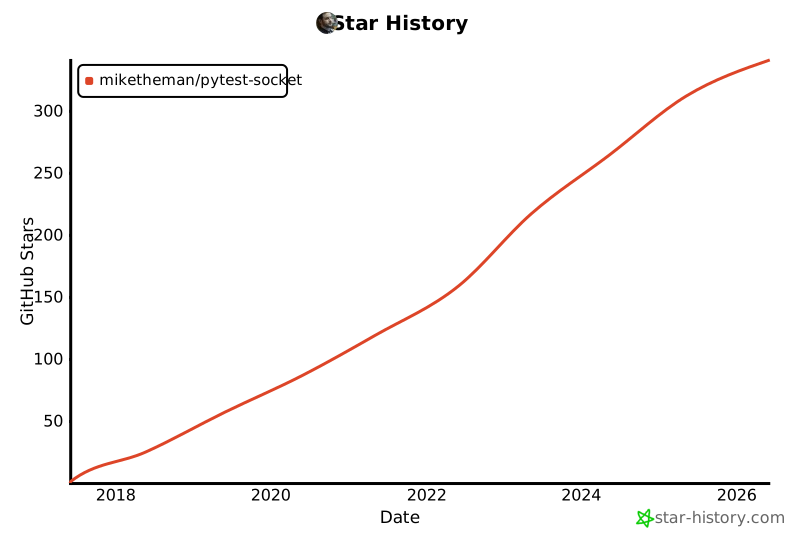
Star History
1 maintainer

Release files for pytest-socket 0.8.1
For a detailed explanation of source distributions (sdists) and built distributions (wheels), please see the package formats documentation.
Source distribution (sdist)
| File | Size | Uploaded | |
|---|---|---|---|
| pytest_socket-0.8.1.tar.gz | 17.3 kB | Details |
Built distribution (wheel)
| File | Interpreter | ABI | Platform | Reset |
|---|---|---|---|---|
| pytest_socket-0.8.1-py3-none-any.whl | Python 3 | none | any | Details |
Total release size: 26.1 kB
Release files / pytest_socket-0.8.1.tar.gz
| Download URL | pytest_socket-0.8.1.tar.gz |
|---|---|
| Size | 17.3 kB |
| Tags | Source |
|
SHA-256 checksum How to use checksums |
2f57787914ad2e1308d09ce141b95c3e55741fbb4fb7b7556593a6b063e0c9c7
|
|
BLAKE2b-256 checksum How to use checksums |
bace4ef7b049852c95a8727b4a7e6496f762df1ac0b47bc0320d10293f5e95ec
|
| Upload date | |
|
Uploaded using Trusted Publishing? What is trusted publishing? |
Yes |
| Uploaded via |
twine/7.0.0 CPython/3.13.14
|
Provenance
Provenance describes where a file came from. On PyPI, provenance is shared via attestations, which provide a verifiable record of the build or publishing details. View details, limitations and caveats.


PyPI Publish Attestation
PyPI verified that this artifact, at this checksum, originated from the publisher listed below.
Signed by GitHub Actions, verified by PyPI on Aug 19, 2026.
Transparency logRelease files / pytest_socket-0.8.1-py3-none-any.whl
| Download URL | pytest_socket-0.8.1-py3-none-any.whl |
|---|---|
| Size | 8.8 kB |
| Tags | Python 3 |
|
SHA-256 checksum How to use checksums |
f9846bed1dcd96eed459e5e14795bbaf96715cf4e827891fe70773817ecb8ed4
|
|
BLAKE2b-256 checksum How to use checksums |
87efab507f117b3d19b54e3c9c632a99c28c3b284562ec6e02e274581d530d92
|
| Upload date | |
|
Uploaded using Trusted Publishing? What is trusted publishing? |
Yes |
| Uploaded via |
twine/7.0.0 CPython/3.13.14
|
Provenance
Provenance describes where a file came from. On PyPI, provenance is shared via attestations, which provide a verifiable record of the build or publishing details. View details, limitations and caveats.
PyPI Publish Attestation
PyPI verified that this artifact, at this checksum, originated from the publisher listed below.
Signed by GitHub Actions, verified by PyPI on Aug 19, 2026.
Transparency log













