


Welcome to qnmfits
qnmfits is an open-source Python code for least-squares fitting of quasinormal modes to ringdown waveforms.
The code is designed to interface with the sxs and scri packages, which allows for easy loading and transformations of SXS waveforms (including CCE waveforms) - but any waveform data can be used.
Quasinormal-mode frequencies and spherical-spheroidal mixing coefficients are loaded via the qnm package, and multimode fitting across multiple spherical-harmonic modes with mode mixing is handled automatically.
Installation
qnmfits is available on conda-forge:
conda install conda-forge::qnmfits
and PyPI:
pip install qnmfits
From source
Clone and install this code locally:
git clone git@github.com:sxs-collaboration/qnmfits.git
cd qnmfits
pip install .
A note on QNM labeling
In this package QNMs are specified with four numbers: (ell, m, n, sign). The first three numbers refer to the usual angular (ell), azimuthal (m), and overtone (n) indices. The fourth number is either +1 or -1, and refers to the sign of the real part of the QNM frequency. In other words, sign=1 refers to the "regular" QNMs to the right of the imaginary axis, and sign=-1 refers to "mirror" QNMs to the left of the imaginary axis. Note that this is different to the prograde (co-rotating) and retrograde (counter-rotating) classification you sometimes see.
For data which the qnm package can't compute (for example, the special $(2,2,8)$ "multiplet"), additional data can be downloaded with the code
import qnmfits
qnmfits.download_cook_data()
which downloads the Cook & Zalutskiy data from here. Note that there are different labelling conventions for these multiplets. For example, the Schwarzschild $(2,2,8)$ QNM has the behaviour of "splitting" into two branches when the spin is increased:
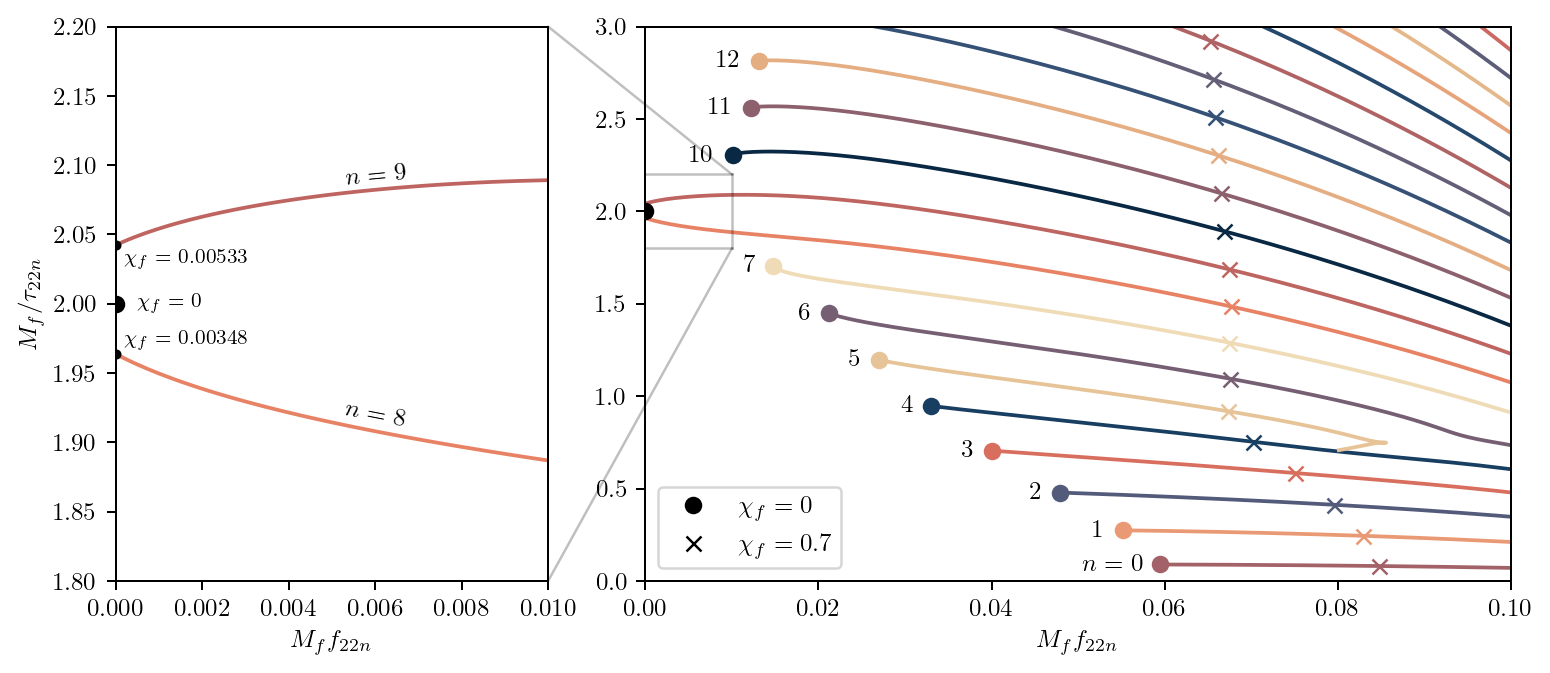
This has led to these two branches being labelled as $(2,2,8_0)$ and $(2,2,8_1)$ by Cook & Zalutskiy (arxiv:1607.07406). However, from a practical perspective we will be mostly working with Kerr black holes, and these two branches behave as a $n=8$ and $n=9$ overtone. So, as indicated by the figure above, we label them as such (this follows the convention of Forteza & Mourier (arXiv:2107.11829)).
Usage
Perform a seven-overtone fit to the (2,2) mode of SXS:BBH_ExtCCE:0001:
import numpy as np
import qnmfits

# Download SXS:BBH_ExtCCE:0001
abd = qnmfits.cce.load(1)

# Transform to the superrest frame. First, shift the times for convenience:
h22 = abd.h.data[:, abd.h.index(2, 2)]
abd.t -= abd.t[np.argmax(np.abs(h22))]

# Map to the superrest frame
abd_prime = qnmfits.utils.to_superrest_frame(abd, t0=300)

# Get the strain and remnant mass and spin
h = abd_prime.h
Mf = abd_prime.bondi_rest_mass()[-1]
chif = np.linalg.norm(abd_prime.bondi_dimensionless_spin()[-1])

# QNMs we want to fit for. The format is (ell, m, n, sign), where sign is +1
# for "regular" (positive real part) modes, and -1 is for "mirror" (negative
# real part) modes.
qnms = [(2, 2, n, 1) for n in range(7+1)]

# Spherical modes we want to fit to. The format is (ell, m).
spherical_modes = [(2, 2)]

# Ringdown start time
t0 = 0.

# Perform the fit
best_fit = qnmfits.fit(
    data=h,
    chif=chif,
    Mf=Mf,
    qnms=qnms,
    spherical_modes=spherical_modes,
    t0=t0
)

print(f"Mismatch = {best_fit['mismatch']}")
The mismatch should be of order 1E-7.
Please see the notebooks in examples for additional code usage.
Contributing
Contributions are welcome! There are at least two ways to contribute to this codebase:
- If you find a bug or want to suggest an enhancement, use the issue tracker on GitHub. It's a good idea to look through past issues, too, to see if anybody has run into the same problem or made the same suggestion before.
- If you will write or edit the python code, we use the fork and pull request model.
You are also allowed to make use of this code for other purposes, as detailed in the MIT license. For any type of contribution, please follow the code of conduct.
Credits
The code is developed and maintained by Lorena Magaña Zertuche and Eliot Finch.
2 maintainers


Metadata
2 maintainers
Release files for qnmfits 2025.3.1
For a detailed explanation of source distributions (sdists) and built distributions (wheels), please see the package formats documentation.
Source distribution (sdist)
| File | Size | Uploaded | Provenance | Actions |
|---|---|---|---|---|
| qnmfits-2025.3.1.tar.gz | 872.4 kB | With provenance | Details for qnmfits-2025.3.1.tar.gz |
Built distribution (wheel)
| File | Interpreter | ABI | Platform | Actions Reset |
|---|---|---|---|---|
| qnmfits-2025.3.1-py2.py3-none-any.whl | Python 2, Python 3 | none | any | Details for qnmfits-2025.3.1-py2.py3-none-any.whl |
Total release size: 892.1 kB
Release files / qnmfits-2025.3.1.tar.gz
| Download URL | qnmfits-2025.3.1.tar.gz |
|---|---|
| Size | 872.4 kB |
| Tags | Source |
|
SHA-256 checksum How to use checksums |
7d384e57915e7776c3f2e093c14039a8d3a457d22e7174f28ee8ac15404b5a4e
|
|
BLAKE2b-256 checksum How to use checksums |
46e9123f1e9c5ac29834b1201526ed2fd71f3728257213f19a06dc8adf327ef2
|
| Upload date | |
|
Uploaded using Trusted Publishing? What is trusted publishing? |
Yes |
| Uploaded via |
twine/6.1.0 CPython/3.12.9
|
Provenance
Provenance describes where a file came from. On PyPI, provenance is shared via attestations, which provide a verifiable record of the build or publishing details. View details, limitations and caveats.


PyPI Publish Attestation
PyPI verified that this artifact, at this checksum, originated from the publisher listed below.
Signed by GitHub Actions, verified by PyPI on Jul 10, 2025.
Transparency logRelease files / qnmfits-2025.3.1-py2.py3-none-any.whl
| Download URL | qnmfits-2025.3.1-py2.py3-none-any.whl |
|---|---|
| Size | 19.8 kB |
| Tags | Python 2 Python 3 |
|
SHA-256 checksum How to use checksums |
3f89f1d17142bc5133e128ca045a8597fa957a29f9aa7afb239c6e771674327f
|
|
BLAKE2b-256 checksum How to use checksums |
19842f04fda761d42bfb5251979a399071a595e665175e728f4c3d47537832b2
|
| Upload date | |
|
Uploaded using Trusted Publishing? What is trusted publishing? |
Yes |
| Uploaded via |
twine/6.1.0 CPython/3.12.9
|
Provenance
Provenance describes where a file came from. On PyPI, provenance is shared via attestations, which provide a verifiable record of the build or publishing details. View details, limitations and caveats.
PyPI Publish Attestation
PyPI verified that this artifact, at this checksum, originated from the publisher listed below.
Signed by GitHub Actions, verified by PyPI on Jul 10, 2025.
Transparency logSecurity for qnmfits 2025.3.1
Provenance
Provenance describes where a file came from. On PyPI, provenance is shared via attestations, which provide a verifiable record of the build or publishing details. View details, limitations and caveats.
Full provenance
All 2 files in this release have been uploaded with provenance metadata.
Attestation for qnmfits-2025.3.1.tar.gz
PyPI Publish Attestation
PyPI verified that this artifact, at this checksum, originated from the publisher listed below.
Signed by GitHub Actions, verified by PyPI on Jul 10, 2025.
Transparency logA note on package security
PyPI is a repository for distributing packages, not a service for auditing them. While third-party security researchers and our staff do their best to detect and remove malicious packages, PyPI cannot guarantee the quality, security or suitability of any given package.
To learn more about protecting yourself from malicious actors, visit our package security documentation.














