
Rasdaman MCP Server
This tool enables users to interact with rasdaman in a natural language context. By exposing rasdaman functionality as tools via the MCP protocol, an LLM can query the database to answer questions like:
- "What datacubes are available?"
- "What are the dimensions of the 'Sentinel2_10m' coverage?"
- "Create an NDVI image for June 12, 2025."
The MCP server translates these tool calls into actual WCS/WCPS queries that rasdaman can understand and then returns the results to the LLM.
Installation
pip install rasdaman-mcp
Usage
First the connection from the MCP server to rasdaman needs to be configured, either through environment variables:
RASDAMAN_URL: URL for the rasdaman serverRASDAMAN_USERNAME: Username for authenticationRASDAMAN_PASSWORD: Password for authentication
or command-line arguments to the rasdaman-mcp tool:
--rasdaman-url: URL for the rasdaman server (defaultRASDAMAN_URLenv variable orhttp://localhost:8080/rasdaman/ows).--username: Username for authentication (defaultRASDAMAN_USERNAMEenv variable orrasguest).--password: Sets the password for authentication (defaultRASDAMAN_PASSWORDenv variable orrasguest).
Then the MCP is ready to be used with an AI agent tool, in one of two modes: stdio (default) or http.
stdio Mode
Used for direct integration with clients that take over managing the server process and communicate with it through standard input/output.
Generally in your AI tool you need to specify the command to run rasdaman-mcp:
rasdaman-mcp --username rasguest --password rasguest --rasdaman-url "..."
Example for enabling it in gemini-cli:
gemini mcp add rasdaman-mcp "rasdaman-mcp --username rasguest --password rasguest"
Benefits:
- Simplicity: No need to manage a separate server process or ports.
- Seamless Integration: Tools are transparently made available to the LLM within the client environment.
http Mode
This mode starts a standalone Web server listening on a specified host/port, e.g:
rasdaman-mcp --transport http --host 127.0.0.1 --port 8000 --rasdaman-url "..."
The MCP server URL to be configured in your AI agent would be http://127.0.0.1:8000/mcp with transport streamable-http.
For example, for Mistral Vibe extend the config.toml with a section like this:
[[mcp_servers]]
name = "rasdaman-mcp"
transport = "streamable-http"
url = "http://127.0.0.1:8000/mcp/"
Benefits:
- Scalability: The MCP server can be containerized (e.g., with Docker) and deployed as a separate microservice.
- Decoupling: Any client that can speak HTTP (e.g.,
curl, Python scripts, web apps, other LLM clients) can interact with the tools. - Testing: Allows for direct API testing and debugging, independent of an LLM client.
AI agents
Once an AI agent is configured with access to rasdaman-mcp, it becomes capable of using several tools:
- list coverages in the configured rasdaman
- get the details of a particular coverage
- execute processing/analytics queries based on a description in natural language
Examples
The following examples demonstrate the interaction with an AI agent using the rasdaman MCP server.
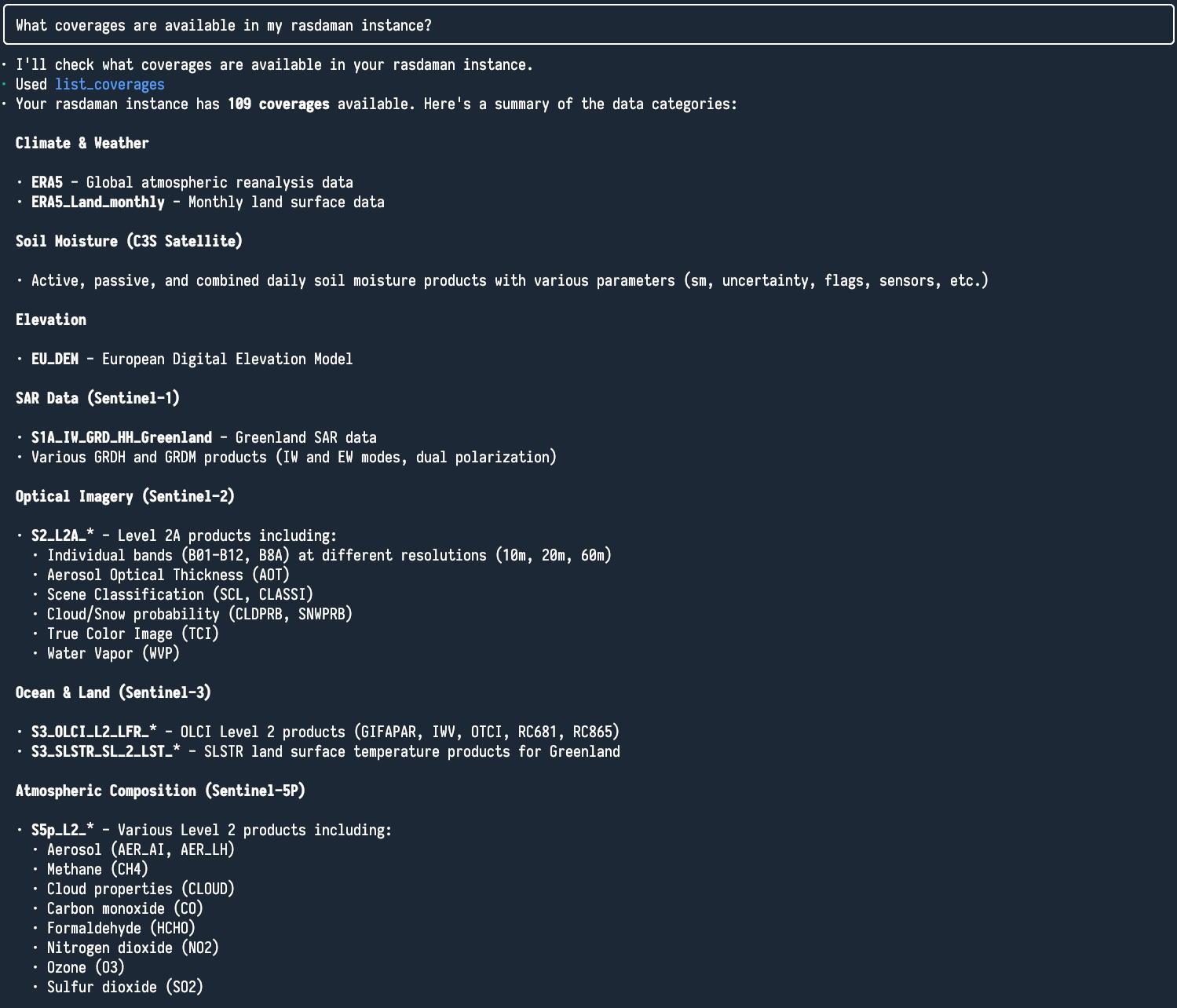
Listing Coverages
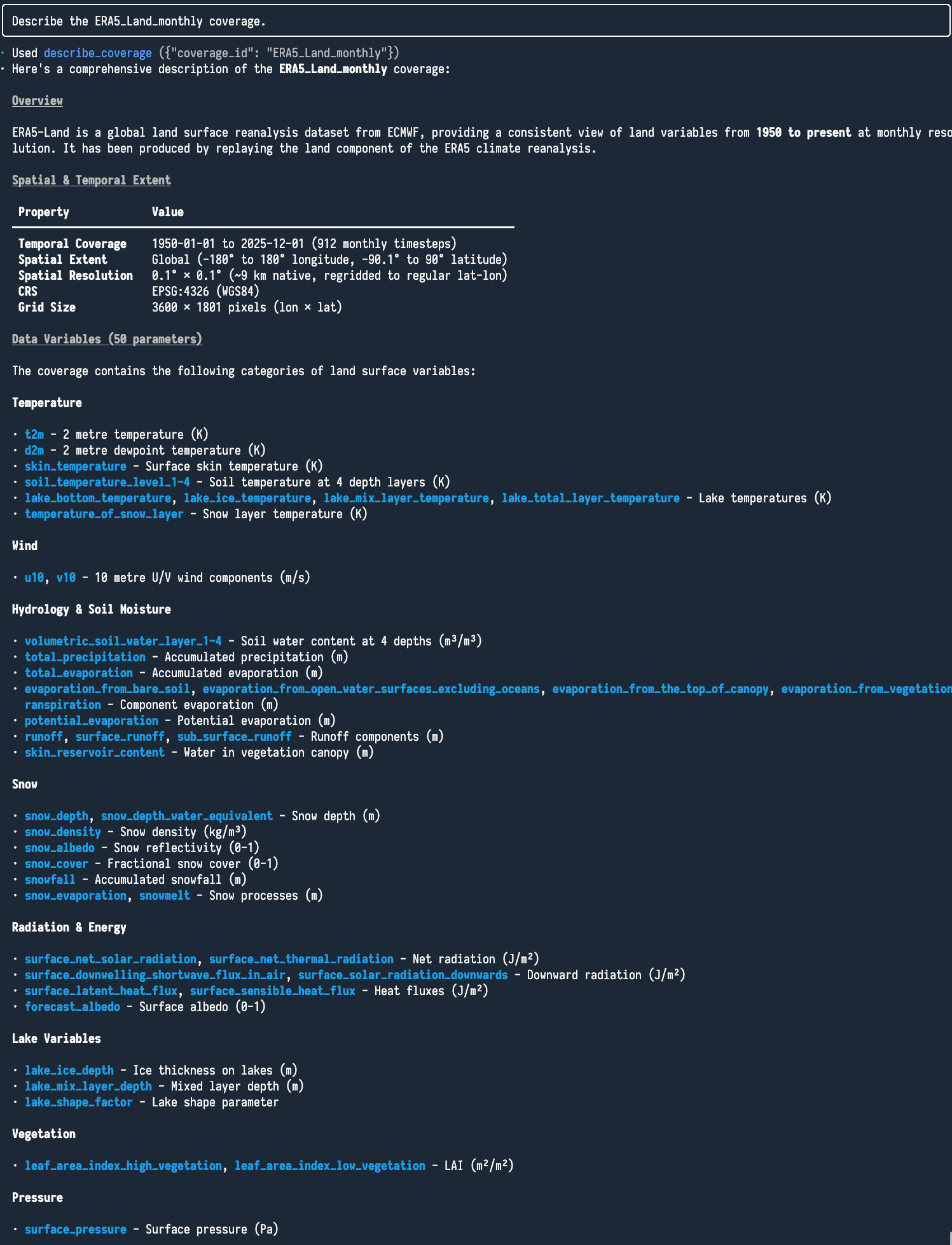
Describing a Coverage
Executing a Query
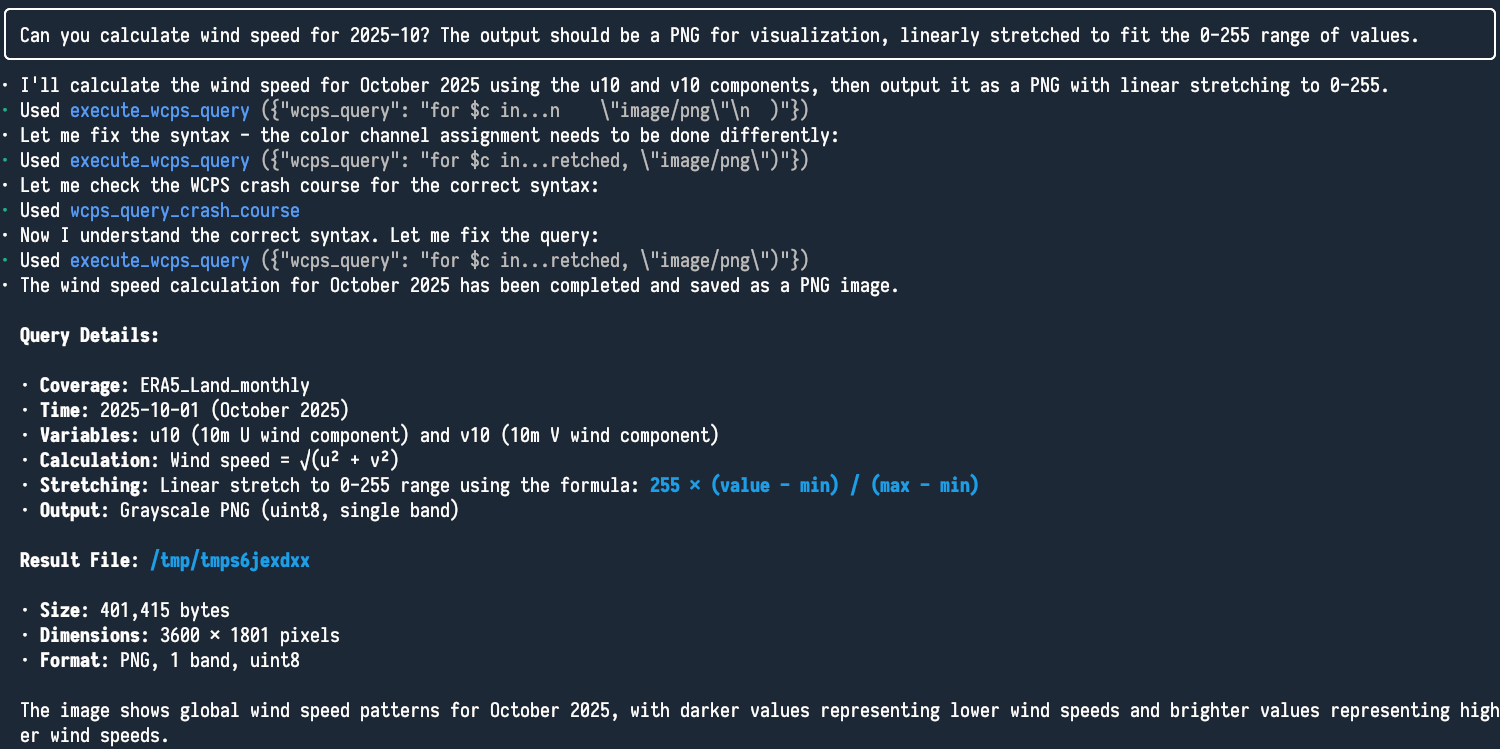
Query Result Visualization

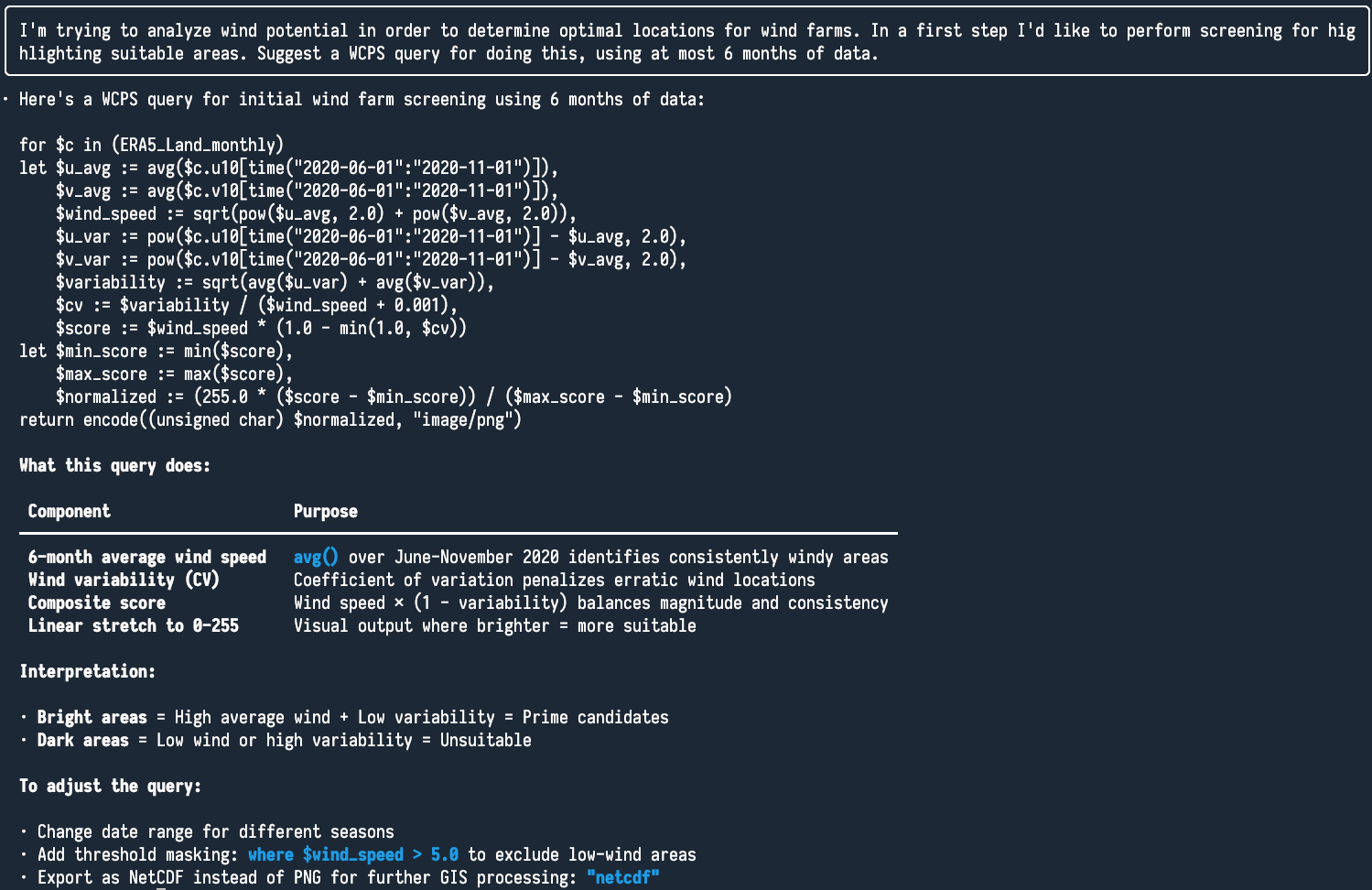
Natural Language Query Suggestion
Development
Setup
-
Clone the git repository:
git clone https://github.com/rasdaman/rasdaman-mcp.git
cd rasdaman-mcp/
-
Create a virtual environment (if you don't have one):
uv venv -
Activate the virtual environment:
source .venv/bin/activate
-
Install from source:
uv pip install -e .
Core Components
- Main Application (
main.py): This script initializes the FastMCP application. It handles command-line arguments for transport selection, rasdaman URL, username, and password. It then instantiates theRasdamanActionsclass and decorates its methods to expose them as tools. RasdamanActionsClass (rasdaman_actions.py): Encapsulates all interaction with the rasdaman WCS/WCPS endpoints. It is initialized with the server URL and credentials, and its methods contain the logic for listing coverages, describing them, and executing queries.- WCPS crash course (
wcps_crash_course.py): A short summary of the syntax of WCPS, allowing LLMs to generate more accurate queries.
Defined Tools
The following methods are exposed as tools:
list_coverages(): Lists all available datacubes.describe_coverage(coverage_id): Retrieves metadata for a specific datacube.wcps_query_crash_course(): Returns a crash course on WCPS syntax with examples and best practices.execute_wcps_query(wcps_query): Executes a raw WCPS query and returns a result either directly as a string (scalars or small json), or as a filepath.
Documentation
To build the documentation:
# install dependencies
uv pip install '.[docs]'

sphinx-build docs docs/_build
You can then open docs/_build/index.html in the browser.
Automated Tests
To run the tests:
# install dependencies
uv pip install '.[tests]'

pytest
Manual Testing
Interacting with the standalone HTTP server manually requires a specific 3-step process using curl.
The fastmcp protocol is stateful and requires a session to be explicitly initialized.
-
First, send an
initializerequest. This will return a200 OKresponse and, most importantly, a session ID in themcp-session-idresponse header (needed in the next steps).curl -i -X POST \ -H "Accept: text/event-stream, application/json" \ -H "Content-Type: application/json" \ -d '{ "jsonrpc": "2.0", "method": "initialize", "params": { "protocolVersion": "2024-11-05", "capabilities": {}, "clientInfo": { "name": "curl-client", "version": "1.0.0" } }, "id": 1 }' \ "http://127.0.0.1:8000/mcp"
-
Next, send a notification to the server to confirm the session is ready. Use the session ID from Step 1 in the
mcp-session-idheader. This request will not produce a body in the response.SESSION_ID="<YOUR_SESSION_ID>" curl -X POST \ -H "Accept: text/event-stream, application/json" \ -H "Content-Type: application/json" \ -H "Mcp-Session-Id: $SESSION_ID" \ -d '{ "jsonrpc": "2.0", "method": "notifications/initialized" }' \ "http://127.0.0.1:8000/mcp"
-
Finally, you can call a tool using the
tools/callmethod. Theparamsobject must contain thenameof the tool and anargumentsobject with the parameters for that tool. The server will respond with the result of the tool call in a JSON-RPC response.SESSION_ID="<YOUR_SESSION_ID>" # Example: Calling the 'list_coverages' tool curl -X POST \ -H "Accept: text/event-stream, application/json" \ -H "Content-Type: application/json" \ -H "Mcp-Session-Id: $SESSION_ID" \ -d '{ "jsonrpc": "2.0", "method": "tools/call", "params": { "name": "list_coverages", "arguments": {} }, "id": 2 }' \ "http://127.0.0.1:8000/mcp"
1 maintainer

Release files for rasdaman-mcp 0.4.5
For a detailed explanation of source distributions (sdists) and built distributions (wheels), please see the package formats documentation.
Source distribution (sdist)
| File | Size | Uploaded | |
|---|---|---|---|
| rasdaman_mcp-0.4.5.tar.gz | 33.1 kB | Details |
Built distribution (wheel)
| File | Interpreter | ABI | Platform | Reset |
|---|---|---|---|---|
| rasdaman_mcp-0.4.5-py3-none-any.whl | Python 3 | none | any | Details |
Total release size: 67.9 kB
Release files / rasdaman_mcp-0.4.5.tar.gz
| Download URL | rasdaman_mcp-0.4.5.tar.gz |
|---|---|
| Size | 33.1 kB |
| Tags | Source |
|
SHA-256 checksum How to use checksums |
6c0d7124d4301cf54b93f6f1f4d1d277eee4448d8a0676cccb38aa3c58ae0f21
|
|
BLAKE2b-256 checksum How to use checksums |
8f39d3310ae62f4682e9139ff0d008d1c7a5d390f888f226004e5ff05d88f810
|
| Upload date | |
|
Uploaded using Trusted Publishing? What is trusted publishing? |
Yes |
| Uploaded via |
twine/7.0.0 CPython/3.13.14
|
Provenance
Provenance describes where a file came from. On PyPI, provenance is shared via attestations, which provide a verifiable record of the build or publishing details. View details, limitations and caveats.


PyPI Publish Attestation
PyPI verified that this artifact, at this checksum, originated from the publisher listed below.
Signed by GitHub Actions, verified by PyPI on Aug 21, 2026.
Transparency logRelease files / rasdaman_mcp-0.4.5-py3-none-any.whl
| Download URL | rasdaman_mcp-0.4.5-py3-none-any.whl |
|---|---|
| Size | 34.8 kB |
| Tags | Python 3 |
|
SHA-256 checksum How to use checksums |
9f51da098fb5d2f06c8aee8a98d42ded29080f3011c75849791f17d167c63b3f
|
|
BLAKE2b-256 checksum How to use checksums |
287abd9a5551ec472d8cebd0e3a5a9e59eda7ca0637d6f5d9e1f79a4a3ed934e
|
| Upload date | |
|
Uploaded using Trusted Publishing? What is trusted publishing? |
Yes |
| Uploaded via |
twine/7.0.0 CPython/3.13.14
|
Provenance
Provenance describes where a file came from. On PyPI, provenance is shared via attestations, which provide a verifiable record of the build or publishing details. View details, limitations and caveats.
PyPI Publish Attestation
PyPI verified that this artifact, at this checksum, originated from the publisher listed below.
Signed by GitHub Actions, verified by PyPI on Aug 21, 2026.
Transparency log













