
Reasoning-aware context runtime for RAG — chunk, retrieve, and allocate the document context an LLM should see, with citations and a Decision Report. In-process, no vector DB.
Verified details
These details have been verified by PyPIProject links
GitHub Statistics
Maintainers

Project description
RedHop
A reasoning-preserving context runtime for RAG.




Hand it a document and a question. RedHop chunks, retrieves, and allocates the context your model should actually see — then tells you what it kept, what it dropped, and why, with citations back to the source. No vector database, no LLM, all in-process.
Get started in 60 seconds
pip install redhop
import redhop

doc = redhop.Document.from_file("contract.pdf")    # parses + chunks + indexes
ctx = doc.context("What is the governing law?")    # retrieves + assembles
answer = llm.generate(ctx.text())                  # any LLM — no lock-in
That's it. ctx.citations tells you where the answer came from;
ctx.report explains what was kept, dropped, and why.
How it compares
Measured on identical documents + budgets + BM25 retrieval, RedHop beats both frameworks on multi-hop evidence retention (80% vs LangChain 71%, LlamaIndex 72%) and beats LangChain on contracts (82% vs 73%). On CUAD's raw-template query LlamaIndex leads by 4 (LlamaIndex 86% vs RedHop 82% ≥0.8 retention).
Honest fair-preprocessing result (bench/compare.py, n=300, 2026-06-08):
applying Stripper(boilerplate) to every system's query lifts everyone:
LlamaIndex 86% → 94%, RedHop 82% → 88%, LangChain 73% → 79%. LlamaIndex
actually benefits more from the same Stripper than RedHop does. RedHop
reaches 90.7% by additionally layering a hand-authored 34-key
clause-name Vocabulary on top — but that recipe was not applied to
LlamaIndex, and the +4.7 framing previously reported here is RedHop-with-
recipe vs LlamaIndex-default, not a like-for-like comparison.
RedHop's clearer architectural lead is multi-hop retention, replicated on
two datasets at n=300: HotpotQA ≥0.8 retention 80% vs LlamaIndex 72%, LangChain
71% (+8); MuSiQue ≥0.8 retention 22% vs LlamaIndex 17%, LangChain 19% (+3 to
+5) — compositional multi-hop is harder, the magnitude shrinks but the lead
holds at the ≥0.8 threshold. raw_topk matches reasoning_preserving on both,
so the edge is RedHop's chunking + BM25 defaults rather than the assembly
strategy.
Push multi-hop further with retrieval="hybrid": measured +12 ≥0.8 on
HotpotQA (71% → 83%) and +8 ≥0.5 on MuSiQue (66% → 74%) at n=100, at
~90-120× per-query latency (3ms → 250-400ms). Stripper and candidate_k tuning
don't help on multi-hop — only dense rerank pierces the lexical-vs-semantic
gap on bridge passages.
Apples-to-apples hybrid vs LangChain/LlamaIndex (same bge-small, n=100, post pure-rerank fix): HotpotQA — RedHop hybrid wins (81% ≥0.8 vs LangChain 77%, LlamaIndex 67%). MuSiQue — LangChain leads narrowly (39% vs RedHop 34%, LlamaIndex 31%). The 0.3.1 audit traced the MuSiQue gap to RedHop's RRF fusion burying bridge passages with low BM25 + high dense rank; this release switches the default to pure rerank. Net: HotpotQA −2, MuSiQue +8 (close to predicted +10). Latency profile (2-5× slower than competitors' hybrid) is a separate open item. See MULTIHOP_HYBRID_COMPETITORS.md
What RedHop's CUAD recipe offers is a reproducible, in-process, audited path
from 82% → 87.7% → 90.7% using Stripper + Vocabulary with a Decision
Report — the primitives are reusable on any templated workload. See
CUAD_CLAUSE_EXPANSION.md,
MUSIQUE_MULTIHOP.md,
and MULTIHOP_HYBRID.md.
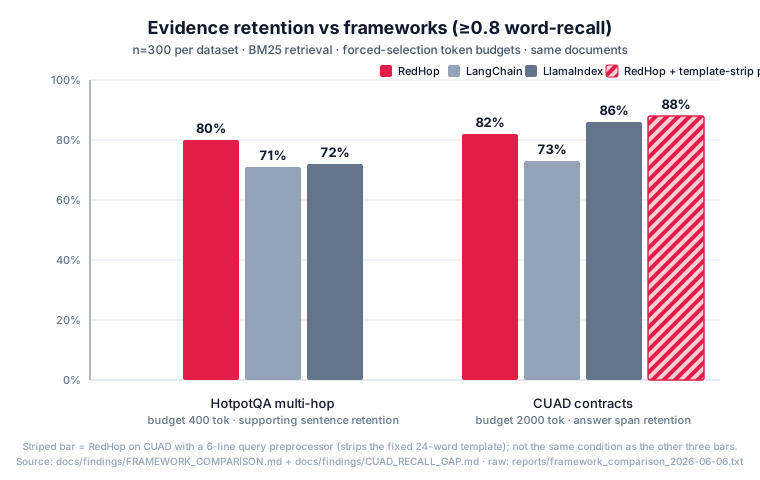
Methodology + raw runs: FRAMEWORK_COMPARISON.md · framework_comparison_2026-06-06.txt.
How it works
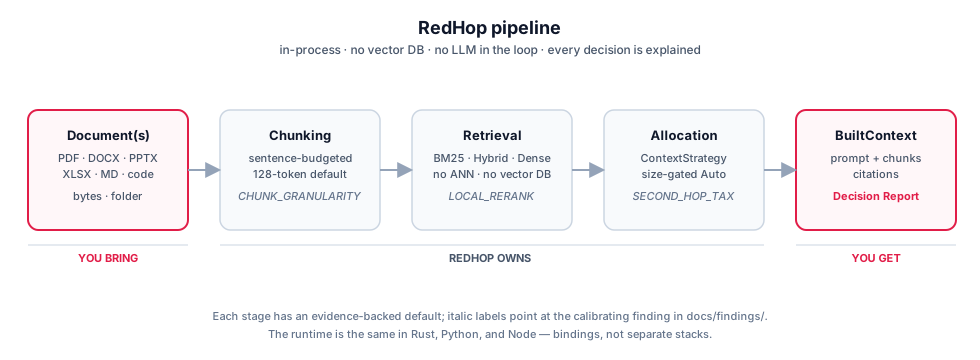
Five stages: you bring documents and a query, RedHop owns parsing, chunking,
retrieval, and context allocation, and you get a BuiltContext with the
assembled prompt, citations, and a Decision Report. Each stage has an
evidence-backed default that traces to a finding in
docs/findings/.
The idea
Retrieval quality is not the same as reasoning quality. Transformers tolerate irrelevant context far better than they tolerate missing reasoning links — so the chunk a multi-hop answer depends on is often low-relevance to the query and gets silently pruned. RedHop's default keeps it, and makes the trade-off visible. It is not a retriever, vector database, agent framework, or workflow engine — it does one thing: turn a document and a query into the right prompt context, and explain the decision.
It explains every decision
Every call returns a Decision Report — what it kept, what it dropped, and why, including when it deliberately leaves a small context untouched.
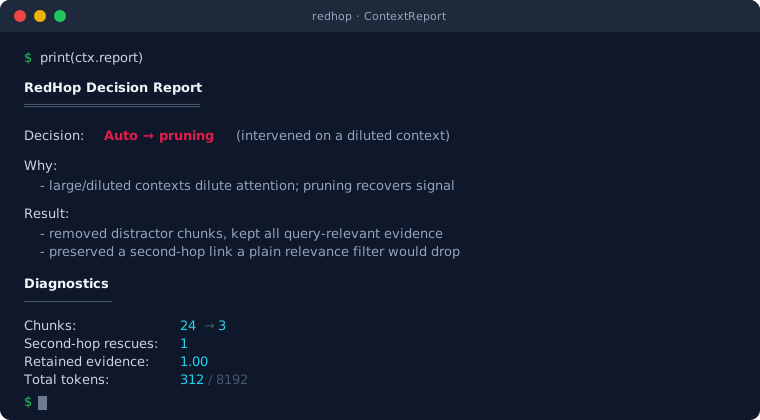
Read the fields directly via ctx.report.auto_decision, total_tokens,
retained_evidence_ratio, or call doc.analyze(query) for the report without
assembling a context.
Cite the evidence
Every selected chunk remembers where it came from:
for c in ctx.citations:
    print(c["source"], c["page"], c["heading"])
    # contract.pdf  3     None      ->  "contract.pdf, p.3"
    # notes.md      None  "Refunds" ->  "notes.md -> Refunds"
Show your work — query rewrites with an audit trail
Every transformation between the raw query and what BM25 actually saw is
recorded on the same Decision Report. Compile a Stripper (boilerplate
removal), a Vocabulary (workload-curated synonyms), or both, run them as
a chain via doc.context_with_rewrites(...), and the per-stage records
land on ctx.report.query_rewrites:
stripper = redhop.Stripper(["highlight", "the", "parts", "of", "this", "contract"])
vocab    = redhop.Vocabulary({"change of control": ["merger", "successor", "acquisition"]})

ctx = doc.context_with_rewrites(query, [stripper, vocab])

for rec in ctx.report.query_rewrites:
    print(rec.stage, "matched=", rec.matched, "added=", rec.added)
The same Vocabulary works chunk-side at ingest via vocab.enrich(chunk_text)
— lifts retrieval +0.19 mean recall on schema-style corpora
(SPIDER_ENRICH);
measured to hurt (−2.0pt) on long prose chunks
(CUAD_ENRICH_DEFINITIONS_NULL).
A/B with redhop.evaluate(...) to confirm before adopting.
Score the change — deterministic, or LLM-judged when you need it
redhop.evaluate(...) runs in two modes. Use deterministic in CI on
every PR; opt into a judge when you want faithfulness / relevancy /
correctness against generated answers.
Deterministic — no API calls, ~ms per query. Returns
context_recall / context_precision / answer_token_recall /
faithfulness_lexical / relevancy_lexical / correctness_lexical
- a composite
overall. Same primitives the Decision Report uses.
ctx_a = doc.context(user_query)
ctx_b = doc.context_with_rewrites(user_query, [stripper, vocab])
eval_a = redhop.evaluate(user_query, ctx_a, gold_chunks=gold_ids)
eval_b = redhop.evaluate(user_query, ctx_b, gold_chunks=gold_ids)
print("lift on overall:", eval_b.overall - eval_a.overall)
LLM-judged — pass judge= plus your own LLM caller (OpenAI,
Anthropic, OpenRouter, local). Adds faithfulness_judged /
relevancy_judged / correctness_judged to the same report.
Claim-decomposed faithfulness (decompose_faithfulness=True) is
substantively equivalent to Ragas — r=+0.664, MAE=0.151 on n=200
HotpotQA, see COMPARISON_RAGAS.
TP/FP/FN F₁ via decompose_correctness=True.
def my_llm(prompt, system):
    # Your LLM SDK call — return a float or {"score": float}.
    return float(openai_client.chat.completions.create(...).choices[0].message.content)

judge = redhop.Judge.from_callable(my_llm).cached()
report = redhop.evaluate(
    user_query, ctx,
    answer="The refund window is thirty days.",
    gold_answer="thirty days",
    judge=judge,
    decompose_faithfulness=True,
    decompose_correctness=True,
)
For user-defined aspects (harmfulness, conciseness, brand voice…),
redhop.critique(answer, aspects=[...], judge=...) runs one judge
call per aspect with polarity-corrected scores. Aggregate test sets
with redhop.summarize(reports).
Full API + field list: ANSWER_QUALITY_EVAL.
Loading documents
| On-ramp | For |
|---|---|
Document.from_text(text, source="document") |
text you already have |
Document.from_chunks([redhop.Chunk(...), ...]) |
content you already chunked — pass typed redhop.Chunk(text, source=..., id=..., metadata={...}) instances |
Document.from_file("x.pdf") |
a file — PDF, DOCX, PPTX, XLSX, Markdown, or text/code |
Document.from_bytes(data, source="x.pdf") |
bytes you fetched (S3 / GCS / HTTP / DB) |
Document.from_folder("./docs", persist=True) |
a whole directory, with an optional incremental on-disk index |
Retrieval tiers — no vector database
Start at the lexical default — it handles most document QA because the words in the question are usually the words in the answer — and climb only when the failure shape calls for it. All in-process, no ANN, no index server.
# Default — most docs (code, API refs, runbooks, financial reports, handbooks)
doc = redhop.Document.from_file("contract.pdf")
ctx = doc.context("What is the governing law?")

# Structured docs with parallel clauses (regional overrides, per-region sub-sections):
doc = redhop.Document.from_file("msa.pdf", retrieval="hybrid", model="bge-small")
ctx = doc.context("What law applies in the UK?", include_heading=True, neighbors=1)

# Synonym-mismatch corpora (HR FAQs, support tickets where users phrase
# things very differently from the docs). Cross-encoder adds 5–10× latency
# — verify it helps on your corpus before enabling.
doc = redhop.Document.from_file("support.md",
    retrieval="hybrid", model="bge-small", rerank="cross-encoder")
The 60-second decision guide with trade-offs and query-writing tips: CHOOSING_A_CONFIG.
Non-English content
Default is a minimal analyzer (tokenize + lowercase + ASCII fold; no
stemmer) — measured to beat English Snowball on every English workload
we tested (RAW_ANALYZER).
Swap with the language= kwarg — "english" for code search /
inflection-heavy English content, or any of the 18 Snowball Porter2
languages (arabic, danish, dutch, english, finnish, french, german, greek, hungarian, italian, norwegian, portuguese, romanian, russian, spanish, swedish, tamil, turkish):
doc = redhop.Document.from_text(german_text, language="german")
# Now `Buch` finds chunks containing `Bücher` (and vice versa)
One analyzer drives both BM25 retrieval AND the grounding scorer, so they can't drift on what "the same term" means. Unknown names raise (we don't silently fall back to English). See the language guide for the full breakdown and the calibration disclaimer (we ship the stemmers; eval-corpus ranking quality on a real domain corpus is the user's call).
Assembly strategies
strategy= |
What it does |
|---|---|
reasoning_preserving (default) |
keep query-relevant seeds and rescue low-relevance chunks linked to one; drop only unlinked junk |
distractor_filtered |
drop everything below a query-grounding bar |
max_density |
greedily pack the densest chunks into the budget |
raw_topk |
keep retrieval order until the budget fills |
auto |
size-gated: pass small contexts through, prune large/diluted ones |
Already have chunks from your own retriever? Wrap each as redhop.Chunk(text, source=..., id=..., metadata={...}) and pass into
redhop.build_context(query, retrieved_chunks=chunks, ...) (low-level) or
redhop.Document.from_chunks(chunks) (full indexing).
Templated workloads — the +9 retention lift (BM25, no model needed)
If every query in your workload follows a fixed template — legal QA ("Highlight the parts (if any) of this contract related to X. Details: …"), support-ticket triage ("Help me with X, my account is Y, the error is Z"), form-filled queries from a structured UI — BM25 weights every query term by corpus IDF, not by how often the term repeats across your query set. The boilerplate words dilute the real signal words, and retention suffers. This is the mechanism behind the 4-point CUAD gap on the head-to-head; closing it doesn't need a vector DB or a different retriever — it needs two small preprocessing helpers on the query side.
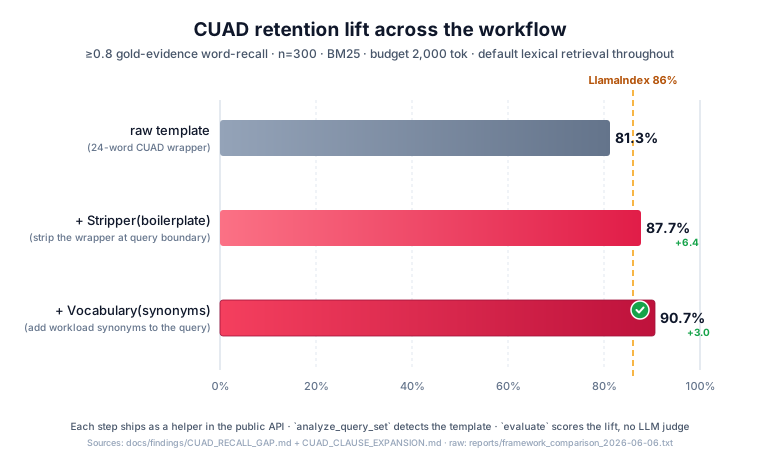
Measured on the CUAD framework comparison (n=300, BM25, budget 2,000 tok):
| step | helper | retention | Δ |
|---|---|---|---|
| raw 24-word template | — | 81.3% | — |
| + strip the wrapper | Stripper |
87.7% | +6.4 |
| + add workload synonyms | Vocabulary |
90.7% | +3.0 |
RedHop with the full workflow is at 90.7% — beating LlamaIndex by 4 points on the same setup, at native BM25 latency (~2.5ms/query). Mechanism + worked clause dict: CUAD_CLAUSE_EXPANSION.md.
Recommended workflow: detect → strip → (optional) expand → A/B. The
rewrite chain runs inside Document.context_with_rewrites(...) so each
stage's audit trail lands on report.query_rewrites automatically.
import redhop

# 1 — Detect. Hand a representative sample of your queries to the analyzer.
report = redhop.analyze_query_set(my_queries[:300])
# report.is_templated            → True / False
# report.template_word_share     → e.g. 0.66 on CUAD
# report.boilerplate_terms       → ["highlight", "contract", "lawyer", …]
# report.estimated_dilution_cost → "high" | "medium" | "low" | "none"

if report.is_templated:
    # 2 — Compile the rewrite chain.
    stripper = redhop.Stripper(report.boilerplate_terms)

    # 3 — (optional) Vocabulary. If your workload has known topic synonyms
    #     (clause types, error codes), compile them once.
    vocab = redhop.Vocabulary({
        # YOUR keys → synonyms; CUAD worked example in CUAD_CLAUSE_EXPANSION.md
        "change of control": ["merger", "successor", "acquisition"],
    })

    # 4 — Run the chain through retrieval; audit lands on report.query_rewrites.
    doc = redhop.Document.from_file("contract.pdf")
    ctx_a = doc.context(user_query)                              # baseline
    ctx_b = doc.context_with_rewrites(user_query, [stripper, vocab])
    eval_a = redhop.evaluate(user_query, ctx_a, gold_chunks=gold_ids)
    eval_b = redhop.evaluate(user_query, ctx_b, gold_chunks=gold_ids)
    print(eval_b.overall - eval_a.overall)   # the lift, deterministically
- Only matters if your queries are templated.
analyze_query_setis conservative by design — HotpotQA and MuSiQue both register quiet (is_templated=False) in the cross-workload probe; CUAD fires. If yours doesn't fire, skip this section. - The analyzer measures the shape of your query set, not your retention. It says "this looks like a templated workload" with the boilerplate terms it found; it does not promise a specific lift. Always A/B on your gold-evidence sample before committing.
- For single-doc extraction workloads also set
strategy="raw_topk".autoroutes large contexts toreasoning_preserving, which solves a multi-hop problem contract extraction doesn't have. RawTopK beats it by ~4 points at every chunk size on CUAD. - We deliberately don't ship a CUAD-specific
strip_template()helper. Templates are workload-specific; baking one in would make the wrong call for the next workload.Stripper(...)andVocabulary({...})take your boilerplate / synonym dict so the call stays on your side. - Or take the one-knob alternative —
retrieval="hybrid". Dense reads chunks as semantic content rather than counting tokens, so the boilerplate ratio stops mattering. Substitutes for stripping by a different mechanism (+5.3 on raw CUAD at ~10ms/query). On CUAD specifically, BM25 + strip + vocabulary still wins — 90.7% / 2.5ms vs hybrid+CE 89.0% / 683ms. The two paths are substitutes, not complements; pick one. See CUAD_HYBRID_RERANK.md.
| helper | what it does | finding |
|---|---|---|
analyze_query_set(queries) |
Inspects your queries; flags whether they're templated and which terms are doing the dilution | QUERY_SET_ANALYZER |
Stripper(boilerplate) |
Compiled token-level boilerplate strip; word-boundary safe (an "of" strip does not erase "of" inside "office"). Plugs into the rewrite chain so the audit trail is captured |
CUAD_RECALL_GAP · MULTILINGUAL_ANALYZER |
Vocabulary({key: [synonyms]}) |
Compiled workload-curated equivalence classes — appends high-IDF synonyms when the token-level key matches. Vocabulary.bidirectional({...}) for symmetric maps (PTO ↔ paid time off). Opposite mechanism to PRF (falsified) |
CUAD_CLAUSE_EXPANSION |
vocab.enrich(chunk_text) |
Chunk-side mirror. Measured to lift retrieval +0.19 mean recall on Spider-shape schemas — use it when your retrieval units are short and opaque (schema columns, error codes, API symbols, defined contract terms). Measured to hurt (−2.0pt) on long prose chunks — don't use it there. A/B with redhop.evaluate(...) against your gold before adopting |
SPIDER_ENRICH + VOCABULARY_ENRICH + CUAD_ENRICH_DEFINITIONS_NULL |
Document.context_with_rewrites(query, [stripper, vocab]) |
Runs the chain through retrieval; per-stage audit lands on report.query_rewrites |
(same finding as above) |
evaluate(query, ctx, gold_chunks=, gold_answer=, judge=, decompose_faithfulness=, decompose_correctness=) |
A/B scoring against gold. Deterministic-by-default (lexical, no LLM); opt-in judge= adds LLM-judged faithfulness/relevancy/correctness, with claim-decomposition and TP/FP/FN modes. Same primitives the Decision Report uses |
ANSWER_QUALITY_EVAL · COMPARISON_RAGAS |
critique(answer, aspects, judge=) |
LLM-judged scoring for user-defined dimensions (harmfulness, conciseness, brand voice…). One judge call per aspect; polarity-corrected so high = good | ANSWER_QUALITY_EVAL |
Decision rule + the recipe on the docs site: Choosing a configuration → "Templated queries with heavy boilerplate".
Documentation
Full docs, the comparison vs LangChain / LlamaIndex, and the evidence behind every default: https://www.redhopai.com
Apache-2.0. Also available for Node.js (npm install redhop) and Rust
(cargo add redhop).
Project details
Verified details
These details have been verified by PyPIProject links
GitHub Statistics
Maintainers
Release history Release notifications | RSS feed


Download files
Download the file for your platform. If you're not sure which to choose, learn more about installing packages.
Source Distribution
Built Distributions
Filter files by name, interpreter, ABI, and platform.
If you're not sure about the file name format, learn more about wheel file names.
Copy a direct link to the current filters
File details
Details for the file redhop-0.3.3.tar.gz.
File metadata
- Download URL: redhop-0.3.3.tar.gz
- Upload date:
- Size: 444.4 kB
- Tags: Source
- Uploaded using Trusted Publishing? Yes
- Uploaded via: twine/6.1.0 CPython/3.13.12
File hashes
| Algorithm | Hash digest | |
|---|---|---|
| SHA256 |
19e5d7623257dbff3114881687c7edc3b795cfb57684fc68642662b67dcab5aa
|
|
| MD5 |
af129eddab1fc549a0513eb7c1cf9206
|
|
| BLAKE2b-256 |
ecaea0c3c0238a7c9897ea4e65879a4e989bd083d4e47b4564dff9293c0cf021
|
Provenance
The following attestation bundles were made for redhop-0.3.3.tar.gz:
Publisher:
release-python.yml on vysakh0/redhop
-
Statement:
-
Statement type:
https://in-toto.io/Statement/v1 -
Predicate type:
https://docs.pypi.org/attestations/publish/v1 -
Subject name:
redhop-0.3.3.tar.gz -
Subject digest:
19e5d7623257dbff3114881687c7edc3b795cfb57684fc68642662b67dcab5aa - Sigstore transparency entry: 1766720144
- Sigstore integration time:
-
Permalink:
vysakh0/redhop@6707e20e41050feb4b4eb25eef3806fe3039d5a0 -
Branch / Tag:
refs/tags/v0.3.3 - Owner: https://github.com/vysakh0
-
Access:
public
-
Token Issuer:
https://token.actions.githubusercontent.com -
Runner Environment:
github-hosted -
Publication workflow:
release-python.yml@6707e20e41050feb4b4eb25eef3806fe3039d5a0 -
Trigger Event:
push
-
Statement type:
File details
Details for the file redhop-0.3.3-cp39-abi3-win_amd64.whl.
File metadata
- Download URL: redhop-0.3.3-cp39-abi3-win_amd64.whl
- Upload date:
- Size: 13.1 MB
- Tags: CPython 3.9+, Windows x86-64
- Uploaded using Trusted Publishing? Yes
- Uploaded via: twine/6.1.0 CPython/3.13.12
File hashes
| Algorithm | Hash digest | |
|---|---|---|
| SHA256 |
bd24b645e1575c9b1a5793e9e2c55334308a17081018110f0b083278725eae62
|
|
| MD5 |
fb7d4987f4839bfeb6c149a965bd0097
|
|
| BLAKE2b-256 |
c46036ae5d3a4790441cb4bfc9a3963ee9a2b90e8b59b144ca4a0b9b9b0f6e83
|
Provenance
The following attestation bundles were made for redhop-0.3.3-cp39-abi3-win_amd64.whl:
Publisher:
release-python.yml on vysakh0/redhop
-
Statement:
-
Statement type:
https://in-toto.io/Statement/v1 -
Predicate type:
https://docs.pypi.org/attestations/publish/v1 -
Subject name:
redhop-0.3.3-cp39-abi3-win_amd64.whl -
Subject digest:
bd24b645e1575c9b1a5793e9e2c55334308a17081018110f0b083278725eae62 - Sigstore transparency entry: 1766720974
- Sigstore integration time:
-
Permalink:
vysakh0/redhop@6707e20e41050feb4b4eb25eef3806fe3039d5a0 -
Branch / Tag:
refs/tags/v0.3.3 - Owner: https://github.com/vysakh0
-
Access:
public
-
Token Issuer:
https://token.actions.githubusercontent.com -
Runner Environment:
github-hosted -
Publication workflow:
release-python.yml@6707e20e41050feb4b4eb25eef3806fe3039d5a0 -
Trigger Event:
push
-
Statement type:
File details
Details for the file redhop-0.3.3-cp39-abi3-manylinux_2_28_x86_64.whl.
File metadata
- Download URL: redhop-0.3.3-cp39-abi3-manylinux_2_28_x86_64.whl
- Upload date:
- Size: 16.9 MB
- Tags: CPython 3.9+, manylinux: glibc 2.28+ x86-64
- Uploaded using Trusted Publishing? Yes
- Uploaded via: twine/6.1.0 CPython/3.13.12
File hashes
| Algorithm | Hash digest | |
|---|---|---|
| SHA256 |
f6f94a5a07d925f86046d5ef9b5a9bdc917065ceb06a0be6f4bb978d466acb42
|
|
| MD5 |
32fa23a32031cf78c3607bacc4087146
|
|
| BLAKE2b-256 |
ab013046b4f2fb0df132e4128da61eefe7cfc4b605fedc22e8f4628866822be8
|
Provenance
The following attestation bundles were made for redhop-0.3.3-cp39-abi3-manylinux_2_28_x86_64.whl:
Publisher:
release-python.yml on vysakh0/redhop
-
Statement:
-
Statement type:
https://in-toto.io/Statement/v1 -
Predicate type:
https://docs.pypi.org/attestations/publish/v1 -
Subject name:
redhop-0.3.3-cp39-abi3-manylinux_2_28_x86_64.whl -
Subject digest:
f6f94a5a07d925f86046d5ef9b5a9bdc917065ceb06a0be6f4bb978d466acb42 - Sigstore transparency entry: 1766720347
- Sigstore integration time:
-
Permalink:
vysakh0/redhop@6707e20e41050feb4b4eb25eef3806fe3039d5a0 -
Branch / Tag:
refs/tags/v0.3.3 - Owner: https://github.com/vysakh0
-
Access:
public
-
Token Issuer:
https://token.actions.githubusercontent.com -
Runner Environment:
github-hosted -
Publication workflow:
release-python.yml@6707e20e41050feb4b4eb25eef3806fe3039d5a0 -
Trigger Event:
push
-
Statement type:
File details
Details for the file redhop-0.3.3-cp39-abi3-manylinux_2_28_aarch64.whl.
File metadata
- Download URL: redhop-0.3.3-cp39-abi3-manylinux_2_28_aarch64.whl
- Upload date:
- Size: 16.6 MB
- Tags: CPython 3.9+, manylinux: glibc 2.28+ ARM64
- Uploaded using Trusted Publishing? Yes
- Uploaded via: twine/6.1.0 CPython/3.13.12
File hashes
| Algorithm | Hash digest | |
|---|---|---|
| SHA256 |
ba7ea162ddf6f78274dc236b55978ac1f2299318918bc36ebc2150742f693707
|
|
| MD5 |
08633f15f9ca2132b26b32b0f60ff6e6
|
|
| BLAKE2b-256 |
b7969eb6af8ee41058c7d6bbf8dbe35c3cfcecacc998e5a2584c76d64c414f50
|
Provenance
The following attestation bundles were made for redhop-0.3.3-cp39-abi3-manylinux_2_28_aarch64.whl:
Publisher:
release-python.yml on vysakh0/redhop
-
Statement:
-
Statement type:
https://in-toto.io/Statement/v1 -
Predicate type:
https://docs.pypi.org/attestations/publish/v1 -
Subject name:
redhop-0.3.3-cp39-abi3-manylinux_2_28_aarch64.whl -
Subject digest:
ba7ea162ddf6f78274dc236b55978ac1f2299318918bc36ebc2150742f693707 - Sigstore transparency entry: 1766720649
- Sigstore integration time:
-
Permalink:
vysakh0/redhop@6707e20e41050feb4b4eb25eef3806fe3039d5a0 -
Branch / Tag:
refs/tags/v0.3.3 - Owner: https://github.com/vysakh0
-
Access:
public
-
Token Issuer:
https://token.actions.githubusercontent.com -
Runner Environment:
github-hosted -
Publication workflow:
release-python.yml@6707e20e41050feb4b4eb25eef3806fe3039d5a0 -
Trigger Event:
push
-
Statement type:
File details
Details for the file redhop-0.3.3-cp39-abi3-macosx_11_0_arm64.whl.
File metadata
- Download URL: redhop-0.3.3-cp39-abi3-macosx_11_0_arm64.whl
- Upload date:
- Size: 14.1 MB
- Tags: CPython 3.9+, macOS 11.0+ ARM64
- Uploaded using Trusted Publishing? Yes
- Uploaded via: twine/6.1.0 CPython/3.13.12
File hashes
| Algorithm | Hash digest | |
|---|---|---|
| SHA256 |
c365a1d50aefc130e89dbace63ee22fef70597d8f42ae67c6e2fe739c649d904
|
|
| MD5 |
4cf88f3c2b4b21962cb72d9dbe0755c3
|
|
| BLAKE2b-256 |
362b06ef1478f69140d028167e9045c04468471cdb4d5aeb7ea3f6369cb8c0f7
|
Provenance
The following attestation bundles were made for redhop-0.3.3-cp39-abi3-macosx_11_0_arm64.whl:
Publisher:
release-python.yml on vysakh0/redhop
-
Statement:
-
Statement type:
https://in-toto.io/Statement/v1 -
Predicate type:
https://docs.pypi.org/attestations/publish/v1 -
Subject name:
redhop-0.3.3-cp39-abi3-macosx_11_0_arm64.whl -
Subject digest:
c365a1d50aefc130e89dbace63ee22fef70597d8f42ae67c6e2fe739c649d904 - Sigstore transparency entry: 1766720483
- Sigstore integration time:
-
Permalink:
vysakh0/redhop@6707e20e41050feb4b4eb25eef3806fe3039d5a0 -
Branch / Tag:
refs/tags/v0.3.3 - Owner: https://github.com/vysakh0
-
Access:
public
-
Token Issuer:
https://token.actions.githubusercontent.com -
Runner Environment:
github-hosted -
Publication workflow:
release-python.yml@6707e20e41050feb4b4eb25eef3806fe3039d5a0 -
Trigger Event:
push
-
Statement type:
File details
Details for the file redhop-0.3.3-cp39-abi3-macosx_10_12_x86_64.whl.
File metadata
- Download URL: redhop-0.3.3-cp39-abi3-macosx_10_12_x86_64.whl
- Upload date:
- Size: 15.5 MB
- Tags: CPython 3.9+, macOS 10.12+ x86-64
- Uploaded using Trusted Publishing? Yes
- Uploaded via: twine/6.1.0 CPython/3.13.12
File hashes
| Algorithm | Hash digest | |
|---|---|---|
| SHA256 |
20f6b0c0510e288807521a68c254b5cc5cc070bd5e7770008513f4994279254e
|
|
| MD5 |
67b74b622c0c28f8a933eb1710d455a0
|
|
| BLAKE2b-256 |
1895b1279b63bfc7e018cc5957395d90e9ed408b649745fec09d2faf6412b5cc
|
Provenance
The following attestation bundles were made for redhop-0.3.3-cp39-abi3-macosx_10_12_x86_64.whl:
Publisher:
release-python.yml on vysakh0/redhop
-
Statement:
-
Statement type:
https://in-toto.io/Statement/v1 -
Predicate type:
https://docs.pypi.org/attestations/publish/v1 -
Subject name:
redhop-0.3.3-cp39-abi3-macosx_10_12_x86_64.whl -
Subject digest:
20f6b0c0510e288807521a68c254b5cc5cc070bd5e7770008513f4994279254e - Sigstore transparency entry: 1766720779
- Sigstore integration time:
-
Permalink:
vysakh0/redhop@6707e20e41050feb4b4eb25eef3806fe3039d5a0 -
Branch / Tag:
refs/tags/v0.3.3 - Owner: https://github.com/vysakh0
-
Access:
public
-
Token Issuer:
https://token.actions.githubusercontent.com -
Runner Environment:
github-hosted -
Publication workflow:
release-python.yml@6707e20e41050feb4b4eb25eef3806fe3039d5a0 -
Trigger Event:
push
-
Statement type:






