
Regressionizer
Python package with a class that allows pipeline-like specification and execution of regression workflows.
Extensive guide is given in the Jupyter notebook "Rapid-specification-of-regression-workflows.ipynb" and the corresponding Markdown document "Rapid-specification-of-regression-workflows.md".
Features summary
-
The class
Regressionizerfacilitates rapid specifications of regressions workflows.- To quickly specify:
- data rescaling and summary
- regression computations
- outliers finding
- conditional Cumulative Distribution Functions (CDFs) reconstruction
- plotting of data, fits, residual errors, outliers, CDFs
- To quickly specify:
-
Regressionizerworks with data frames, numpy arrays, lists of numbers, and lists of numeric pairs.
Details and arguments
-
The curves computed with Quantile Regression are called regression quantiles.
-
Regressionizerhas three regression methods:quantile_regressionquantile_regression_fitleast_squares_fit
-
The regression quantiles computed with the methods
quantile_regressionandquantile_regression_fitcorrespond to probabilities specified with the argumentprobs. -
The method
quantile_regressioncomputes fits using a B-spline functions basis.- The basis is specified with the arguments
knotsandorder. orderis 3 by default.
- The basis is specified with the arguments
-
The methods
quantile_regession_fitandleast_squares_fituse lists of basis functions to fit with specified with the argumentfuncs.
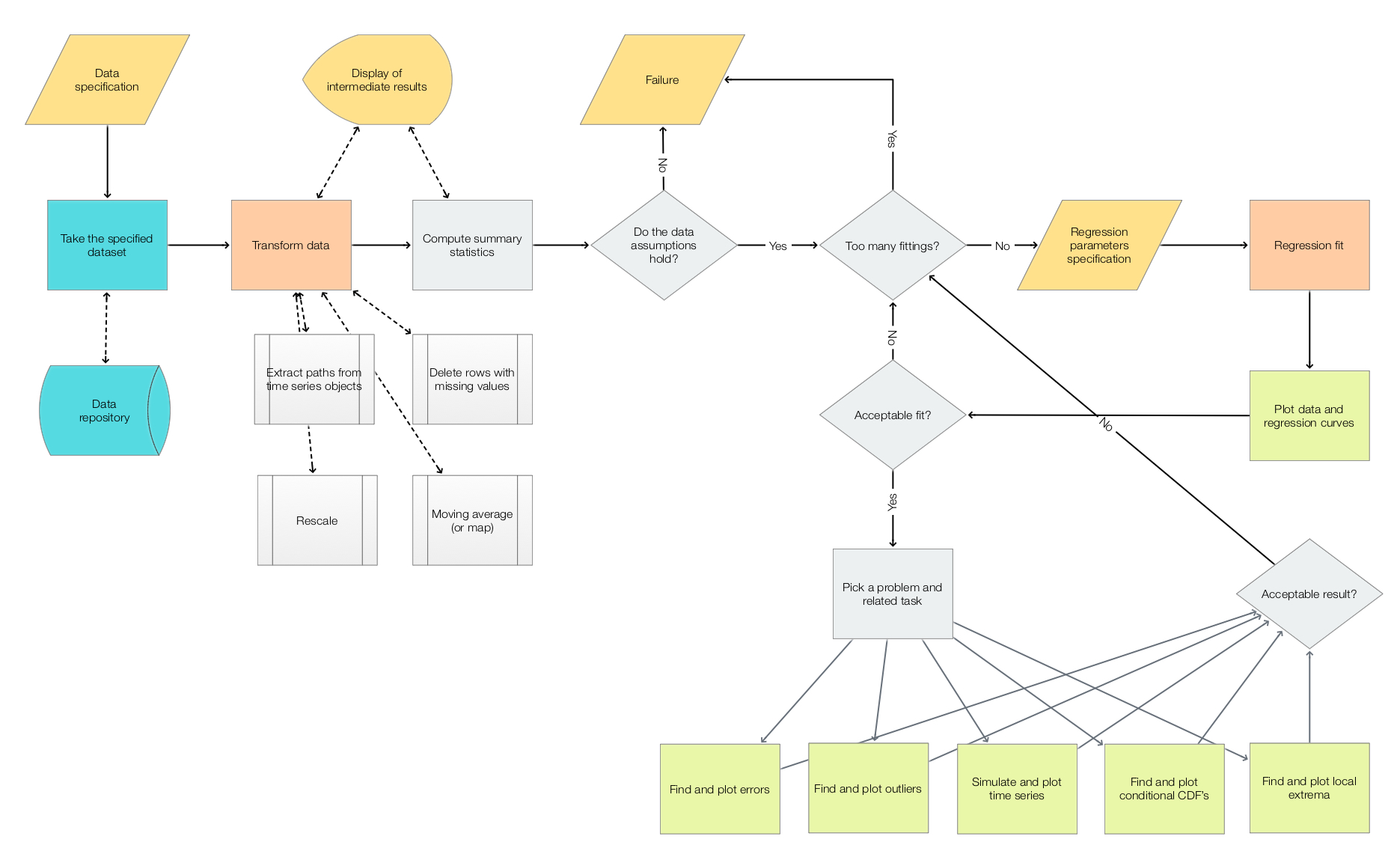
Workflows flowchart
The following flowchart summarizes the workflows that are supported by Regressionizer:
Usage examples
Import libraries:
from Regressionizer import *
import numpy as np
Generate random data:
np.random.seed(0)
x = np.linspace(0, 2, 300)
y = np.sin(2 * np.pi * x) + np.random.normal(0, 0.4, x.shape)
data = np.column_stack((x, y)
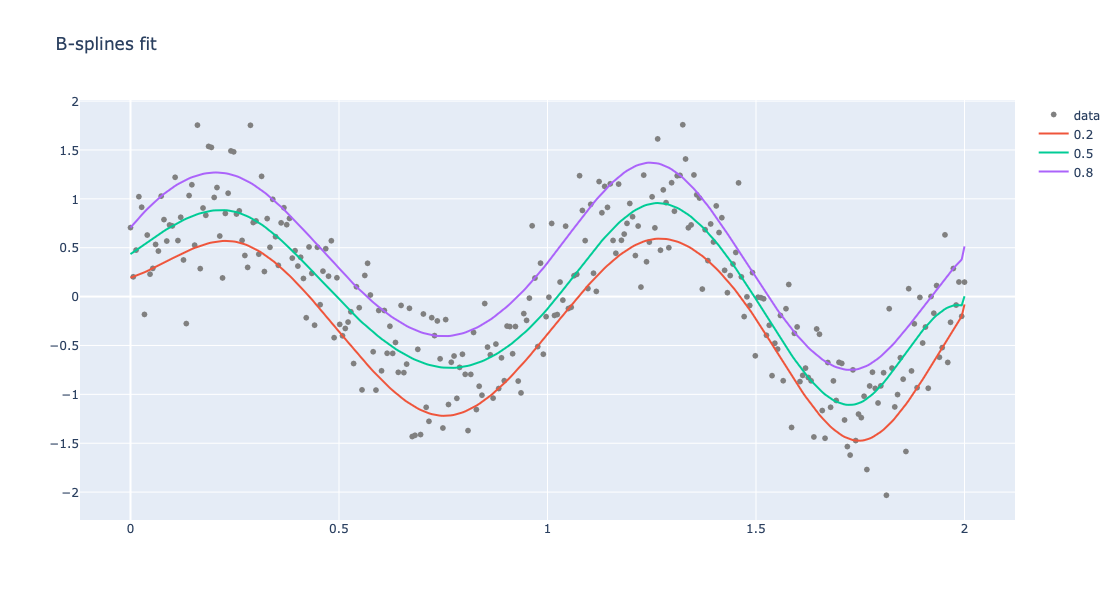
Compute quantile regression for probabilities [0.2, 0.5, 0.8] and make the corresponding plot:
obj = (Regressionizer(data)
       .quantile_regression(knots=8, probs=[0.2, 0.5, 0.8])
       .plot(title="B-splines fit", template="plotly")
       )
Show the plot obtained above:
obj.take_value().show()
References
Articles, books
[RK1] Roger Koenker, Quantile Regression, Cambridge University Press, 2005.
[RK2] Roger Koenker, "Quantile Regression in R: a vignette", (2006), CRAN.
[AA1] Anton Antonov, "A monad for Quantile Regression workflows", (2018), MathematicaForPrediction at GitHub.
Packages, paclets
[RKp1] Roger Koenker,
quantreg,
CRAN.
[AAp1] Anton Antonov, Quantile Regression WL paclet, (2014-2023), GitHub/antononcube.
[AAp2] Anton Antonov, Monadic Quantile Regression WL paclet, (2018-2024), GitHub/antononcube.
[AAp3] Anton Antonov,
QuantileRegression,
(2019),
Wolfram Function Repository.
Repositories
[AAr1] Anton Antonov, DSL::English::QuantileRegressionWorkflows in Raku, (2020), GitHub/antononcube.
Videos
[AAv1] Anton Antonov, "Boston useR! QuantileRegression Workflows 2019-04-18", (2019), Anton Antonov at YouTube.
[AAv2] Anton Antonov, "useR! 2020: How to simplify Machine Learning workflows specifications", (2020), R Consortium at YouTube.
1 maintainer

Metadata
1 maintainer
Release files for Regressionizer 0.1.9
For a detailed explanation of source distributions (sdists) and built distributions (wheels), please see the package formats documentation.
Source distribution (sdist)
| File | Size | Uploaded | Provenance | Actions |
|---|---|---|---|---|
| regressionizer-0.1.9.tar.gz | 24.6 kB | Without provenance | Details for regressionizer-0.1.9.tar.gz |
Built distribution (wheel)
| File | Interpreter | ABI | Platform | Actions Reset |
|---|---|---|---|---|
| Regressionizer-0.1.9-py3-none-any.whl | Python 3 | none | any | Details for Regressionizer-0.1.9-py3-none-any.whl |
Total release size: 47.4 kB
Release files / regressionizer-0.1.9.tar.gz
| Download URL | regressionizer-0.1.9.tar.gz |
|---|---|
| Size | 24.6 kB |
| Tags | Source |
|
SHA-256 checksum How to use checksums |
75009e04708f22bbd738ac1e3b32ad1bdc900a8fac1a6017b9f7a30dc38dd41d
|
|
BLAKE2b-256 checksum How to use checksums |
ea3d8062cee8b68346a964224e8338283fca81930cb9a7ea3121a47a65490b7c
|
| Upload date | |
|
Uploaded using Trusted Publishing? What is trusted publishing? |
No |
| Uploaded via |
twine/6.0.1 CPython/3.12.2
|
Release files / Regressionizer-0.1.9-py3-none-any.whl
| Download URL | Regressionizer-0.1.9-py3-none-any.whl |
|---|---|
| Size | 22.8 kB |
| Tags | Python 3 |
|
SHA-256 checksum How to use checksums |
ed487784ce58b783e21ff91bb92c74555c20a4bc14a577e70fdf2352dd876737
|
|
BLAKE2b-256 checksum How to use checksums |
852903dcdf644298616c61ace4fb28961125c2ab422d6e4c285876b93142744b
|
| Upload date | |
|
Uploaded using Trusted Publishing? What is trusted publishing? |
No |
| Uploaded via |
twine/6.0.1 CPython/3.12.2
|
Security for Regressionizer 0.1.9
Provenance
Provenance describes where a file came from. On PyPI, provenance is shared via attestations, which provide a verifiable record of the build or publishing details. View details, limitations and caveats.
No provenance found
None of the files in this release were uploaded with provenance metadata.
A note on package security
PyPI is a repository for distributing packages, not a service for auditing them. While third-party security researchers and our staff do their best to detect and remove malicious packages, PyPI cannot guarantee the quality, security or suitability of any given package.
To learn more about protecting yourself from malicious actors, visit our package security documentation.














