


About
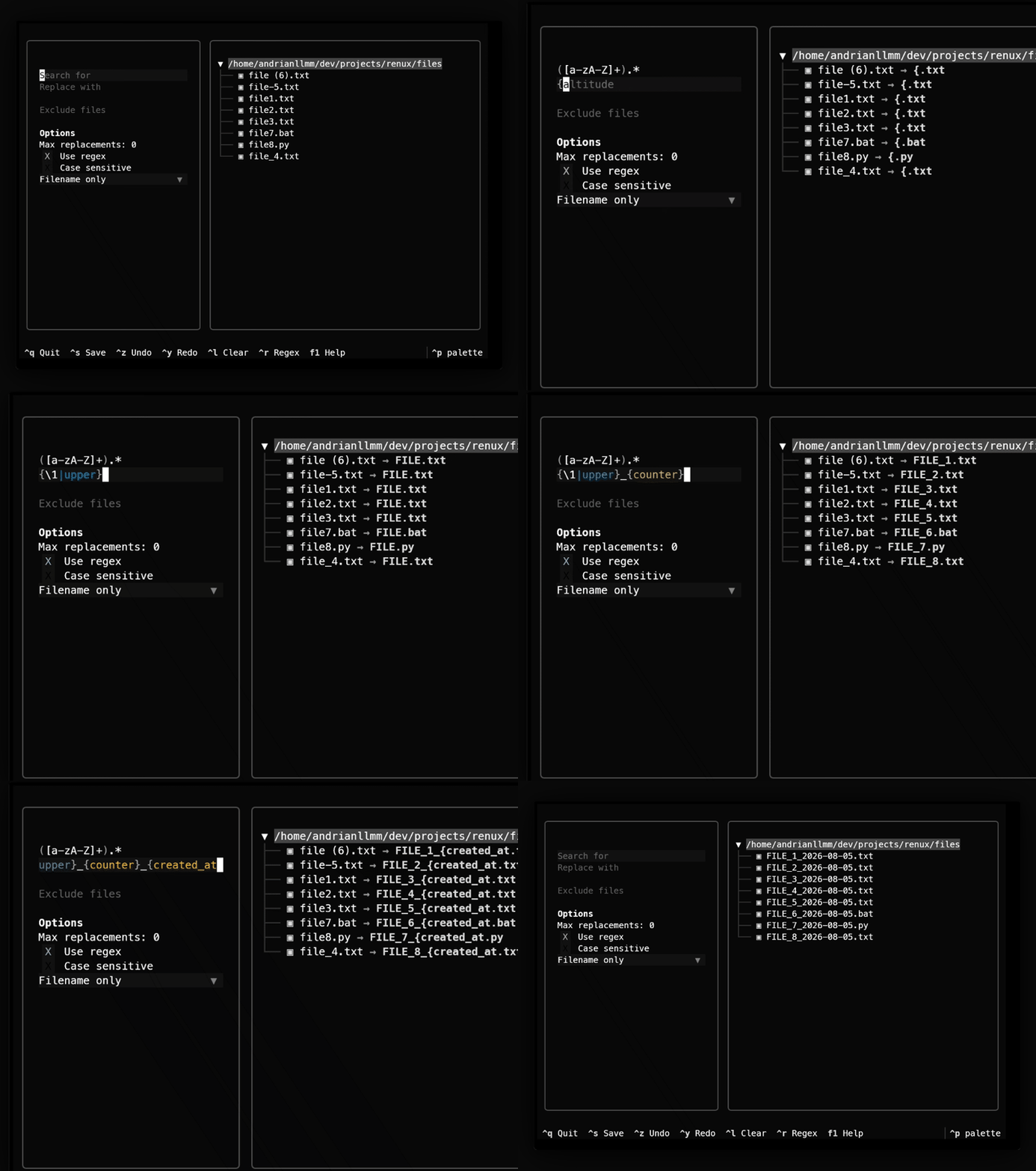
renux is a tool with a text-based (terminal) user interface (TUI) that
automates file renaming. It simplifies this task with features like regex,
placeholders, and text transformations, making it ideal for situations such as
renaming photos, cleaning up download folders, or enforcing consistent naming
conventions.
Features
- Regex: perform advanced renaming with pattern matching, capturing groups, and replacements.
- Text transformations: apply text transformations like slugify, camelCase to snake_case, and more.
- Counter placeholders: add incremental counters (e.g., file1.txt, file2.txt) with customizable starting points, increments, and padding.
- Date placeholders: include file creation/modification dates or the current date in filenames with customizable formats.
- File size placeholders: include a file's size, auto-scaled to the largest sensible unit or a specific one (bytes, KB, MB, GB).
- Image placeholders: include an image's width and height in pixels, plus EXIF capture date and camera make/model when available.
- Location placeholders: include a photo's GPS latitude, longitude, and altitude from EXIF data when available.
- Video placeholders: include a video's width, height, frame rate, and duration.
- Backup and undo/redo: save and restore changes to your files.
- File exclusion: exclude files from renaming.
- Keyboard shortcuts: use hotkeys to quickly apply actions and navigate the UI.
Installation
Using pipx (recommended).
pipx install renux
Alternatively, you can use pip.
AI Agent Skill
If you use an AI coding agent (Claude Code, etc.), you can install a
skill that teaches it how to drive renux for bulk-renaming
tasks:
npx skills add https://github.com/andrianllmm/renux/tree/main/skills/renux
Usage
renux [directory] [pattern] [replacement]
Arguments
directory: Directory where files are located (default is the current directory or.).pattern: Search pattern, which can be a regular expression (default is '').replacement: Replacement string for the pattern (default is '').
Options
-c COUNT,--count COUNT: Max replacements per file (default is 0, meaning unlimited).-r,--regex: Treats the pattern as a regular expression (default is True).--case-sensitive: Makes the search case-sensitive (default is False).--apply-to: Specifies where the renaming should be applied. Options are:name: Rename the file's base name (default).ext: Rename the file's extension.both: Rename both the name and extension.--exclude PATTERN: Exclude files matchingPATTERN(exact name or glob, e.g.README.md,*.log). Repeatable, e.g.--exclude README.md --exclude Dockerfile. In the TUI, this is a comma-separated field in the form.
Patterns are evaluated in order, gitignore-style: prefix a pattern with !
to re-include a file matched by an earlier pattern, e.g.
--exclude "*.txt" --exclude "!foo1.txt" excludes all .txt files except
foo1.txt.
-y,--yes: Apply the rename immediately without opening the TUI (headless mode, useful for scripts/CI).--dry-run: Preview the rename without opening the TUI or changing any files (headless mode).--undo: Undo the last rename applied todirectorywithout opening the TUI (headless mode).--redo: Redo the last undone rename indirectorywithout opening the TUI (headless mode).
Tags
-
Text transformations:
{string|filter}slugify: Convert into a URL/filename-friendly format (e.g. "hello world" → "hello-world")lower: Convert to lowercaseupper: Convert to uppercasecaps: Capitalize the first lettertitle: Capitalize each wordcamel: Convert to camel case (e.g. "hello world" → "helloWorld")pascal: Convert to pascal case (e.g. "hello world" → "HelloWorld")snake: Convert to snake case (e.g. "hello world" → "hello_world")kebab: Convert to kebab case (e.g. "hello world" → "hello-world")swapcase: Swap the case (e.g. "Hello World" → "hELLO wORLD")reverse: Reverse the string (e.g. "Hello World" → "dlroW olleH")strip: Remove leading and trailing whitespacelen: Get the length of the string
-
General
- Counter:
{counter(start=1,step=1,padding=1)}, e.g.,{counter(1,2,3)}Insert an incrementing counter. Each placeholder occurrence tracks its own sequence, advancing bystepafter every file.
- Counter:
-
Date
- Now:
{now(<format>)}, e.g.,{now(%Y)}The current date/time. - Created At:
{created_at(<format>)}The file's creation date/time. - Modified At:
{modified_at(<format>)}The file's last-modified date/time.
- Now:
-
File
- Size:
{size(<unit>)}, e.g.,{size(mb)}The file's size. Auto-scaled to the largest sensible unit unless a unit (b, kb, mb, gb) is given.
- Size:
-
Image
- Width:
{width}The image's width in pixels. - Height:
{height}The image's height in pixels. - Taken At:
{taken_at(<format>)}, e.g.,{taken_at(%Y)}The photo's capture date/time from EXIF metadata. Not available for images without EXIF data (e.g. screenshots, re-exported/edited images). - Camera Make:
{camera_make}The camera manufacturer from EXIF metadata. Not available for images without EXIF data. - Camera Model:
{camera_model}The camera model from EXIF metadata. Not available for images without EXIF data.
- Width:
-
Location
- Latitude:
{latitude}The photo's GPS latitude in decimal degrees. Not available for images without GPS EXIF data. - Longitude:
{longitude}The photo's GPS longitude in decimal degrees. Not available for images without GPS EXIF data. - Altitude:
{altitude}The photo's GPS altitude in meters. Not available for images without GPS EXIF data.
- Latitude:
-
Video
- Video Width:
{video_width}The video's width in pixels. - Video Height:
{video_height}The video's height in pixels. - Frame Rate:
{frame_rate}The video's frame rate. Not available for all containers (e.g. MP4). - Duration:
{duration}The video's duration, in seconds.
- Video Width:
Run renux --help for more details.
Examples
- Rename files starting with "IMG" to "Image":
renux my_photos/ IMG_ Image_
- Rename all
.txtfiles to.bak:renux my_directory/ .txt .bak --apply-to ext
- Use regex to retain information from the old name:
renux my_documents "document (\d).pdf" "doc (\1).pdf" -r
- Append a counter to filenames:
renux my_files/ file "file_{counter}"
- Append creation year to filenames:
renux my_files/ file "file_{created_at(%Y)}"
- Apply transformations like slugify:
renux my_files "(.*)" "{filename|slugify}" -r
Dev Setup
- Clone the repo
git clone https://github.com/andrianllmm/renux.git
cd renux
- Install dependencies with Poetry
poetry install
Testing
Run tests with pytest:
poetry run python -m pytest
Contributing
Contributions are welcome! See CONTRIBUTING.md for more details.
License
Distributed under the MIT License.
1 maintainer

Metadata
1 maintainer
Release files for renux 0.4.1
For a detailed explanation of source distributions (sdists) and built distributions (wheels), please see the package formats documentation.
Source distribution (sdist)
| File | Size | Uploaded | |
|---|---|---|---|
| renux-0.4.1.tar.gz | 23.5 kB | Details |
Built distribution (wheel)
| File | Interpreter | ABI | Platform | Reset |
|---|---|---|---|---|
| renux-0.4.1-py3-none-any.whl | Python 3 | none | any | Details |
Total release size: 50.8 kB
Release files / renux-0.4.1.tar.gz
| Download URL | renux-0.4.1.tar.gz |
|---|---|
| Size | 23.5 kB |
| Tags | Source |
|
SHA-256 checksum How to use checksums |
29ff8ed954ddf5179aaa7643e792f43be3348c9568c2da04eef3fd966b70785b
|
|
BLAKE2b-256 checksum How to use checksums |
9c63b9b16591c64a0858ac1512ac4cfa32abbdf382b6e1dc616829f165dbe694
|
| Upload date | |
|
Uploaded using Trusted Publishing? What is trusted publishing? |
Yes |
| Uploaded via |
twine/7.0.0 CPython/3.13.14
|
Provenance
Provenance describes where a file came from. On PyPI, provenance is shared via attestations, which provide a verifiable record of the build or publishing details. View details, limitations and caveats.


PyPI Publish Attestation
PyPI verified that this artifact, at this checksum, originated from the publisher listed below.
Signed by GitHub Actions, verified by PyPI on Aug 5, 2026.
Transparency logRelease files / renux-0.4.1-py3-none-any.whl
| Download URL | renux-0.4.1-py3-none-any.whl |
|---|---|
| Size | 27.3 kB |
| Tags | Python 3 |
|
SHA-256 checksum How to use checksums |
e8458756baa6ae72f25938123fc52463241ed1c6f82af7d1eed5525e5106270e
|
|
BLAKE2b-256 checksum How to use checksums |
3f5193c552a71da5ed0ae9a2b7f2eaf9a811cd6646bf067cd3b729a09de632a3
|
| Upload date | |
|
Uploaded using Trusted Publishing? What is trusted publishing? |
Yes |
| Uploaded via |
twine/7.0.0 CPython/3.13.14
|
Provenance
Provenance describes where a file came from. On PyPI, provenance is shared via attestations, which provide a verifiable record of the build or publishing details. View details, limitations and caveats.
PyPI Publish Attestation
PyPI verified that this artifact, at this checksum, originated from the publisher listed below.
Signed by GitHub Actions, verified by PyPI on Aug 5, 2026.
Transparency log













