
repolix

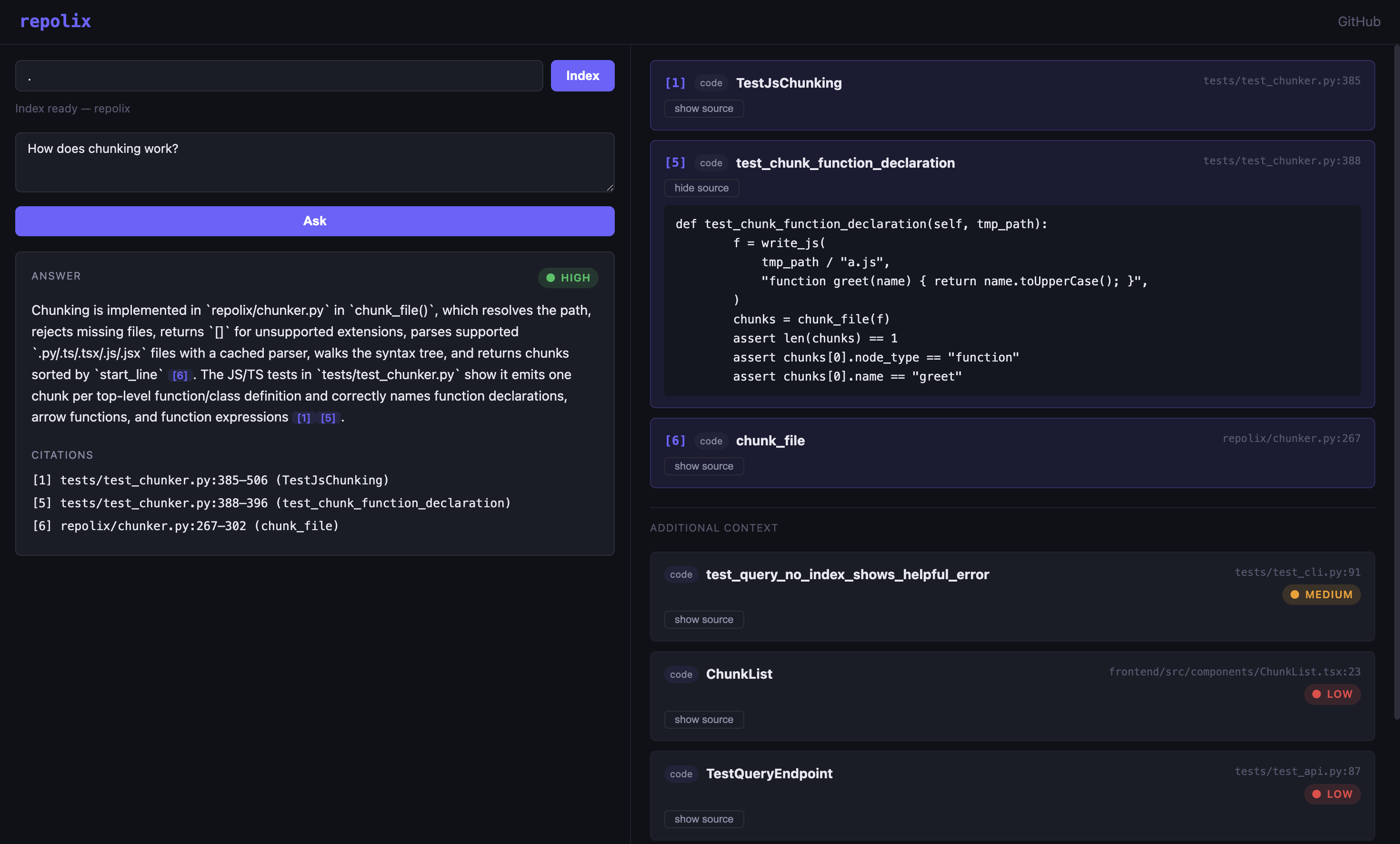
Ask plain English questions about a Python, JavaScript, or TypeScript repo. Get answers with exact file and line citations.
Preview
$ repolix index ./myrepo
Indexing /path/to/myrepo
Indexing  100% ████████████████████ 24/24
╭──────── Index Complete ─────────╮
│ Files found:    24              │
│ Files indexed:  22              │
│ Files skipped:  2 (unchanged)   │
│ Chunks stored:  183             │
╰─────────────────────────────────╯

$ repolix query "how does authentication work"
Searching...
Generating answer...
╭──────────────────────── Answer ──────────────────────────╮
│ authenticate_user() in auth/validators.py validates       │
│ credentials by calling validate_token() [1], which checks │
│ expiry and signature. On success it creates a session via │
│ SessionService.create() [2].                              │
╰───────────────────────────────────────────────────────────╯
──────────────────────── Citations ────────────────────────
  [1] auth/validators.py:14-28  (validate_token)
  [2] auth/session.py:45-67     (SessionService.create)

confidence: high
Search runs on your machine. Indexing uses OpenAI embeddings. Answers can use OpenAI or a local Ollama model.
Quickstart
Requirements
- Python 3.11+
- OpenAI API key for indexing and search (get one here)
- Optional: Ollama for local answers
Node.js is not required for end users. The web UI is pre-built and bundled inside the package.
Install
pip install repolix
Set your API key
export OPENAI_API_KEY=sk-your-key-here
# or add it to a .env file in your working directory
Index a repo
repolix index ./path/to/repo
Ask a question
repolix query "how does authentication work"

# Raw chunks without an LLM
repolix query "where is UserService defined" --no-llm

# Force re-index all files, not just changed ones
repolix index ./path/to/repo --force
Local answers with Ollama
OpenAI is the default. For local generation, install Ollama and pull a model:
ollama pull llama3.2

repolix query "how does indexing skip unchanged files" --provider ollama
repolix tour . --provider ollama
repolix trace retrieve --explain --provider ollama
index and query search still need an OpenAI key. tour and trace --explain with --provider ollama do not. Use --model to pick a different Ollama model.
Get an orientation briefing
repolix tour .
╭──────────────────────────── Tour ─────────────────────────────╮
│ OVERVIEW                                                       │
│ repolix is a local-first codebase context engine...           │
│                                                                │
│ ENTRY POINTS                                                   │
│ repolix/cli.py — main() is the Click entrypoint               │
│ repolix/api.py — FastAPI app started by uvicorn               │
│                                                                │
│ MAJOR MODULES                                                  │
│ store.py: embedding pipeline and ChromaDB management          │
│ retriever.py: hybrid search, RRF, and re-ranking              │
│ ...                                                            │
╰────────────────────────────────────────────────────────────────╯
──────────────── Most Referenced ────────────────
  _get_client     called by 6 functions
  chunk_file      called by 4 functions

Analyzed 183 chunks
repolix tour scans the call-graph metadata already in ChromaDB — no extra API calls for embeddings. A single LLM call produces the briefing.
# Scope to a subdirectory
repolix tour . --path repolix/

# Save briefing to .repolix/tour.md
repolix tour . --save
Trace a call graph
repolix trace retrieve
╭──────────────── Trace: retrieve ─────────────────╮
│ retrieve  [repolix/retriever.py:58]               │
│ ├── query_chunks  [repolix/store.py:180]          │
│ │   └── _get_client  [repolix/store.py:43]        │
│ ├── keyword_search  [repolix/store.py:240]        │
│ ├── reciprocal_rank_fusion  [repolix/retriever.py:...]│
│ └── expand_via_call_graph  [repolix/retriever.py:...]│
╰───────────────────────────────────────────────────╯
── Callers of retrieve ──────────────────────────────
  query          repolix/cli.py:181
  query_endpoint repolix/api.py:95

3 levels · 6 nodes
repolix trace is zero API calls by default — it reads call-graph metadata already stored in ChromaDB from the index run.
# Show what calls a function (reverse direction)
repolix trace retrieve --reverse

# Increase traversal depth
repolix trace index_repo --depth 5

# Add a plain-English explanation of the call chain (1 LLM call)
repolix trace retrieve --explain
Web UI
uvicorn repolix.api:app --port 8000
# Open http://localhost:8000 (or whatever host/port you chose)
Use any port; the bundled UI talks to the API on the same origin. Add --host 0.0.0.0 if you need LAN access. For npm run dev (frontend on :3000), the dev server defaults to an API at http://localhost:8000; set VITE_API_URL in frontend/.env if the API uses another host or port.
Why repolix
Getting dropped into an unfamiliar codebase is painful. Documentation is outdated. Grep finds strings, not meaning. LLM chatbots hallucinate file names and function signatures because they have no access to your actual code.
Who is this for
repolix is for developers navigating code they didn't write — a new job, an open-source repo, vendor code. It does not need an editor session. Indexing uses OpenAI embeddings; answers can stay local with Ollama.
How it works
1. AST chunking Tree-sitter parses each file into a syntax tree (Python and JavaScript/TypeScript grammars). repolix splits only at function and class boundaries — every chunk is semantically complete. Methods are tracked with their parent class for disambiguation.
2. Hybrid search Queries run against OpenAI embeddings (vector search) and exact token matching (keyword search) simultaneously. Results are merged using Reciprocal Rank Fusion, a ranking algorithm that rewards consistency across search methods over dominance in just one.
3. Call graph expansion After initial retrieval, repolix inspects each chunk's call graph and fetches called functions that didn't rank highly on their own. This surfaces implementation details that live one function call away from the entry point.
4. Metadata re-ranking Retrieved chunks are re-ranked using function names, file paths, docstrings, and call graph signals before being sent to the LLM.
5. Cited answers The top chunks go to the LLM with instructions to answer directly and cite every claim. Citations map back to exact file paths and line numbers.
Output format
Each query produces:
- A prose answer with inline citations
[1],[2], etc. - A citations section with exact file paths and line ranges. Citations marked
[truncated]mean the function exceeded the 300-token chunk cap. - A confidence label (
high/medium/low) based on how strongly the retrieved chunks matched the query across function names, file paths, docstrings, and call graph signals.
Cost
Indexing uses OpenAI embeddings (~$0.02 for a 30k-line repo). Re-index skips unchanged files. --provider ollama makes generation free; search still embeds via OpenAI.
Stack
| Layer | Choice |
|---|---|
| AST parsing | Tree-sitter |
| Embeddings | text-embedding-3-small |
| Vector store | ChromaDB (local, no server needed) |
| LLM | gpt-5.4-mini, or Ollama (--provider ollama) |
| Backend | FastAPI |
| Frontend | React + TypeScript |
| CLI | Click + Rich |
Install from source
git clone https://github.com/TheAsianFish/repolix
cd repolix
python -m venv .venv
source .venv/bin/activate
pip install -e ".[dev]"
For frontend development (requires Node.js 18+):
cd frontend && npm install && cd ..
bash start.sh
# Backend: http://localhost:8000  |  Frontend: http://localhost:3000
Limitations
- JSDoc is not extracted into chunk text yet (JavaScript/TypeScript chunks use source and identifiers only)
- Best on repos up to ~30k lines
- Deeply nested functions are included in their parent chunk
- Large functions (>300 tokens) are truncated at the chunk cap
- Complex cross-file reasoning may require rephrasing the query
- Indexing and
querysearch still use OpenAI embeddings; local embeddings are next
Roadmap
Shipped in V2
.ts,.tsx,.js,.jsxindexing via Tree-sitter JavaScript/TypeScript grammarsrepolix tour— proactive orientation briefing driven by call-graph metadata (0.2.2)repolix trace— BFS call-graph traversal with forward/reverse/explain modes (0.2.3)- Exact-name lookup for
traceso common symbols are not missed (0.2.4) - Ollama for answer generation (0.3.0)
Next
- 0.3.1 — local embeddings so indexing and search need no OpenAI key
- 0.3.2 —
repolix status(index stats, provider, model)
Backlog
- MCP server so AI coding tools can call the same retrieve / trace operations
- VS Code extension
- Multi-repo support
Contributing
Bug reports and pull requests are welcome. Please open an issue before submitting a large change so we can discuss the approach.
License
MIT © 2026 Patrick Chung
1 maintainer

Download files
Download the file for your platform. If you're not sure which to choose, learn more about installing packages.
Source Distribution
Built Distribution
Filter files by name, interpreter, ABI, and platform.
If you're not sure about the file name format, learn more about wheel file names.
Copy a direct link to the current filters
File details
Details for the file repolix-0.3.0.tar.gz.
File metadata
- Download URL: repolix-0.3.0.tar.gz
- Upload date:
- Size: 170.2 kB
- Tags: Source
- Uploaded using Trusted Publishing? No
- Uploaded via:
twine/6.2.0 CPython/3.14.2
File hashes
| Algorithm | Hash digest | |
|---|---|---|
| SHA256 |
f3b57b81fb73553f2e56a01835b8c8666080277569b3cacc9f35284da38ee0f8
|
|
| MD5 |
75b4f9962749a88c030f76339be3c8a0
|
|
| BLAKE2b-256 |
fd8a1738867b4104f7f43a49d427c6eb865bfdb67934e81184d8798b100d5323
|
File details
Details for the file repolix-0.3.0-py3-none-any.whl.
File metadata
- Download URL: repolix-0.3.0-py3-none-any.whl
- Upload date:
- Size: 152.1 kB
- Tags: Python 3
- Uploaded using Trusted Publishing? No
- Uploaded via:
twine/6.2.0 CPython/3.14.2
File hashes
| Algorithm | Hash digest | |
|---|---|---|
| SHA256 |
64fcb13f8be55b18c1635cf39c221f7b3c3f27278a353df97a52e4d7309c9cdb
|
|
| MD5 |
747a39b7fc4172bf7d126b5223f23b65
|
|
| BLAKE2b-256 |
e256e237c9c3aff2b9cbd2eee241f0efbf5ae4a2e2b1807c7ee36f11b096382b
|














