
Differentiable RHEED simulations and Reconstruction in JAX

Project description
Rheedium (Documentation)












Overview
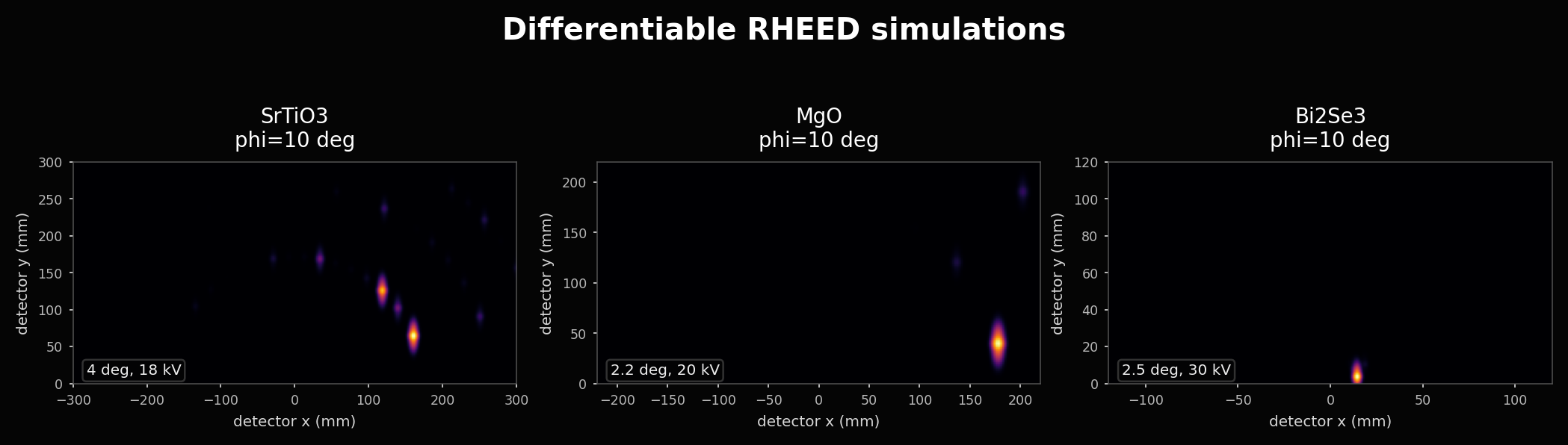
Rheedium is a JAX-based computational framework for simulating RHEED (Reflection High-Energy Electron Diffraction) patterns, with full automatic differentiation and GPU acceleration. Because every simulation step is a differentiable JAX function, you can run it forward (crystal → pattern) or backward (experimental pattern → crystal/instrument parameters) by gradient descent — the same code powers both simulation and reconstruction.
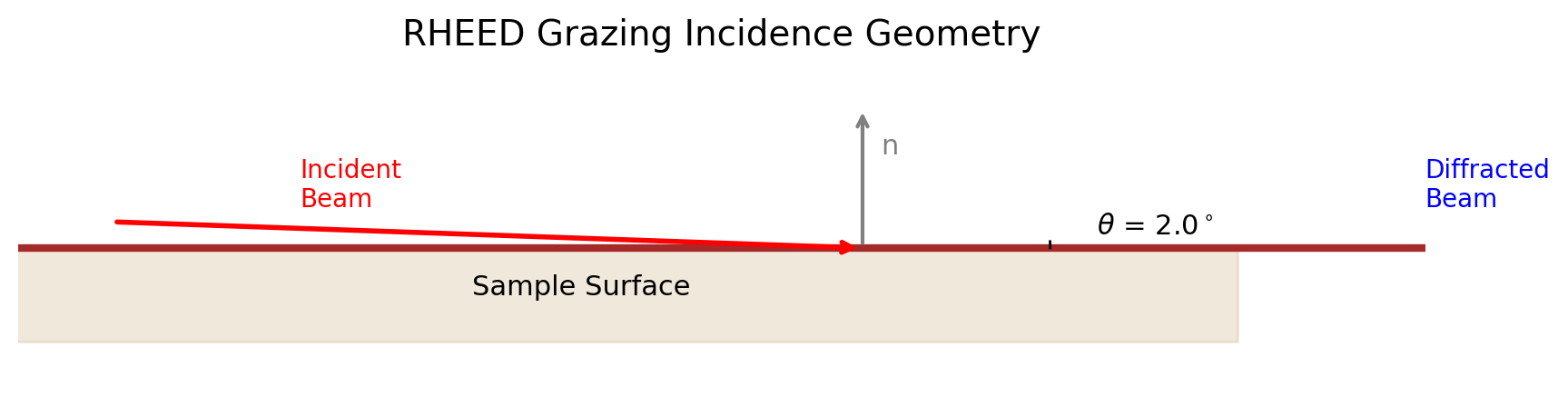
RHEED geometry: a high-energy beam grazes the surface and diffracts onto the detector.
New here? Read this README top to bottom first. The Mental model and Repository map sections are enough to know where any piece of functionality lives and why it is shaped the way it is. Then jump to a tutorial for a worked example.
Install
pip install rheedium # from PyPI
git clone git@github.com:debangshu-mukherjee/rheedium.git
cd rheedium
uv sync --extra dev             # full dev environment (recommended for hacking)
GPU users: install the cuda extra (pip install "rheedium[cuda]") on Linux
x86-64. Everything below works identically on CPU.
Quick start
import rheedium as rh

# 1. Load a crystal from CIF / XYZ / POSCAR (format auto-detected)
crystal = rh.inout.parse_crystal("tests/test_data/SrTiO3.cif")

# 2. Simulate a detector image end-to-end (structure -> pattern -> image)
image = rh.simul.simulate_detector_image(
    crystal,
    voltage_kv=20.0,   # beam energy
    theta_deg=2.0,     # grazing incidence angle
    hmax=5, kmax=5,    # reciprocal-lattice range
)

# 3. Display it with a phosphor-screen colormap
rh.plots.plot_rheed(image)
For the lower-level pattern object (sparse reflections + detector coordinates,
before rasterization) use rh.simul.ewald_simulator(crystal, ...), which
returns a RHEEDPattern. simulate_detector_image is the full kinematic
pipeline that wraps it and renders a dense image.
Mental model
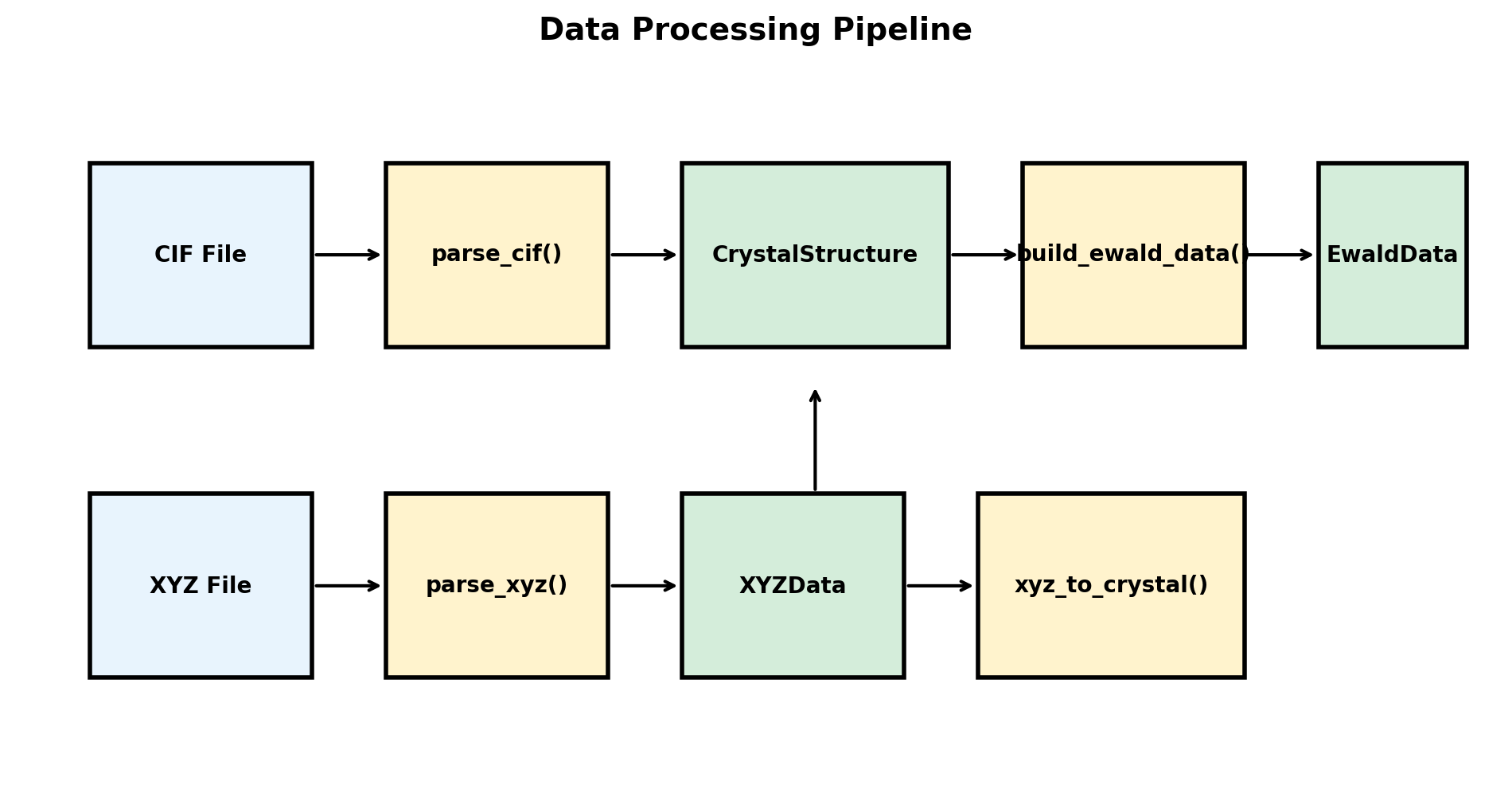
RHEED is grazing-incidence electron diffraction off a crystal surface. The physics — and this codebase — follow one pipeline. Read this once and the package layout becomes obvious:
   CIF / XYZ / POSCAR              inout/        parse_crystal()
            │
            ▼
   CrystalStructure  ──────────────  types/      JAX PyTree (positions, cell)
            │
   (optional surface work)           procs/      slabs, reconstructions,
            │                                     defects, grains, library
            ▼
   reciprocal lattice + Ewald sphere  ucell/      build_cell_vectors(),
            │                          simul/      reciprocal lattice, Ewald
            ▼
   reflections × structure factors    simul/      form factors, Debye-Waller,
   intersected with the Ewald sphere              CTRs, finite domains
            │
   instrument broadening              simul/      divergence, energy spread,
            │                                     detector PSF
            ▼
   RHEEDPattern  ──► detector image   simul/      project + rasterize
            │
            ▼
   plot / compare / fit               plots/  recon/  audit/
- Forward (simulate): walk the pipeline top to bottom. Entry point
simul.simulate_detector_image/simul.ewald_simulator. - Inverse (reconstruct):
recon/differentiates the forward pipeline and fits crystal/instrument/orientation parameters to an experimental image. - Validate:
audit/checks the simulator against physics invariants (Friedel symmetry, elastic closure, form-factor monotonicity, …) and against stored reference images.
Why the code is shaped this way (key design choices)
-
JAX everywhere. Every numerical function is pure, traceable, and
jit/grad/vmap-friendly. This is what makes reconstruction (recon/) possible at all — the forward simulator is the model you optimize through. -
PyTrees for all data structures.
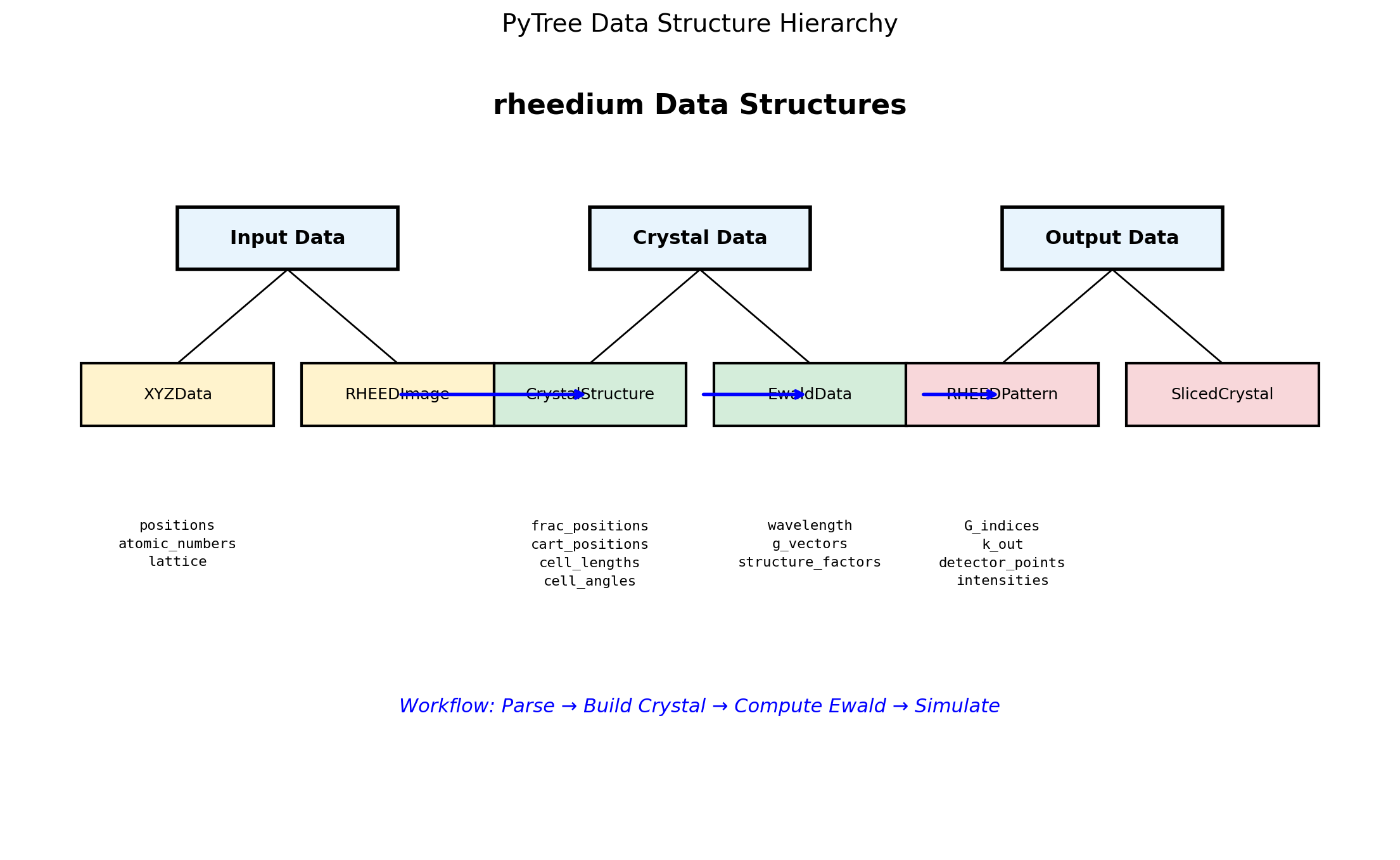
CrystalStructure,RHEEDPattern,RHEEDImage, beams, and distributions (intypes/) are registered JAX PyTrees. They flow throughjit/gradand shard across devices unchanged. Construct them with thecreate_*factory functions, not raw constructors. -
Runtime-checked array shapes. Functions are annotated with
jaxtypingshapes (e.g.Float[Array, "n 3"]) and enforced bybeartypeduring tests. A wrong-shape array fails loudly at the call site instead of producing silent garbage. -
64-bit by default.
jax_enable_x64is set at import (in src/rheedium/init.py) — diffraction geometry needs the precision. -
Namespace sub-packages, flat public API. Access everything as
rh.<subpackage>.<function>(e.g.rh.inout.parse_crystal). Each subpackage's__init__.pydefines its public surface via__all__. -
Optional distributed execution.
rh.init_distributed()wraps multi-host JAX setup; opt in withRHEEDIUM_DISTRIBUTED=1for SLURM batch jobs. No-op on a single machine.
The physics, visualized
Each stage of the pipeline has a physical knob you can inspect and plot
(rh.plots.*). These figures come straight from the package:
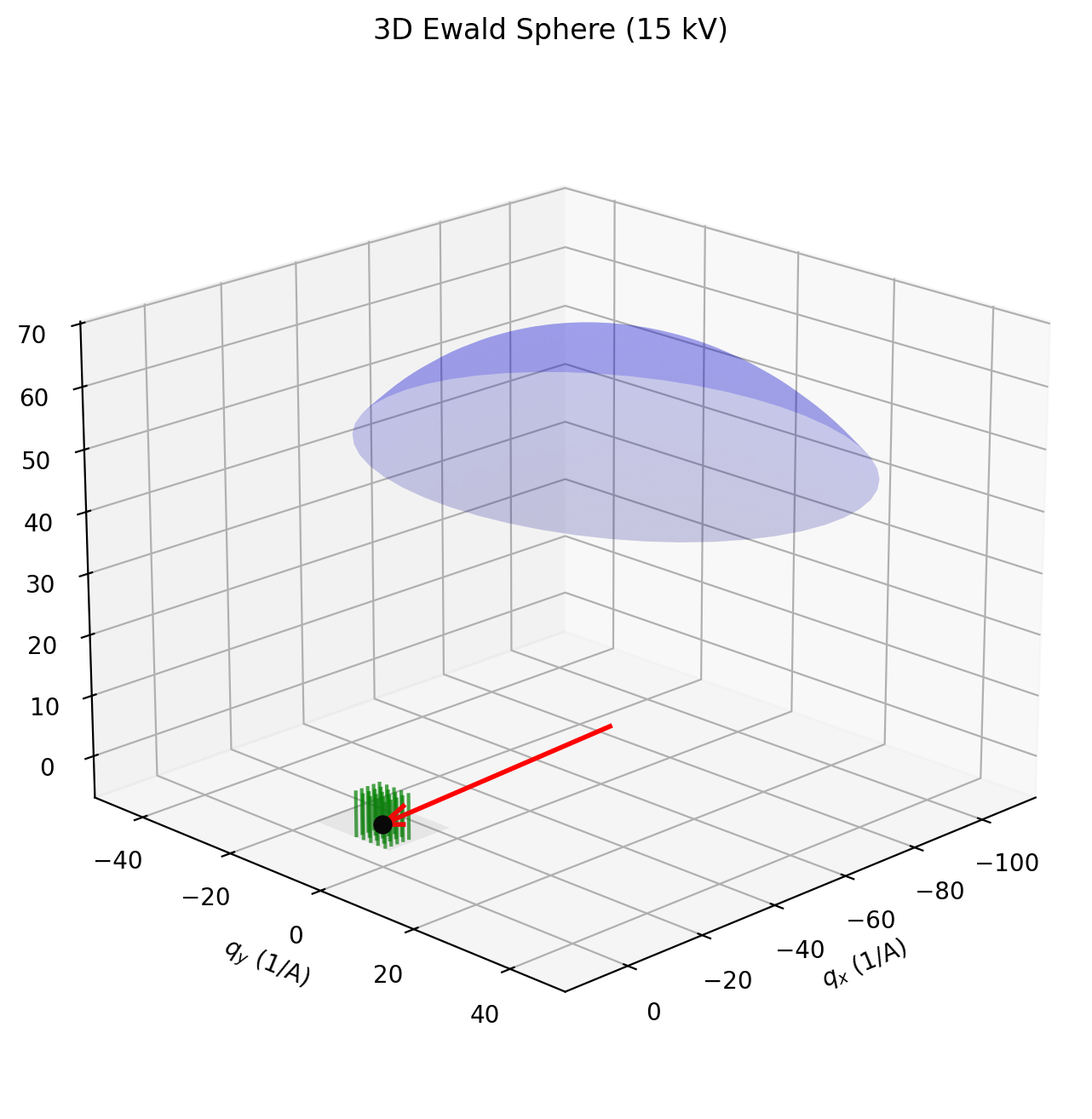 Ewald construction ( simul.ewald)
|
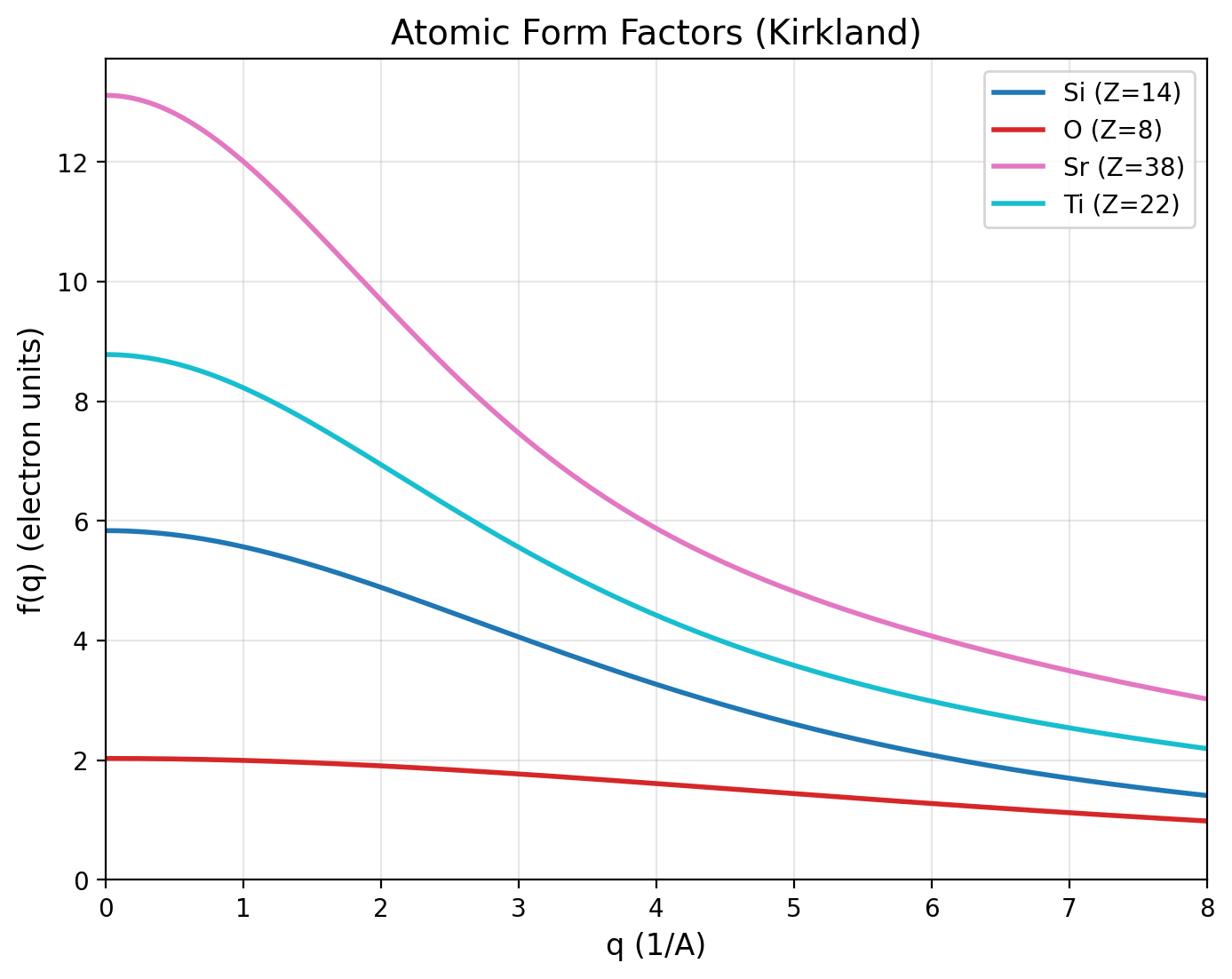 Atomic form factors ( simul.form_factors)
|
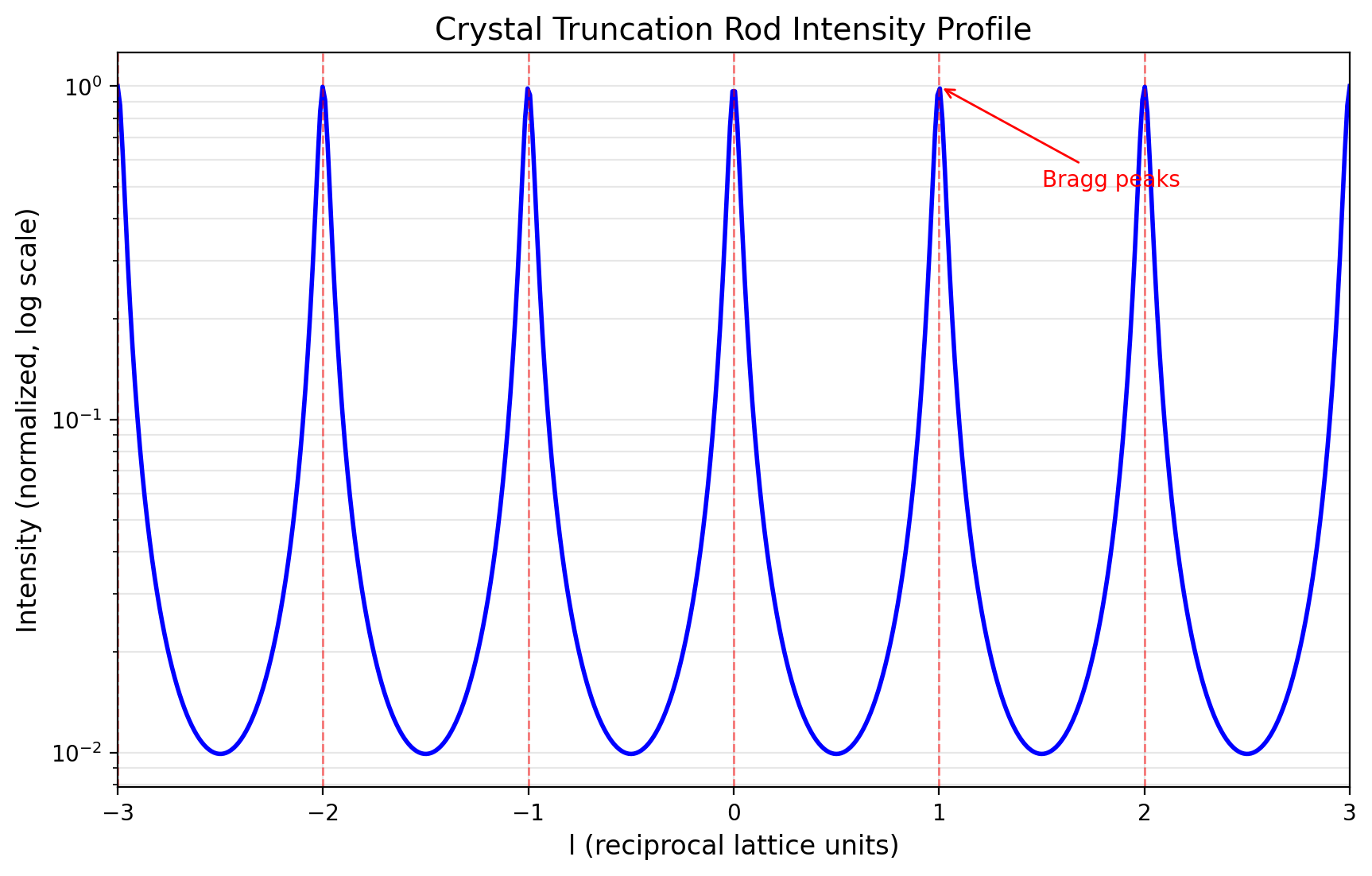 Crystal truncation rods ( simul.surface_rods)
|
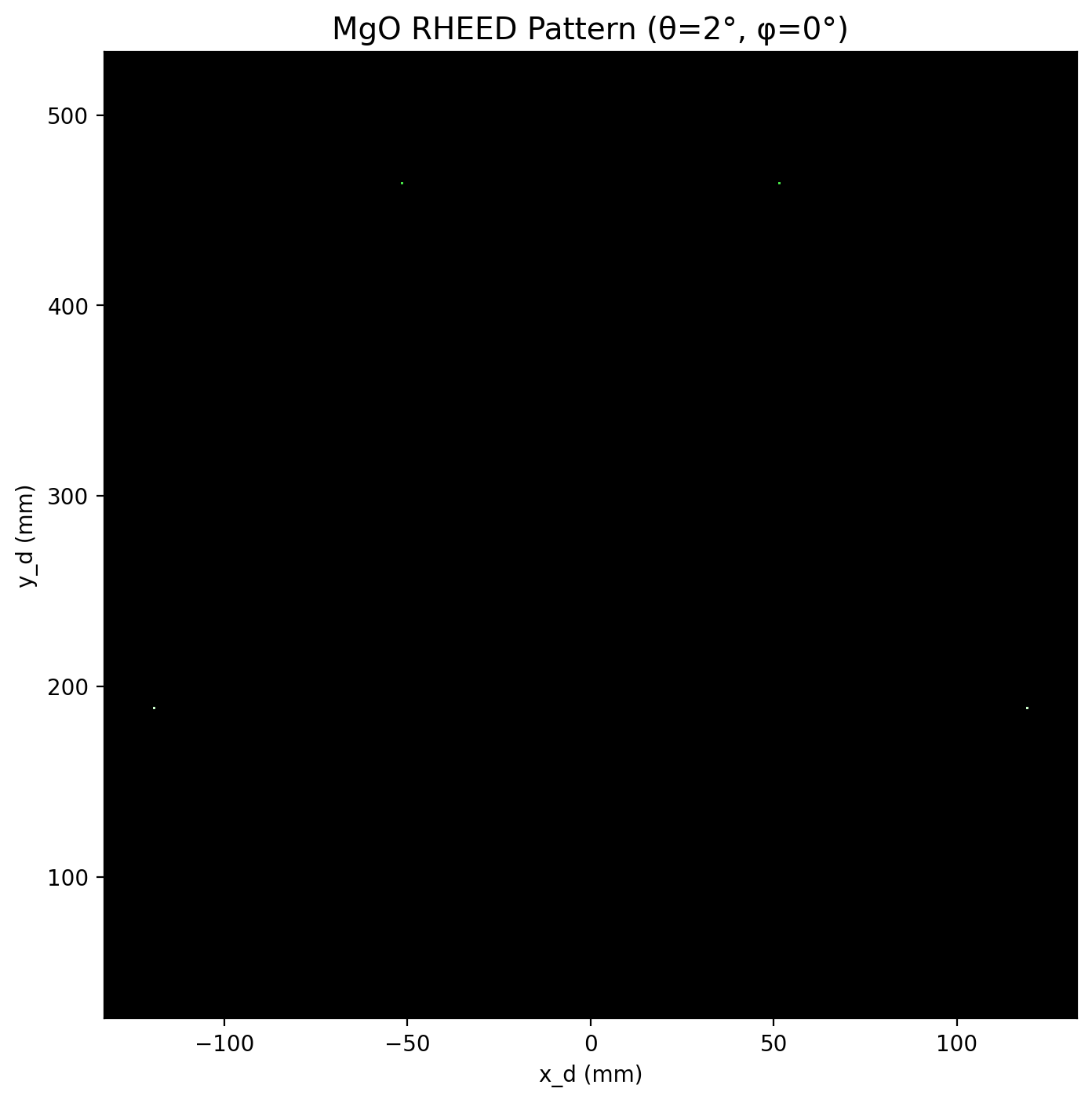 Simulated RHEED — MgO(001) ( simul.simulate_detector_image)
|
Repository map
src/rheedium/
├── types/    PyTree data structures + physical constants   (the vocabulary)
├── ucell/    unit-cell & reciprocal-space crystallography
├── inout/    parsing & I/O (CIF/XYZ/POSCAR/VASP, TIFF, HDF5, ASE/pymatgen)
├── simul/    the RHEED simulator (kinematic, multislice, instrument effects)
├── procs/    differentiable surface models (slabs, reconstructions, defects)
├── recon/    inverse problems (fit structure/params from experimental data)
├── plots/    visualization (patterns + physics diagrams)
├── tools/    shared numerical kernels (Bessel, quadrature, wavelength, sharding)
└── audit/    physics-invariant checks & reference-image benchmarking
What lives where
types/ — the data vocabulary the whole package speaks. Define a structure
or beam here, pass it everywhere.
crystal_types.py,beam_types.py,rheed_types.py— the core PyTrees.distributions.py— orientation/size distributions for ensemble averaging.constants.py,custom_types.py— physical constants and scalar/array aliases.- Entry points:
create_crystal_structure,create_electron_beam,create_rheed_pattern,create_rheed_image,create_ewald_data.
ucell/ — crystallography: lattice parameters ↔ Cartesian vectors,
reciprocal space, surface slicing.
- Entry points:
build_cell_vectors,reciprocal_unitcell,generate_reciprocal_points,atom_scraper,bulk_to_slice,miller_to_reciprocal.
inout/ — get structures and images in and out.
crystal.py(parse_crystal— auto-detect),cif.py,poscar.py,vaspxml.py,xyz.py— structure parsers.tiff.py— load experimental detector frames (load_tiff_as_rheed_image,detect_beam_center).hdf5.py— serialize PyTrees (save_to_h5,load_from_h5).interop.py—from_ase/to_ase,from_pymatgen/to_pymatgen.
simul/ — the heart of the package; the forward simulator.
simulator.py— high-level orchestrators:simulate_detector_image,ewald_simulator,multislice_simulator, plus detector projection/rendering.ewald.py,kinematic.py— Ewald-sphere construction and kinematic spots.form_factors.py— Kirkland/Lobato atomic form factors + Debye-Waller.surface_rods.py,finite_domain.py— crystal truncation rods and finite-domain broadening (the surface-sensitivity physics).multislice.py,potential.py— dynamical multislice primitives.beam_averaging.py— instrument broadening (divergence, energy spread, PSF).sweeps.py— batched simulators over angle/energy/orientation grids.
procs/ — differentiable procedural surface models (apply before simulating).
surface_builder.py(create_surface_slab,apply_surface_reconstruction,add_adsorbate_layer),surface_modifier.py(steps, occupancy/displacement fields),crystal_defects.py,grains.py,preprocessing.py(experimental image cleanup),library.py(ready-made surfaces: Si(111)-7×7, GaAs(001)-2×4, SrTiO₃, MgO, …).
recon/ — fit parameters to data by differentiating the simulator.
optimizers.py(gauss_newton_reconstruction,adam_reconstruction),losses.py,orientation.py(orientation fitting + Fisher-information uncertainty).
plots/ — figuring.py (plot_rheed, phosphor colormap) and diagrams.py
(publication physics figures: Ewald sphere, form factors, CTR profiles, …).
tools/ — shared math kernels used across simul/: special.py (Bessel
functions), quadrature.py (Gauss-Hermite), simul_utils.py (wavelength_ang,
incident_wavevector, interaction_constant), parallel.py (device sharding),
wrappers.py (jax_safe).
audit/ — invariants.py (run_default_invariants — physics checks, no
fixtures needed), metrics.py (image-space accuracy metrics),
reference_benchmark.py (regression against stored reference images).
Common workflows
import rheedium as rh

# --- Build and simulate a reconstructed surface ---
crystal = rh.inout.parse_crystal("structure.cif")
slab    = rh.procs.create_surface_slab(crystal, miller_indices=[1, 1, 1])
recon7  = rh.procs.apply_surface_reconstruction(slab, m=7, n=7)
image   = rh.simul.simulate_detector_image(recon7, voltage_kv=20.0, theta_deg=2.0)

# --- Or start from a pre-built surface in the library ---
si = rh.procs.si111_7x7()

# --- Reconstruct: fit a structure to an experimental image ---
exp    = rh.inout.load_tiff_as_rheed_image("rheed.tif")
result = rh.recon.adam_reconstruction(crystal_init, exp.data, ...)

# --- Validate the simulator against physics ---
rh.audit.run_default_invariants()
Tests, tutorials, and docs
- Tutorials — runnable, narrated examples in tutorials/ (paired
.ipynb+ jupytext.py), e.g. 01_kinematic_SrTiO3.py. Start here for a worked end-to-end run. Also rendered in the online tutorials. - Tests — tests/ mirrors
src/one-to-one (tests/test_rheedium/test_<subpkg>/test_<module>.py). To understand any function's contract, read its test. Property-based tests usehypothesis; shape contracts are enforced viajaxtyping+beartype. - Guides & API — conceptual guides (Ewald sphere, form factors, CTRs, PyTree architecture, …) and the full API reference on Read the Docs.
Development
uv sync --extra dev
Recommended local validation before pushing (matches CI):
uv run ruff check src/ tests/        # lint
uv run ruff format --check src/ tests/   # format
uv run ty check src                  # static type check
uv run pytest -v                     # tests (pytest-xdist runs them in parallel)
See CONTRIBUTING.md for conventions (numpydoc docstrings, jaxtyping idioms, the tests-mirror-src layout, and the type-checker configuration rationale).
License
This project is licensed under the MIT License - see the LICENSE file for details.
Citation
If you use Rheedium in your research, please cite:
@software{rheedium_software,
  title={Rheedium: High-Performance RHEED Pattern Simulation},
  author={Mukherjee, Debangshu},
  year={2025},
  url={https://github.com/debangshu-mukherjee/rheedium},
  version={2025.10.05},
  doi={10.5281/zenodo.14757400},
}
Release history Release notifications | RSS feed


Download files
Download the file for your platform. If you're not sure which to choose, learn more about installing packages.
Source Distribution
Built Distribution
Filter files by name, interpreter, ABI, and platform.
If you're not sure about the file name format, learn more about wheel file names.
Copy a direct link to the current filters
File details
Details for the file rheedium-2026.6.7.tar.gz.
File metadata
- Download URL: rheedium-2026.6.7.tar.gz
- Upload date:
- Size: 248.6 kB
- Tags: Source
- Uploaded using Trusted Publishing? No
- Uploaded via: uv/0.8.9
File hashes
| Algorithm | Hash digest | |
|---|---|---|
| SHA256 |
7606922cec1499a9c24328551c5e25036c0fa2b9171c924a13f63417e34a8740
|
|
| MD5 |
5e7f20ea1346a0eff3ed30ffe0a2e4a1
|
|
| BLAKE2b-256 |
303b58569f86ee4ced24a1724daed6cc674c3bfa8aaea7608192ef0dcdb62fc0
|
File details
Details for the file rheedium-2026.6.7-py3-none-any.whl.
File metadata
- Download URL: rheedium-2026.6.7-py3-none-any.whl
- Upload date:
- Size: 290.9 kB
- Tags: Python 3
- Uploaded using Trusted Publishing? No
- Uploaded via: uv/0.8.9
File hashes
| Algorithm | Hash digest | |
|---|---|---|
| SHA256 |
cce76f68ff980a8cc9e6081f1e1b39a7f625de54fff70b09351e22bfbcf21f66
|
|
| MD5 |
21e69c390463665dd9a2a375d34a3879
|
|
| BLAKE2b-256 |
870f8550980b4bd424bc6be69cf5f8bd723987a85bcc714717da7b93336b5037
|






