
Welcome to Roerich



Roerich is a python library for online and offline change point detection for time series analysis, signal processing, and segmentation. It was named after the painter Nicholas Roerich, known as the Master of the Mountains. Read more at: https://www.roerich.org.

Currently, the library contains official implementations of change point detection algorithms based on direct density ratio estimation from the following articles:
- Mikhail Hushchyn and Andrey Ustyuzhanin. “Generalization of Change-Point Detection in Time Series Data Based on Direct Density Ratio Estimation.” J. Comput. Sci. 53 (2021): 101385. [journal] [arxiv]
- Mikhail Hushchyn, Kenenbek Arzymatov and Denis Derkach. “Online Neural Networks for Change-Point Detection.” ArXiv abs/2010.01388 (2020). [arxiv]
Dependencies and install
pip install roerich
or
git clone https://github.com/HSE-LAMBDA/roerich.git
cd roerich
pip install -e .
Basic usage
(See more examples in the documentation.)
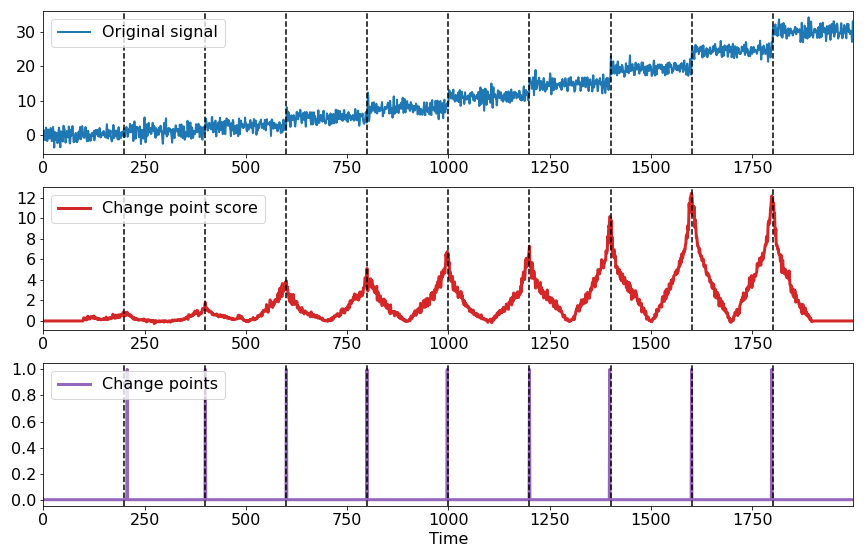
The following code snippet generates a noisy synthetic data, performs change point detection, and displays the results. If you use own dataset, make
sure that it has a shape (seq_len, n_dims).
import roerich
from roerich.change_point import ChangePointDetectionClassifier

# generate time series
X, cps_true = roerich.generate_dataset(period=200, N_tot=2000)

# detection
# base_classifier = 'logreg', 'qda', 'dt', 'rf', 'mlp', 'knn', 'nb'
# metric = 'klsym', 'pesym', 'jsd', 'mmd', 'fd'
cpd = ChangePointDetectionClassifier(base_classifier='mlp', metric='klsym', window_size=100)
score, cps_pred = cpd.predict(X)

# visualization
roerich.display(X, cps_true, score, cps_pred)
Support
- Home: https://github.com/HSE-LAMBDA/roerich
- Documentation: https://hse-lambda.github.io/roerich
- For any usage questions, suggestions and bugs use the issue page, please.
Related libraries


Thanks to all our contributors

2 maintainers


Metadata
2 maintainers
Release files for roerich 0.6.0
For a detailed explanation of source distributions (sdists) and built distributions (wheels), please see the package formats documentation.
Source distribution (sdist)
| File | Size | Uploaded | Provenance | Actions |
|---|---|---|---|---|
| roerich-0.6.0.tar.gz | 22.8 kB | Without provenance | Details for roerich-0.6.0.tar.gz |
Built distribution (wheel)
| File | Interpreter | ABI | Platform | Actions Reset |
|---|---|---|---|---|
| roerich-0.6.0-py3-none-any.whl | Python 3 | none | any | Details for roerich-0.6.0-py3-none-any.whl |
Total release size: 59.1 kB
Release files / roerich-0.6.0.tar.gz
| Download URL | roerich-0.6.0.tar.gz |
|---|---|
| Size | 22.8 kB |
| Tags | Source |
|
SHA-256 checksum How to use checksums |
10ae9791adfb4fa0d6f83261b7895c1fd45745342c14d5fef7b3d5bcbf40569c
|
|
BLAKE2b-256 checksum How to use checksums |
24473937b28ea505a13e813260803544bcc404497bcaac4be3e1b74c447cc361
|
| Upload date | |
|
Uploaded using Trusted Publishing? What is trusted publishing? |
No |
| Uploaded via |
twine/4.0.2 CPython/3.9.16
|
Release files / roerich-0.6.0-py3-none-any.whl
| Download URL | roerich-0.6.0-py3-none-any.whl |
|---|---|
| Size | 36.2 kB |
| Tags | Python 3 |
|
SHA-256 checksum How to use checksums |
5e28671f200b2d095e9b01be51bb00217c6ecfb877d42437e7e8bf0a60808280
|
|
BLAKE2b-256 checksum How to use checksums |
10d96f2b634558bc3d2bbab7cfc3fec76f1819cf21ddcc1c794f50d7734e112b
|
| Upload date | |
|
Uploaded using Trusted Publishing? What is trusted publishing? |
No |
| Uploaded via |
twine/4.0.2 CPython/3.9.16
|
Security for roerich 0.6.0
Provenance
Provenance describes where a file came from. On PyPI, provenance is shared via attestations, which provide a verifiable record of the build or publishing details. View details, limitations and caveats.
No provenance found
None of the files in this release were uploaded with provenance metadata.
A note on package security
PyPI is a repository for distributing packages, not a service for auditing them. While third-party security researchers and our staff do their best to detect and remove malicious packages, PyPI cannot guarantee the quality, security or suitability of any given package.
To learn more about protecting yourself from malicious actors, visit our package security documentation.














