
This release has been yanked by its maintainers, and will be ignored by installers, except when explicitly specified.
Reason given by maintainers: surgeryfredbackend is depreciated, use surgeryfred
Fiducial Registration Educational Demonstration
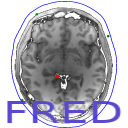







Author: Stephen Thompson
Fiducial Registration Educational Demonstration (SciKit-SurgeryFRED) is part of the SciKit-Surgery software project, developed at the Wellcome EPSRC Centre for Interventional and Surgical Sciences, part of University College London (UCL). This repository only contains the backend functions, not any user interface.
Fiducial Registration Educational Demonstration is tested with Python 3.X
Fiducial Registration Educational Demonstration is intended to be used as part of an online tutorial in using fiducial based registration. The tutorial covers the basic theory of fiducial based registration, which is used widely in image guided interventions. The tutorial aims to help the students develop an intuitive understanding of key concepts in fiducial based registration, including Fiducial Localisation Error, Fiducial Registration Error, and Target Registration Error.
Please explore the project structure, and implement your own functionality.
Citing
If you use SciKit-SurgeryFRED in your research or teaching please cite it. Individual releases can be cited via the Zenodo tag. SciKit-Surgery should be cited as:
Thompson S, Dowrick T, Ahmad M, et al. “SciKit-Surgery: compact libraries for surgical navigation.” International Journal of Computer Assisted Radiology and Surgery. 2020 May. DOI: 10.1007/s11548-020-02180-5.
Developing
Cloning
You can clone the repository using the following command:
git clone https://github.com/UCL/scikit-surgeryfredbackend
Running tests
Pytest is used for running unit tests:
pip install pytest
python -m pytest
Linting
This code conforms to the PEP8 standard. Pylint can be used to analyse the code:
pip install pylint
pylint --rcfile=tests/pylintrc sksurgeryfredbackend
Installing
You can pip install directly from the repository as follows:
pip install git+https://github.com/UCL/scikit-surgeryfredbackend
Contributing
Please see the contributing guidelines.
Useful links
Licensing and copyright
Copyright 2020 University College London. Fiducial Registration Educational Demonstration is released under the BSD-3 license. Please see the license file for details.
Acknowledgements
1 maintainer

Metadata
1 maintainer
Release files for scikit-surgeryfredbackend 0.0.6
For a detailed explanation of source distributions (sdists) and built distributions (wheels), please see the package formats documentation.
Source distribution (sdist)
| File | Size | Uploaded | Provenance | Actions |
|---|---|---|---|---|
| scikit-surgeryfredbackend-0.0.6.tar.gz | 28.0 kB | Without provenance | Details for scikit-surgeryfredbackend-0.0.6.tar.gz |
Release files / scikit-surgeryfredbackend-0.0.6.tar.gz
| Download URL | scikit-surgeryfredbackend-0.0.6.tar.gz |
|---|---|
| Size | 28.0 kB |
| Tags | Source |
|
SHA-256 checksum How to use checksums |
51fa07fe512b693efac45e7430a7211346cc41ca9f6eab25340a6f11a3920b80
|
|
BLAKE2b-256 checksum How to use checksums |
c9dedd3d30df3d86f68e5e65c62210134fc859270f5fbd56534df754594044df
|
| Upload date | |
|
Uploaded using Trusted Publishing? What is trusted publishing? |
No |
| Uploaded via |
twine/3.2.0 pkginfo/1.6.1 requests/2.25.0 setuptools/50.3.2 requests-toolbelt/0.9.1 tqdm/4.52.0 CPython/3.8.6
|
Security for scikit-surgeryfredbackend 0.0.6
Provenance
Provenance describes where a file came from. On PyPI, provenance is shared via attestations, which provide a verifiable record of the build or publishing details. View details, limitations and caveats.
No provenance found
None of the files in this release were uploaded with provenance metadata.
A note on package security
PyPI is a repository for distributing packages, not a service for auditing them. While third-party security researchers and our staff do their best to detect and remove malicious packages, PyPI cannot guarantee the quality, security or suitability of any given package.
To learn more about protecting yourself from malicious actors, visit our package security documentation.













