
SET-ANUBIS

Simulation, accEptance and sensiTivity studies framework for ANUBIS











SET-ANUBIS is a modular framework for studying the sensitivity of the proposed ANUBIS detector to scenarios containing long-lived particles (LLPs). It provides a common analysis chain from the definition of a beyond-the-Standard-Model (BSM) spectrum to the calculation of decay properties, event generation, event ingestion, detector-geometry acceptance and truth-level event selection.
The framework was developed to reduce the model-specific code normally required for LLP sensitivity studies. A model supplied in Universal Feynman Output (UFO) format can be connected to several calculation and generation strategies, while the downstream geometry and selection stages remain common. This makes it possible to compare models using the same detector description, selection logic and provenance machinery.
Scientific scope
ANUBIS is a proposed transverse LLP detector at LHC Point 1. The detector concept uses resistive-plate-chamber tracking stations in the ATLAS cavern and service-shaft infrastructure. It is intended to provide sensitivity to neutral LLPs that escape the main ATLAS detector before decaying into charged final states in the surrounding cavern volume.
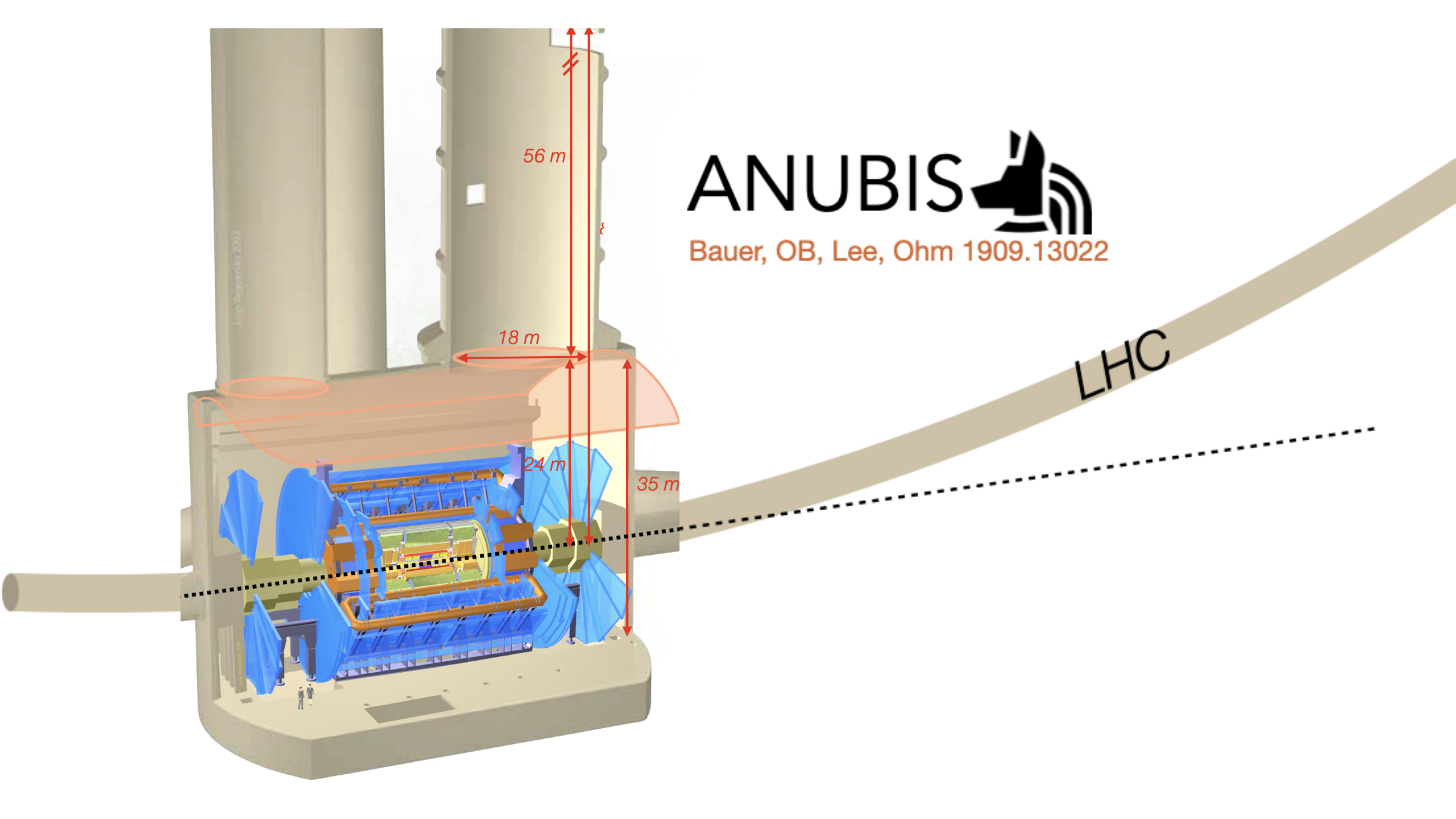
ANUBIS ceiling-detector concept and LHC Point-1 geometry, reproduced from the ANUBIS proposal (arXiv:1909.13022) under CC BY-NC-ND 4.0. The PDF page was converted to PNG without altering its content.
SET-ANUBIS addresses three connected parts of an ANUBIS sensitivity study:
- Signal-sample preparation. Model parameters and particle properties are read from UFO inputs; decay widths, branching ratios and lifetimes are supplied through interchangeable calculation strategies; MadGraph or optional Pythia workflows are then prepared for event generation.
- Geometric acceptance and event selection. HepMC events are converted into analysis objects and propagated through a model of the ATLAS cavern and ANUBIS tracking stations. The selection applies decay-volume, station-intersection, tracking, missing-transverse-momentum and isolation requirements.
- Sensitivity inputs and provenance. Acceptances can be combined with luminosities, production cross sections, branching fractions and signal efficiencies. Cards, scan metadata, compact event bundles and derived artefacts can be stored with content-based identifiers for later inspection or reproduction.
Software organisation
The code is organised using ports and adapters. Each physics domain exposes a small interface, while file formats, databases, external programs and visualisation tools are implemented as adapters. This separation keeps the physics logic testable and allows individual backends to be replaced without rewriting the complete workflow.
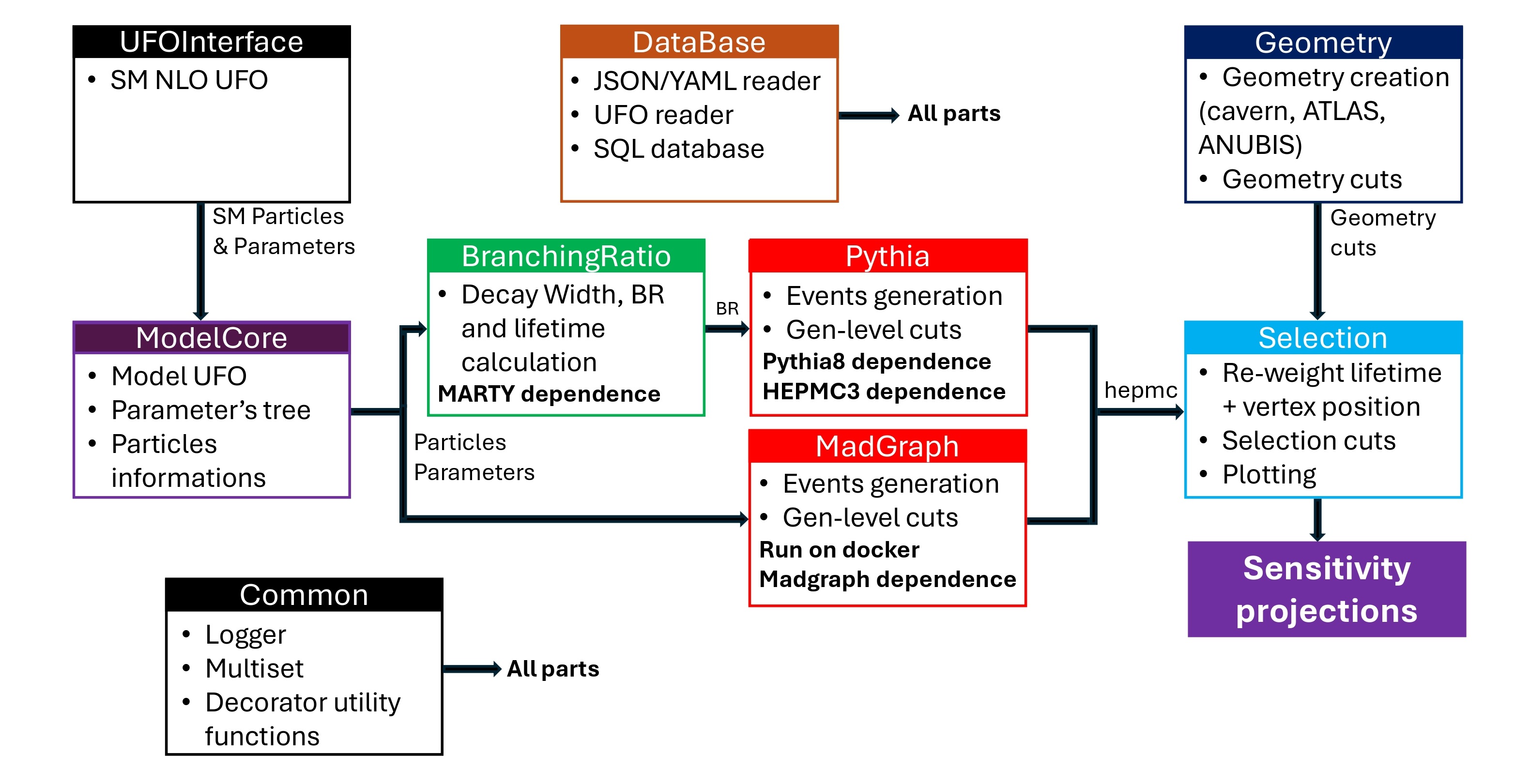
The principal subsystems are:
- Model core and UFO interface — expose scan parameters, particle content and packaged model resources.
- Decay-property layer — evaluate or prepare partial widths, total widths, branching ratios and lifetimes using Python functions, interpolation tables, UFO information, MadGraph or MARTY-oriented workflows.
- MadGraph layer — construct process commands, run cards, parameter cards, MadSpin cards and shower configuration for scan points.
- Pythia layer — prepare
.cmndfiles and optionally build a native Pythia8/HepMC3 interface for dedicated studies. - Geometry and selection — convert HepMC events into dataframe bundles, build prompt jets and isolation variables, evaluate the ANUBIS geometry and apply the analysis cutflow.
- Database and content-addressed storage — retain scan metadata and compact, selection-ready event bundles while avoiding unnecessary duplication of large generator outputs.
- Dash applications — inspect HepMC events in the cavern geometry and audit the database, stored artefacts and bundle sizes.
Installation
The Python distribution is named SetAnubis:
python -m pip install SetAnubis
For a development checkout:
git clone https://github.com/SET-ANUBIS/set-anubis.git
cd set-anubis
python -m pip install -e ".[dev,docs,selection,madgraph]"
python -m pytest -q setanubis/tests
Optional feature groups are available through extras:
python -m pip install "SetAnubis[selection]"  # HepMC ingestion and selection helpers
python -m pip install "SetAnubis[madgraph]"   # MadGraph/Docker helpers
python -m pip install "SetAnubis[app]"        # Dash applications
python -m pip install "SetAnubis[docs]"       # local Sphinx documentation
Optional Pythia8/HepMC3 extension
The standard wheel is Python-only. The native interface is built only when it is explicitly requested and the external installations are supplied:
SETANUBIS_BUILD_PYTHIA=1 \
SETANUBIS_PYTHIA8_DIR=/path/to/pythia8 \
SETANUBIS_HEPMC3_DIR=/path/to/hepmc3 \
python -m pip install --no-binary SetAnubis "SetAnubis[pythia]"
For a local checkout, the external helper can build HepMC3 and Pythia8 before the editable installation:
./External_Integration/install.sh HepMC3 Pythia
SETANUBIS_BUILD_PYTHIA=1 \
SETANUBIS_PYTHIA8_DIR=$PWD/External_Integration/Pythia/pythia8315 \
SETANUBIS_HEPMC3_DIR=$PWD/External_Integration/HepMC3/hepmc3-install \
python -m pip install -e ".[pythia]"
setanubis-pythia-check
The native-build policy and supported environment variables are described in PYTHIA_PACKAGING.md.
Public Python interface
The recommended import layer is the lower-case module setanubis:
from setanubis import (
    SetAnubisInterface,
    MadGraphCommandConfig,
    GeneralCardInterface,
    SelectionConfig,
    SelectionPipelineBuilder,
    DecayInterface,
    CalculationDecayStrategy,
    ufo_path,
)
Internal modules under SetAnubis.core remain available for advanced development, but analysis scripts and public examples should use the stable facade whenever possible.
Worked workflows
MadGraph card preparation
The following example prepares an HNL scan without launching MadGraph:
from setanubis import (
    SetAnubisInterface,
    MadGraphCommandConfig,
    GeneralCardInterface,
    ufo_path,
)

model = SetAnubisInterface(str(ufo_path("UFO_HNL")))
config = MadGraphCommandConfig(
    neo_set_anubis=model,
    model_in_madgraph="UFO_HNL",
    shower="py8",
    madspin="ON",
    cache=False,
)

cards = GeneralCardInterface(config)
cards.run_card_builder.set("nevents", 2000)
cards.run_card_builder.set("ebeam1", 6800)
cards.run_card_builder.set("ebeam2", 6800)

cards.madspin_builder.clear_decays()
cards.madspin_builder.add_decay("decay n1 > ell ell vv")

job = cards.jobscript_builder
job.add_process("generate p p > n1 ell # [QCD]")
job.set_output_launch("HNL_ANUBIS_scan")
job.configure_cards()
job.add_parameter_scan("MN1", "[0.5, 1.0, 2.0]")
job.add_parameter_scan("VeN1", "[1e-6, 1e-5]")

print(job.serialize())
Additional examples are available in setanubis/SetAnubis/examples/MadGraph.
Branching ratios, decay widths and lifetimes
The branching-ratio examples demonstrate each supported preparation path: explicit values, trusted Python calculators, interpolation tables, UFO-derived functions, MadGraph preparation and MARTY source preparation.
python setanubis/SetAnubis/examples/BranchingRatio/dev_examples/example_manual_values_and_lifetime.py
python setanubis/SetAnubis/examples/BranchingRatio/dev_examples/example_file_interpolation.py
python setanubis/SetAnubis/examples/BranchingRatio/dev_examples/example_madgraph_preparation.py --output-dir prepared_widths
python setanubis/SetAnubis/examples/BranchingRatio/dev_examples/example_marty_preparation.py --output prepared_marty/z_to_ddbar.cpp
The preparation examples do not run MadGraph, Docker, a compiler or MARTY. Python calculators and UFO models are executable inputs and should only be loaded from trusted sources.
Geometry-aware selection and cutflow tracing
The nominal cutflow first identifies LLP decays in the relevant cavern or shaft volume, rejects vertices inside ATLAS, evaluates the ANUBIS station and track intersections, and finally applies missing-transverse-momentum and isolation requirements.
from setanubis import (
    ATLASCavernGeometry,
    ATLASCavernGeometryConfig,
    SelectionGeometryAdapter,
    SelectionConfig,
    RunConfig,
    MinThresholds,
    MinDR,
    SelectionPipelineBuilder,
    EventsBundleSource,
)

geometry = SelectionGeometryAdapter(
    ATLASCavernGeometry.create(
        ATLASCavernGeometryConfig(mode="ceiling", origin="IP", use_cache=False)
    )
)

selection = SelectionConfig(
    geometry=geometry,
    minMET=30.0,
    minP=MinThresholds(LLP=0.1, chargedTrack=0.1, neutralTrack=0.1, jet=0.1),
    minPt=MinThresholds(LLP=0.0, chargedTrack=5.0, neutralTrack=5.0, jet=15.0),
    minDR=MinDR(jet=0.4, chargedTrack=0.4, neutralTrack=0.4),
    nStations=2,
    nIntersections=2,
    nTracks=2,
)

pipeline = (
    SelectionPipelineBuilder()
    .set_options(add_jets=True, compute_isolation=True, selection_mode="standard")
    .build()
)
source = EventsBundleSource.from_bundle_file("sample_bundle.pkl.gz")
result = pipeline.run(source, selection, RunConfig(capture_intermediate=True))

trace = result["trace"]
print(trace.candidate_summary)
print(trace.event_summary)
trace.write_report("selection_trace_output")
The repository includes a compact seven-event HNL sample selected from a 4,000-event corpus. It contains representative events that fail at InCavern, NotInATLAS, Geometry, Tracker, MET and IsoJets, together with one event that reaches the final selection. The aligned HepMC, compressed CSV, trusted compressed-pickle bundle and provenance manifest occupy less than 1 MB.
python setanubis/SetAnubis/examples/Selection/example_real_selection_trace_report.py \
  --output-dir selection_trace_output
Security note: loading a pickle can execute arbitrary Python code. Only load bundles produced by a trusted SET-ANUBIS workflow or obtained from a verified source. See
SECURITY.md.
Console banners
The public API can display a compact SET-ANUBIS banner once per Python process.
The default auto mode only prints in an interactive terminal, so redirected
logs, notebooks and CI jobs remain quiet unless the banner is explicitly
requested.
export SETANUBIS_BANNER=always  # force the SET-ANUBIS banner
export SETANUBIS_BANNER=never   # disable it
from setanubis import show_banner

show_banner(force=True)
The SET-ANUBIS banner identifies the software version and developers, reports
whether the optional compiled Pythia binding is available in the current Python
environment, and reminds users to cite the current ANUBIS proceedings
contribution together with the versioned Zenodo software record
10.5281/zenodo.21462101. The
SETANUBIS_ZENODO_DOI environment variable remains available as an explicit
override for development builds and later releases.
FastJet prints its own citation banner the first time a clustering sequence is created. SET-ANUBIS suppresses that console output by default so that selection jobs, notebooks and CI logs remain concise. Users can restore it explicitly:
export SETANUBIS_FASTJET_BANNER=1
or in Python:
from setanubis import JetClustering, JetClusteringConfig

clustering = JetClustering(JetClusteringConfig(show_banner=True))
Suppressing the FastJet console banner does not alter the clustering algorithm and does not remove the requirement to cite FastJet in scientific work.
Reproducibility
The reproducibility/ directory contains five deterministic CPC scenarios, labelled R1–R5. Each scenario has a documented input/, a generated output/ directory excluded from Git, a version-controlled expected_output/, and an independently executable run.py.
- R1 checks the public model interface and bundled HNL UFO.
- R2 reproduces reference partial widths, total width and branching ratios.
- R3 generates a deterministic Pythia command card without running Pythia.
- R4 generates MadGraph, run, parameter, shower and MadSpin cards without running MadGraph or Docker.
- R5 rebuilds the seven-event sample directly from the packaged HepMC2 input and reproduces the geometry-aware selection cutflow and trace report.
python -m pip install -e ".[dev,selection]"
python reproducibility/run_reproducibility.py \
  --output-root reproducibility_outputs
A successful run creates reproducibility_outputs/VALIDATED. The generated summaries are compared with the corresponding expected_output/summary.json files. The dedicated Reproducibility / CPC R1-R5 GitHub workflow is intended to be a required status check before merging or releasing.
Interactive applications
The optional Dash applications are specialised scientific inspection tools rather than generic dashboards:
- HepMC selection explorer — starts from the packaged CPC R5 HNL sample, reproduces the ordered selection cutflow, identifies the first failed stage for each event, and overlays LLP vertices and decay topologies on the ATLAS-cavern/ANUBIS geometry.
- Campaign database inspector — starts from an internal SQLite/CAS demonstration workspace and audits generator provenance, scan metadata, retained artifacts and selection-ready DataFrame bundles.
Install and launch them with:
python -m pip install "SetAnubis[app,selection]"
setanubis-hepmc-explorer --host 127.0.0.1 --port 8050
setanubis-db-dashboard --host 127.0.0.1 --port 8051
Both applications have usable packaged defaults. Local HepMC files or campaign databases can be selected from their sidebars; explicit database paths remain available through --db, --storage and --events-root. The version-controlled selection and geometry APIs, not an interactive screenshot, remain the source of truth for published results.
Documentation and validation
The Sphinx manual is hosted at https://set-anubis.github.io/set-anubis/. A strict local build can be run with:
python -m pip install -e ".[docs]"
setanubis-docs --strict
The release gate includes the Python 3.10–3.13 test matrix, public-API contract tests, static checks, dependency and source security scans, deterministic reproducibility examples, documentation warnings as errors, package construction and clean-wheel installation.
Maintainers can run the fast post-patch checks and the complete release-candidate gate with:
python scripts/run_patch_checks.py
python scripts/run_patch_checks.py --full
The underlying scripts/check_release_metadata.py command verifies that the package version, release date, DOI, licence, contacts, changelog, Sphinx metadata and release workflow remain coherent. Maintainer-side GitHub environment, branch-protection and Trusted Publisher settings are documented in GITHUB_RELEASE_SETUP.md.
Citation and archival
Citation metadata for the software is provided in CITATION.cff. Until the dedicated Computer Physics Communications software article is available, its preferred-citation points to the related ANUBIS proceedings contribution, ANUBIS: Projected Sensitivities and Initial Results from the proANUBIS demonstrator with Run 3 LHC data. Replace that temporary preferred citation with the final CPC record when it becomes public.
The ANUBIS HNL sensitivity study obtained with SET-ANUBIS is available as Projected sensitivity of the ANUBIS detector to heavy neutral leptons. Users should cite the software record and the physics article(s) relevant to the analysis being reproduced.
Version 1.0.0 is archived under the reserved Zenodo DOI 10.5281/zenodo.21462101. The repository also contains .zenodo.json metadata for the manual software deposit. Because the DOI was reserved in a Zenodo draft before tagging, the GitHub--Zenodo automatic archiving integration must remain disabled for this first release to avoid creating a duplicate record. Upload the clean set-anubis-1.0.0-source.zip attached to the GitHub Release to that draft before publication, and verify its SHA-256 value against SHA256SUMS. The wheel, source distribution, checksums and validated release-metadata report remain available as immutable GitHub Release assets.
Project roles and contributors
- Théo Reymermier — Project Leader and Lead Developer
- Paul Swallow — Project Manager and Developer
- Contributors — Sofie Erner, Anna Mullin, Toby Satterthwaite and Oleg Brandt
The software creator and contributor roles are recorded in .zenodo.json; the complete acknowledgement list is maintained in AUTHORS.md.
License
SET-ANUBIS is free software distributed under the GNU General Public License, version 3 or any later version (GPL-3.0-or-later). See LICENSE. Files originating from external projects remain subject to their respective upstream terms where indicated.
1 maintainer

Metadata
1 maintainer
Release files for SetAnubis 1.0.0
For a detailed explanation of source distributions (sdists) and built distributions (wheels), please see the package formats documentation.
Source distribution (sdist)
| File | Size | Uploaded | |
|---|---|---|---|
| setanubis-1.0.0.tar.gz | 6.5 MB | Details |
Built distribution (wheel)
| File | Interpreter | ABI | Platform | Reset |
|---|---|---|---|---|
| setanubis-1.0.0-py3-none-any.whl | Python 3 | none | any | Details |
Total release size: 9.4 MB
Release files / setanubis-1.0.0.tar.gz
| Download URL | setanubis-1.0.0.tar.gz |
|---|---|
| Size | 6.5 MB |
| Tags | Source |
|
SHA-256 checksum How to use checksums |
17c9f1fc5c2532bf93e59e1eaafdbf42f0ffa616b94c00fd995a94f178a2ac10
|
|
BLAKE2b-256 checksum How to use checksums |
fbbab2b5f6db607728b0fa781c62ef13ee0f49a268d472a2c855bbe790f37ab1
|
| Upload date | |
|
Uploaded using Trusted Publishing? What is trusted publishing? |
Yes |
| Uploaded via |
twine/6.1.0 CPython/3.13.14
|
Provenance
Provenance describes where a file came from. On PyPI, provenance is shared via attestations, which provide a verifiable record of the build or publishing details. View details, limitations and caveats.


PyPI Publish Attestation
PyPI verified that this artifact, at this checksum, originated from the publisher listed below.
Signed by GitHub Actions, verified by PyPI on Jul 20, 2026.
Transparency logRelease files / setanubis-1.0.0-py3-none-any.whl
| Download URL | setanubis-1.0.0-py3-none-any.whl |
|---|---|
| Size | 2.9 MB |
| Tags | Python 3 |
|
SHA-256 checksum How to use checksums |
3fe7973fe721e7f16df3b6fa2766320047dcb312c2212b65edaa327771bc8344
|
|
BLAKE2b-256 checksum How to use checksums |
bffabef916d9de18a5361f15719adccaa9ef576e7317d1b08bb024b547d229dd
|
| Upload date | |
|
Uploaded using Trusted Publishing? What is trusted publishing? |
Yes |
| Uploaded via |
twine/6.1.0 CPython/3.13.14
|
Provenance
Provenance describes where a file came from. On PyPI, provenance is shared via attestations, which provide a verifiable record of the build or publishing details. View details, limitations and caveats.
PyPI Publish Attestation
PyPI verified that this artifact, at this checksum, originated from the publisher listed below.
Signed by GitHub Actions, verified by PyPI on Jul 20, 2026.
Transparency log












