
simple-rule-engine
A lightweight yet powerful rule engine that allows declarative specification of business rules and saves tons of repeated development work.
- This library has been utilized in authoring & evaluation of a number of complex credit decisioning, upgrade/downgrade, and lender evaulation criteria rules at FundsCorner
- This library can also be considered as a Policy Framework for validating IaC (Infrastructure as Code).


At a glance
simple-rule-engine is a Python library that enables declarative specification of decision or scoring rules.
Example Decision matrix
| Bureau Score | Marital Status | Decision |
|---|---|---|
| between 650 and 800 | in [Married, Unspecified] | GO |
Rule specification
from simpleruleengine.conditional.when_all import WhenAll
from simpleruleengine.expression.expression import Expression
from simpleruleengine.operator.between import Between
from simpleruleengine.operator.string_in import In
from simpleruleengine.rulerow.rule_row_decision import RuleRowDecision
from simpleruleengine.ruleset.rule_set_decision import RuleSetDecision
from simpleruleengine.token.numeric_token import NumericToken
from simpleruleengine.token.string_token import StringToken

if __name__ == "__main__":
    cibil_score_between_650_800 = Expression(
        NumericToken("cibil_score"),
        Between(floor=650, ceiling=800)
    )
    marital_status_in_married_unspecified = Expression(
        StringToken("marital_status"),
        In("Married", "Unspecified")
    )

    rule_row_decision_go = RuleRowDecision(
        WhenAll(
            cibil_score_between_650_800,
            marital_status_in_married_unspecified
        ),
        "GO"
    )
    rule_set_decision = RuleSetDecision(rule_row_decision_go)

    fact = dict(
        cibil_score=700,
        marital_status="Married"
    )
    assert rule_set_decision.evaluate(fact) == "GO"
Key Features
- Ability to declaratively author both Scoring and Decision Rules.
- The library offers composable functional syntax that can be extended with various format adapters. See here for an example of such an extension.
- Ability to version control rule declarations thus enabling auditing of rule changes over a period of time.
- Ability to author chained rules. Evaluation of one rule can refer to the result of another rule, thus enabling modular, hierarchical rules.
Installation
pip install simpleruleengine==2.0.2
Source Code
simple-rule-engine GitHub Repository
Table of Contents
Why Rule Engine?
Decision making has always been at the heart of any business. In certain industries (such as Lending), some of the decisions made are so dynamic & at a flux that programming these decisions by hand is counter-productive. See here for additional context.
Take the example of the decision of giving someone a loan. It primarily involves ascertaining two fundamental factors:
- Ability to repay the loan.
- Intent to repay the loan.
When you start assessing a borrower based on above, you typically get all facts required to make a decision (such as Bureau score, bank statements etc.) and you will pass these facts through a decision matrix to arrive at
- A composite score on a scale that gives an indication of whether the borrower will repay the loan (intent)
- A recommendation of how much loan should be given to the borrower. (ability)
The aforementioned decisions involve evaluation of multiple parameters. You simply cannot write a program to solve such complex scoring or decision problems:
- The evaluations and/or scores will always change over a period of time to adjust to business needs
- The rules will also change based on the nature of the business product.
The simple-rule-engine solves such dynamic decision making problems by abstracting the scoring or decision making into a framework and providing a standard rule template to author the rules.
The rules can be authored through a separate UI and stored as rule template in a database. The rule engine then can be treated as a service and just by passing all the facts (a.k.a inputs), we get the the corresponding decisions or scores (output).
The caller of the rule engine is agnostic of the business logic behind rule evaluation.
Benefits
- Declarative authoring of rules. This can be done by a business analyst, and can be facilitated through a UI.
- Once composed, rules can be serialized as a json and persisted into database for repeated use.
- The developer just focuses on extracting the facts that are required to be passed into the engine.
- Ability to version a rule and audit rule changes over a period of time.
- Segregate business logic from the data.
Concepts
The simple-rule-engine is composed of two parts:
- A Rule template which enables one to declaratively specify a rule, which can either be a Decision (or) a Score. The rule template is uniquely identified by a name.
- A parser engine which when passed with a rule name & facts, parses the rule template against the facts given and provides an output. The output can either be a score (numeric) or a decision (anything).
The simple-rule-engine allows the rules to be “chained”. I.e. you can build a small portion of the score as an independent rule and “use” this rule in another rule.
Rule Declaration Language
- At the heart of simple-rule-engine is the rule declaration language.
- The rule declaration language supports two types of rules: Decision rule or a Score rule.
Score rule:
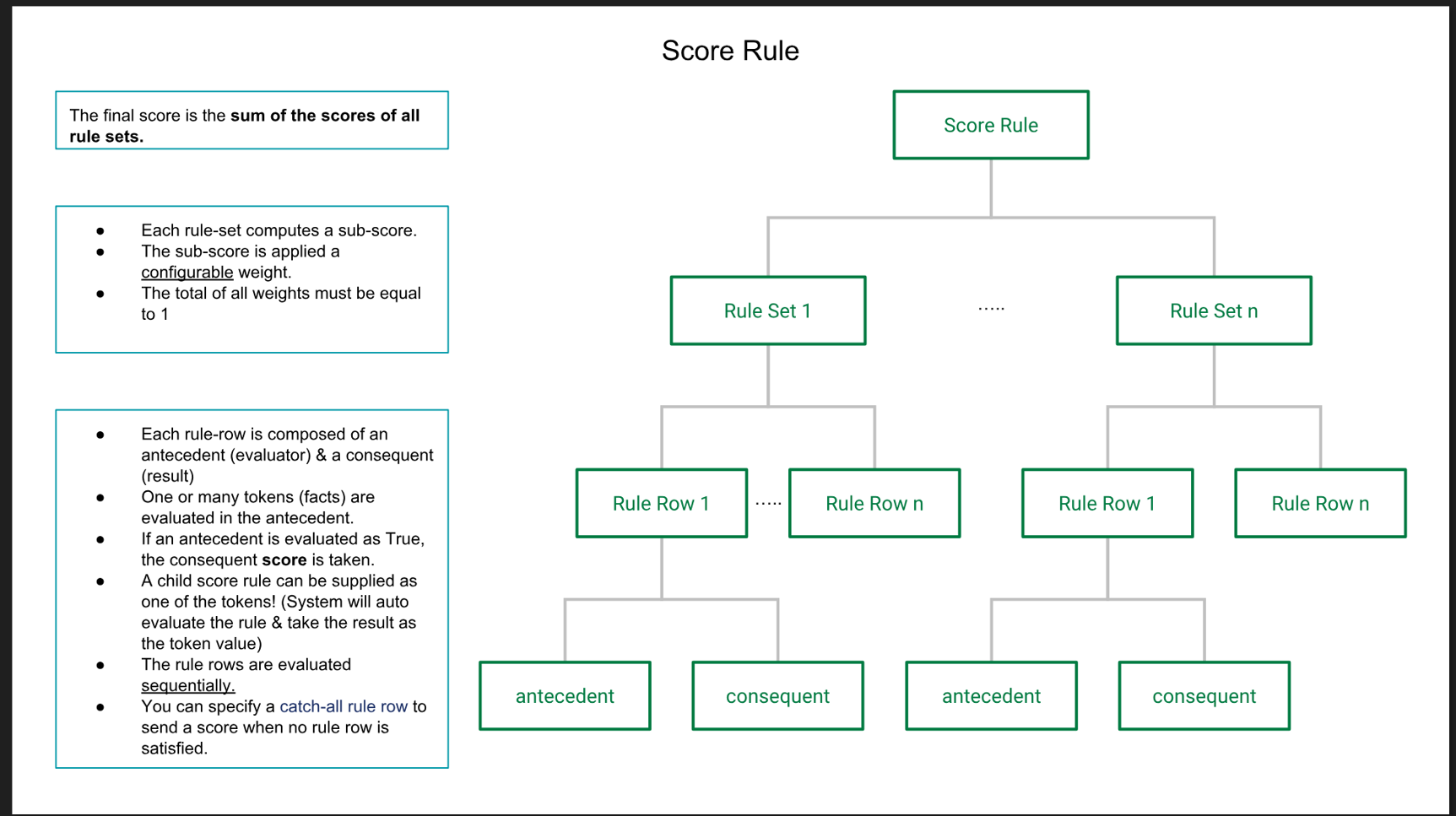
- A Score rule is composed of one or many rule sets.
- Each rule-set computes a sub-score and is applied a weight.
- The total score then would be the sum of all the individual scores of all the rule sets belonging to a rule.
- A rule set is composed of one or many rule rows.
- You can ‘roughly’ think of each Rule Row as a Conditional evaluation of the facts (a.k.a antecedent) & a score based on these conditions (a.k.a consequent).
Decision rule:
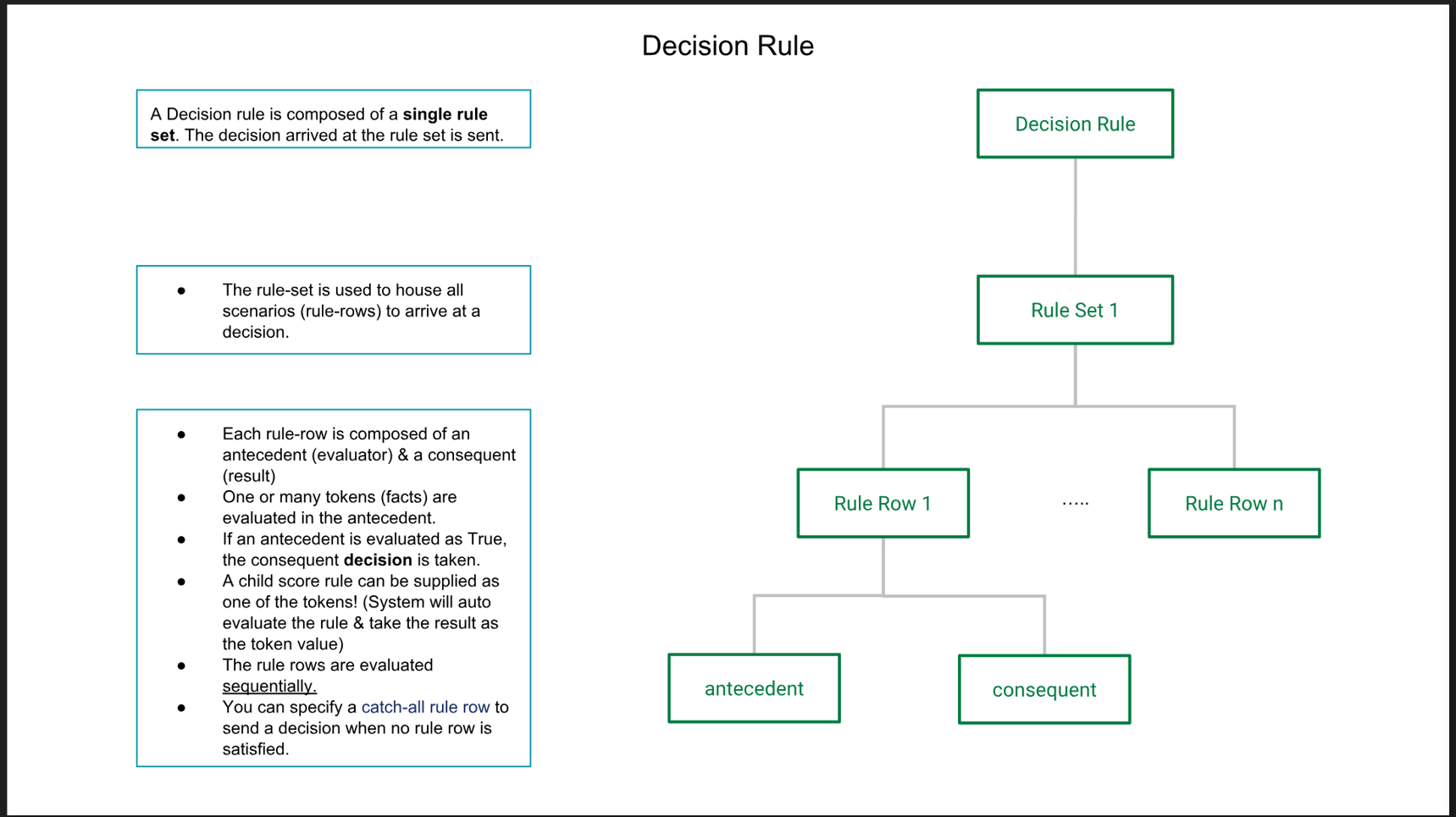
- A Decision rule is always composed of only one rule set.
- A rule set is composed of one or many rule rows.
- You can ‘roughly’ think of each Rule Row as a Conditional evaluation of the facts (a.k.a antecedent) & a decision based on these conditions (a.k.a consequent).
- A decision rule always arrives at a single decision at the end of parsing.
- The decision can be anything (a numeric, a string such as YES/NO or even a JSON)
- Once a Rule Row evaluates to True, the corresponding decision is returned immediately.
Antecedent and Consequent
- An antecedent at the core is an evaluator. It evaluates one or many facts through an operator.
- For evaluating numeric facts, a numeric operator is used. It can be one of (<=, <, >, >=, ==, <>, between, is_none)
- For evaluating string facts, a string operator is used. It can be one of (in_list, contains, is_none, equals)
- You can mix evaluation of more than one fact & combine the result with an “and” or “or” condition.
- You can perform complex evaluations involving multiple facts combining AND and OR conditions recursively in the antecedent. See Examples.
- A rule can be part of another rule. See Examples
Grammar
Token:
An entity that is representative of a fact, and also guides clients on the data type of fact to be supplied.
Types of Tokens:
- NumericToken
- StringToken
- BooleanToken
- RuleToken: A rule itself, composed as a Token
Example:
StringToken("pet")represents a token pet of type String.NumericToken("age")represents a token age of type Numeric.
A rule can be a Token too. A RuleToken implements Token and composes a Rule. When asked for value, a RuleToken executes the rule it composes and provides the value.
Operator:
An Operator composes a base value and evaluates against a value supplied.
Example: Gte(35).evaulate(15) returns False. Gte(35.0).evaulate(40.0) returns True.
Expression:
An Expression composes a Token on the left hand side (LHS), Operator in the middle and the data to be evaulated on the right hand side (RHS).
Example:
Expression(NumericToken("cibil_score"), Between(floor=650, ceiling=800)) represents an evaulation that compares whether the fact cibil_score is between 650 and 800 or not. Specified in SQL terms, this translates to WHERE cibil_score between 650 and 800.
Expression(NumericToken("cibil_score"), Between(floor=650, ceiling=800)).evaluate(dict(cibil_score=700)) evaluates to True.
Conditional:
- A Conditional composes a list of Expressions.
- WhenAll evaluates to True when all expressions evaluate to True.
- WhenAny evaluates to True when any expression evaluates to True.
- A Conditional can compose a Conditional - this enables clients to express complex conditions.
- A Conditional can be further extended to implement NotWhenAll or NotWhenAny etc. as well.
Example:
cibil_score_between_650_800 = Expression(NumericToken("cibil_score"), Between(floor=650, ceiling=800))
marital_status_in_married_unspecified = Expression(StringToken("marital_status"), In("Married", "Unspecified"))
business_owned_by_self_family = Expression(StringToken("business_ownership"), In("Owned by Self", "Owned by Family"))

WhenAll(
    cibil_score_between_650_800,
    marital_status_in_married_unspecified,
    business_owned_by_self_family
)

# A Conditional composing another Conditional. The below statement is equivalent of
# WHERE applicant_age >= 35 AND ( business_ownership in ('SELF', 'FAMILY') OR applicant_ownership in ('SELF', 'FAMILY') )
WhenAll(
    applicant_age_gte_35,
    WhenAny(
        business_owned_by_self_family,
        applicant_owned_by_self_family
    )
),
RuleRowDecision/RuleRowScore:
- A RuleRow composes a Conditional (as an antecedent) and specifies a consequent (result) when antecedent evaluates to True.
- For a Score, consequent must be a float.
- For a Decision, consequent can be anything.
RuleSetDecision/RuleSetScore:
- A Rule Set composes a set of RuleRows.
- For a score, each rule set carries a weight and the total weight of all rule sets must be equal to 1.
- For a decision, there must be only one rule set.
RuleDecision/RuleScore:
- A rule composes one or many Rule sets.
- For a score, the total score is calculated as sum(rule set score * weight).
- A rule exposes
get_token_dict_structurefunction that returns a dictionary of all facts required for the rule to be executed successfully.
Examples
A simple decision tree involving facts
Decision matrix
| Bureau Score | Marital Status | Business Ownership | Decision |
|---|---|---|---|
| between 650 and 800 | in [Married, Unspecified] | in [Owned by Self, Owned by Family] | GO |
Rule specification
from simpleruleengine.conditional.when_all import WhenAll
from simpleruleengine.expression.expression import Expression
from simpleruleengine.operator.between import Between
from simpleruleengine.operator.string_in import In
from simpleruleengine.rulerow.rule_row_decision import RuleRowDecision
from simpleruleengine.ruleset.rule_set_decision import RuleSetDecision
from simpleruleengine.token.numeric_token import NumericToken
from simpleruleengine.token.string_token import StringToken

if __name__ == "__main__":
    cibil_score_between_650_800 = Expression(
        NumericToken("cibil_score"),
        Between(floor=650, ceiling=800)
    )
    marital_status_in_married_unspecified = Expression(
        StringToken("marital_status"),
        In("Married", "Unspecified")
    )
    business_owned_by_self_family = Expression(
        StringToken("business_ownership"),
        In("Owned by Self", "Owned by Family")
    )

    rule_row_decision_go = RuleRowDecision(
        WhenAll(
            cibil_score_between_650_800,
            marital_status_in_married_unspecified,
            business_owned_by_self_family
        ),
        "GO"
    )
    rule_set_decision = RuleSetDecision(rule_row_decision_go)

    fact = dict(
        cibil_score=700,
        marital_status="Married",
        business_ownership="Owned by Self"
    )
    assert rule_set_decision.evaluate(fact) == "GO"
A complex decision tree involving multiple AND and OR conditions
Decision matrix
| Applicant Age | Applicant Ownership | Business Ownership | Decision |
|---|---|---|---|
| >=35 | in [Owned by Self, Owned by Family] | in [Owned by Self, Owned by Family] | GO |
| >=35 | in [Owned by Self, Owned by Family] | in [Rented] | GO |
| >=35 | in [Rented] | in [Owned by Self, Owned by Family] | GO |
| >=35 | in [Rented] | in [Rented] | NO GO |
| <35 | in [Rented] | in [Rented] | NO GO |
| <35 | in [Owned by Self, Owned by Family] | in [Rented] | NO GO |
| <35 | in [Rented] | in [Owned by Self, Owned by Family] | NO GO |
| <35 | in [Owned by Self, Owned by Family] | in [Owned by Self, Owned by Family] | GO |
- when the applicant age is >=35, either of applicant ownership or business ownership must be Owned.
- When the applicant age is <35, both the applicant ownership and business ownership must be Owned.
Rule specification
from simpleruleengine.conditional.when_all import WhenAll
from simpleruleengine.conditional.when_any import WhenAny
from simpleruleengine.expression.expression import Expression
from simpleruleengine.operator.greater_than_equal import Gte
from simpleruleengine.operator.string_in import In
from simpleruleengine.rulerow.rule_row_decision import RuleRowDecision
from simpleruleengine.ruleset.rule_set_decision import RuleSetDecision
from simpleruleengine.token.numeric_token import NumericToken
from simpleruleengine.token.string_token import StringToken

if __name__ == "__main__":
    applicant_age_gte_35 = Expression(
        NumericToken("applicant_age"),
        Gte(35)
    )
    business_owned_by_self_family = Expression(
        StringToken("business_ownership"),
        In("Owned by Self", "Owned by Family")
    )
    applicant_owned_by_self_family = Expression(
        StringToken("applicant_ownership"),
        In("Owned by Self", "Owned by Family")
    )

    rule_row_decision_go = RuleRowDecision(
        WhenAll(
            applicant_age_gte_35,
            WhenAny(
                business_owned_by_self_family,
                applicant_owned_by_self_family
            )
        ),
        "GO"
    )
    rule_set_decision = RuleSetDecision(rule_row_decision_go)

    fact_go = dict(
        applicant_age=42,
        applicant_ownership="Not Owned",
        business_ownership="Owned by Self"
    )
    assert rule_set_decision.evaluate(fact_go) == "GO"

    fact_no_go_1 = dict(
        applicant_age=42,
        applicant_ownership="Not Owned",
        business_ownership="Not Owned"
    )
    assert rule_set_decision.evaluate(fact_no_go_1) != "GO"

    fact_no_go_2 = dict(
        applicant_age=25,
        applicant_ownership="Owned by Self",
        business_ownership="Owned by Self"
    )
    assert rule_set_decision.evaluate(fact_no_go_2) != "GO"
A scoring rule involving multiple parameters
| Rule set Name | Weightage |
|---|---|
| no_of_running_bl_pl | 0.5 |
| last_loan_drawn_in_months | 0.5 |
no_of_running_bl_pl
| Condition | Score |
|---|---|
| no_of_running_bl_pl >= 7 | -100 |
| no_of_running_bl_pl >= 4 | -40 |
| no_of_running_bl_pl >= 2 | 30 |
| no_of_running_bl_pl >= 0 | 100 |
| no_of_running_bl_pl is none | 100 |
last_loan_drawn_in_months
| Condition | Score |
|---|---|
| last_loan_drawn_in_months == 0 | 30 |
| last_loan_drawn_in_months <3 | -30 |
| last_loan_drawn_in_months <= 12 | 40 |
| last_loan_drawn_in_months >12 | 100 |
| last_loan_drawn_in_months is none | 100 |
Rule Specification
from simpleruleengine.conditional.when_all import WhenAll
from simpleruleengine.operator.greater_than_equal import Gte
from simpleruleengine.operator.greater_than import Gt
from simpleruleengine.operator.equal import Eq
from simpleruleengine.operator.less_than import Lt
from simpleruleengine.operator.less_than_equal import Lte
from simpleruleengine.rulerow.rule_row_score import RuleRowScore
from simpleruleengine.ruleset.rule_set_score import RuleSetScore
from simpleruleengine.rule.rule_score import RuleScore
from simpleruleengine.token.numeric_token import NumericToken
from simpleruleengine.expression.expression import Expression

if __name__ == "__main__":
    no_run_bl_pl_gte_7_score_minus_100 = RuleRowScore(
        WhenAll(Expression(NumericToken("no_of_running_bl_pl"), Gte(7))),
        -100
    )
    no_run_bl_pl_gte_4_score_minus_40 = RuleRowScore(
        WhenAll(Expression(NumericToken("no_of_running_bl_pl"), Gte(4))),
        -40
    )
    no_run_bl_pl_gte_2_score_30 = RuleRowScore(
        WhenAll(Expression(NumericToken("no_of_running_bl_pl"), Gte(2))),
        30
    )
    no_run_bl_pl_gte_0_score_100 = RuleRowScore(
        WhenAll(Expression(NumericToken("no_of_running_bl_pl"), Gte(0))),
        100
    )

    no_of_run_bl_pl_rule_set = RuleSetScore(
        no_run_bl_pl_gte_7_score_minus_100,
        no_run_bl_pl_gte_4_score_minus_40,
        no_run_bl_pl_gte_2_score_30,
        no_run_bl_pl_gte_0_score_100,
        weight=0.5
    )

    fact_no_run_bl_pl_2 = dict(no_of_running_bl_pl=2)
    assert no_of_run_bl_pl_rule_set.evaluate(fact_no_run_bl_pl_2) == 15.0

    last_loan_drawn_in_months_eq_0_score_30 = RuleRowScore(
        WhenAll(Expression(NumericToken("last_loan_drawn_in_months"), Eq(0))),
        30
    )
    last_loan_drawn_in_months_lt_3_score_minus_30 = RuleRowScore(
        WhenAll(Expression(NumericToken("last_loan_drawn_in_months"), Lt(3))),
        -30
    )
    last_loan_drawn_in_months_lte_12_score_40 = RuleRowScore(
        WhenAll(Expression(NumericToken("last_loan_drawn_in_months"), Lte(12))),
        40
    )
    last_loan_drawn_in_months_gt_12_score_100 = RuleRowScore(
        WhenAll(Expression(NumericToken("last_loan_drawn_in_months"), Gt(12))),
        100
    )

    last_loan_drawn_in_months_rule_set = RuleSetScore(
        last_loan_drawn_in_months_eq_0_score_30,
        last_loan_drawn_in_months_lt_3_score_minus_30,
        last_loan_drawn_in_months_lte_12_score_40,
        last_loan_drawn_in_months_gt_12_score_100,
        weight=0.5
    )

    fact_last_loan_drawn_in_months_lte_12 = dict(last_loan_drawn_in_months=6)
    assert last_loan_drawn_in_months_rule_set.evaluate(
        fact_last_loan_drawn_in_months_lte_12) == 20.0

    fact_rule_score = dict(last_loan_drawn_in_months=6, no_of_running_bl_pl=2)
    rule_score = RuleScore(
        no_of_run_bl_pl_rule_set,
        last_loan_drawn_in_months_rule_set
    )
    assert rule_score.execute(fact_rule_score) == 35.0

    no_run_bl_pl_gte_7_score_minus_100 = RuleRowScore(
        WhenAll(Expression(NumericToken("no_of_running_bl_pl"), Gte(7))), -100)
    no_run_bl_pl_gte_4_score_minus_40 = RuleRowScore(
        WhenAll(Expression(NumericToken("no_of_running_bl_pl"), Gte(4))), -40)
    no_run_bl_pl_gte_2_score_30 = RuleRowScore(
        WhenAll(Expression(NumericToken("no_of_running_bl_pl"), Gte(2))), 30)
    no_run_bl_pl_gte_0_score_100 = RuleRowScore(
        WhenAll(Expression(NumericToken("no_of_running_bl_pl"), Gte(0))), 100)

    no_of_run_bl_pl_rule_set = RuleSetScore(
        no_run_bl_pl_gte_7_score_minus_100,
        no_run_bl_pl_gte_4_score_minus_40,
        no_run_bl_pl_gte_2_score_30,
        no_run_bl_pl_gte_0_score_100,
        weight=0.5
    )

    fact_no_run_bl_pl_2 = dict(no_of_running_bl_pl=2)
    assert no_of_run_bl_pl_rule_set.evaluate(fact_no_run_bl_pl_2) == 15.0

    last_loan_drawn_in_months_eq_0_score_30 = RuleRowScore(
        WhenAll(Expression(NumericToken("last_loan_drawn_in_months"), Eq(0))),
        30
    )
    last_loan_drawn_in_months_lt_3_score_minus_30 = RuleRowScore(
        WhenAll(Expression(NumericToken("last_loan_drawn_in_months"), Lt(3))),
        -30
    )
    last_loan_drawn_in_months_lte_12_score_40 = RuleRowScore(
        WhenAll(Expression(NumericToken("last_loan_drawn_in_months"), Lte(12))),
        40
    )
    last_loan_drawn_in_months_gt_12_score_100 = RuleRowScore(
        WhenAll(Expression(NumericToken("last_loan_drawn_in_months"), Gt(12))),
        100
    )

    last_loan_drawn_in_months_rule_set = RuleSetScore(
        last_loan_drawn_in_months_eq_0_score_30,
        last_loan_drawn_in_months_lt_3_score_minus_30,
        last_loan_drawn_in_months_lte_12_score_40,
        last_loan_drawn_in_months_gt_12_score_100,
        weight=0.5
    )

    fact_last_loan_drawn_in_months_lte_12 = dict(last_loan_drawn_in_months=6)
    assert last_loan_drawn_in_months_rule_set.evaluate(
        fact_last_loan_drawn_in_months_lte_12) == 20.0

    fact_rule_score = dict(last_loan_drawn_in_months=6, no_of_running_bl_pl=2)
    rule_score = RuleScore(
        no_of_run_bl_pl_rule_set,
        last_loan_drawn_in_months_rule_set
    )
    assert rule_score.execute(fact_rule_score) == 35.0
A nested rule that involves another rule for evaulation
Rule
- If cibil score is between 650 and 800, score is 100
- If cibil score is less than 650, score is 0
- Decide GO if pet in [dog, cat] and cibil score is greater than 0
Rule Specification
from simpleruleengine.conditional.when_all import WhenAll
from simpleruleengine.expression.expression import Expression
from simpleruleengine.operator.between import Between
from simpleruleengine.operator.greater_than import Gt
from simpleruleengine.operator.greater_than_equal import Gte
from simpleruleengine.operator.string_in import In
from simpleruleengine.operator.less_than_equal import Lte
from simpleruleengine.operator.less_than import Lt
from simpleruleengine.operator.string_not_in import NotIn
from simpleruleengine.rulerow.rule_row_decision import RuleRowDecision
from simpleruleengine.ruleset.rule_set_decision import RuleSetDecision
from simpleruleengine.rulerow.rule_row_score import RuleRowScore
from simpleruleengine.ruleset.rule_set_score import RuleSetScore
from simpleruleengine.token.numeric_token import NumericToken
from simpleruleengine.token.string_token import StringToken
from simpleruleengine.token.rule_token import RuleToken
from simpleruleengine.rule.rule_score import RuleScore

if __name__ == "__main__":
    cibil_score_between_650_800 = Expression(
        NumericToken("cibil_score"),
        Between(floor=650, ceiling=800)
    )

    cibil_score_lt_650 = Expression(
        NumericToken("cibil_score"),
        Lt(650)
    )

    rule_row_between_650_800 = RuleRowScore(
        antecedent=WhenAll(cibil_score_between_650_800),
        consequent=100
    )

    rule_row_between_lt_650 = RuleRowScore(
        antecedent=WhenAll(cibil_score_lt_650),
        consequent=0
    )

    rule_set_cibil_score = RuleSetScore(
        rule_row_between_lt_650,
        rule_row_between_650_800,
        weight=1
    )

    rule_cibil_score = RuleScore(rule_set_cibil_score)

    fact = dict(cibil_score=350)
    assert rule_cibil_score.execute(fact) == 0

    expression_pet_in_dog_cat = Expression(
        StringToken(name="pet"),
        In("dog", "cat")
    )

    expression_cibil_score_gt_0 = Expression(
        RuleToken(name="cibil_rule", rule=rule_cibil_score),
        Gt(0)
    )

    when_all_cibil_and_pet = WhenAll(
        expression_cibil_score_gt_0,
        expression_pet_in_dog_cat
    )

    rule_row_go_cibil_and_pet = RuleRowDecision(
        antecedent=when_all_cibil_and_pet,
        consequent="GO"
    )

    rule_set_decision_cibil_score_and_pet = RuleSetDecision(
        rule_row_go_cibil_and_pet)

    fact = dict(cibil_score=350, pet="dog")
    assert rule_set_decision_cibil_score_and_pet.evaluate(fact) != "GO"

    fact = dict(cibil_score=725, pet="dog")
    assert rule_set_decision_cibil_score_and_pet.evaluate(fact) == "GO"
1 maintainer

Metadata
1 maintainer
Release files for simpleruleengine 2.0.2
For a detailed explanation of source distributions (sdists) and built distributions (wheels), please see the package formats documentation.
Source distribution (sdist)
| File | Size | Uploaded | Provenance | Actions |
|---|---|---|---|---|
| simpleruleengine-2.0.2.tar.gz | 20.1 kB | Without provenance | Details for simpleruleengine-2.0.2.tar.gz |
Built distribution (wheel)
| File | Interpreter | ABI | Platform | Actions Reset |
|---|---|---|---|---|
| simpleruleengine-2.0.2-py3-none-any.whl | Python 3 | none | any | Details for simpleruleengine-2.0.2-py3-none-any.whl |
Total release size: 50.1 kB
Release files / simpleruleengine-2.0.2.tar.gz
| Download URL | simpleruleengine-2.0.2.tar.gz |
|---|---|
| Size | 20.1 kB |
| Tags | Source |
|
SHA-256 checksum How to use checksums |
1ac4d1310c996bebf4e747d6d1477f7cb41e07c24b29df0ae03d0d6d884e337f
|
|
BLAKE2b-256 checksum How to use checksums |
91838c366ed33ec27a9c227ef6f2653b005111ffef4a2936c5d1189c51437112
|
| Upload date | |
|
Uploaded using Trusted Publishing? What is trusted publishing? |
No |
| Uploaded via |
twine/4.0.1 CPython/3.7.5
|
Release files / simpleruleengine-2.0.2-py3-none-any.whl
| Download URL | simpleruleengine-2.0.2-py3-none-any.whl |
|---|---|
| Size | 29.9 kB |
| Tags | Python 3 |
|
SHA-256 checksum How to use checksums |
9a500201ec31ee4edb56bd6b26b189bf4087f10045940c16cb348ab61e42cc93
|
|
BLAKE2b-256 checksum How to use checksums |
39c427490841b3227cbf68ddb94f038930ccedac6de3bc9fec5614d921fbf175
|
| Upload date | |
|
Uploaded using Trusted Publishing? What is trusted publishing? |
No |
| Uploaded via |
twine/4.0.1 CPython/3.7.5
|
Security for simpleruleengine 2.0.2
Provenance
Provenance describes where a file came from. On PyPI, provenance is shared via attestations, which provide a verifiable record of the build or publishing details. View details, limitations and caveats.
No provenance found
None of the files in this release were uploaded with provenance metadata.
A note on package security
PyPI is a repository for distributing packages, not a service for auditing them. While third-party security researchers and our staff do their best to detect and remove malicious packages, PyPI cannot guarantee the quality, security or suitability of any given package.
To learn more about protecting yourself from malicious actors, visit our package security documentation.














