

SnikrFlow
Native binary security triage and reachability platform.
Stop wondering where to start reversing a binary. Let SnikrFlow tell you.


Built by John Ebinyi Odey at Stodachon
The problem
You've got a large ELF binary or an Android .so library. Thousands of functions.
No idea where the interesting stuff is. You could spend two hours blindly
following callers, references, and branches in Ghidra... or you could ask:
"Before I spend two hours reversing this binary, tell me where I should spend those two hours."
That's what SnikrFlow answers.
SnikrFlow is not a replacement for Ghidra, IDA, Binary Ninja, or GDB. It's the step before those tools: automated triage, reachability analysis, and symbolic execution that narrows "here are thousands of functions" down to "here are the paths you should investigate first."
Large ELF / Android .so
        │
        ▼
    SnikrFlow
        │
        ├── ELF analysis          ├── Call graph analysis
        ├── Function discovery    ├── Reachability
        ├── JNI discovery         ├── Data-flow analysis
        ├── Security sink detect  └── Symbolic execution
        ├── CFG analysis
        │
        ▼
  Prioritized findings
        │
        ▼
      Ghidra
        │
        ▼
  Deep manual RE
Install
pip install snikrflow
(Or, for development: clone the repo and pip install -e .)
Requires Python 3.11+. Built on angr + Claripy for the underlying static/symbolic analysis engine.
Quick start
# The whole pipeline, orchestrated -- this is the one you actually want
snikrflow audit libfoo.so

# Or drill in stage by stage:
snikrflow info libfoo.so                 # ELF metadata
snikrflow functions libfoo.so            # discovered functions (angr CFGFast + symbols)
snikrflow jni libfoo.so                  # statically-exported JNI entry points
snikrflow sinks libfoo.so                # security-sensitive function calls
snikrflow cfg libfoo.so                  # control-flow graph summary
snikrflow callers libfoo.so 0x400d80     # who calls this address
snikrflow callees libfoo.so 0x400d80     # what this address calls
snikrflow reach libfoo.so --source 0x403a00 --sink 0x400d80     # static reachability
snikrflow solve libfoo.so --source 0x403a00 --target 0x400d80   # symbolic candidate input
snikrflow dataflow libfoo.so --source 0x403a00 --sink 0x400d80  # does tainted data reach the sink?
Every command supports --json for scripting/piping into other tools.
Demo
Here's SnikrFlow in action — from installation to native binary analysis.
Installation
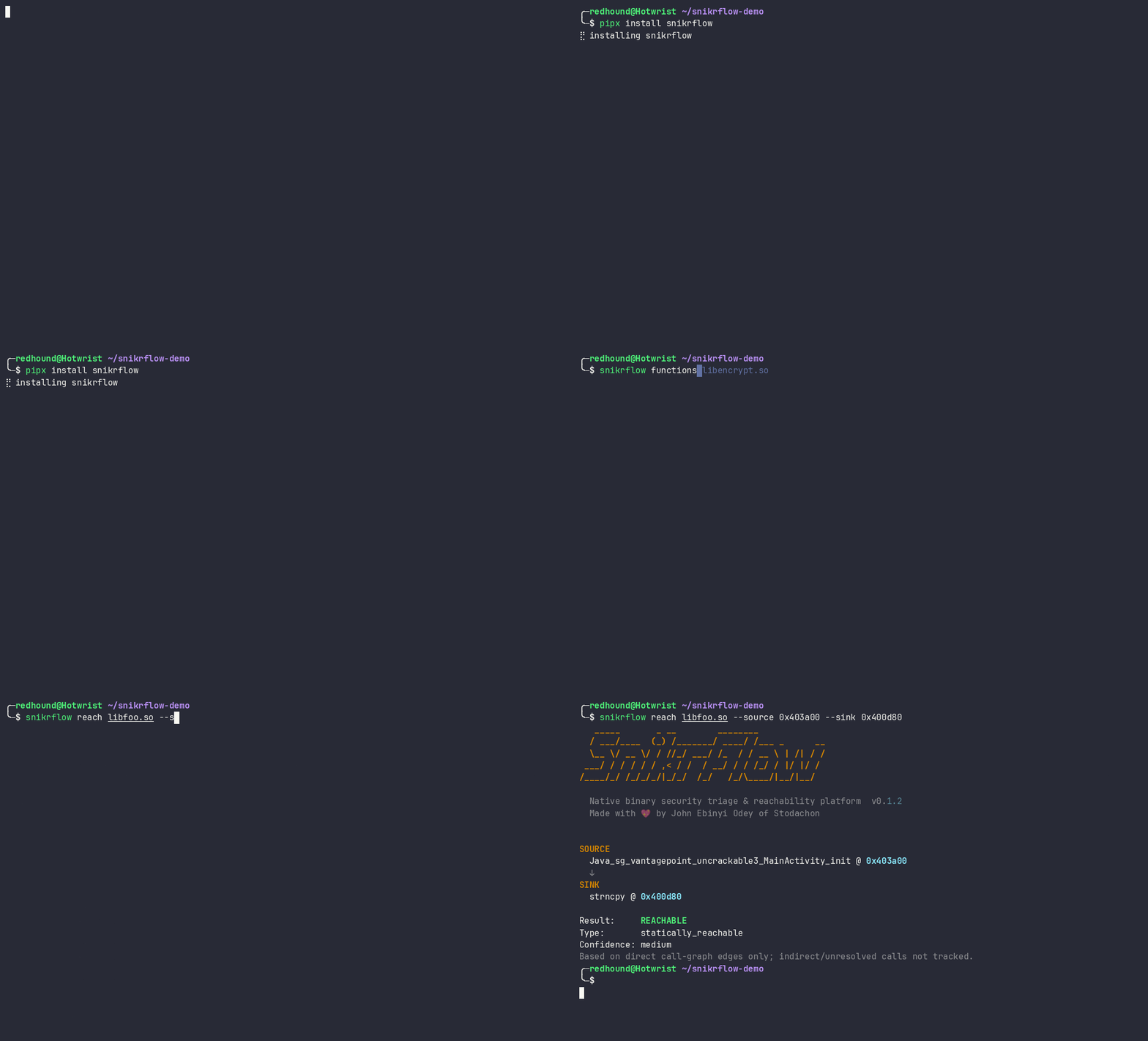
Interactive terminal demo
Explore SnikrFlow's analysis workflow, including reachability, CFG analysis, callers, callees, and other security triage commands.
▶ Watch the full interactive Asciinema demo
What audit actually does
audit is the flagship command -- it runs the full pipeline automatically:
- Discovers all functions, JNI entry points, and security-sensitive sinks.
- Checks static (call-graph) reachability across every JNI-to-sink pair -- cheap, so it covers everything.
- Ranks the statically-reachable pairs by call-chain directness and picks the most promising few for deep analysis.
- Runs data-flow (symbolic) analysis on that shortlist -- expensive, so it's spent only where it matters.
- Scores risk transparently and prints ranked findings.
SnikrFlow Security Audit
═══════════════════════════
Binary
  Architecture: x86_64
  Type:         Shared Object
Functions
  294 discovered
  3 JNI candidates
Security-sensitive operations
  2 identified
Interesting paths
  1 statically reachable
  1 selected for data-flow analysis
Findings
  [MEDIUM] JNI -> memory
    Source: Java_..._MainActivity_init @ 0x403a00
    Sink:   strncpy @ 0x400d80  (memory)
    Status: statically_reachable
Risk levels are a prioritization aid, not a vulnerability verdict. Manual verification is still required -- SnikrFlow narrows the search space, it doesn't replace the researcher.
Architecture
SnikrFlow is built in layers, deliberately kept independent from its analysis backend:
CLI ──┐
      ├──> Core Engine ──> SnikrFlow Models ──> Analysis Interfaces ──> Backends
Future GUI ──┘                                                          (angr today;
                                                                     Unicorn/Pin/Dyninst
                                                                          possible later)
- SnikrFlow owns the concepts (
Function,SecuritySink,AnalysisPath,SymbolicResult,AnalysisFinding, ...). The CLI never touches angr objects directly. analysis/interfaces/define what SnikrFlow can do.analysis/backends/angr/define how angr does it today. Adding a future backend means writing a new backend module, not rewriting the CLI.- The sink signature database (
sinks/signatures.py) is a plain, editable Python dict -- add your own categories/functions freely.
Terminology (read this before trusting a finding)
SnikrFlow is deliberately precise about what different results mean -- these are never used interchangeably:
| Term | Meaning |
|---|---|
statically_reachable |
A direct call-graph path exists. Doesn't see indirect calls (function pointers, vtables). |
SAT (solve) |
A concrete candidate input exists that walks this exact path. Not a confirmed exploit. |
POSSIBLE (dataflow) |
Symbolic input appears to reach the sink's argument. Heuristic, not sound taint analysis. |
| Risk level (audit) | A prioritization signal. Never a confirmed vulnerability. |
Responsible use
SnikrFlow is for authorized security research only -- use it against binaries you own or have explicit permission to analyze.
Credits
Built on angr and Claripy. CLI powered by Typer and Rich.
License
SnikrFlow is licensed under the GNU General Public License v3.0 — see LICENSE for the full text.
1 maintainer

Metadata
1 maintainer
Release files for snikrflow 0.1.3
For a detailed explanation of source distributions (sdists) and built distributions (wheels), please see the package formats documentation.
Source distribution (sdist)
| File | Size | Uploaded | Provenance | Actions |
|---|---|---|---|---|
| snikrflow-0.1.3.tar.gz | 51.7 kB | Without provenance | Details for snikrflow-0.1.3.tar.gz |
Built distribution (wheel)
| File | Interpreter | ABI | Platform | Actions Reset |
|---|---|---|---|---|
| snikrflow-0.1.3-py3-none-any.whl | Python 3 | none | any | Details for snikrflow-0.1.3-py3-none-any.whl |
Total release size: 102.4 kB
Release files / snikrflow-0.1.3.tar.gz
| Download URL | snikrflow-0.1.3.tar.gz |
|---|---|
| Size | 51.7 kB |
| Tags | Source |
|
SHA-256 checksum How to use checksums |
4db2e6d21f5c898b41b38755a145261f429b6ee02be20381a4a87709288ed993
|
|
BLAKE2b-256 checksum How to use checksums |
3b235f7dcdf40a4e1a5b9c61d1b9bcc5f23d52c49cd6be998e7c83258a32651d
|
| Upload date | |
|
Uploaded using Trusted Publishing? What is trusted publishing? |
No |
| Uploaded via |
twine/7.0.0 CPython/3.13.14
|
Release files / snikrflow-0.1.3-py3-none-any.whl
| Download URL | snikrflow-0.1.3-py3-none-any.whl |
|---|---|
| Size | 50.7 kB |
| Tags | Python 3 |
|
SHA-256 checksum How to use checksums |
3a280d1b3ae6846b0be00f938e37b9565001786d689652ef1388fa823c2796d0
|
|
BLAKE2b-256 checksum How to use checksums |
9cbe0bea947ecfb19832ec32ed7a2cf33057d490aff81f51dff72a7788ee2e68
|
| Upload date | |
|
Uploaded using Trusted Publishing? What is trusted publishing? |
No |
| Uploaded via |
twine/7.0.0 CPython/3.13.14
|
Security for snikrflow 0.1.3
Provenance
Provenance describes where a file came from. On PyPI, provenance is shared via attestations, which provide a verifiable record of the build or publishing details. View details, limitations and caveats.
No provenance found
None of the files in this release were uploaded with provenance metadata.
A note on package security
PyPI is a repository for distributing packages, not a service for auditing them. While third-party security researchers and our staff do their best to detect and remove malicious packages, PyPI cannot guarantee the quality, security or suitability of any given package.
To learn more about protecting yourself from malicious actors, visit our package security documentation.














