
snodo









Get evidence that an agent's work is done before it merges. Snodo runs your process validators and test gate inside the agent's own work loop.
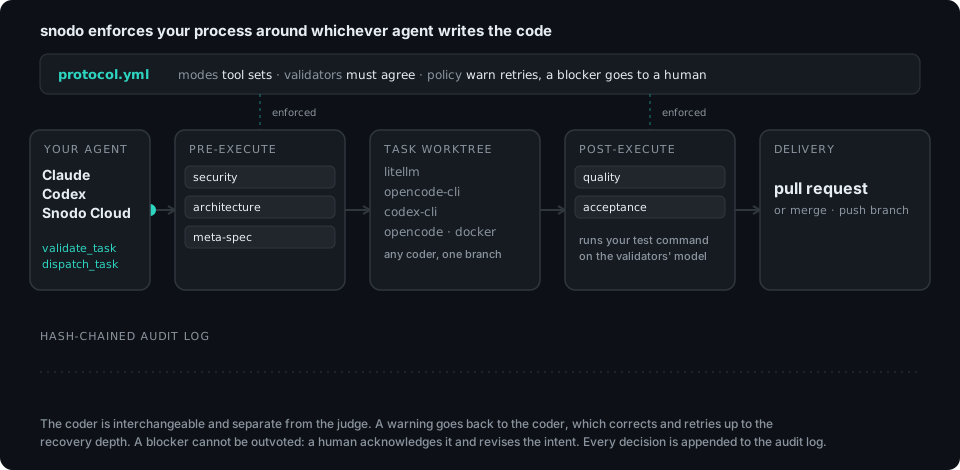
The gate caught work an agent thought was ready: across 515 gate runs, 102 did not pass; in 15 tasks, the gate sent failing-test evidence back to the coder and the next attempt passed. See the examples and counts.
Install and first run
Follow the canonical per-language first-run quickstart for Python, Node/TypeScript, Go, or Rust. It includes the starter files needed for the initial commit, the Git identity prerequisite, and each stack's detected test command and governed hello-world mock task. Install or update Snodo with:
curl -fsSL https://snodo.dev/install | bash
The installer sets up uv if needed. Alternatives are uv tool install snodo
and pip install snodo. To try the published package without installing it,
run uvx snodo --version. Python 3.12+ is required.
Before spending anything on an existing repository, run snodo ready. Without
an LLM, it checks whether the artefacts the protocol expects — decision records,
a resolvable test command, coder configs — are committed, and scores what is
missing by how cheap it is to fix. Task worktrees only see HEAD, so "present
on disk" is not enough. See the runbook for readiness, the
full configuration surface, and the command reference.
Why add this alongside CI, agent instructions, and code review?
Snodo enforces the protocol's validators and test gate before work merges, inside the agent's own loop. A failure returns to the coder as evidence; a blocker halts the run and cannot be outvoted; every decision is recorded in a hash-chained audit log. The cost is one gate run per task, plus the validators' model calls.
Built with snodo
From v0.19.0, snodo is developed with snodo. Each change to this repository
starts as a task spec, passes snodo's validators, is written by a coding agent
in its own worktree, is verified by the test gate, and arrives here as a pull
request that snodo opened. The protocol that governs this repository is
.snodo/protocol.yml, and every run is recorded in its audit
log.
AI coding agents are fast, confident and non-deterministic. They will report a task as finished while a test is failing, while the change has drifted outside the task, or while it contradicts a decision your team recorded months ago. Asking the agent again does not settle any of that. snodo is built for the gap: you describe your development process as a protocol, and the engine enforces it around whichever agent writes the code.
The protocol is a YAML file. It declares modes — the stages of your process,
each with an explicit tool set — validators that must agree before work
proceeds, and the policy for when they disagree. Enforcement is structural,
not advisory: mutations are gated behind a signed validation token, a single
blocker halts execution before any vote (so a critical finding cannot be
outvoted), and every governance decision is written to a hash-chained audit log.
snodo does not make an agent more reliable. It makes the process hold whether or
not the agent cooperates.
The working loop
Connect an agent to Snodo over MCP. Group work into plans. A plan is one clear
intention. Waves group its tasks: tasks in a wave run in parallel, and waves run
in series. Queues group and schedule plans. Dispatch a single task only for a
true one-off with no related work. A plan with one task in one wave adds nothing.
The orchestrator then validates and starts the work. Each task still passes through the
protocol's validator loop; jobs run asynchronously. Follow task status and
progress in the configured cloud live view (/now?task_ref=<task_ref>) when
cloud sync is configured, and follow live output with
snodo logs <job_id> --watch. watch_job also has an optional MCP Apps panel,
but some hosts (including Claude Desktop and relayed sessions) show only its
plain-text snapshot.
Register Snodo's mode-pinned MCP servers with snodo serve --mcp-install.
Installation supports Claude Desktop, Claude Code, Cursor, Gemini CLI, GitHub Copilot (VS Code and CLI) and the
Codex family (ChatGPT desktop, Codex CLI and IDE extension). It writes their
user-level configurations: Claude Desktop's platform-specific config,
Claude Code's ~/.claude.json, Cursor's ~/.cursor/mcp.json, Gemini CLI's
~/.gemini/settings.json, and Codex's ~/.codex/config.toml (relocated by
CODEX_HOME). Only detected clients are updated; unrelated MCP entries are
preserved and each updated client is reported. Restart each updated client to
connect.
Optional job notifications can send project-named updates to ntfy, a generic
webhook, Slack, Discord, or Teams. Configure targets in
~/.snodo/config.yml ($SNODO_HOME/config.yml when overridden), then check
them with snodo config --notify-test. The configuration reference
covers all user-level settings.
orchestrator → MCP validate/dispatch or plan/queue → job → live browser watch
                                                     └→ snodo logs <job_id> --watch
That makes snodo an AI-SDLC protocol engine: a governance layer over the software development lifecycle, for teams where AI agents are first-class contributors. The coder is interchangeable and separate from the judge — an in-process LLM client, a host CLI authenticated against your own subscription, or a containerised server all converge on the same gate and the same merge path.
Container image
Build the Snodo engine image from the repository root with
docker build -f docker/Dockerfile -t snodo .. Run it against a mounted Git
repository with docker run --rm -v "$PWD:/workspace" -w /workspace snodo ready;
the image's entrypoint is snodo, so CLI arguments are passed directly. The
image contains no code-host credentials; provide any required credentials through
your runtime's normal environment or secret mechanism.
What a mock run does
The canonical quickstart's --mock run uses a deterministic stub coder that
writes a stack-specific hello-world fixture and test; it implements the
hello-world task. The task still passes through the configured governance and
verification flow, and the generated test passes with that stack's test runner
available. The mock makes no provider API call and does not prove that a real
coder can implement your project's requirements. For provider-backed coding, configure
credentials (for example, snodo config add anthropic <key> or
ANTHROPIC_API_KEY) and run without --mock.
Project status
Actively-developed research implementation (beta). The enforcement invariants — token integrity, capability boundaries, non-overridable blockers, audit completeness — are verified by property-based tests over randomised inputs. Measured size, complexity and the CI gates are on the docs home.
Three honest boundaries, so you meet them here rather than an hour in:
- The
opencodecoder paths are experimental.litellm(the default),openai,anthropic,gemini,opencode-cli,codex-cli,claude-cli,agyandmockare supported. The built-inlitellmcoder exists so snodo works with nothing else installed; if an expert CLI is available, prefer it. - The repository is trusted, not sandboxed. snodo runs your test and build
commands, and a protocol file is executable input, like a
Makefileor a CI config. ADR 014 is the threat model; do not point it at untrusted code. - This is a preprint-stage research artifact. The paper is under review; treat the code as a working implementation of the ideas, not a finished product.
Where to go next
| Page | What it covers |
|---|---|
| Protocol reference | The full protocol.yml language: modes, validators, constraints, disagreement policies, well-formedness, templates |
| Coder backends | Every --coder, how selection works, and how adapters are added |
| Runbook | Install, configure, the CLI reference, MCP serving, troubleshooting |
| Configuration | User settings, provider credentials, cloud, and job notifications |
| Architecture | How enforcement works end to end, the package map, the invariant-to-mechanism table |
| Machine interface | The versioned --json contract and validation-outcome exit codes |
| Authoring a plan | The contract for hand- and orchestrator-authored multi-wave plans |
| Design decisions | Every ADR, from PyJWT over custom HMAC to module-scoped governance |
| Docs home | The published site |
Research
Preprint: Specifying AI-SDLC Processes: A Protocol Language for Human-Agent Boundaries — arXiv:2606.20615.
Prifti, Y. (2026). Specifying AI-SDLC Processes: A Protocol Language for Human-Agent Boundaries. arXiv:2606.20615. https://doi.org/10.48550/arXiv.2606.20615
@misc{prifti2026snodo,
  title         = {Specifying AI-SDLC Processes: A Protocol Language for Human-Agent Boundaries},
  author        = {Prifti, Ylli},
  year          = {2026},
  eprint        = {2606.20615},
  archivePrefix = {arXiv},
  doi           = {10.48550/arXiv.2606.20615},
  url           = {https://arxiv.org/abs/2606.20615}
}
Empirical studies live in studies/, and the paper's claims are
mapped to code and tests in Research.
Contributing
See CONTRIBUTING.md.
License
Copyright (C) 2026 The snodo Authors. Licensed under the Apache License, Version 2.0 — see LICENSE.
1 maintainer

Metadata
1 maintainer
Release files for snodo 0.26.0
For a detailed explanation of source distributions (sdists) and built distributions (wheels), please see the package formats documentation.
Source distribution (sdist)
| File | Size | Uploaded | Provenance | |
|---|---|---|---|---|
| snodo-0.26.0.tar.gz | 288.1 kB | With provenance | Details |
Built distribution (wheel)
| File | Interpreter | ABI | Platform | Reset |
|---|---|---|---|---|
| snodo-0.26.0-py3-none-any.whl | Python 3 | none | any | Details |
Total release size: 604.2 kB
Release files / snodo-0.26.0.tar.gz
| Download URL | snodo-0.26.0.tar.gz |
|---|---|
| Size | 288.1 kB |
| Tags | Source |
|
SHA-256 checksum How to use checksums |
abfd9c274f978305052847427e96d8489ad5f34450b5207fdba8d4b5458a7114
|
|
BLAKE2b-256 checksum How to use checksums |
e4c7f8a9dc596e3e8640724998a8d99fca219edfa93eeef6fcb8273ce5de548b
|
| Upload date | |
|
Uploaded using Trusted Publishing? What is trusted publishing? |
Yes |
| Uploaded via |
twine/7.0.0 CPython/3.13.14
|
Provenance
Provenance describes where a file came from. On PyPI, provenance is shared via attestations, which provide a verifiable record of the build or publishing details. View details, limitations and caveats.


PyPI Publish Attestation
PyPI verified that this artifact, at this checksum, originated from the publisher listed below.
Signed by GitHub Actions, verified by PyPI on Oct 16, 2026.
Transparency logRelease files / snodo-0.26.0-py3-none-any.whl
| Download URL | snodo-0.26.0-py3-none-any.whl |
|---|---|
| Size | 316.1 kB |
| Tags | Python 3 |
|
SHA-256 checksum How to use checksums |
889d75ac7fc80dad1f94019f70b037860569a4ce8c58a2feb14205e3e952ad2c
|
|
BLAKE2b-256 checksum How to use checksums |
b2b13df3fe39f34516e0a6e795e6d59362e938a9d074f3df27708382478a09ff
|
| Upload date | |
|
Uploaded using Trusted Publishing? What is trusted publishing? |
Yes |
| Uploaded via |
twine/7.0.0 CPython/3.13.14
|
Provenance
Provenance describes where a file came from. On PyPI, provenance is shared via attestations, which provide a verifiable record of the build or publishing details. View details, limitations and caveats.
PyPI Publish Attestation
PyPI verified that this artifact, at this checksum, originated from the publisher listed below.
Signed by GitHub Actions, verified by PyPI on Oct 16, 2026.
Transparency logSecurity for snodo 0.26.0
Provenance
Provenance describes where a file came from. On PyPI, provenance is shared via attestations, which provide a verifiable record of the build or publishing details. View details, limitations and caveats.
Full provenance
All 2 files in this release have been uploaded with provenance metadata.
Attestation for snodo-0.26.0.tar.gz
PyPI Publish Attestation
PyPI verified that this artifact, at this checksum, originated from the publisher listed below.
Signed by GitHub Actions, verified by PyPI on Oct 16, 2026.
Transparency logA note on package security
PyPI is a repository for distributing packages, not a service for auditing them. While third-party security researchers and our staff do their best to detect and remove malicious packages, PyPI cannot guarantee the quality, security or suitability of any given package.
To learn more about protecting yourself from malicious actors, visit our package security documentation.














