
SolidsPy: 2D-Finite Element Analysis with Python
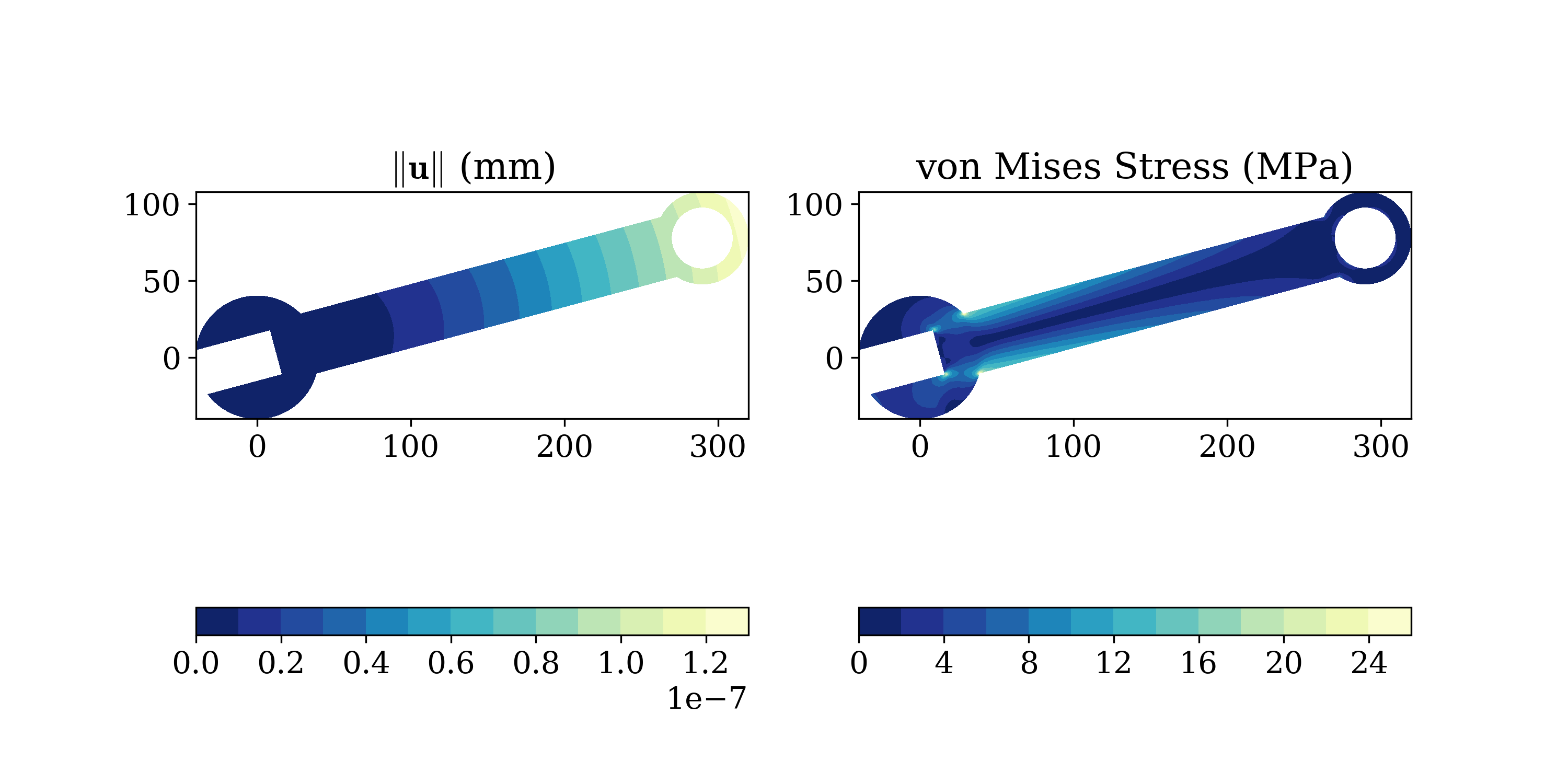


A simple finite element analysis code for 2D elasticity problems. The code uses as input simple-to-create text files defining a model in terms of nodal, element, material and load data.
- Documentation: http://solidspy.readthedocs.io
- GitHub: https://github.com/AppliedMechanics-EAFIT/SolidsPy
- PyPI: https://pypi.org/project/solidspy/
- Free and open source software: MIT license
Features
- It is based on an open-source environment.
- It is easy to use.
- The code allows to find displacement, strain and stress solutions for arbitrary two-dimensional domains discretized into finite elements and subject to point loads.
- The code is organized in independent modules for pre-processing, assembly and post-processing allowing the user to easily modify it or add features like new elements or analyses pipelines.
- It was created with academic and research purposes.
- It has been used to tech the following courses:
- Introduction to Solid Mechanics.
- Computational Modeling.
- Introduction to the Finite Element Methods.
- Introduction to Soil Mechanics.
Installation
The code is written in Python and it depends on numpy, and scipy and. It
has been tested under Windows, Mac, Linux and Android.
To install SolidsPy open a terminal and type:
pip install solidspy
To specify through a GUI the folder where the input files are stored you will need to install easygui.
To easily generate the required SolidsPy text files out of a Gmsh model you will need meshio.
These two can be installed with:
pip install easygui
pip install meshio
How to run a simple model
For further explanation check the docs.
Let's suppose that we have a simple model represented by the following files (see tutorials/square example for further explanation).
nodes.txt
    0  0.00  0.00   0  -1
    1  2.00  0.00   0  -1
    2  2.00  2.00   0   0
    3  0.00  2.00   0   0
    4  1.00  0.00  -1  -1
    5  2.00  1.00   0   0
    6  1.00  2.00   0   0
    7  0.00  1.00   0   0
    8  1.00  1.00   0   0
eles.txt
    0   1   0   0   4   8   7
    1   1   0   4   1   5   8
    2   1   0   7   8   6   3
    3   1   0   8   5   2   6
mater.txt
1.0 0.3
loads.txt
    3  0.0  1.0
    6  0.0  2.0
    2  0.0  1.0
Run it in Python as follows:
import matplotlib.pyplot as plt  # load matplotlib
from solidspy import solids_GUI  # import our package
disp = solids_GUI()  # run the Finite Element Analysis
plt.show()    # plot contours
For Mac users it is suggested to use an IPython console to run the example.
License
This project is licensed under the MIT license. The documents are licensed under Creative Commons Attribution License.
Citation
To cite SolidsPy in publications use
Nicolás Guarín-Zapata, Juan Gomez (2023). SolidsPy: Version 1.1.0 (Version v1.1.0). Zenodo. https://doi.org/10.5281/zenodo.7694030
A BibTeX entry for LaTeX users is
@software{solidspy,
 title = {SolidsPy: 2D-Finite Element Analysis with Python},
 version = {1.1.0},
 author = {Guarín-Zapata, Nicolás and Gómez, Juan},
 year = 2023,
 keywords = {Python, Finite elements, Scientific computing, Computational mechanics},
 abstract = {SolidsPy is a simple finite element analysis code for 2D elasticity
 problems. The code uses as input simple-to-create text files defining a model
 in terms of nodal, element, material and load data.},
 url = {https://github.com/AppliedMechanics-EAFIT/SolidsPy},
 doi = {https://doi.org/10.5281/zenodo.7694030}
}
1 maintainer

Metadata
1 maintainer
Release files for solidspytest 0.1
For a detailed explanation of source distributions (sdists) and built distributions (wheels), please see the package formats documentation.
Source distribution (sdist)
| File | Size | Uploaded | Provenance | Actions |
|---|---|---|---|---|
| solidspytest-0.1.tar.gz | 36.7 kB | Without provenance | Details for solidspytest-0.1.tar.gz |
Release files / solidspytest-0.1.tar.gz
| Download URL | solidspytest-0.1.tar.gz |
|---|---|
| Size | 36.7 kB |
| Tags | Source |
|
SHA-256 checksum How to use checksums |
8e0d8b492315c4b378fd6e0b593ac604a339e9dfd549f8ccab2809cc75a04ee7
|
|
BLAKE2b-256 checksum How to use checksums |
b661cc2354807e2824b04d1697bbd298d65c169526a40e46bcbfdd01031b70c8
|
| Upload date | |
|
Uploaded using Trusted Publishing? What is trusted publishing? |
No |
| Uploaded via |
twine/4.0.2 CPython/3.11.5
|
Security for solidspytest 0.1
Provenance
Provenance describes where a file came from. On PyPI, provenance is shared via attestations, which provide a verifiable record of the build or publishing details. View details, limitations and caveats.
No provenance found
None of the files in this release were uploaded with provenance metadata.
A note on package security
PyPI is a repository for distributing packages, not a service for auditing them. While third-party security researchers and our staff do their best to detect and remove malicious packages, PyPI cannot guarantee the quality, security or suitability of any given package.
To learn more about protecting yourself from malicious actors, visit our package security documentation.













