

structlog makes logging in Python faster, less painful, and more powerful by adding structure to your log entries. It has been successfully used in production at every scale since 2013, while embracing cutting-edge technologies like asyncio or type hints along the way, and influenced the design of structured logging packages in other ecosystems.
Thanks to its highly flexible design, it’s up to you whether you want structlog to take care about the output of your log entries or whether you prefer to forward them to an existing logging system like the standard library’s logging module.
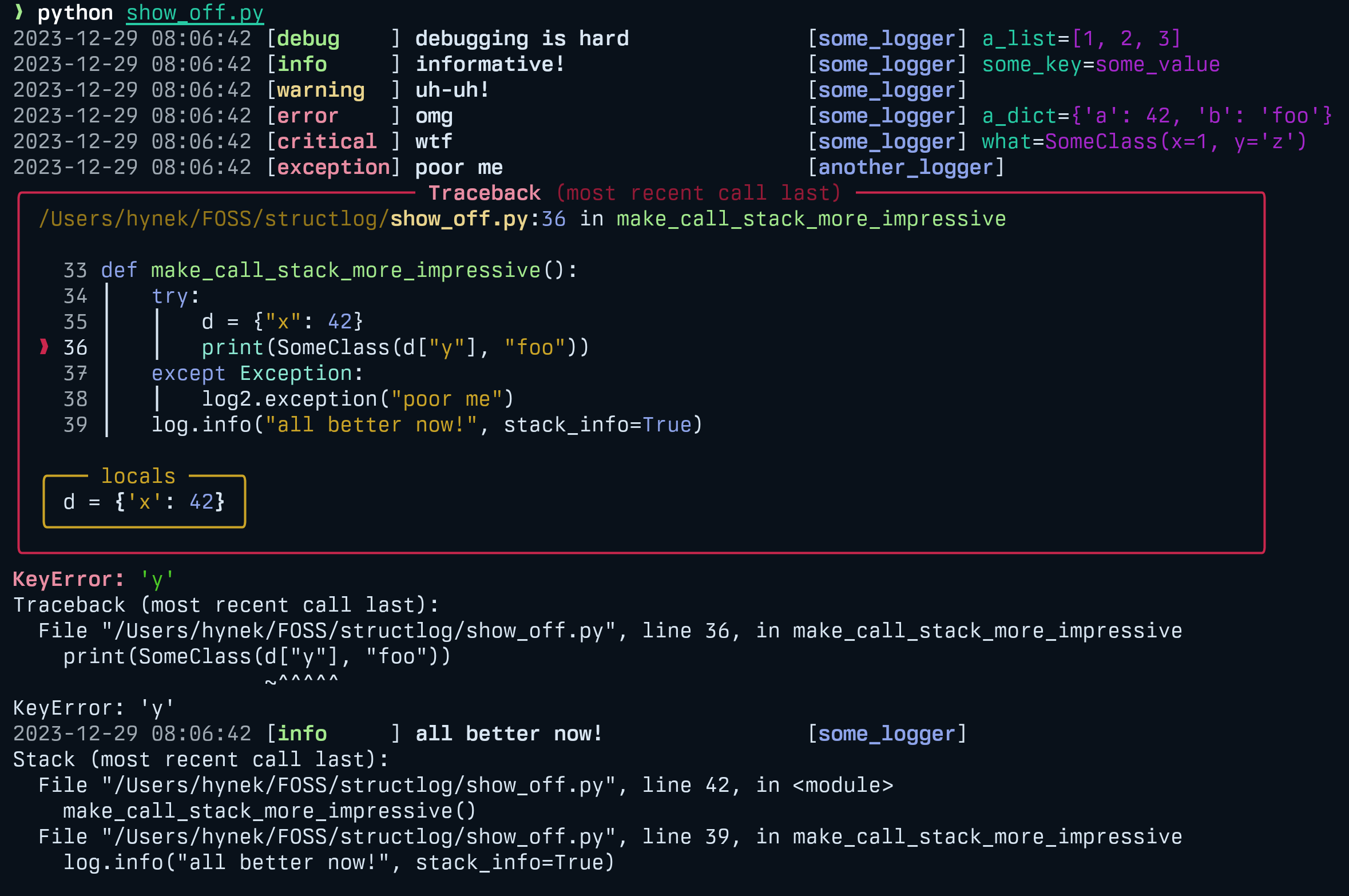
Once you feel inspired to try it out, check out our friendly Getting Started tutorial that also contains detailed installation instructions!
If you prefer videos over reading, check out Markus Holtermann’s DjangoCon Europe 2019 talk: Logging Rethought 2: The Actions of Frank Taylor Jr.
Easier Logging
You can stop writing prose and start thinking in terms of an event that happens in the context of key/value pairs:
>>> from structlog import get_logger
>>> log = get_logger()
>>> log.info("key_value_logging", out_of_the_box=True, effort=0)
2020-11-18 09:17.09 [info     ] key_value_logging    effort=0 out_of_the_box=True
Each log entry is a meaningful dictionary instead of an opaque string now!
Data Binding
Since log entries are dictionaries, you can start binding and re-binding key/value pairs to your loggers to ensure they are present in every following logging call:
>>> log = log.bind(user="anonymous", some_key=23)
>>> log = log.bind(user="hynek", another_key=42)
>>> log.info("user.logged_in", happy=True)
2020-11-18 09:18.28 [info     ] user.logged_in    another_key=42 happy=True some_key=23 user=hynek
You can also bind key/value pairs to thread-local storage and contextvars.
Powerful Pipelines
Each log entry goes through a processor pipeline that is just a chain of functions that receive a dictionary and return a new dictionary that gets fed into the next function. That allows for simple but powerful data manipulation:
def timestamper(logger, log_method, event_dict):
    """Add a timestamp to each log entry."""
    event_dict["timestamp"] = time.time()
    return event_dict
There are plenty of processors for most common tasks coming with structlog:
Collectors of call stack information (“How did this log entry happen?”),
…and exceptions (“What happened‽”).
Unicode encoders/decoders.
Flexible timestamping.
Formatting
structlog is completely flexible about how the resulting log entry is emitted. Since each log entry is a dictionary, it can be formatted to any format:
A colorful key/value format for local development,
JSON for easy parsing,
or some standard format you have parsers for like nginx or Apache httpd.
Internally, formatters are processors whose return value (usually a string) is passed into loggers that are responsible for the output of your message. structlog comes with multiple useful formatters out-of-the-box.
Output
structlog is also flexible with the final output of your log entries:
A built-in lightweight printer like in the examples above. Easy to use and fast.
Use the standard library’s or Twisted’s logging modules for compatibility. In this case structlog works like a wrapper that formats a string and passes them off into existing systems that won’t know that structlog even exists. Or the other way round: structlog comes with a logging formatter that allows for processing third party log records.
Don’t format it to a string at all! structlog passes you a dictionary and you can do with it whatever you want. Reported uses cases are sending them out via network or saving them in a database.
Highly Testable
structlog is thouroughly tested and we see it as our duty to help you to achieve the same in your applications. That’s why it ships with a bunch of helpers to introspect your application’s logging behavior with little-to-no boilerplate.
Getting Help
Please use the structlog tag on StackOverflow to get help.
Answering questions of your fellow developers is also a great way to help the project!
Project Information
structlog is dual-licensed under Apache License, version 2 and MIT, available from PyPI, the source code can be found on GitHub, the documentation at https://www.structlog.org/.
We collect useful third-party extension in our wiki.
structlog targets Python 3.6 and later. PyPy3 is known to work, but is not tested anymore.
structlog for Enterprise
Available as part of the Tidelift Subscription.
The maintainers of structlog and thousands of other packages are working with Tidelift to deliver commercial support and maintenance for the open source packages you use to build your applications. Save time, reduce risk, and improve code health, while paying the maintainers of the exact packages you use. Learn more.
1 maintainer

Metadata
1 maintainer
Release files for structlog 21.4.0
For a detailed explanation of source distributions (sdists) and built distributions (wheels), please see the package formats documentation.
Source distribution (sdist)
| File | Size | Uploaded | |
|---|---|---|---|
| structlog-21.4.0.tar.gz | 469.2 kB | Details |
Built distribution (wheel)
| File | Interpreter | ABI | Platform | Reset |
|---|---|---|---|---|
| structlog-21.4.0-py3-none-any.whl | Python 3 | none | any | Details |
Total release size: 521.0 kB
Release files / structlog-21.4.0.tar.gz
| Download URL | structlog-21.4.0.tar.gz |
|---|---|
| Size | 469.2 kB |
| Tags | Source |
|
SHA-256 checksum How to use checksums |
305a66201f9605a2e8a2595271a446f258175901c09c01e4c2c2a8ac5b68edf1
|
|
BLAKE2b-256 checksum How to use checksums |
9ce4914100454f7443c1498cd4eba04ce18a212a79ba12e4fbc76bd7c2454b7d
|
| Upload date | |
|
Uploaded using Trusted Publishing? What is trusted publishing? |
No |
| Uploaded via |
twine/3.4.2 importlib_metadata/4.6.1 pkginfo/1.7.0 requests/2.25.1 requests-toolbelt/0.9.1 tqdm/4.61.2 CPython/3.9.6
|
Release files / structlog-21.4.0-py3-none-any.whl
| Download URL | structlog-21.4.0-py3-none-any.whl |
|---|---|
| Size | 51.9 kB |
| Tags | Python 3 |
|
SHA-256 checksum How to use checksums |
6ed8fadb27cf8362be0e606f5e79ccdd3b1e879aac65f9dc0ac3033fd013a7be
|
|
BLAKE2b-256 checksum How to use checksums |
c4d3ae07004a781e908fa0984012d224f95eb98571617d3a32aa53f88b8d9dce
|
| Upload date | |
|
Uploaded using Trusted Publishing? What is trusted publishing? |
No |
| Uploaded via |
twine/3.4.2 importlib_metadata/4.6.1 pkginfo/1.7.0 requests/2.25.1 requests-toolbelt/0.9.1 tqdm/4.61.2 CPython/3.9.6
|














