
Installation
To install on Linux type into the commandline:
pip install TCRnumba
It requires CUDA and is not yet tested for MacOS or Windows.
Usage
In Python you can import
import TCRnumba
Then, test the script, by running the additional commands
import TCRnumba.graph_numba as gn
import TCRnumba.convert_pure as cp
adjacency_sparse = gn.adjacency_matrix(['ABC', 'DEF', 'EFG', 'ABC', 'ABD', 'EEE', 'EEF', 'EFF', 'GGE', 'GAS'], N_part=2, len_xy=5, direct_output=True)
cp.convert_pure(adjacency_sparse, 2, 5)
Use SONIA to create files
sonia-generate --humanTRB -n 1000000 --pre -o pre_example.txt
Functions
convert_pure(sparse, single_sidelength, len_x)
Takes list of single digit indices and convert into a dense matrix.
dense_matrix(data, len_xy)
Takes list of two digit indices and convert that into a dense matrix.
total_idx(el, N_part, i, j, len_x, len_y)
Converts indices from single-number indices to two-number indices. "N_part" is the number of strings in each block. i and j are int numbers, referring to the index of the block. len_x and len_y are int numbers denoting the number of blocks in height and length.
adjacency_matrix(seq, name="sparse.txt", idx_max=0, name_params="data/sparse_params.txt", N_part=None, len_xy=None, direct_output=False)
Inputs a list of strings "seq" and calculate the distance matrix. Save under the filename "name". // define the other params of all the presented functions
robustness distribution
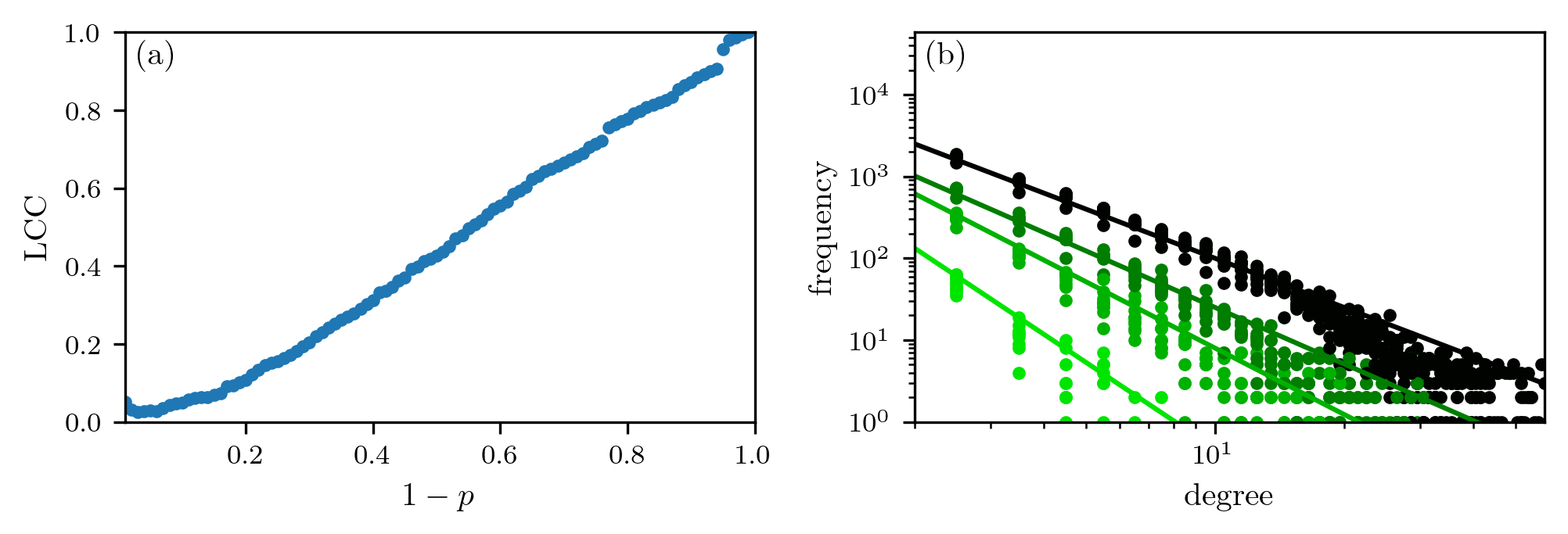
(a) The relative size of the largest connected component (LCC)
as a function of $1-p$, where $p$ is the fraction of removed
nodes. The TCR network has \NSeqRobustness nodes with
lmax = 1.
The TCR network does not exhibit a
percolation phase transition. Moreover, the system
is robust against small node removal.
(b) The corresponding degree distribution of the same
network is plotted for (0.01, 0.49, 0.69, 0.89) with darker
green indicating a smaller p. With increasing p, the curve
shifts downwards and becomes steeper as the number of nodes decreases.
1 maintainer

Metadata
1 maintainer
Release files for TCRnumba 0.2.6
For a detailed explanation of source distributions (sdists) and built distributions (wheels), please see the package formats documentation.
Source distribution (sdist)
| File | Size | Uploaded | Provenance | Actions |
|---|---|---|---|---|
| TCRnumba-0.2.6.tar.gz | 27.9 kB | Without provenance | Details for TCRnumba-0.2.6.tar.gz |
Release files / TCRnumba-0.2.6.tar.gz
| Download URL | TCRnumba-0.2.6.tar.gz |
|---|---|
| Size | 27.9 kB |
| Tags | Source |
|
SHA-256 checksum How to use checksums |
3878cbdf8a635c0b1ba64974b4ab89c26f820b2347e9bac85cf7f1cd3b3acf54
|
|
BLAKE2b-256 checksum How to use checksums |
3e217eab7964db09b9da41c77f164c82c2dd59f5590c777ffd3938166aa06721
|
| Upload date | |
|
Uploaded using Trusted Publishing? What is trusted publishing? |
No |
| Uploaded via |
twine/3.4.1 importlib_metadata/3.10.0 pkginfo/1.6.1 requests/2.24.0 requests-toolbelt/0.9.1 tqdm/4.59.0 CPython/3.8.5
|
Security for TCRnumba 0.2.6
Provenance
Provenance describes where a file came from. On PyPI, provenance is shared via attestations, which provide a verifiable record of the build or publishing details. View details, limitations and caveats.
No provenance found
None of the files in this release were uploaded with provenance metadata.
A note on package security
PyPI is a repository for distributing packages, not a service for auditing them. While third-party security researchers and our staff do their best to detect and remove malicious packages, PyPI cannot guarantee the quality, security or suitability of any given package.
To learn more about protecting yourself from malicious actors, visit our package security documentation.














