



textX is a meta-language for building Domain-Specific Languages (DSLs) in Python. It is inspired by Xtext.
In a nutshell, textX will help you build your textual language in an easy way. You can invent your own language or build a support for already existing textual language or file format.
From a single language description (grammar), textX will build a parser and a meta-model (a.k.a. abstract syntax) for the language. See the docs for the details.
textX follows the syntax and semantics of Xtext but differs in some places and is implemented 100% in Python using Arpeggio PEG parser - no grammar ambiguities, unlimited lookahead, interpreter style of work.
Quick intro
from textx import metamodel_from_str, get_children_of_type

grammar = """
Model: shapes*=Shape;
Shape: Circle | Line;
Circle: 'circle' center=Point '/' radius=INT;
Line: 'line' start=Point '/' end=Point;
Point: x=INT ',' y=INT;
"""

mm = metamodel_from_str(grammar)

# Meta-model knows how to parse and instantiate models.
model = mm.model_from_str("""
    line 10, 10 / 20, 20
    line 14, 78 / 89, 33
    circle 14, 20/10
    line 18, 89 / 78, 65
""")

# At this point model is plain Python object graph with instances of
# dynamically created classes and attributes following the grammar.

def _(p):
    "returns coordinate of the given Point as string"
    return "{},{}".format(p.x, p.y)

for shape in model.shapes:
    if shape.__class__.__name__ == 'Circle':
        print('Circle: center={}, radius={}'
              .format(_(shape.center), shape.radius))
    else:
        print('Line: from={} to={}'.format(_(shape.start), _(shape.end)))

# Output:
# Line: from=10,10 to=20,20
# Line: from=14,78 to=89,33
# Circle: center=14,20, radius=10
# Line: from=18,89 to=78,65

# Collect all points starting from the root of the model
points = get_children_of_type("Point", model)
for point in points:
    print('Point: {}'.format(_(point)))

# Output:
# Point: 10,10
# Point: 20,20
# Point: 14,78
# Point: 89,33
# Point: 14,20
# Point: 18,89
# Point: 78,65
Video tutorials
Introduction to textX
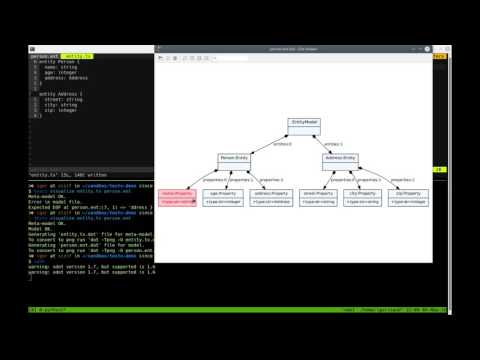
Implementing Martin Fowler’s State Machine DSL in textX

Docs and tutorials
The full documentation with tutorials is available at http://igordejanovic.net/textX/
Discussion and help
For bug report, general discussion and help please use GitHub issue tracker.
License
MIT
Python versions
Tested for 2.7, 3.3+
1 maintainer

Metadata
1 maintainer
Release files for textX 1.7.0
For a detailed explanation of source distributions (sdists) and built distributions (wheels), please see the package formats documentation.
Source distribution (sdist)
| File | Size | Uploaded | Provenance | Actions |
|---|---|---|---|---|
| textX-1.7.0.tar.gz | 44.4 kB | Without provenance | Details for textX-1.7.0.tar.gz |
Built distribution (wheel)
| File | Interpreter | ABI | Platform | Actions Reset |
|---|---|---|---|---|
| textX-1.7.0-py2.py3-none-any.whl | Python 3, Python 2 | none | any | Details for textX-1.7.0-py2.py3-none-any.whl |
Total release size: 95.2 kB
Release files / textX-1.7.0.tar.gz
| Download URL | textX-1.7.0.tar.gz |
|---|---|
| Size | 44.4 kB |
| Tags | Source |
|
SHA-256 checksum How to use checksums |
c6b6a91bd82a8727afbfa040a36fa8597fc925a71ea906ec480317aec9e29d71
|
|
BLAKE2b-256 checksum How to use checksums |
9f8a02a7d23f8e7fb603baf5f8c5a38cf3a66f08928d5f35dae84bc75d5ba921
|
| Upload date | |
|
Uploaded using Trusted Publishing? What is trusted publishing? |
No |
Release files / textX-1.7.0-py2.py3-none-any.whl
| Download URL | textX-1.7.0-py2.py3-none-any.whl |
|---|---|
| Size | 50.8 kB |
| Tags | Python 2 Python 3 |
|
SHA-256 checksum How to use checksums |
4c8388ad91bdc7d14d6c1c2a12c9e1cd29f3d8a6cf084aba6a26546b863ec3b0
|
|
BLAKE2b-256 checksum How to use checksums |
692b17c7cc82e3921535a5f044307582364fe33017ced22f066dd62b01283885
|
| Upload date | |
|
Uploaded using Trusted Publishing? What is trusted publishing? |
No |
Security for textX 1.7.0
Provenance
Provenance describes where a file came from. On PyPI, provenance is shared via attestations, which provide a verifiable record of the build or publishing details. View details, limitations and caveats.
No provenance found
None of the files in this release were uploaded with provenance metadata.
A note on package security
PyPI is a repository for distributing packages, not a service for auditing them. While third-party security researchers and our staff do their best to detect and remove malicious packages, PyPI cannot guarantee the quality, security or suitability of any given package.
To learn more about protecting yourself from malicious actors, visit our package security documentation.














