

A good Timeseries Anomaly Generator.







GutenTAG is an extensible tool to generate time series datasets with and without anomalies. A GutenTAG time series consists of a single (univariate) or multiple (multivariate) channels containing a base oscillation with different anomalies at different positions and of different kinds.




tl;dr
-
Install GutenTAG from PyPI:
pip install timeeval-gutenTAG
GutenTAG supports Python 3.9, 3.10, 3.11, 3.12, and 3.13; all other requirements are installed with the pip-call above.
-
Create a generation configuration file
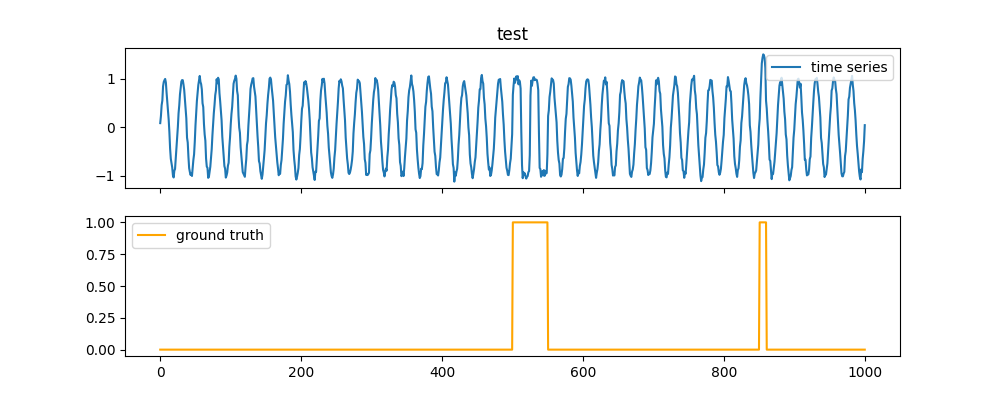
example-config.yamlwith the instructions to generate a single time series with two anomalies: A pattern anomaly in the middle and an amplitude anomaly at the end of the series. You can use the following content:timeseries: - name: demo length: 1000 base-oscillations: - kind: sine frequency: 4.0 amplitude: 1.0 variance: 0.05 anomalies: - position: middle length: 50 kinds: - kind: pattern sinusoid_k: 10.0 - position: end length: 10 kinds: - kind: amplitude amplitude_factor: 1.5
-
Execute GutenTAG with a seed and let it plot the time series:
gutenTAG --config-yaml example-config.yaml --seed 11 --no-save --plot
You should see the following time series:
Documentation
GutenTAG's documentation can be found here.
Citation
If you use GutenTAG in your project or research, please cite our demonstration paper:
Phillip Wenig, Sebastian Schmidl, and Thorsten Papenbrock. TimeEval: A Benchmarking Toolkit for Time Series Anomaly Detection Algorithms. PVLDB, 15(12): 3678 - 3681, 2022. doi:10.14778/3554821.3554873
@article{WenigEtAl2022TimeEval,
  title = {TimeEval: {{A}} Benchmarking Toolkit for Time Series Anomaly Detection Algorithms},
  author = {Wenig, Phillip and Schmidl, Sebastian and Papenbrock, Thorsten},
  date = {2022},
  journaltitle = {Proceedings of the {{VLDB Endowment}} ({{PVLDB}})},
  volume = {15},
  number = {12},
  pages = {3678 -- 3681},
  doi = {10.14778/3554821.3554873}
}
Contributing
We welcome contributions to GutenTAG. If you have spotted an issue with GutenTAG or if you want to enhance it, please open an issue first. See Contributing for details.


Release files for timeeval-GutenTAG 1.5.0
For a detailed explanation of source distributions (sdists) and built distributions (wheels), please see the package formats documentation.
Source distribution (sdist)
| File | Size | Uploaded | |
|---|---|---|---|
| timeeval_gutentag-1.5.0.tar.gz | 51.8 kB | Details |
Built distribution (wheel)
| File | Interpreter | ABI | Platform | Reset |
|---|---|---|---|---|
| timeeval_gutentag-1.5.0-py3-none-any.whl | Python 3 | none | any | Details |
Total release size: 116.0 kB
Release files / timeeval_gutentag-1.5.0.tar.gz
| Download URL | timeeval_gutentag-1.5.0.tar.gz |
|---|---|
| Size | 51.8 kB |
| Tags | Source |
|
SHA-256 checksum How to use checksums |
270273e83cf3a474bb1f8b4a8f60f468aadaeb8d79f897d9cc8aee373c4bdf3c
|
|
BLAKE2b-256 checksum How to use checksums |
41de61276075d53912c04c8b36ec9d796a45ac16c0129fcec0081952d3c9775a
|
| Upload date | |
|
Uploaded using Trusted Publishing? What is trusted publishing? |
Yes |
| Uploaded via |
twine/6.1.0 CPython/3.12.8
|
Provenance
Provenance describes where a file came from. On PyPI, provenance is shared via attestations, which provide a verifiable record of the build or publishing details. View details, limitations and caveats.


PyPI Publish Attestation
PyPI verified that this artifact, at this checksum, originated from the publisher listed below.
Signed by GitHub Actions, verified by PyPI on May 9, 2025.
Transparency logRelease files / timeeval_gutentag-1.5.0-py3-none-any.whl
| Download URL | timeeval_gutentag-1.5.0-py3-none-any.whl |
|---|---|
| Size | 64.3 kB |
| Tags | Python 3 |
|
SHA-256 checksum How to use checksums |
79de446bf41b4ea1ffef0e0adccabe8a541c934c4b664c7e5194e2be5fb27852
|
|
BLAKE2b-256 checksum How to use checksums |
fbca0524326e96409f6e041d18a819cb37bcef148e7c0c23b4bf1fb504f4f931
|
| Upload date | |
|
Uploaded using Trusted Publishing? What is trusted publishing? |
Yes |
| Uploaded via |
twine/6.1.0 CPython/3.12.8
|
Provenance
Provenance describes where a file came from. On PyPI, provenance is shared via attestations, which provide a verifiable record of the build or publishing details. View details, limitations and caveats.
PyPI Publish Attestation
PyPI verified that this artifact, at this checksum, originated from the publisher listed below.
Signed by GitHub Actions, verified by PyPI on May 9, 2025.
Transparency log













