
tokenstash
Paste a key once. Approve each directory. Keep secrets out of status output.
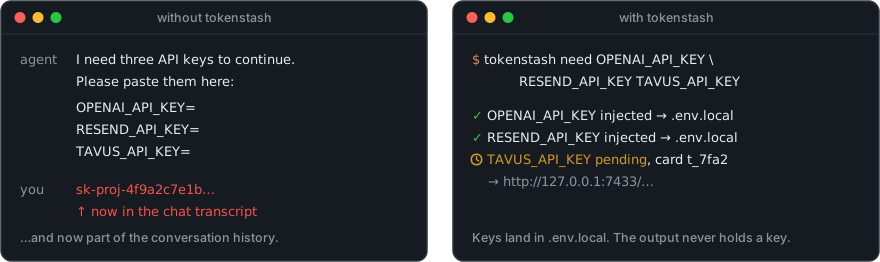
A local credential broker for coding agents. When your agent needs an API key, it asks tokenstash instead of asking you to paste it into the chat. The key goes into your project's env file, and the agent gets back a status line instead of the key.
Download · Security · Changelog



Install
brew install kgarg2468/tokenstash/tokenstash
# or
npm install -g tokenstash
# or
uv tool install tokenstash
Then, once:
tokenstash init
init picks your OS keychain and adds tokenstash to the agents it finds: Claude Code, Codex, Cursor and Gemini CLI. macOS and Linux; Windows is not supported yet.
Other ways to install
bun add -g tokenstash
pnpm add -g tokenstash
pipx install tokenstash
cargo install --locked --git https://github.com/kgarg2468/tokenstash tokenstash
Prebuilt binaries for macOS (Apple Silicon, Intel) and Linux (x64, arm64; static, any distribution) are on the latest release, with sha256 files and a build attestation you can check with gh attestation verify tokenstash-<platform>.tar.gz --repo kgarg2468/tokenstash. The npm and PyPI packages carry the same binary and run no install scripts.
How it works
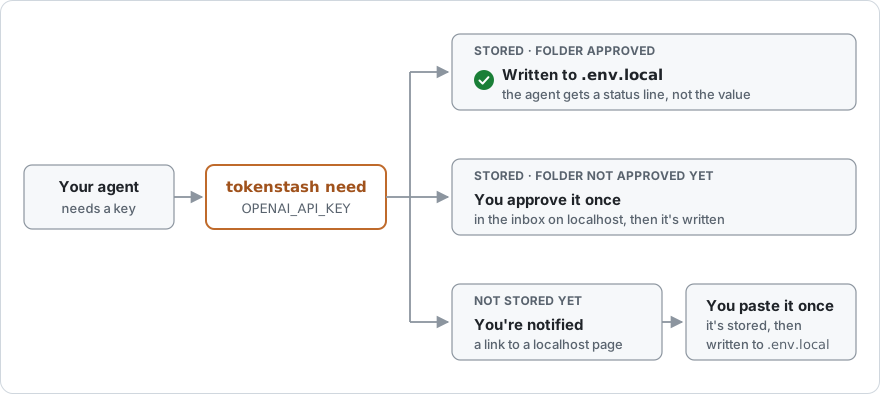
When the agent needs a key, it runs tokenstash need OPENAI_API_KEY (or asks over MCP). There are three outcomes:
- You have the key and this folder is approved: it's written to
.env.localand the agent carries on. - You have the key but this folder hasn't been approved: you get a notification. Open it, see exactly which keys would go into which file, and approve once.
- You don't have the key yet: you get a notification and a link to a page tokenstash serves on localhost, with the provider's signup link and the steps. Paste the key there once; it's stored in your OS keychain, and every later project can get it from there.
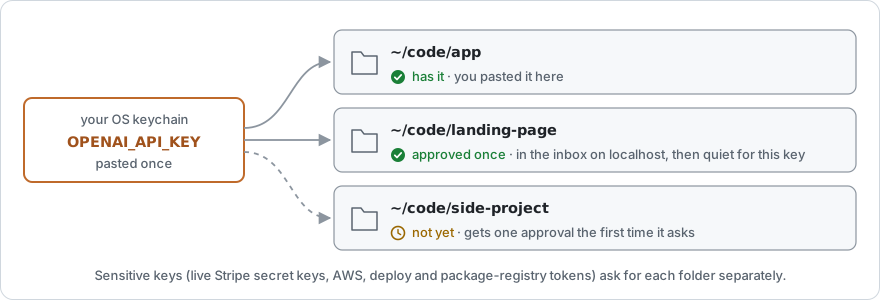
- Approval is per folder, and you choose how wide. The first time a folder asks for keys you already have, you get three choices: Allow these (just the listed keys), Allow these + any non-sensitive key here (also future registry-known, non-sensitive keys), or Deny (remembered for 24 hours by default).
- Sensitive keys always ask. Live Stripe secret keys, AWS credentials, deploy and package-registry tokens, and any key tokenstash doesn't recognise get their own approval in each folder. The broad choice never covers them.
- Local secrets are generated, not asked for.
AUTH_SECRET,JWT_SECRET,SESSION_SECRETand similar are created by tokenstash, one per folder. - Keys can be re-checked with the provider. Keys whose provider supports an unattended check are re-checked before delivery when a check is due. A rejected key becomes a "replace this key" request; if the provider can't be reached, the key is delivered unchecked.
Where your key goes
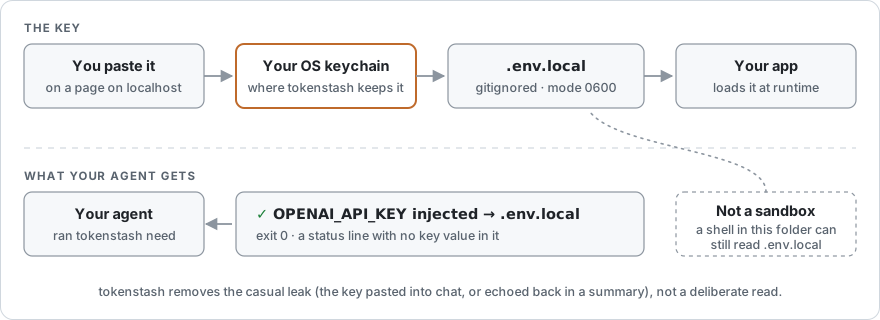
The value goes from the page you paste it on, to your OS keychain, to the project's .env.local (mode 0600, and added to .gitignore). need and the MCP tool report back with an exit code and a line like ✓ OPENAI_API_KEY injected → .env.local, without the value, so delivering a key doesn't put it into the chat, a summary, or the conversation history. scripts/leak-test.sh runs the real binary with a canary key on every commit and fails if the canary appears on any of the surfaces it checks.
Your app loads .env.local the way it already would: frameworks such as Next.js read it on their own; for anything else, use your runtime's dotenv support, or start the program with tokenstash run --.
It's not a sandbox. An agent with a shell in an approved folder can read .env.local, just as it could without tokenstash, and anything you type into a request's note or answer field goes back to the agent as text. What goes away is the casual leak: the key pasted into chat or echoed back in a summary. The details are under Security details below and in SECURITY.md.
Using it
After tokenstash init, the agents it set up are instructed to ask tokenstash for keys. You can also run it yourself:
tokenstash need OPENAI_API_KEY RESEND_API_KEY   # write the keys you have; ask for the rest
tokenstash run -- npm run dev                   # load .env.local, and ask for a key the program says is missing
tokenstash open                                 # the inbox: everything waiting on you
tokenstash doctor                               # check the setup
Automatic, or only when you say so
By default the agent asks tokenstash on its own: init registers the MCP server and installs a skill that tells the agent to request a key whenever code needs one. If you would rather nothing happen until you ask:
tokenstash init --mode explicit
This takes the MCP server and everything the agent reads unprompted back out, and installs one command that only you can invoke: /tokenstash OPENAI_API_KEY in Claude Code and Cursor, /prompts:tokenstash OPENAI_API_KEY in Codex, /tokenstash OPENAI_API_KEY in Gemini CLI. Typed bare, it requests whatever the current task needs, and it covers the rest of that task: a key the work turns out to need later goes through it too. The command runs tokenstash need under the same rules, so the value still goes to .env.local and never into the chat. In a session where you don't type it, nothing tells the agent about tokenstash, so it will ask you for keys the way it always did. The one exception is a project where you ran tokenstash init --project: its AGENTS.md section stays, rewritten to say that keys are requested only when you invoke the command and never pasted in chat. tokenstash init --mode auto switches back, doctor shows the mode, and init --undo removes either.
Uninstall
- Take tokenstash out of your agents:
tokenstash init --undo. It puts back the agent config filesinitchanged, from the copies it saved at the time, and deletes the files it created. An edit you made to one of those files sinceinit(another MCP server added to Cursor, say) is lost with it, so check them first. - Optionally, remove your stored keys and data: expand the section below. Do this after step 1, since the data directory holds the copies
init --undorestores from. - Remove the program:
brew uninstall tokenstash, ornpm uninstall -g tokenstash,uv tool uninstall tokenstash,pipx uninstall tokenstash.
Remove stored keys and all data
Do this for the default data directory and for every TOKENSTASH_HOME you have used; each one has its own keychain entries.
- Run
tokenstash list, withTOKENSTASH_HOMEset for a custom home and kept set for the next commands. It shows every key in that home's index, with its identity; generated secrets likeAUTH_SECREThave one identity per folder. Remove each withtokenstash forget NAME --identity IDENTITY. Then runtokenstash doctorand note the stash backend it shows. - Stop any program you started with
tokenstash run, close your agent sessions, then stop any tokenstash still running, for example withpkill -x tokenstash(which stops it for every home). A background inbox only exits on its own after 30 idle minutes with nothing waiting, and never if it was started with--keep. - Clear what the index didn't know about: a key whose index was lost earlier is still in the OS store. Search for
tokenstashin Keychain Access on macOS or Passwords and Keys (Seahorse) on Linux, and delete tokenstash's entries; their service istokenstashfor the default home, ortokenstash-and eight hex characters for a custom one. On Linux you can also runsecret-tool clear service tokenstashfor the default home; it skips entries in a locked keyring, so unlock it in Passwords and Keys first. Ifdoctorshowedkeyutils, the keys are in the kernel keyring and are gone after a reboot. - Delete the data directory:
~/.config/tokenstashon Linux ($XDG_CONFIG_HOME/tokenstashif you set it),~/Library/Application Support/tokenstashon macOS, and anyTOKENSTASH_HOMEdirectory you used.
Keys already written into projects' .env.local files stay there until you delete them.
More
Command overview
| Command | What it does |
|---|---|
tokenstash need NAME… [--blocking] |
Write keys to the env file, or ask for them. Exit 0 written · 10 waiting on you · 20 denied · 30 expired · 1 error |
tokenstash ask "title" [--url URL] [--step STEP…] |
Ask you to do something only a person can do (a DNS record, a dashboard toggle, an OAuth consent screen) |
tokenstash open · tasks · answer [ID] |
See what's waiting on you and answer it, in the inbox or from the terminal |
tokenstash list · forget NAME [--identity ID] · rotate NAME |
Manage stored keys (never shows values) |
tokenstash bind NAME --identity ID |
Use a different identity (say, work) for one key in this folder |
tokenstash check · report-bad NAME |
Check keys with their providers; tell tokenstash a provider rejected one |
tokenstash workspaces [list|revoke DIR|forget DIR] |
Which folders are approved for which keys; take a folder's approvals away |
tokenstash export · import BUNDLE |
Move your stash to another machine in a passphrase-encrypted bundle |
tokenstash run -- COMMAND |
Run a program with .env.local loaded; see below |
tokenstash init [--mode auto|explicit] [--undo] · doctor · audit · registry |
Set up or remove the agent connections, automatic or on your command only; check the setup; see every delivery; list known providers |
tokenstash mcp · inbox |
The MCP server and the inbox (started for you) |
tokenstash run loads .env.local into the program's environment. If the program exits with an error and its output names a registry-known variable that isn't set, tokenstash asks for it and restarts the program once it arrives. A key requested this way needs your approval each time, even in an approved folder, since the program's output chose it.
Commands that widen what an agent can reach (approving, opening the full inbox, listing or exporting keys, and others) only run for a person at a terminal; the full list is in SECURITY.md.
Agents that speak MCP get six tools: secrets_request, secrets_list, secrets_report_invalid, human_request, task_check and task_list. The MCP server only acts for the folder your agent opened.
Configuration
config.toml lives in the data directory: ~/.config/tokenstash/ on Linux and ~/Library/Application Support/tokenstash/ on macOS, or wherever TOKENSTASH_HOME points. Every setting is optional.
| Setting | Default | |
|---|---|---|
env_file |
.env.local |
the file keys are written to, relative to the project root |
inbox_port |
7433 |
the localhost port the inbox uses |
task_ttl_hours |
24 |
how long a request stays open, and how long a denial is remembered |
stash_backend |
auto |
keyring (OS keychain), keyutils (Linux kernel keyring; cleared on reboot), insecure-file (plaintext, for CI only) |
notifications |
true |
desktop notifications |
verify_every |
24h |
how often a key is re-checked with its provider: <n>h, <n>m, always or never |
The project is the git checkout you're in, so in a monorepo apps/web and apps/api share one .env.local at the repo root. A folder that isn't a checkout is its own project.
Over SSH or in a container: the inbox runs on the remote machine's localhost, so forward port 7433, or answer from the terminal with tokenstash answer. In a container without a keychain, set TOKENSTASH_STASH=insecure-file (plaintext) or run tokenstash on the host.
Security details
- Delivery output never holds the key.
needandsecrets_requestreturn a status without the value.tokenstash run --is different by nature: it passes the program's own output through, with best-effort redaction of stored values. - What you type goes back to the agent. A note or reason on a request, and the answer to an
ask, reach the agent as text. Never put a key there. - The link an agent prints opens one request. It can answer or decline that request and nothing else. Approving a folder needs the full inbox, which reaches you only through the desktop notification or
tokenstash open. - Some places never receive a key: your home directory itself,
/, shared temporary directories, and tool and credential directories (~/.ssh,~/.aws,~/.claude, …). - A folder that already has the value needs no approval. If its own untracked
.env.localalready holds the same value for a non-sensitive registry key, that delivery goes ahead without a card. - "A person at a terminal" is a heuristic. An agent that fakes a terminal, or a process reading your keychain as you, is outside what tokenstash can stop. It guards the line between the agent's tools and you, not between programs running as you.
What's in scope, what isn't, and how to report a problem: SECURITY.md.
What it isn't
Not a vault: for that, use 1Password or Infisical. Not a proxy: tokenstash is never in the path of your API requests. Not discovery: it never reads gh, aws, Claude Code or Codex credentials. Not a sandbox: see Where your key goes.
Adding a provider
crates/core/registry/providers.json has one entry per key: its name, the provider, the signup page, the steps, the key's format, and an optional liveness check. Pull requests welcome; see CONTRIBUTING.md and the registry verification record. How well agents actually follow tokenstash's instructions is measured in docs/agent-conformance.md.
License
MIT
1 maintainer

Metadata
1 maintainer
Release files for tokenstash 0.3.0
For a detailed explanation of source distributions (sdists) and built distributions (wheels), please see the package formats documentation.
Built distributions (wheels)
| File | Reset | |||
|---|---|---|---|---|
| tokenstash-0.3.0-py3-none-manylinux_2_17_x86_64.manylinux2014_x86_64.musllinux_1_1_x86_64.whl | Python 3 | none | Linux musl 1.1+ x86-64, Linux glibc 2.17+ x86-64 | Details |
| tokenstash-0.3.0-py3-none-manylinux_2_17_aarch64.manylinux2014_aarch64.musllinux_1_1_aarch64.whl | Python 3 | none | Linux glibc 2.17+ ARM64, Linux musl 1.1+ ARM64 | Details |
| tokenstash-0.3.0-py3-none-macosx_11_0_arm64.whl | Python 3 | none | macOS 11.0+ ARM64 | Details |
| tokenstash-0.3.0-py3-none-macosx_10_12_x86_64.whl | Python 3 | none | macOS 10.12+ x86-64 | Details |
Total release size: 21.8 MB
Release files / tokenstash-0.3.0-py3-none-manylinux_2_17_x86_64.manylinux2014_x86_64.musllinux_1_1_x86_64.whl
| Download URL | tokenstash-0.3.0-py3-none-manylinux_2_17_x86_64.manylinux2014_x86_64.musllinux_1_1_x86_64.whl |
|---|---|
| Size | 6.9 MB |
| Tags | Linux glibc 2.17+ x86-64 Linux musl 1.1+ x86-64 Python 3 |
|
SHA-256 checksum How to use checksums |
a9ba9487103544ffe9c3ac06ea36daf4460912a4d9b608f0b07b79a191140157
|
|
BLAKE2b-256 checksum How to use checksums |
e83dd60bb08f3a93745b5e456356461f0b45ba8271cf510a2f1ee52d504130ed
|
| Upload date | |
|
Uploaded using Trusted Publishing? What is trusted publishing? |
Yes |
| Uploaded via |
twine/7.0.0 CPython/3.13.14
|
Provenance
Provenance describes where a file came from. On PyPI, provenance is shared via attestations, which provide a verifiable record of the build or publishing details. View details, limitations and caveats.


PyPI Publish Attestation
PyPI verified that this artifact, at this checksum, originated from the publisher listed below.
Signed by GitHub Actions, verified by PyPI on Sep 14, 2026.
Transparency logRelease files / tokenstash-0.3.0-py3-none-manylinux_2_17_aarch64.manylinux2014_aarch64.musllinux_1_1_aarch64.whl
| Download URL | tokenstash-0.3.0-py3-none-manylinux_2_17_aarch64.manylinux2014_aarch64.musllinux_1_1_aarch64.whl |
|---|---|
| Size | 6.7 MB |
| Tags | Linux glibc 2.17+ ARM64 Linux musl 1.1+ ARM64 Python 3 |
|
SHA-256 checksum How to use checksums |
73e54c82d3246d4aacdd4fbb973ee269df366362a45aeb920fd8d4dc75aa5fd9
|
|
BLAKE2b-256 checksum How to use checksums |
aa4ad3032d7fe361949dc32d2577e89a7583ca89a25d0960bfb3e25bfea79eb2
|
| Upload date | |
|
Uploaded using Trusted Publishing? What is trusted publishing? |
Yes |
| Uploaded via |
twine/7.0.0 CPython/3.13.14
|
Provenance
Provenance describes where a file came from. On PyPI, provenance is shared via attestations, which provide a verifiable record of the build or publishing details. View details, limitations and caveats.
PyPI Publish Attestation
PyPI verified that this artifact, at this checksum, originated from the publisher listed below.
Signed by GitHub Actions, verified by PyPI on Sep 14, 2026.
Transparency logRelease files / tokenstash-0.3.0-py3-none-macosx_11_0_arm64.whl
| Download URL | tokenstash-0.3.0-py3-none-macosx_11_0_arm64.whl |
|---|---|
| Size | 4.0 MB |
| Tags | Python 3 macOS 11.0+ ARM64 |
|
SHA-256 checksum How to use checksums |
955a141dde6f6b4d422a07fe0126e1239cd4e23cfc36278f5766c6b68440fc15
|
|
BLAKE2b-256 checksum How to use checksums |
ada2150691b769dc7bc6ca599d8f48709e4555bb1c1f4e1ef6b92d6e274703cf
|
| Upload date | |
|
Uploaded using Trusted Publishing? What is trusted publishing? |
Yes |
| Uploaded via |
twine/7.0.0 CPython/3.13.14
|
Provenance
Provenance describes where a file came from. On PyPI, provenance is shared via attestations, which provide a verifiable record of the build or publishing details. View details, limitations and caveats.
PyPI Publish Attestation
PyPI verified that this artifact, at this checksum, originated from the publisher listed below.
Signed by GitHub Actions, verified by PyPI on Sep 14, 2026.
Transparency logRelease files / tokenstash-0.3.0-py3-none-macosx_10_12_x86_64.whl
| Download URL | tokenstash-0.3.0-py3-none-macosx_10_12_x86_64.whl |
|---|---|
| Size | 4.2 MB |
| Tags | Python 3 macOS 10.12+ x86-64 |
|
SHA-256 checksum How to use checksums |
bb9d2db9e010e6b23142a86df078294f10879618c28e9ba97c9f949fe874240a
|
|
BLAKE2b-256 checksum How to use checksums |
8ded23c169a9d5316857b510f4051b0cf64e9cfccf9c3cd14d39df99a67e334a
|
| Upload date | |
|
Uploaded using Trusted Publishing? What is trusted publishing? |
Yes |
| Uploaded via |
twine/7.0.0 CPython/3.13.14
|
Provenance
Provenance describes where a file came from. On PyPI, provenance is shared via attestations, which provide a verifiable record of the build or publishing details. View details, limitations and caveats.
PyPI Publish Attestation
PyPI verified that this artifact, at this checksum, originated from the publisher listed below.
Signed by GitHub Actions, verified by PyPI on Sep 14, 2026.
Transparency log













