
Spline-Based Convolution Operator of SplineCNN


This is a PyTorch implementation of the spline-based convolution operator of SplineCNN, as described in our paper:
Matthias Fey, Jan Eric Lenssen, Frank Weichert, Heinrich Müller: SplineCNN: Fast Geometric Deep Learning with Continuous B-Spline Kernels (CVPR 2018)
The operator works on all floating point data types and is implemented both for CPU and GPU.
Installation
Anaconda
Update: You can now install pytorch-spline-conv via Anaconda for all major OS/PyTorch/CUDA combinations 🤗
Given that you have pytorch >= 1.8.0 installed, simply run
conda install pytorch-spline-conv -c pyg
Binaries
We alternatively provide pip wheels for all major OS/PyTorch/CUDA combinations, see here.
PyTorch 2.0
To install the binaries for PyTorch 2.0.0, simply run
pip install torch-spline-conv -f https://data.pyg.org/whl/torch-2.0.0+${CUDA}.html
where ${CUDA} should be replaced by either cpu, cu117, or cu118 depending on your PyTorch installation.
cpu |
cu117 |
cu118 |
|
|---|---|---|---|
| Linux | ✅ | ✅ | ✅ |
| Windows | ✅ | ✅ | ✅ |
| macOS | ✅ |
PyTorch 1.13
To install the binaries for PyTorch 1.13.0, simply run
pip install torch-spline-conv -f https://data.pyg.org/whl/torch-1.13.0+${CUDA}.html
where ${CUDA} should be replaced by either cpu, cu116, or cu117 depending on your PyTorch installation.
cpu |
cu116 |
cu117 |
|
|---|---|---|---|
| Linux | ✅ | ✅ | ✅ |
| Windows | ✅ | ✅ | ✅ |
| macOS | ✅ |
Note: Binaries of older versions are also provided for PyTorch 1.4.0, PyTorch 1.5.0, PyTorch 1.6.0, PyTorch 1.7.0/1.7.1, PyTorch 1.8.0/1.8.1, PyTorch 1.9.0, PyTorch 1.10.0/1.10.1/1.10.2, PyTorch 1.11.0 and PyTorch 1.12.0/1.12.1 (following the same procedure).
For older versions, you need to explicitly specify the latest supported version number or install via pip install --no-index in order to prevent a manual installation from source.
You can look up the latest supported version number here.
From source
Ensure that at least PyTorch 1.4.0 is installed and verify that cuda/bin and cuda/include are in your $PATH and $CPATH respectively, e.g.:
$ python -c "import torch; print(torch.__version__)"
>>> 1.4.0

$ echo $PATH
>>> /usr/local/cuda/bin:...

$ echo $CPATH
>>> /usr/local/cuda/include:...
Then run:
pip install torch-spline-conv
When running in a docker container without NVIDIA driver, PyTorch needs to evaluate the compute capabilities and may fail.
In this case, ensure that the compute capabilities are set via TORCH_CUDA_ARCH_LIST, e.g.:
export TORCH_CUDA_ARCH_LIST = "6.0 6.1 7.2+PTX 7.5+PTX"
Usage
from torch_spline_conv import spline_conv

out = spline_conv(x,
                  edge_index,
                  pseudo,
                  weight,
                  kernel_size,
                  is_open_spline,
                  degree=1,
                  norm=True,
                  root_weight=None,
                  bias=None)
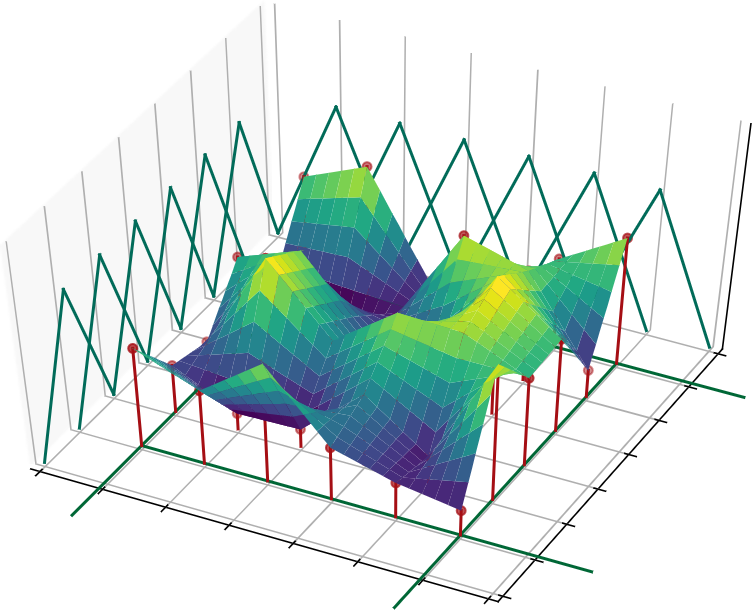
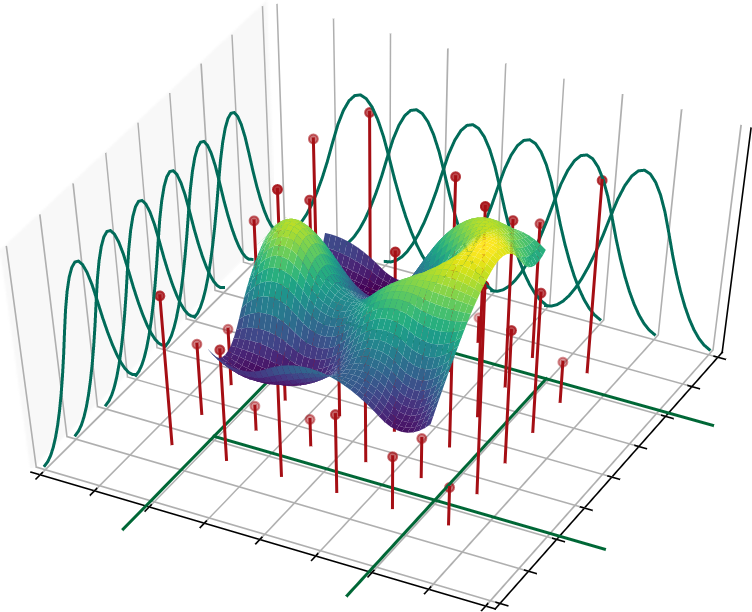
Applies the spline-based convolution operator

Parameters
- x (Tensor) - Input node features of shape
(number_of_nodes x in_channels). - edge_index (LongTensor) - Graph edges, given by source and target indices, of shape
(2 x number_of_edges). - pseudo (Tensor) - Edge attributes, ie. pseudo coordinates, of shape
(number_of_edges x number_of_edge_attributes)in the fixed interval [0, 1]. - weight (Tensor) - Trainable weight parameters of shape
(kernel_size x in_channels x out_channels). - kernel_size (LongTensor) - Number of trainable weight parameters in each edge dimension.
- is_open_spline (ByteTensor) - Whether to use open or closed B-spline bases for each dimension.
- degree (int, optional) - B-spline basis degree. (default:
1) - norm (bool, optional): Whether to normalize output by node degree. (default:
True) - root_weight (Tensor, optional) - Additional shared trainable parameters for each feature of the root node of shape
(in_channels x out_channels). (default:None) - bias (Tensor, optional) - Optional bias of shape
(out_channels). (default:None)
Returns
- out (Tensor) - Out node features of shape
(number_of_nodes x out_channels).
Example
import torch
from torch_spline_conv import spline_conv

x = torch.rand((4, 2), dtype=torch.float)  # 4 nodes with 2 features each
edge_index = torch.tensor([[0, 1, 1, 2, 2, 3], [1, 0, 2, 1, 3, 2]])  # 6 edges
pseudo = torch.rand((6, 2), dtype=torch.float)  # two-dimensional edge attributes
weight = torch.rand((25, 2, 4), dtype=torch.float)  # 25 parameters for in_channels x out_channels
kernel_size = torch.tensor([5, 5])  # 5 parameters in each edge dimension
is_open_spline = torch.tensor([1, 1], dtype=torch.uint8)  # only use open B-splines
degree = 1  # B-spline degree of 1
norm = True  # Normalize output by node degree.
root_weight = torch.rand((2, 4), dtype=torch.float)  # separately weight root nodes
bias = None  # do not apply an additional bias

out = spline_conv(x, edge_index, pseudo, weight, kernel_size,
                  is_open_spline, degree, norm, root_weight, bias)

print(out.size())
torch.Size([4, 4])  # 4 nodes with 4 features each
Cite
Please cite our paper if you use this code in your own work:
@inproceedings{Fey/etal/2018,
  title={{SplineCNN}: Fast Geometric Deep Learning with Continuous {B}-Spline Kernels},
  author={Fey, Matthias and Lenssen, Jan Eric and Weichert, Frank and M{\"u}ller, Heinrich},
  booktitle={IEEE Conference on Computer Vision and Pattern Recognition (CVPR)},
  year={2018},
}
Running tests
pytest
C++ API
torch-spline-conv also offers a C++ API that contains C++ equivalent of python models.
mkdir build
cd build
# Add -DWITH_CUDA=on support for the CUDA if needed
cmake ..
make
make install
1 maintainer

Metadata
1 maintainer
Release files for torch-spline-conv 1.2.2
For a detailed explanation of source distributions (sdists) and built distributions (wheels), please see the package formats documentation.
Source distribution (sdist)
| File | Size | Uploaded | Provenance | |
|---|---|---|---|---|
| torch_spline_conv-1.2.2.tar.gz | 25.4 kB | Without provenance | Details |
Release files / torch_spline_conv-1.2.2.tar.gz
| Download URL | torch_spline_conv-1.2.2.tar.gz |
|---|---|
| Size | 25.4 kB |
| Tags | Source |
|
SHA-256 checksum How to use checksums |
ed45a81da29f774665dbdd4709d7e534cdf16d2e7006dbd06957f35bd09661b2
|
|
BLAKE2b-256 checksum How to use checksums |
a0505f80c47bf09b561ded0981b088ab0064424843696aa35b3b83afde421e56
|
| Upload date | |
|
Uploaded using Trusted Publishing? What is trusted publishing? |
No |
| Uploaded via |
twine/4.0.1 CPython/3.9.12
|
Security for torch-spline-conv 1.2.2
Provenance
Provenance describes where a file came from. On PyPI, provenance is shared via attestations, which provide a verifiable record of the build or publishing details. View details, limitations and caveats.
No provenance found
None of the files in this release were uploaded with provenance metadata.
A note on package security
PyPI is a repository for distributing packages, not a service for auditing them. While third-party security researchers and our staff do their best to detect and remove malicious packages, PyPI cannot guarantee the quality, security or suitability of any given package.
To learn more about protecting yourself from malicious actors, visit our package security documentation.














