


twin4build: A python package for Data-driven and Ontology-based modeling and simulation of buildings
Dynamic modeling and simulation of buildings, featuring fully differentiable models for parameter estimation and optimal control. Supports integration of semantic models for automatic model generation and fast implementation.
Core Classes and Functionality
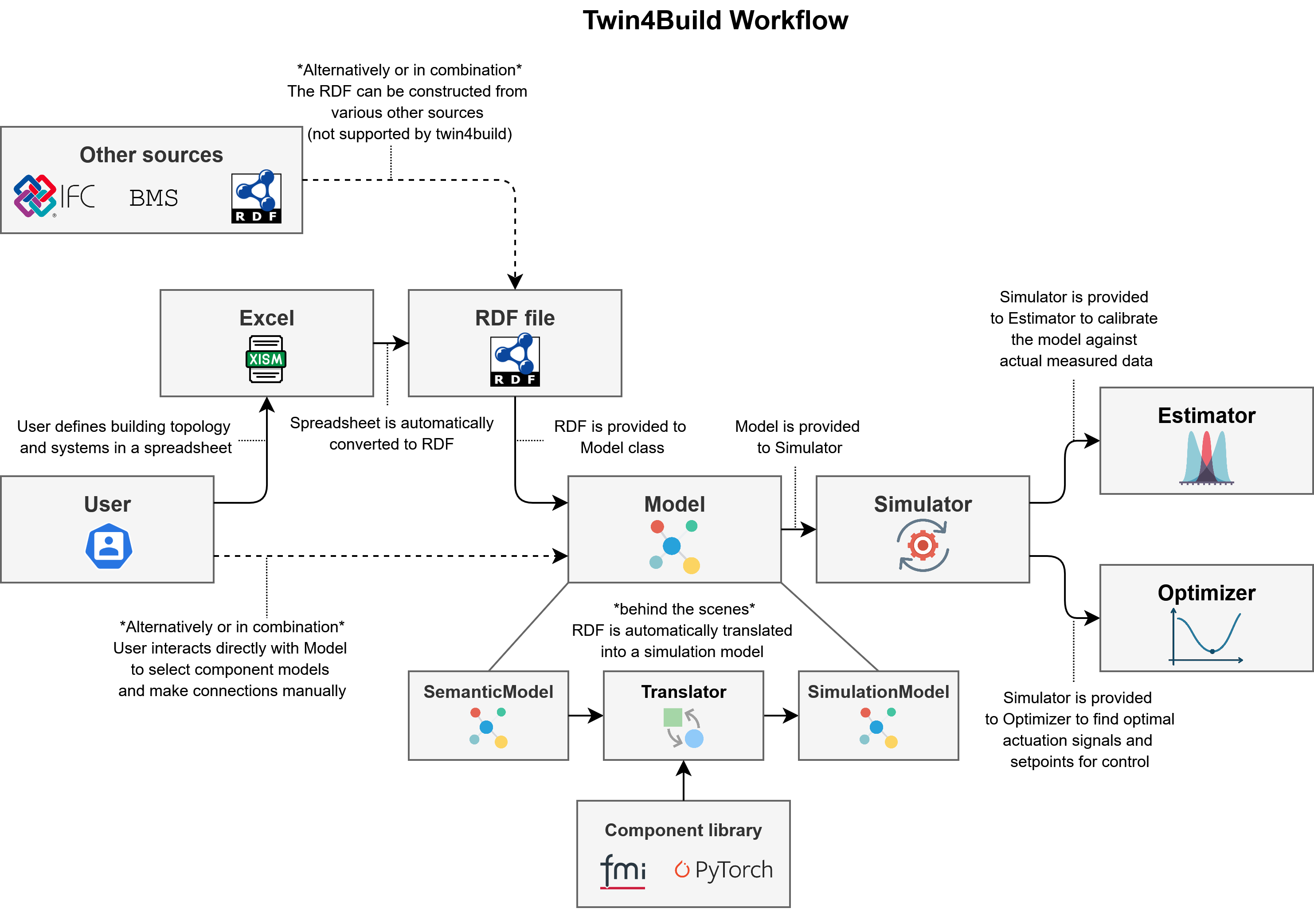
Twin4Build provides several top-level classes for building, simulating, translating, calibrating, and optimizing building energy models:
-
Model:
The main container for your building system, components, and their connections. Use this class to assemble your digital twin from reusable components. -
Simulator:
Runs time-based simulations of your Model, producing time series outputs for all components. Handles the simulation loop and time stepping. -
Translator:
Automatically generates a Model from a semantic model (ontology-based building description) and maintains a link between these. Enables ontology-driven, automated model creation. -
Estimator:
Performs parameter estimation (calibration) for your Model using measured data. Supports both least-squares and PyTorch-based optimization. -
Optimizer:
Optimizes building operation by adjusting setpoints or control variables to minimize objectives or satisfy constraints, using gradient-based methods.
All classes are accessible via the main package import:
import twin4build as tb
A typical workflow would look like this:
Examples and Tutorials
Below are some examples of how to use the package. More examples are coming soon.
Basics of Twin4Build
-
Part 1: Connecting components, simulating a model, and visualization
-
Translator
-
Estimator
-
Optimizer
-
Documentation
The documentation can be found online. Below is a code snippet showing the basic functionality of the package.
import twin4build as tb

# Create a model
model = tb.Model(id="example_model")

# Define components
damper = tb.DamperTorchSystem(id="damper")
space = tb.BuildingSpaceTorchSystem("space")

# Add connections to the model
self.add_connection(damper, space,
                    "airFlowRate", "supplyAirFlowRate")

# Load the model
model.load()

# Create a simulator instance
simulator = tb.Simulator(model)

# Simulate the model
step_size = 600 #Seconds
start_time = datetime.datetime(year=2025, month=1, day=10, hour=0, minute=0, second=0) # Optionally set the timezone
end_time = datetime.datetime(year=2025, month=1, day=12, hour=0, minute=0, second=0) # Optionally set the timezone
simulator.simulate(step_size=step_size,
                   start_time=start_time,
                   end_time=end_time)

# Plot the results
plot.plot_component(simulator,
                    components_1axis=[("Damper", "airFlowRate")],
                    components_2axis=[("Damper", "damperPosition")],
                    ylabel_1axis="Air flow rate", #Optional
                    ylabel_2axis="Damper position", #Optional
                    show=True,
                    nticks=11)
Installation
The package is installed with pip:
pip install twin4build
The following python versions are supported:
| Python version | Windows | Ubuntu |
|---|---|---|
| 3.9 |  |
 |
| 3.10 |  |
 |
| 3.11 |  |
 |
| 3.12 |  |
 |
Graphviz (recomended)
To utilize the graph-drawing capabilities of twin4build, the drawing engine Graphviz must be installed. It can be installed by downloading the install-file from the official website or by using your favorite package manager:
Ubuntu
sudo add-apt-repository universe
sudo apt update
sudo apt install graphviz
Windows
On windows, the winget or choco package managers can be used:
winget install graphviz
choco install graphviz
MacOS
brew install graphviz
Publications
[1] Bjørnskov, J. & Thomsen, A. & Jradi, M. (2025). Large-scale field demonstration of an interoperable and ontology-based energy modeling framework for building digital twins. Applied Energy, 387, [125597]
[2] Bjørnskov, J. & Jradi, M. & Wetter, M. (2025). Automated Model Generation and Parameter Estimation of Building Energy Models Using an Ontology-Based Framework. Energy and Buildings 329, [115228]
[3] Bjørnskov, J. & Jradi, M. (2023). An Ontology-Based Innovative Energy Modeling Framework for Scalable and Adaptable Building Digital Twins. Energy and Buildings, 292, [113146].
[4] Bjørnskov, J., Badhwar, A., Singh, D., Sehgal, M., Åkesson, R., & Jradi, M. (2025). Development and demonstration of a digital twin platform leveraging ontologies and data-driven simulation models. Journal of Building Performance Simulation, 1–13.
[5] Bjørnskov, J. & Jradi, M. (2023). Implementation and demonstration of an automated energy modeling framework for scalable and adaptable building digital twins based on the SAREF ontology. Building Simulation.
[6] Andersen, A. H. & Bjørnskov, J. & Jradi, M. (2023). Adaptable and Scalable Energy Modeling of Ventilation Systems as Part of Building Digital Twins. In Proceedings of the 18th International IBPSA Building Simulation Conference: BS2023 International Building Performance Simulation Association.
Cite as
@article{OntologyBasedBuildingModelingFramework,
    title = {An ontology-based innovative energy modeling framework for scalable and adaptable building digital twins},
    journal = {Energy and Buildings},
    volume = {292},
    pages = {113146},
    year = {2023},
    issn = {0378-7788},
    doi = {https://doi.org/10.1016/j.enbuild.2023.113146},
    url = {https://www.sciencedirect.com/science/article/pii/S0378778823003766},
    author = {Jakob Bjørnskov and Muhyiddine Jradi},
    keywords = {Digital twin, Data-driven, Building energy model, Building simulation, Ontology, SAREF},
}
1 maintainer

Metadata
1 maintainer
Release files for twin4build 1.1.2
For a detailed explanation of source distributions (sdists) and built distributions (wheels), please see the package formats documentation.
Source distribution (sdist)
| File | Size | Uploaded | Provenance | Actions |
|---|---|---|---|---|
| twin4build-1.1.2.tar.gz | 572.2 kB | With provenance | Details for twin4build-1.1.2.tar.gz |
Built distribution (wheel)
| File | Interpreter | ABI | Platform | Actions Reset |
|---|---|---|---|---|
| twin4build-1.1.2-py3-none-any.whl | Python 3 | none | any | Details for twin4build-1.1.2-py3-none-any.whl |
Total release size: 1.2 MB
Release files / twin4build-1.1.2.tar.gz
| Download URL | twin4build-1.1.2.tar.gz |
|---|---|
| Size | 572.2 kB |
| Tags | Source |
|
SHA-256 checksum How to use checksums |
e35522a657653237205bdb57b3fb2f1555d956902bcdf0640469560414256e85
|
|
BLAKE2b-256 checksum How to use checksums |
d6446a85b83201d2ce03aea9bef7d95ff86805ad7383139ab543c113f15fd5a8
|
| Upload date | |
|
Uploaded using Trusted Publishing? What is trusted publishing? |
Yes |
| Uploaded via |
twine/6.1.0 CPython/3.13.7
|
Provenance
Provenance describes where a file came from. On PyPI, provenance is shared via attestations, which provide a verifiable record of the build or publishing details. View details, limitations and caveats.


PyPI Publish Attestation
PyPI verified that this artifact, at this checksum, originated from the publisher listed below.
Signed by GitHub Actions, verified by PyPI on Oct 29, 2025.
Transparency logRelease files / twin4build-1.1.2-py3-none-any.whl
| Download URL | twin4build-1.1.2-py3-none-any.whl |
|---|---|
| Size | 618.8 kB |
| Tags | Python 3 |
|
SHA-256 checksum How to use checksums |
1ae633bdfdf2e3f171dcafa4d34677991a2422cf112d0ca5b7695fea4e247a1b
|
|
BLAKE2b-256 checksum How to use checksums |
3a0f14d08a1c1266e581f260948d3640638ce69cd233910103338461e16864f2
|
| Upload date | |
|
Uploaded using Trusted Publishing? What is trusted publishing? |
Yes |
| Uploaded via |
twine/6.1.0 CPython/3.13.7
|
Provenance
Provenance describes where a file came from. On PyPI, provenance is shared via attestations, which provide a verifiable record of the build or publishing details. View details, limitations and caveats.
PyPI Publish Attestation
PyPI verified that this artifact, at this checksum, originated from the publisher listed below.
Signed by GitHub Actions, verified by PyPI on Oct 29, 2025.
Transparency logSecurity for twin4build 1.1.2
Provenance
Provenance describes where a file came from. On PyPI, provenance is shared via attestations, which provide a verifiable record of the build or publishing details. View details, limitations and caveats.
Full provenance
All 2 files in this release have been uploaded with provenance metadata.
Attestation for twin4build-1.1.2.tar.gz
PyPI Publish Attestation
PyPI verified that this artifact, at this checksum, originated from the publisher listed below.
Signed by GitHub Actions, verified by PyPI on Oct 29, 2025.
Transparency logA note on package security
PyPI is a repository for distributing packages, not a service for auditing them. While third-party security researchers and our staff do their best to detect and remove malicious packages, PyPI cannot guarantee the quality, security or suitability of any given package.
To learn more about protecting yourself from malicious actors, visit our package security documentation.














