

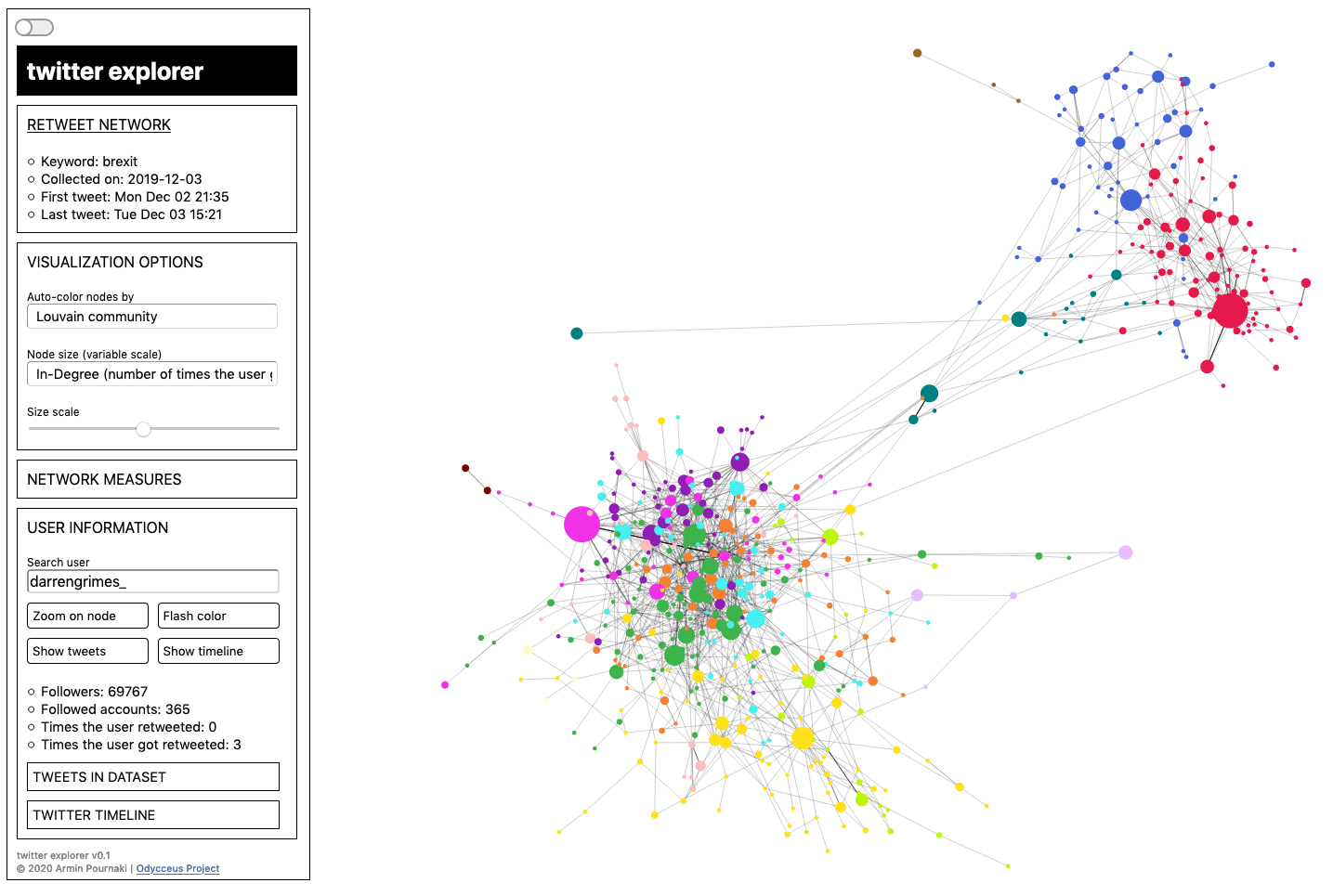
An interface to explore Twitter data through interactive network visualizations.
Features
The twitter explorer helps computational social scientists to:
-
Collect Twitter data by providing a visual interface for the Twitter Search API (v2 Standard, v2 Academic Research, v1.1 Standard).
-
Transform the collected data into networks: retweet/quote/mention/reply networks capturing different interactions between users and hashtag networks revealing the semantic layer of the debate.
-
Explore these networks interactively by using state-of-the-art graph visualizations.
Quick start
The twitter explorer requires Python ≥ 3.7. If you meet this requirement, open a terminal and run:
$ pip install twitterexplorer
You can now run the collector and the visualizer that will open in a new browser tab:
$ twitterexplorer collector
$ twitterexplorer visualizer
Since v.0.6.0, the twitter-explorer can also be used as a Python package. Please have a look at the examples here.
Getting started
Please refer to the documentation for detailed installation instructions and how to use the twitter explorer.
Screenshots
Data protection
The twitter explorer facilitates the collection of data through the Twitter Search API. Please respect the developer agreement when handling the collected data. Our interface includes a privacy option that allows to remove all accessible metadata of users that have less than 5000 followers (no public figures) from the interactive visualization in order to comply with current privacy standards. By only displaying tweets that still exist at the time of exploration, the interface complies with Twitter's display requirements.
Future development
- Add progress bar for collector
- Incorporate dynamics of the retweet networks
- Add different graph measures
Common errors
Error: StreamlitAPIException due to an outdated version of Streamlit
Fix: pip3 install streamlit --upgrade
Error: AttributeError: module 'google.protobuf.descriptor' has no attribute '_internal_create_key'
Fix: pip3 install protobuf --upgrade
How to cite
Pournaki, A., Gaisbauer, F., Banisch, S., & Olbrich, E. (2021). The Twitter Explorer: A Framework for Observing Twitter through Interactive Networks. Journal of Digital Social Research, 3(1), 106–118. https://doi.org/10.33621/jdsr.v3i1.64
Related software
- gazouilloire A command line tool for long-term tweets collection, including the possibility of automatic recursive retrieval within the corpus of all tweets to which collected tweets are answering
- minet A command line tool for scraping the public Twitter API (among other things). As of v0.4, the minet file format is compatible with the twitter-explorer!
- DMI-TCAT
A tool for streaming real-time tweets and storing them in an SQL database - twarc
Another CLI for Twitter search/streaming API
About
The idea for the twitter explorer originated from fruitful discussions in the context of the Odycceus project between Armin Pournaki, Felix Gaisbauer, Sven Banisch and Eckehard Olbrich. The tool is designed and developed by Armin Pournaki.
Acknowledgements
The twitter explorer stands on the shoulders of giants:
- Streamlit
The frontends of the collector and visualizer are made with Streamlit, a powerful and easily accessible tool to create interactive Python applications. - force-graph
The interactive graph visualization relies on the force-graph library. - igraph
All the graph operations in the twitter explorer are handled by the Python version of igraph. - twarc and tweepy
Easy-to-use Python wrappers for Twitter APIs. - twitwi
A collection of Twitter-related helper functions for Python.
Funding
This project has received funding from the European Union’s Horizon 2020 research and innovation programme under grant agreement No 732942.
License
The twitter explorer is licensed under the GNU GPLV3 license.
1 maintainer

Metadata
1 maintainer
Release files for twitterexplorer 0.7.3
For a detailed explanation of source distributions (sdists) and built distributions (wheels), please see the package formats documentation.
Source distribution (sdist)
| File | Size | Uploaded | Provenance | Actions |
|---|---|---|---|---|
| twitterexplorer-0.7.3.tar.gz | 52.6 kB | Without provenance | Details for twitterexplorer-0.7.3.tar.gz |
Built distribution (wheel)
| File | Interpreter | ABI | Platform | Actions Reset |
|---|---|---|---|---|
| twitterexplorer-0.7.3-py3-none-any.whl | Python 3 | none | any | Details for twitterexplorer-0.7.3-py3-none-any.whl |
Total release size: 115.8 kB
Release files / twitterexplorer-0.7.3.tar.gz
| Download URL | twitterexplorer-0.7.3.tar.gz |
|---|---|
| Size | 52.6 kB |
| Tags | Source |
|
SHA-256 checksum How to use checksums |
87bcde5202d680f32026ef2b390b2e8dd024f3ba5717d1d184db7810cc7a6320
|
|
BLAKE2b-256 checksum How to use checksums |
d3e8a4b17bf008ea8913c5bfe73526b98ec280b40d9b7448608f6cd0ae8361fb
|
| Upload date | |
|
Uploaded using Trusted Publishing? What is trusted publishing? |
No |
| Uploaded via |
twine/6.2.0 CPython/3.13.2
|
Release files / twitterexplorer-0.7.3-py3-none-any.whl
| Download URL | twitterexplorer-0.7.3-py3-none-any.whl |
|---|---|
| Size | 63.2 kB |
| Tags | Python 3 |
|
SHA-256 checksum How to use checksums |
bfa4d207505123a3c368ba23e1284090a53eb87288e4646b397c4a2afcd64d78
|
|
BLAKE2b-256 checksum How to use checksums |
d9b39ae61841f9f05c68d494ada9c4992256986ef48d74a4bafbf6a8eedced28
|
| Upload date | |
|
Uploaded using Trusted Publishing? What is trusted publishing? |
No |
| Uploaded via |
twine/6.2.0 CPython/3.13.2
|
Security for twitterexplorer 0.7.3
Provenance
Provenance describes where a file came from. On PyPI, provenance is shared via attestations, which provide a verifiable record of the build or publishing details. View details, limitations and caveats.
No provenance found
None of the files in this release were uploaded with provenance metadata.
A note on package security
PyPI is a repository for distributing packages, not a service for auditing them. While third-party security researchers and our staff do their best to detect and remove malicious packages, PyPI cannot guarantee the quality, security or suitability of any given package.
To learn more about protecting yourself from malicious actors, visit our package security documentation.














