
 Unitary Compiler Collection








The Unitary Compiler Collection (UCC) is a Python library for frontend-agnostic, high performance compilation of quantum circuits. UCC's goal is to gather together the best of open source compilation to make quantum programming simpler, faster, and more scalable.
By leveraging qBraid, UCC interfaces automatically with multiple quantum computing frameworks, including Qiskit, Cirq, and PyTKET and supports programs in OpenQASM 2 and OpenQASM 3. For the full list, just call ucc.supported_circuit_formats.
We use the Merit Terminal to pay contributors who implement new compiler passes in our repo! Check out our open issues tagged with #merit-bounty to see which are eligible for compensation.
Want to know more?
| Resource | Description |
|---|---|
| Documentation | Check out our documentation for more information on using and contributing to UCC. |
| Discussions | For code, repo, or ecosystem questions. |
| Discord | For casual or time-sensitive questions, including weekly community calls. |
| Research Publications | Explore academic work utilizing UCC. |
Quickstart
Installation
Note: UCC requires Python version ≥ 3.12.
For normal users of UCC, you can install via pip as
pip install ucc
If developing, including if building custom transpiler passes, please install uv, which is used to managed dependencies and ensure a reproducible development enviroment. Once uv is installed, setup your development environment via
git clone https://github.com/unitaryfoundation/ucc.git
cd ucc
uv sync --all-extras --all-groups
This uv sync command ensures the optional developer and documentation dependences are installed. For development with uv, we assume you either prefix each command with uv run, or
you first activate the uv managed virtual environment by running source .venv/bin/activate in your shell.
For more details on using uv, refer to its documentation or this tutorial.
Example with Qiskit, Cirq, and PyTKET
Define a circuit with your preferred quantum SDK and compile it!
from ucc import compile

from pytket import Circuit as TketCircuit
from cirq import Circuit as CirqCircuit
from qiskit import QuantumCircuit as QiskitCircuit
from cirq import H, CNOT, LineQubit

def test_tket_compile():
    circuit = TketCircuit(2)
    circuit.H(0)
    circuit.CX(0, 1)
    compile(circuit)

def test_qiskit_compile():
    circuit = QiskitCircuit(2)
    circuit.h(0)
    circuit.cx(0, 1)
    compile(circuit)

def test_cirq_compile():
    qubits = LineQubit.range(2)
    circuit = CirqCircuit(
        H(qubits[0]),
        CNOT(qubits[0], qubits[1]))
    compile(circuit)
How does UCC stack up?
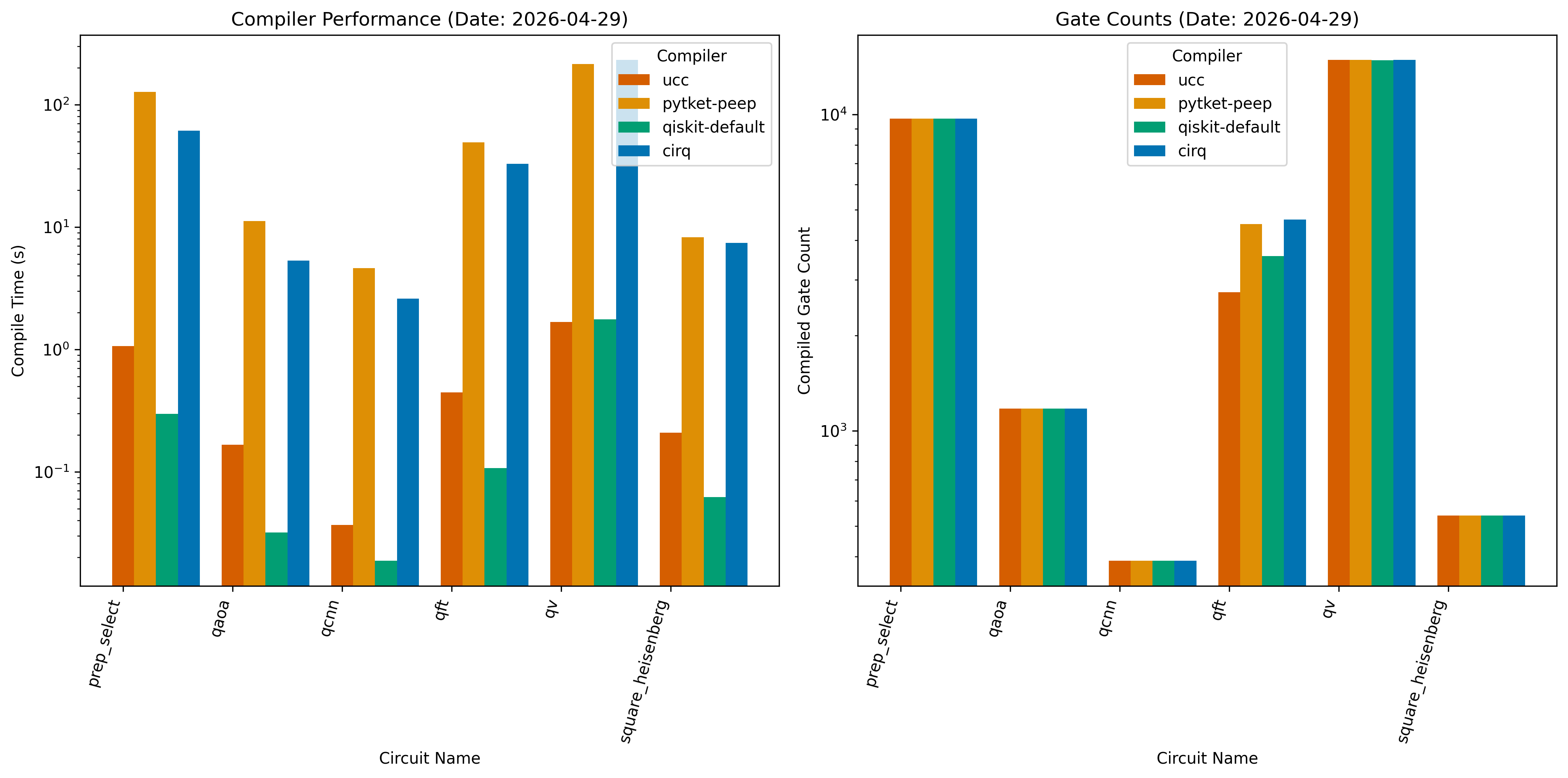
UCC seeks to provide an end-to-end compiler that works well for the majority of the users out of the box. Today, this is achieved by running a particular subset of Qiskit transpiler passes.
To ensure we continue to improve performance and meet user needs, we regularly run benchmarks comparing UCC against the latest versions of leading quantum compiler frameworks across a range of circuits. Here’s the latest:
And here you can see progress over time, with new package versions labeled for each compiler:
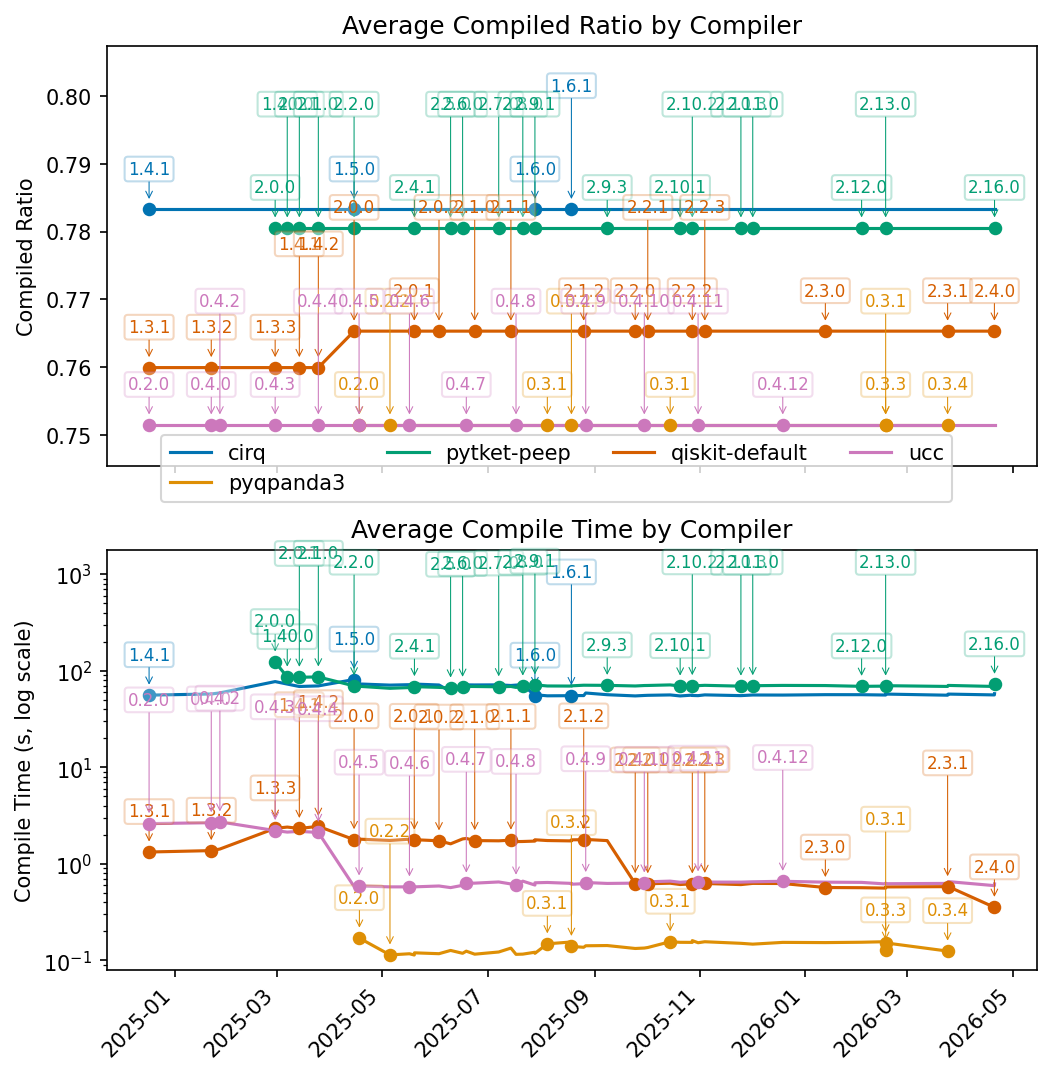
FullPeepHoleOptimize function of PyTKET.
The benchmark code, configurations and raw results from running on specific hardware are maintined in the companion repository of ucc-bench.
To learn more about running these benchmarks, the overall benchmark philosophy, or how to contribute to improving the benchmarking methodology, check out the benchmarking section in the docs or the README.md in ucc-bench.
Contributing
We’re building UCC as a community-driven project. Your contributions help improve the tool for everyone! There are many ways you can contribute, such as
- 💸 Create a Custom Compiler Pass:💸 Learn how in the User Guide. Eligible for compensation through the Merit Terminal!
- Submit a bug report or feature request: Submit a bug report or feature request on GitHub.
- Contribute Code: Follow the Contribution Guide to submit new passes and improvements.
If you have questions about contributing please ask on the Unitary Foundation Discord.
License
UCC is distributed under GNU Affero General Public License version 3.0(AGPLv3). Parts of ucc contain code or modified code that is part of Qiskit or Qiskit Benchpress, which are distributed under the Apache 2.0 license.
Contributors ✨
Thank you to all of the wonderful people that have made this project possible. Non-code contributors are also much appreciated, and are listed here. Thank you to:
- @francespoblete for designing the UCC logo.
Contributions of any kind are welcome!
3 maintainers


Metadata
3 maintainers
Release files for ucc 0.4.12
For a detailed explanation of source distributions (sdists) and built distributions (wheels), please see the package formats documentation.
Source distribution (sdist)
| File | Size | Uploaded | Provenance | |
|---|---|---|---|---|
| ucc-0.4.12.tar.gz | 413.4 kB | With provenance | Details |
Built distribution (wheel)
| File | Interpreter | ABI | Platform | Reset |
|---|---|---|---|---|
| ucc-0.4.12-py3-none-any.whl | Python 3 | none | any | Details |
Total release size: 449.5 kB
Release files / ucc-0.4.12.tar.gz
| Download URL | ucc-0.4.12.tar.gz |
|---|---|
| Size | 413.4 kB |
| Tags | Source |
|
SHA-256 checksum How to use checksums |
62048c180089dd6d49ced311092b4b98445177c15995baf43c64fdb0daeb4e3b
|
|
BLAKE2b-256 checksum How to use checksums |
806353fcb0327df99a701d871e029db8bb18d18baa7258ca9d0fb82cc1d6168a
|
| Upload date | |
|
Uploaded using Trusted Publishing? What is trusted publishing? |
Yes |
| Uploaded via |
twine/6.1.0 CPython/3.13.7
|
Provenance
Provenance describes where a file came from. On PyPI, provenance is shared via attestations, which provide a verifiable record of the build or publishing details. View details, limitations and caveats.


PyPI Publish Attestation
PyPI verified that this artifact, at this checksum, originated from the publisher listed below.
Signed by GitHub Actions, verified by PyPI on Dec 18, 2025.
Transparency logRelease files / ucc-0.4.12-py3-none-any.whl
| Download URL | ucc-0.4.12-py3-none-any.whl |
|---|---|
| Size | 36.1 kB |
| Tags | Python 3 |
|
SHA-256 checksum How to use checksums |
df90146b69c6fa0e10e85401a7eaec0bcc550e065a12e89f5638f1ffb5982dbc
|
|
BLAKE2b-256 checksum How to use checksums |
c318a57f6e1d29584932304e28665ac488a73998db30376a7dff02e1348cc42d
|
| Upload date | |
|
Uploaded using Trusted Publishing? What is trusted publishing? |
Yes |
| Uploaded via |
twine/6.1.0 CPython/3.13.7
|
Provenance
Provenance describes where a file came from. On PyPI, provenance is shared via attestations, which provide a verifiable record of the build or publishing details. View details, limitations and caveats.
PyPI Publish Attestation
PyPI verified that this artifact, at this checksum, originated from the publisher listed below.
Signed by GitHub Actions, verified by PyPI on Dec 18, 2025.
Transparency logSecurity for ucc 0.4.12
Provenance
Provenance describes where a file came from. On PyPI, provenance is shared via attestations, which provide a verifiable record of the build or publishing details. View details, limitations and caveats.
Full provenance
All 2 files in this release have been uploaded with provenance metadata.
Attestation for ucc-0.4.12.tar.gz
PyPI Publish Attestation
PyPI verified that this artifact, at this checksum, originated from the publisher listed below.
Signed by GitHub Actions, verified by PyPI on Dec 18, 2025.
Transparency logA note on package security
PyPI is a repository for distributing packages, not a service for auditing them. While third-party security researchers and our staff do their best to detect and remove malicious packages, PyPI cannot guarantee the quality, security or suitability of any given package.














