
UralicNLP
Natural language processing for many languages



UralicNLP can produce morphological analyses, generate morphological forms, lemmatize words and give lexical information about words in Uralic and other languages. The languages we support include the following languages: Finnish, Russian, German, English, Norwegian, Swedish, Arabic, Ingrian, Meadow & Eastern Mari, Votic, Olonets-Karelian, Erzya, Moksha, Hill Mari, Udmurt, Tundra Nenets, Komi-Permyak, North Sami, South Sami and Skolt Sami. Currently, UralicNLP uses stable builds for the supported languages.
See the catalog of supported languages
Some of the supported languages: 🇸🇦 🇪🇸 🇮🇹 🇵🇹 🇩🇪 🇫🇷 🇳🇱 🇬🇧 🇷🇺 🇫🇮 🇸🇪 🇳🇴 🇩🇰 🇱🇻 🇪🇪
Check out UralicGUI - a graphical user interface for UralicNLP.
☕ Check out UralicNLP official Java version
♯ Check out UralicNLP official C# version
🌐 Check out UralicNLP official JS version
Installation
The library can be installed from PyPi.
pip install uralicNLP
If you want to use the Constraint Grammar features (from uralicNLP.cg3 import Cg3), you will also need to install VISL CG-3.
Use UralicNLP in ChatGPT!
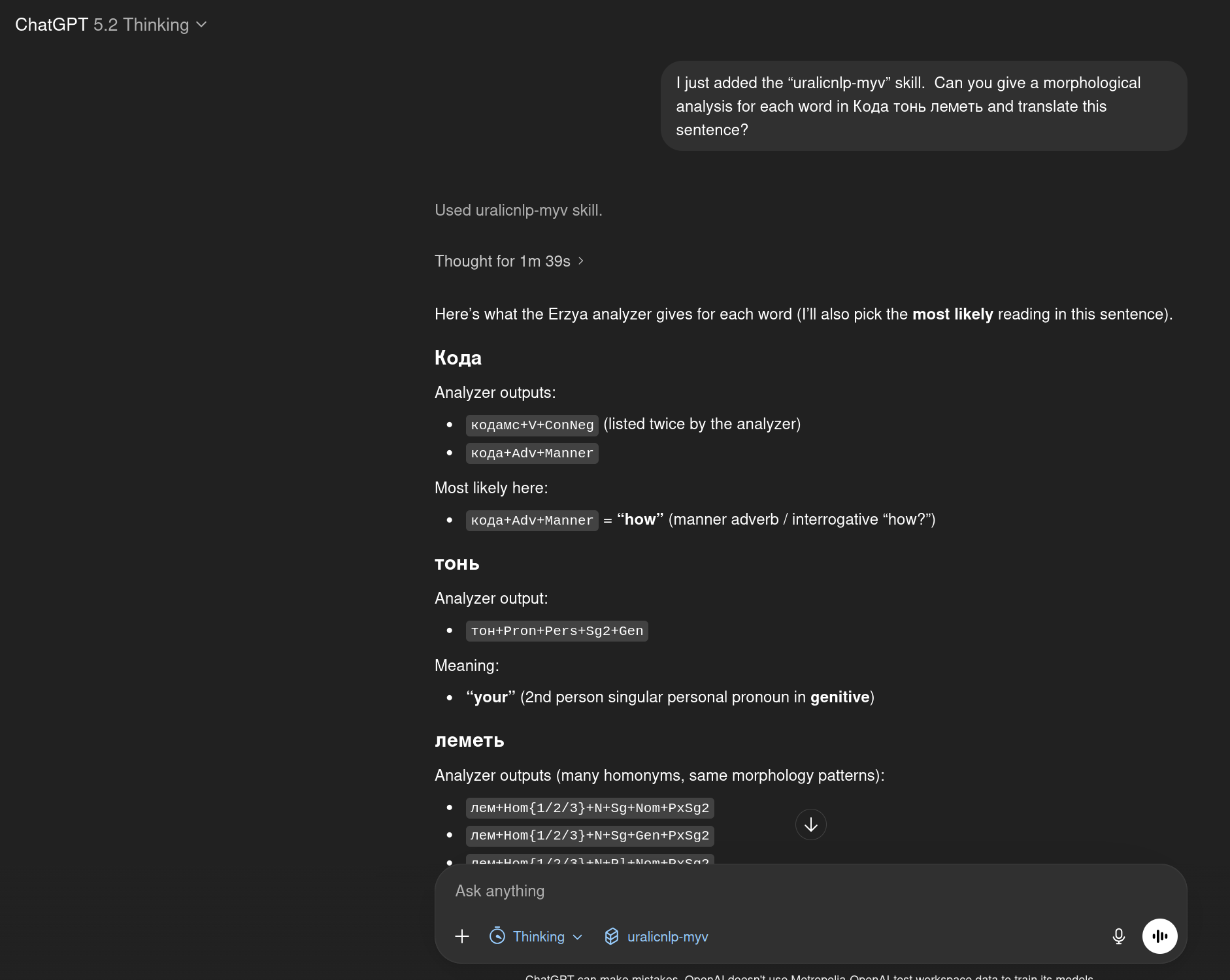
UralicNLP skills are available for ChatGPT. Download yours today!
MCP
Who said LLMs don't speak endangered languages? UralicNLP now supports MCP! Connect UralicNLP main functionality directly to your favorite MCP supporting LLM! Read more in the UralicMCP wiki.
Large language models (LLMs)
UralicNLP supports a wide range of LLMs and it can even embed text in some endangered languages Check out LLMs.
UralicNLP can cluster texts into semantically similar categories. Learn more about clustering.
List supported languages
The API is under constant development and new languages will be added to the nightly builds system. That's why UralicNLP provides a functionality for looking up the list of currently supported languages. The method returns 3 letter ISO codes for the languages.
from uralicNLP import uralicApi
uralicApi.supported_languages()
>>{'cg': ['vot', 'lav', 'izh', 'rus', 'lut', 'fao', 'est', 'nob', 'ron', 'olo', 'bxr', 'hun', 'crk', 'chr', 'vep', 'deu', 'mrj', 'gle', 'sjd', 'nio', 'myv', 'som', 'sma', 'sms', 'smn', 'kal', 'bak', 'kca', 'otw', 'ciw', 'fkv', 'nds', 'kpv', 'sme', 'sje', 'evn', 'oji', 'ipk', 'fit', 'fin', 'mns', 'rmf', 'liv', 'cor', 'mdf', 'yrk', 'tat', 'smj'], 'dictionary': ['vot', 'lav', 'rus', 'est', 'nob', 'ron', 'olo', 'hun', 'koi', 'chr', 'deu', 'mrj', 'sjd', 'myv', 'som', 'sma', 'sms', 'smn', 'kal', 'fkv', 'mhr', 'kpv', 'sme', 'sje', 'hdn', 'fin', 'mns', 'mdf', 'vro', 'udm', 'smj'], 'morph': ['vot', 'lav', 'izh', 'rus', 'lut', 'fao', 'est', 'nob', 'swe', 'ron', 'eng', 'olo', 'bxr', 'hun', 'koi', 'crk', 'chr', 'vep', 'deu', 'mrj', 'ara', 'gle', 'sjd', 'nio', 'myv', 'som', 'sma', 'sms', 'smn', 'kal', 'bak', 'kca', 'otw', 'ciw', 'fkv', 'nds', 'mhr', 'kpv', 'sme', 'sje', 'evn', 'oji', 'ipk', 'fit', 'fin', 'mns', 'rmf', 'liv', 'cor', 'mdf', 'yrk', 'vro', 'udm', 'tat', 'smj']}
The dictionary key lists the languages that are supported by the lexical lookup, whereas morph lists the languages that have morphological FSTs and cg lists the languages that have a CG.
Download models
On the command line:
python -m uralicNLP.download --languages fin eng
python -m uralicNLP.download --languages dictionary
From python code:
from uralicNLP import uralicApi
uralicApi.download("fin")
uralicApi.download("dictionary")
Notice that dictionary downloads a multilingual dictionary model for all supported languages.
Lemmatize words
A word form can be lemmatized with UralicNLP. This does not do any disambiguation but rather returns a list of all the possible lemmas.
from uralicNLP import uralicApi
uralicApi.lemmatize("вирев", "myv")
>>['вирев', 'вирь']
uralicApi.lemmatize("luutapiiri", "fin", word_boundaries=True)
>>['luuta|piiri', 'luu|tapiiri']
An example of lemmatizing the word вирев in Erzya (myv). By default, a descriptive analyzer is used. Use uralicApi.lemmatize("вирев", "myv", descriptive=False) for a non-descriptive analyzer. If word_boundaries is set to True, the lemmatizer will mark word boundaries with a |.
Morphological analysis
Apart from just getting the lemmas, it's also possible to perform a complete morphological analysis.
from uralicNLP import uralicApi
uralicApi.analyze("voita", "fin")
>>[['voi+N+Sg+Par', 0.0], ['voi+N+Pl+Par', 0.0], ['voitaa+V+Act+Imprt+Prs+ConNeg+Sg2', 0.0], ['voitaa+V+Act+Imprt+Sg2', 0.0], ['voitaa+V+Act+Ind+Prs+ConNeg', 0.0], ['voittaa+V+Act+Imprt+Prs+ConNeg+Sg2', 0.0], ['voittaa+V+Act+Imprt+Sg2', 0.0], ['voittaa+V+Act+Ind+Prs+ConNeg', 0.0], ['vuo+N+Pl+Par', 0.0]]
An example of analyzing the word voita in Finnish (fin). The default analyzer is descriptive. To use a normative analyzer instead, use uralicApi.analyze("voita", "fin", descriptive=False).
Morphological generation
From a lemma and a morphological analysis, it's possible to generate the desired word form.
from uralicNLP import uralicApi
uralicApi.generate("käsi+N+Sg+Par", "fin")
>>[['kättä', 0.0]]
An example of generating the singular partitive form for the Finnish noun käsi. The result is kättä. The default generator is a regular normative generator. uralicApi.generate("käsi+N+Sg+Par", "fin", dictionary_forms=True) uses a normative dictionary generator and uralicApi.generate("käsi+N+Sg+Par", "fin", descriptive=True) a descriptive generator.
Morphological segmentation
UralicNLP makes it possible to split a word form into morphemes. (Note: this does not work with all languages)
from uralicNLP import uralicApi
uralicApi.segment("luutapiirinikin", "fin")
>>[['luu', 'tapiiri', 'ni', 'kin'], ['luuta', 'piiri', 'ni', 'kin']]
In the example, the word luutapiirinikin has two possible interpretations luu|tapiiri and luuta|piiri, the segmentation is done for both interpretations.
Disambiguation
This section has been moved to UralicNLP wiki page on disambiguation.
Dictionaries
You can get translations for minority language words easily with the following code:
 from uralicNLP import uralicApi
 uralicApi.get_translation("piânnai", "sms")
 >> {'sme': ['beana'], 'sjd': ['пе̄ннэ'], 'sju': ['biegˈŋja', 'dä̀rra'], 'rus': ['собака'], 'nob': ['hund'], 'eng': ['dog'], 'deu': ['Hund'], 'fin': ['koira']}
Learn more about dictionaries in the wiki page on dictionaries.
Parsing UD CoNLL-U annotated TreeBank data
UralicNLP comes with tools for parsing and searching CoNLL-U formatted data. Please refer to the Wiki for the UD parser documentation.
Other functionalities
Cite
If you use UralicNLP in an academic publication, please cite it as follows:
Hämäläinen, Mika. (2019). UralicNLP: An NLP Library for Uralic Languages. Journal of open source software, 4(37), [1345]. https://doi.org/10.21105/joss.01345
@article{uralicnlp_2019,
    title={{UralicNLP}: An {NLP} Library for {U}ralic Languages},
    DOI={10.21105/joss.01345},
    journal={Journal of Open Source Software},
    author={Mika Hämäläinen},
    year={2019},
    volume={4},
    number={37},
    pages={1345}
}
For citing the FSTs and CGs, see uralicApi.model_info(language).
The FST and CG tools and dictionaries come mostly from the GiellaLT repositories and Apertium.
1 maintainer

Metadata
1 maintainer
Release files for uralicNLP 2.1.3
For a detailed explanation of source distributions (sdists) and built distributions (wheels), please see the package formats documentation.
Source distribution (sdist)
| File | Size | Uploaded | Provenance | |
|---|---|---|---|---|
| uralicnlp-2.1.3.tar.gz | 119.2 kB | Without provenance | Details |
Built distribution (wheel)
| File | Interpreter | ABI | Platform | Reset |
|---|---|---|---|---|
| uralicnlp-2.1.3-py2.py3-none-any.whl | Python 2, Python 3 | none | any | Details |
Total release size: 236.9 kB
Release files / uralicnlp-2.1.3.tar.gz
| Download URL | uralicnlp-2.1.3.tar.gz |
|---|---|
| Size | 119.2 kB |
| Tags | Source |
|
SHA-256 checksum How to use checksums |
901da2e382be7b396d4914faeaa4fb4c920c9344f981e0c34235447640a2ef49
|
|
BLAKE2b-256 checksum How to use checksums |
b44aa0d17a92bd8f1ed89d03debd4a8b954cf9a7d13fefe9143682b0ad9d3da5
|
| Upload date | |
|
Uploaded using Trusted Publishing? What is trusted publishing? |
No |
| Uploaded via |
twine/7.0.0 CPython/3.14.4
|
Release files / uralicnlp-2.1.3-py2.py3-none-any.whl
| Download URL | uralicnlp-2.1.3-py2.py3-none-any.whl |
|---|---|
| Size | 117.7 kB |
| Tags | Python 2 Python 3 |
|
SHA-256 checksum How to use checksums |
6664a0f8e90c93a23b7e19678362de9f1b83e910b427698bd5b6f7e8ea0dd12e
|
|
BLAKE2b-256 checksum How to use checksums |
504f0a52655cc0b578cd95efa4f256bebf801e7aae48b86b7cff50624737347c
|
| Upload date | |
|
Uploaded using Trusted Publishing? What is trusted publishing? |
No |
| Uploaded via |
twine/7.0.0 CPython/3.14.4
|
Security for uralicNLP 2.1.3
Provenance
Provenance describes where a file came from. On PyPI, provenance is shared via attestations, which provide a verifiable record of the build or publishing details. View details, limitations and caveats.
No provenance found
None of the files in this release were uploaded with provenance metadata.
A note on package security
PyPI is a repository for distributing packages, not a service for auditing them. While third-party security researchers and our staff do their best to detect and remove malicious packages, PyPI cannot guarantee the quality, security or suitability of any given package.
To learn more about protecting yourself from malicious actors, visit our package security documentation.














