
vfairness
Measure and explain machine-learning fairness, and say plainly when the data does not support a verdict.




vfairness is a Python library for auditing whether a machine-learning system treats different groups fairly, for finding the sources of bias behind an unfair result, and for intervening to reduce it. It is built for the ML engineers, data scientists, auditors, and risk and compliance teams who have to stand behind a fairness claim. It covers classification, regression, and ranking models, and extends the same discipline to LLM, agent, and vision systems.
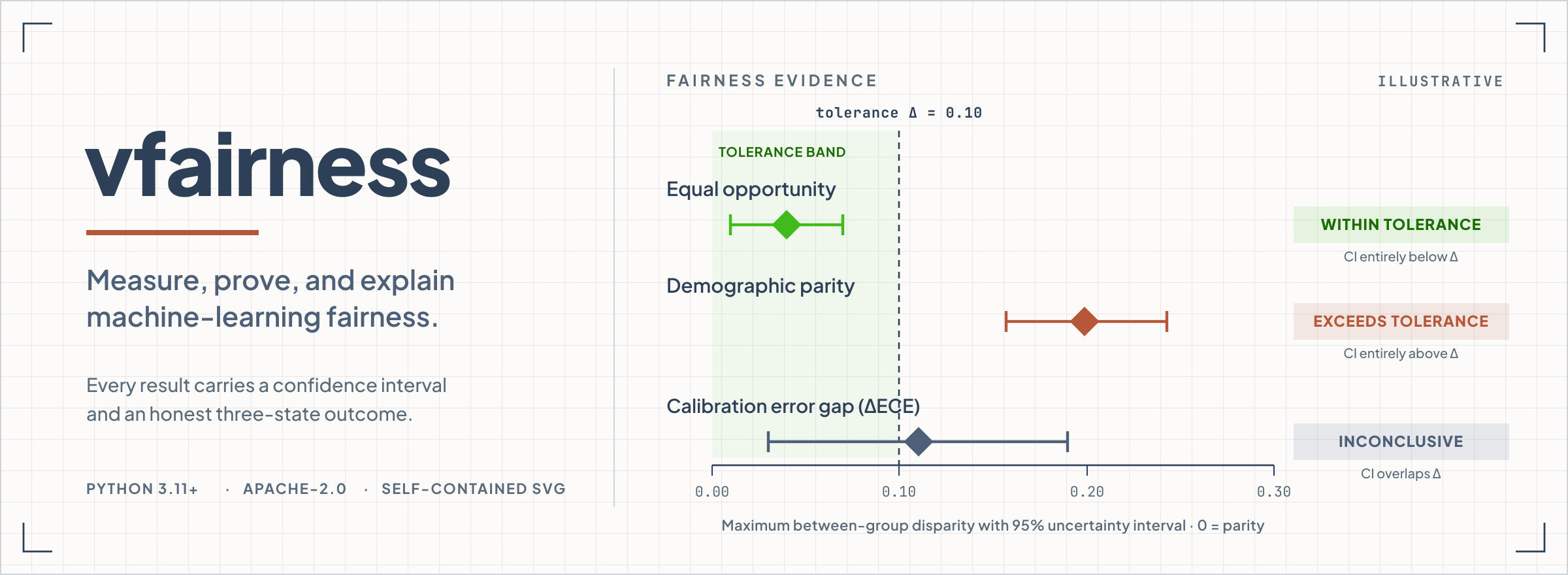
What sets it apart is honesty under uncertainty. A measured disparity is an
estimate, not a fact, so vfairness compares the whole confidence interval to a
configurable tolerance and returns a three-state verdict rather than a point
estimate dressed up as a yes or no: the disparity is within tolerance,
exceeds it, or the evidence is inconclusive. These are statistical evidence
states, not a final judgment of fairness (the API exposes them as fair /
unfair / insufficient_evidence); a disparity it cannot measure is reported
the same honest way, never as a silent pass.
Documentation, guides, and a live example gallery: vfairness.validant.ai
Beta
0.2.0is the second public beta, released 2026-10-26 and installable withpip install vfairness. New in 0.2.0: deployment policies that hold a model to the coverage a deployment requires. It is a0.xrelease: the frozen public surface is stable and changes only through a deprecation cycle, while experimental surface may still move before1.0.0. See Beta and API stability and the release history.
Why vfairness
-
Verdicts you can defend. Where a metric carries an interval, the verdict is read from the whole interval rather than the point estimate, so a tight large-sample gap and a wide small-sample gap of the same size are treated differently, as they should be. A "within tolerance" result is then positive evidence of practical equivalence, not merely a failure to prove disparity. Bootstrap and Bayesian intervals, effect sizes and multiple-testing correction are all available, and the
*_with_cifunctions provide an interval for every metric that has one.Know which route you are on.
get_report(include_ci=True)populatesmetrics_with_cifor three of the five default metrics (demographic_parity_difference,equalized_odds_difference,equal_opportunity_difference).demographic_parity_ratioandpredictive_parity_differencecome back as plain point estimates there, with no interval and no interval-derived verdict. For those two, calldisparate_impact_ratio_with_ciandpredictive_parity_difference_with_cidirectly. This matters most for the four-fifths ratio, which is the statistic a regulator is most likely to ask about. -
Fails closed, not silent. An undefined group rate, or a run left with a single assessable group, does not return a number: the report comes back
assessable: Falsewithfairness_score: Noneand every metric listed undernot_assessable_metrics, rather than a fabricated score. The two release gates behave the same way.assert_fairnessrefuses a metric whose value is NaN with "NOT MEASURABLE ... so the metric was never compared against threshold (fail closed)", andModelFairnessGateblocks on a metric it could not compute rather than approving an unevaluated check. -
The whole lifecycle, one library. A six-stage pipeline covers preprocessing bias detection, in-processing constraints, post-processing calibration and thresholding, evaluation, operations (CI/CD gates, monitoring, drift), and reporting.
-
Beyond tabular models. Dedicated surfaces for LLMs (counterfactual prompt testing, BBQ / BOLD / DecodingTrust benchmarks), agents and multi-agent systems, vision, and retrieval groundedness.
-
Explainability built in. SHAP-family attributions, a fairness decomposition, counterfactuals, and faithfulness / stability diagnostics, so you can explain why a result is unfair, not only that it is.
-
Corroborated against the field. A differential test suite checks vfairness against fairlearn and AIF360: where a metric is shared, the numbers agree within tolerance (the suite runs when those reference libraries are installed); where definitions legitimately differ, the difference is documented in
docs/DIVERGENCES.md. -
Report-ready. Self-contained SVG reports and dashboards render with no browser or JavaScript dependency.
-
Engineered for reliance. A typed public API (
py.typed), a large test suite with mutation and property-based testing, a versioned assessment methodology stamped into every report, and a security-reviewed egress guard.
Installation
pip install vfairness
Requires Python 3.11 or newer. The 0.0.1 distribution that carried this name
before this release is our own early 4.5 KB placeholder from March 2026 with no
FairnessAnalyzer in it; it has been yanked, so a resolver will not select it.
If you pinned it, upgrade rather than reinstall.
The core installs on numpy, pandas, scipy, scikit-learn, and requests.
Optional capabilities are opt-in extras, so a lean install stays lean:
| Extra | Adds |
|---|---|
rendering |
SVG report and dashboard templates (Jinja2) |
viz |
Matplotlib / Seaborn charts |
dashboard |
Interactive Plotly dashboards |
training |
PyTorch fairness-aware losses and trainable calibrators |
llm |
LLM output scorers (VADER sentiment, profanity detection) |
causal |
Causal fairness graphs |
xai |
SHAP-family attributions and explainability diagnostics |
mcp |
Model Context Protocol server |
all |
Everything above |
pip install "vfairness[rendering,viz]" # reports + charts
Requires Python 3.11 or newer.
Quick start
import numpy as np
from vfairness import FairnessAnalyzer, demographic_parity_difference_with_ci

# A hiring model that approves men more often than women.
rng = np.random.default_rng(7)
n = 2000
gender = rng.choice(["female", "male"], size=n)
y_true = rng.integers(0, 2, size=n)                  # the true outcome
selection_rate = np.where(gender == "male", 0.62, 0.38)
y_pred = (rng.random(n) < selection_rate).astype(int)  # the model's decisions

# One call for a full, statistically validated fairness report. On this data all
# five metrics are measurable, so the verdict is a plain pass/fail count, and the
# summary states the rows it was computed over.
analyzer = FairnessAnalyzer(y_true, y_pred, gender)
report = analyzer.get_report(include_ci=True)
print(report["assessment"]["summary"])
# -> 1/5 metrics within thresholds (data provenance: 2000 of 2000 rows assessed, 0 excluded for missing values, 0 in 0 group(s) withheld by the group-size floor, missing_strategy='exclude')

# Or a single metric, with the confidence interval that drives the verdict.
result = demographic_parity_difference_with_ci(y_true, y_pred, gender, random_state=0)
print(f"Demographic parity gap: {result.point_estimate:.3f}  "
      f"95% CI [{result.lower_bound:.3f}, {result.upper_bound:.3f}]  "
      f"significant={result.is_significant}")
# -> Demographic parity gap: 0.199  95% CI [0.157, 0.243]  significant=True

# The same metric through the analyzer carries the three-state verdict, and the
# verdict is read from the whole interval, not from the point estimate.
graded = analyzer.demographic_parity_difference(include_ci=True, random_state=0)
print(f"verdict={graded.verdict}")
# -> verdict=unfair

# On a 60-row slice the gap is smaller and the interval is far wider, so the
# same code declines to call it either way rather than reporting a pass.
small = FairnessAnalyzer(y_true[:60], y_pred[:60], gender[:60], min_group_size=5)
thin = small.demographic_parity_difference(include_ci=True, random_state=0)
lo, hi = thin.confidence_interval
print(f"60 rows: {thin.value:.3f}  95% CI [{lo:.3f}, {hi:.3f}]  verdict={thin.verdict}")
# -> 60 rows: 0.029  95% CI [0.000, 0.292]  verdict=insufficient_evidence

# The third state at group level, on data that actually triggers it. Add 12
# nonbinary rows: too few to support a verdict, so instead of quietly dropping
# them or folding them into a pass, the report names them as insufficient
# evidence.
gender_3 = np.append(gender, ["nonbinary"] * 12)
y_true_3 = np.append(y_true, rng.integers(0, 2, size=12))
y_pred_3 = np.append(y_pred, rng.integers(0, 2, size=12))

assessment = FairnessAnalyzer(y_true_3, y_pred_3, gender_3).get_report()["assessment"]
print(assessment["summary"])
# -> 1/5 metrics within thresholds (1 group(s) with insufficient evidence, excluded from the verdict: ['nonbinary']) (data provenance: 2012 of 2012 rows assessed, 0 excluded for missing values, 12 in 1 group(s) withheld by the group-size floor, missing_strategy='exclude')
print(assessment["insufficient_evidence_groups"][0]["verdict"])
# -> insufficient_evidence
The Getting Started guide walks through regression and ranking audits, interventions, calibration, monitoring, and CI/CD gates.
What is inside
Metric families, each defined against its primary literature source and tested against hand-derived values and cross-library references:
- Independence (allocation): demographic parity, disparate impact ratio (the four-fifths statistic).
- Separation (error parity): equal opportunity, equalized odds, predictive equality, false-negative-rate parity, accuracy parity.
- Sufficiency (calibration): predictive parity, negative predictive value parity, calibration difference, integrated calibration index, multicalibration.
- Continuous, decision-utility, and integrity: pricing disparity, net benefit parity, conditional adverse impact, and proxy-leakage audits.
- Ranking: exposure and representation parity over ranked output.
Fifteen sub-packages: the six-stage pipeline (preprocessing,
in_processing, post_processing, evaluation, operations, rendering),
eight specialized surfaces (llm, agents*, multi_agent*, xai,
vision*, legal*, mcp*, validity*), and a cross-cutting net egress
guard.
* Open today; not guaranteed to remain part of this distribution. The surfaces marked with an asterisk (
agents,multi_agent,vision,legal,mcp,validity) are specialized, research-stage capabilities. As they mature into validated, production-grade tooling, some may be taken forward as part of the commercial Validant platform rather than this open-source distribution, and may therefore be withdrawn from, or not included in, future releases. We say so here rather than later, so that you can plan any dependency on them with that in mind.This cannot affect what has already been published: every release made available under Apache-2.0 stays available under those terms permanently, including the right to use, modify, fork, and redistribute it. The core pipeline, the metric families, and the
llm,xai, andnetsurfaces are not covered by this notice and remain open source.
Documentation
Everything is on vfairness.validant.ai:
- Getting Started: install, first audit, interventions, monitoring.
- API Reference: every public function and class.
- Concepts: the fairness definitions, the impossibility results, and how the library reasons about them.
- Sample Assessments: full walkthroughs for hiring, lending, LLM, and ranking audits.
- SVG Gallery: every report and chart template with live previews.
- Business Guide: why algorithmic fairness matters, in plain language.
From the library to the platform
Fairness and explainability are genuinely hard: choosing the right metric for a use case, reading a confidence interval correctly, meeting a regulatory threshold, and turning a result into a decision are expert work. vfairness is the open engine underneath validant.ai, a continuous digital-trust assurance platform that makes that work approachable.
Where the library gives you the primitives, the platform gives you the guided path: a visual workspace that recommends the right fairness definition for your use case and jurisdiction, runs the assessment for you, explains each result in plain language, tracks trust over time, and produces independently verifiable, tamper-evident assurance reports and credentials. It is built so a product manager, a compliance lead, or a data scientist can each take the pathway that fits them, without first becoming a fairness researcher.
The goal of publishing this library and building that platform is the same: to make rigorous AI fairness and explainability something every team can actually do, not a specialty reserved for a few. Use the library directly when you want full control in code; reach for the platform at validant.ai when you want the assessment, the explanation, and the assurance handled for you.
Beta and API stability
vfairness follows Semantic Versioning.
0.2.0 is the second beta, published to PyPI on 2026-10-26 from the v0.2.0
tag on validantai/vfairness; the first, 0.1.0, was published on 2026-10-02. The API is
not frozen until 1.0.0, so a 0.x minor release may still change experimental
surface. The frozen public surface
(FairnessAnalyzer, MetricResult, and the core classification, regression, and
ranking metric functions) is already treated as stable and changes only through a
one-minor-version deprecation warning, with removals reserved for 1.0.0. See
docs/API_STABILITY.md and the
changelog.
Citation
If you use vfairness in your work, please cite the software (see
CITATION.cff) and the underlying paper:
Glinz & Company GmbH. The Architecture of Digital Trust: A Multi-Level Framework for Bridging the AI Value Gap. 2026 IEEE Swiss Conference on Data Science and AI (SDS), pp. 60-67. doi:10.1109/SDS70563.2026.00016
Contributing
Contributions are welcome. Please read CONTRIBUTING.md and
the Code of Conduct, and report security issues per
SECURITY.md.
License
1 maintainer

Metadata
1 maintainer
Release files for vfairness 0.2.0
For a detailed explanation of source distributions (sdists) and built distributions (wheels), please see the package formats documentation.
Source distribution (sdist)
| File | Size | Uploaded | Provenance | Actions |
|---|---|---|---|---|
| vfairness-0.2.0.tar.gz | 3.0 MB | With provenance | Details for vfairness-0.2.0.tar.gz |
Built distribution (wheel)
| File | Interpreter | ABI | Platform | Actions Reset |
|---|---|---|---|---|
| vfairness-0.2.0-py3-none-any.whl | Python 3 | none | any | Details for vfairness-0.2.0-py3-none-any.whl |
Total release size: 6.2 MB
Release files / vfairness-0.2.0.tar.gz
| Download URL | vfairness-0.2.0.tar.gz |
|---|---|
| Size | 3.0 MB |
| Tags | Source |
|
SHA-256 checksum How to use checksums |
2d18e237f251b799613becc9ccb4254abcd4d81ca1bc6fe3a539e68164f19c89
|
|
BLAKE2b-256 checksum How to use checksums |
9b861100dd463be14b8d4d7702e7602f98b5c79b1a9ae52fc52d26500d9a039f
|
| Upload date | |
|
Uploaded using Trusted Publishing? What is trusted publishing? |
Yes |
| Uploaded via |
twine/7.0.0 CPython/3.13.14
|
Provenance
Provenance describes where a file came from. On PyPI, provenance is shared via attestations, which provide a verifiable record of the build or publishing details. View details, limitations and caveats.


PyPI Publish Attestation
PyPI verified that this artifact, at this checksum, originated from the publisher listed below.
Signed by GitHub Actions, verified by PyPI on Oct 26, 2026.
Transparency logRelease files / vfairness-0.2.0-py3-none-any.whl
| Download URL | vfairness-0.2.0-py3-none-any.whl |
|---|---|
| Size | 3.2 MB |
| Tags | Python 3 |
|
SHA-256 checksum How to use checksums |
31788ac6210d6ba42190182007a426cd617a18d5a7024fc53379e760f0a12d55
|
|
BLAKE2b-256 checksum How to use checksums |
0f5e171229d1f2daeb91e44be96e5b2b52976d803d783b98246a70760a5afb5f
|
| Upload date | |
|
Uploaded using Trusted Publishing? What is trusted publishing? |
Yes |
| Uploaded via |
twine/7.0.0 CPython/3.13.14
|
Provenance
Provenance describes where a file came from. On PyPI, provenance is shared via attestations, which provide a verifiable record of the build or publishing details. View details, limitations and caveats.
PyPI Publish Attestation
PyPI verified that this artifact, at this checksum, originated from the publisher listed below.
Signed by GitHub Actions, verified by PyPI on Oct 26, 2026.
Transparency logSecurity for vfairness 0.2.0
Provenance
Provenance describes where a file came from. On PyPI, provenance is shared via attestations, which provide a verifiable record of the build or publishing details. View details, limitations and caveats.
Full provenance
All 2 files in this release have been uploaded with provenance metadata.
Attestation for vfairness-0.2.0.tar.gz
PyPI Publish Attestation
PyPI verified that this artifact, at this checksum, originated from the publisher listed below.
Signed by GitHub Actions, verified by PyPI on Oct 26, 2026.
Transparency logA note on package security
PyPI is a repository for distributing packages, not a service for auditing them. While third-party security researchers and our staff do their best to detect and remove malicious packages, PyPI cannot guarantee the quality, security or suitability of any given package.
To learn more about protecting yourself from malicious actors, visit our package security documentation.














