
🏛️ Official CSICC 2025 Implementation
"Adaptive Chunking for VideoRAG Pipelines with a Newly Gathered Bilingual Educational Dataset"
(Presented at the 30th International Computer Society of Iran Computer Conference — CSICC 2025)




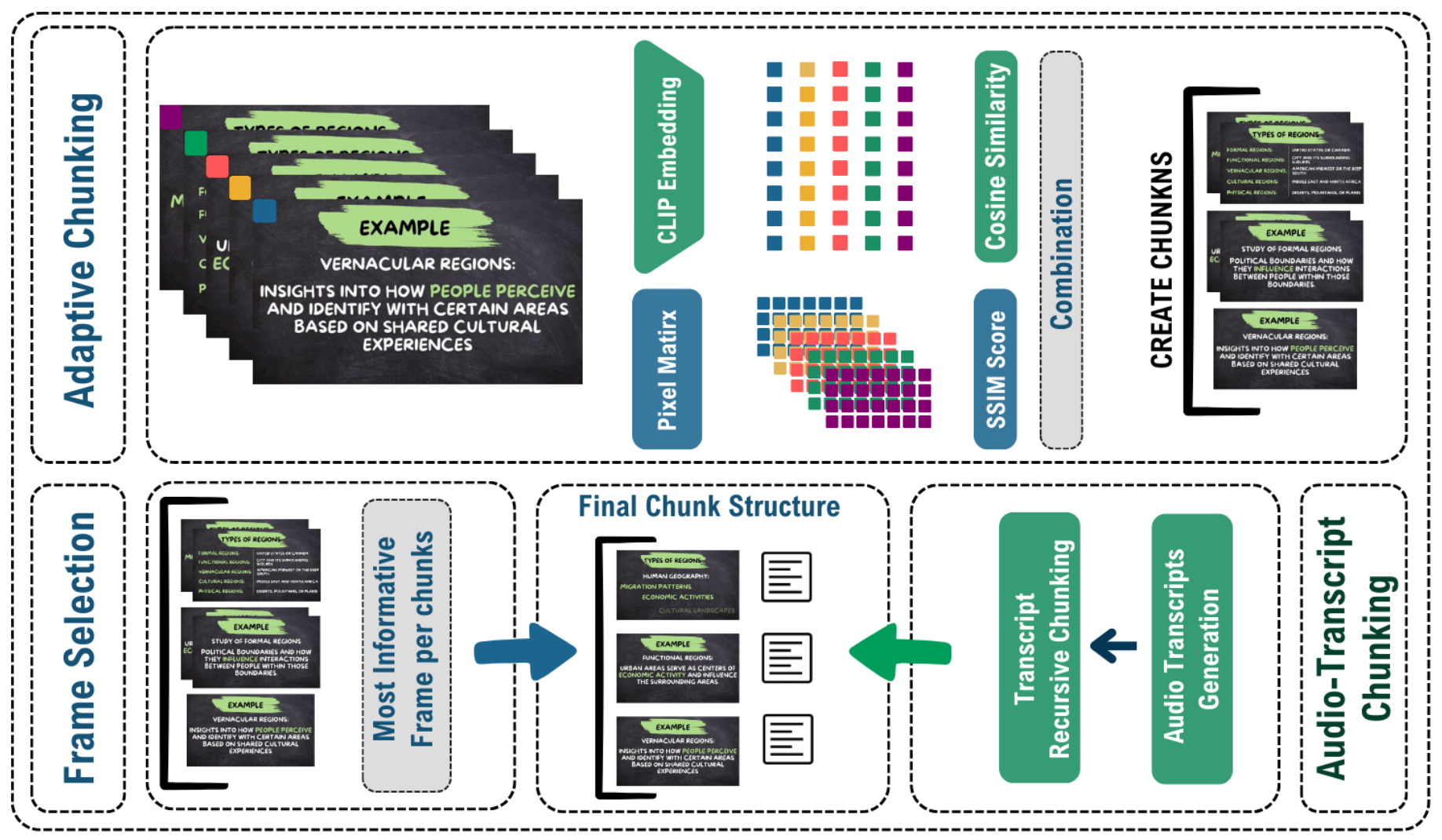
📊 Project Pipeline
📖 Overview
VideoRAC (Video Retrieval-Adaptive Chunking) provides a comprehensive framework for multimodal retrieval-augmented generation (RAG) in educational videos. This toolkit integrates visual-semantic chunking, entropy-based keyframe selection, and LLM-driven question generation to enable effective multimodal retrieval.
This repository is the official implementation of the CSICC 2025 paper by Hemmat et al.
Hemmat, A., Vadaei, K., Shirian, M., Heydari, M.H., Fatemi, A. “Adaptive Chunking for VideoRAG Pipelines with a Newly Gathered Bilingual Educational Dataset.” Proceedings of the 30th International Computer Society of Iran Computer Conference (CSICC 2025), University of Isfahan.
🧠 Research Background
This framework underpins the EduViQA bilingual dataset, designed for evaluating lecture-based RAG systems in both Persian and English. The dataset and code form a unified ecosystem for multimodal question generation and retrieval evaluation.
Key Contributions:
- 🎥 Adaptive Hybrid Chunking — Combines CLIP cosine similarity with SSIM-based visual comparison.
- 🧮 Entropy-Based Keyframe Selection — Extracts high-information frames for retrieval.
- 🗣️ Transcript–Frame Alignment — Synchronizes ASR transcripts with visual semantics.
- 🔍 Multimodal Retrieval — Integrates visual and textual embeddings for RAG.
- 🧠 Benchmark Dataset — 20 bilingual educational videos with 50 QA pairs each.
⚙️ Installation
pip install VideoRAC
🚀 Usage Example
1️⃣ Hybrid Chunking
from VideoRAC.Modules import HybridChunker

chunker = HybridChunker(
    clip_model='openai/clip-vit-base-patch32',
    alpha=0.6,
    threshold_embedding=0.85,
    threshold_ssim: float=0.8,
    interval: int=1,
)
chunks, timestamps, duration = chunker.chunk("lecture.mp4")
chunker.evaluate()
2️⃣ Q&A Generation
from VideoRAC.Modules import VideoQAGenerator

def my_llm_fn(messages):
    from openai import OpenAI
    client = OpenAI()
    response = client.chat.completions.create(model="gpt-4o", messages=messages)
    return response.choices[0].message.content

urls = ["https://www.youtube.com/watch?v=2uYu8nMR5O4"]
qa = VideoQAGenerator(video_urls=urls, llm_fn=my_llm_fn)
qa.process_videos()
📈 Results Summary (CSICC 2025)
| Method | AR | CR | F | Notes |
|---|---|---|---|---|
| VideoRAC (CLIP+SSIM) | 0.87 | 0.82 | 0.91 | Best performance overall |
| CLIP-only | 0.80 | 0.75 | 0.83 | Weaker temporal segmentation |
| Simple Slicing | 0.72 | 0.67 | 0.76 | Time-based only |
Evaluated using RAGAS metrics: Answer Relevance (AR), Context Relevance (CR), and Faithfulness (F).
🧾 License
Licensed under Creative Commons Attribution 4.0 International (CC BY 4.0).
You may share and adapt this work with attribution. Please cite our paper when using VideoRAC or EduViQA:
@INPROCEEDINGS{10967455,
  author={Hemmat, Arshia and Vadaei, Kianoosh and Shirian, Melika and Heydari, Mohammad Hassan and Fatemi, Afsaneh},
  booktitle={2025 29th International Computer Conference, Computer Society of Iran (CSICC)},
  title={Adaptive Chunking for VideoRAG Pipelines with a Newly Gathered Bilingual Educational Dataset},
  year={2025},
  volume={},
  number={},
  pages={1-7},
  keywords={Measurement;Visualization;Large language models;Pipelines;Retrieval augmented generation;Education;Question answering (information retrieval);Multilingual;Standards;Context modeling;Video QA;Datasets Preparation;Academic Question Answering;Multilingual},
  doi={10.1109/CSICC65765.2025.10967455}}
👥 Authors
University of Isfahan — Department of Computer Engineering
- Kianoosh Vadaei — kia.vadaei@gmail.com
- Melika Shirian — mel.shirian@gmail.com
- Arshia Hemmat — amirarshia.hemmat@kellogg.ox.ac.uk
- Mohammad Hassan Heydari — heidary0081@gmail.com
- Afsaneh Fatemi — a.fatemi@eng.ui.ac.ir
⭐ Official CSICC 2025 Implementation — Give it a star if you use it in your research! ⭐ Made with ❤️ at University of Isfahan
3 maintainers


Metadata
3 maintainers
Release files for VideoRAC 0.2.7
For a detailed explanation of source distributions (sdists) and built distributions (wheels), please see the package formats documentation.
Source distribution (sdist)
| File | Size | Uploaded | |
|---|---|---|---|
| videorac-0.2.7.tar.gz | 20.1 kB | Details |
Built distribution (wheel)
| File | Interpreter | ABI | Platform | Reset |
|---|---|---|---|---|
| videorac-0.2.7-py3-none-any.whl | Python 3 | none | any | Details |
Total release size: 38.6 kB
Release files / videorac-0.2.7.tar.gz
| Download URL | videorac-0.2.7.tar.gz |
|---|---|
| Size | 20.1 kB |
| Tags | Source |
|
SHA-256 checksum How to use checksums |
6dce66a9bae051bb769c098f8af9e5be189f3f60539c31ae8e8c0a29f8774f90
|
|
BLAKE2b-256 checksum How to use checksums |
7aa092c0f743bb3b3a460a194997f4ad9d046813b0fb91bba44f3c961d308553
|
| Upload date | |
|
Uploaded using Trusted Publishing? What is trusted publishing? |
No |
| Uploaded via |
twine/6.2.0 CPython/3.11.11
|
Release files / videorac-0.2.7-py3-none-any.whl
| Download URL | videorac-0.2.7-py3-none-any.whl |
|---|---|
| Size | 18.5 kB |
| Tags | Python 3 |
|
SHA-256 checksum How to use checksums |
ef2b8ac28bdcea5e59f7e23807362349d6e0461d4d6ebcf856bdc551c0b7174c
|
|
BLAKE2b-256 checksum How to use checksums |
d49c8b151cf79c997097b1d27204976b5f3e539a1fc3f186333fefe1394aa177
|
| Upload date | |
|
Uploaded using Trusted Publishing? What is trusted publishing? |
No |
| Uploaded via |
twine/6.2.0 CPython/3.11.11
|














