
Webeye
A Powerful Library for making ethical-hacking/pen-testing tools
At your Fingertips, just in 3-5 lines of code...
Features
• Subdomain Enumerator
• Port scanner
• ReverseDNS Lookup
• ReversIP Lookup
• Banner Grabber
• Firewall Detector
• Honeypot Detector (Based on Honeyscore)
• Pagelinks Extractor
• Shared DNS Scanner
• DNS Lookup
• Whois Lookup
• Geo-IP Lookup
• SiteDown detector
• ROT encoder & decoder from (ROT-1 - ROT-25)
Installation
pip install -U webeye
Getting Started
# importing
from webeye import *
# host
host="google.com"
# schema
schema="https://"
# subdomains
subdomains=subenum(host=host)
# dns lookup
dns=fetch_dns(host=host)
# banner grabber
grabbed=grab(host=host,schema=schema)
# check for ports
ports=scan(host=host, port=1025, start=0, dev_mode = False)
# cloudflare
detected=enumerate_waf(host=host)
# honeypot
honeypot=is_honeypot(host=host)
Custom Things
You can also scan specific ports, Iterable type args can also be added...
webeye.scan('google.com', [21,80,443])
You can get IP address of subdomain too...
print(webeye.subenum(target, no_ip=False))
Webeye as Asynchronous
from webeye import AsyncHelper

asyncmanner = AsyncHelper()

async def portscan(target):
    await asyncmanner.scan(target, 1024)

async def reversedns(target):
    await asyncmanner.reversedns(target)

async def whois(target):
    await asyncmanner.whois(target)

async def extract_pagelink(target):
    await asyncmanner.extract_pagelink(target)

async def shared_dns(target):
    await asyncmanner.fetch_shared_dns(target)

async def bannergrabber(target):
    await asyncmanner.grab(target)

async def geoip(target):
    await asyncmanner.geoip(target)

async def find_subdomains(target):
    await asyncmanner.find_subdomains(target)

async def dnslook(target):
    await asyncmanner.fetch_dns(target)

async def reversiplook(target):
    await asyncmanner.reverseip(target)

async def enumeratefirewall(target):
    await asyncmanner.enumerate_firewall(target)

async def is_honeypot(target):
    await asyncmanner.is_honeypot(target)
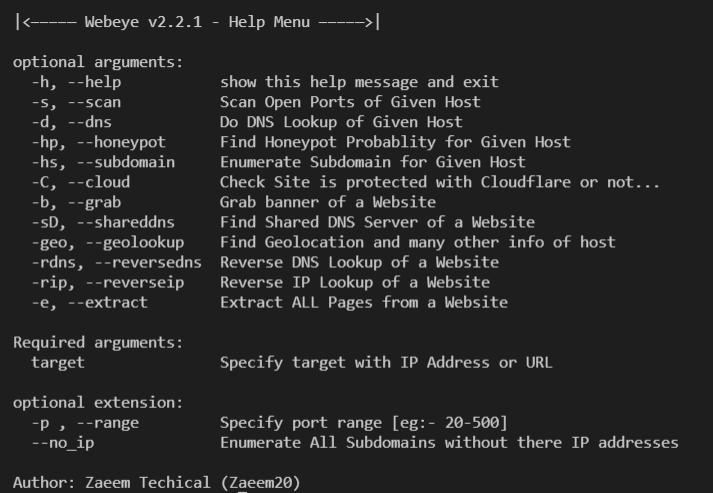
Webeye as CLI
Support
• Discord
1 maintainer

Metadata
1 maintainer
Release files for webeye 2.3.12
For a detailed explanation of source distributions (sdists) and built distributions (wheels), please see the package formats documentation.
Source distribution (sdist)
| File | Size | Uploaded | Provenance | Actions |
|---|---|---|---|---|
| webeye-2.3.12.tar.gz | 10.4 kB | Without provenance | Details for webeye-2.3.12.tar.gz |
Built distribution (wheel)
| File | Interpreter | ABI | Platform | Actions Reset |
|---|---|---|---|---|
| webeye-2.3.12-py3-none-any.whl | Python 3 | none | any | Details for webeye-2.3.12-py3-none-any.whl |
Total release size: 21.3 kB
Release files / webeye-2.3.12.tar.gz
| Download URL | webeye-2.3.12.tar.gz |
|---|---|
| Size | 10.4 kB |
| Tags | Source |
|
SHA-256 checksum How to use checksums |
2b21194a36bcf6ac3488e7850a55d9ae85ce4490f9137398f518c6601e290da7
|
|
BLAKE2b-256 checksum How to use checksums |
8aceb6c3fb2a4a8f88dc74d3d6ec90ab539f07837e2c01bb75485e07b05390f6
|
| Upload date | |
|
Uploaded using Trusted Publishing? What is trusted publishing? |
No |
| Uploaded via |
twine/4.0.0 CPython/3.9.13
|
Release files / webeye-2.3.12-py3-none-any.whl
| Download URL | webeye-2.3.12-py3-none-any.whl |
|---|---|
| Size | 10.9 kB |
| Tags | Python 3 |
|
SHA-256 checksum How to use checksums |
6f7c57e1be341b7b646ecc1638580c76d47ad8e8ec4ccb7c8c0340ec62f1050b
|
|
BLAKE2b-256 checksum How to use checksums |
1c1df966222a066f0d5f60dd20e7234395e200a8d9f01d92fb6044d452ada60b
|
| Upload date | |
|
Uploaded using Trusted Publishing? What is trusted publishing? |
No |
| Uploaded via |
twine/4.0.0 CPython/3.9.13
|
Security for webeye 2.3.12
Provenance
Provenance describes where a file came from. On PyPI, provenance is shared via attestations, which provide a verifiable record of the build or publishing details. View details, limitations and caveats.
No provenance found
None of the files in this release were uploaded with provenance metadata.
A note on package security
PyPI is a repository for distributing packages, not a service for auditing them. While third-party security researchers and our staff do their best to detect and remove malicious packages, PyPI cannot guarantee the quality, security or suitability of any given package.
To learn more about protecting yourself from malicious actors, visit our package security documentation.














