
zetapy
Repository containing ZETA functions and dependencies. For an example of how to use the code, check example.py.
Now available as pip package! Simply "pip install zetapy".
- This Python repository and the pip package are maintained by Guido Meijer and Alexander Heimel.
- The original code is written in MATLAB by Jorrit Montijn .
- A Julia port, developed by Pierre Le Merre, is available here: ZetaJu
Our pre-print describing data-stitching, the time-series ZETA-test, and the two-sample tests is available online.
The article describing the original ZETA-test has been published in eLife.
The ZETA-test for spiking data has been extensively tested on real and artificial data, and has been peer-reviewed. The time-series ZETA-test and two-sample ZETA-tests are also thoroughly tested and are described in our pre-print, which we will submit for peer-review soon. We are confident all ZETA-tests, including the two-sample tests, are reliable and statistically sound, but if you find any bugs, do let us know on the Issues page!
This repository contains five main functions:
- zetatest: Calculates the Zenith of Event-based Time-locked Anomalies (ZETA) for spike times of a single neuron. Outputs a p-value.
- zetatstest: Calculates the time-series version of ZETA, for data such as calcium imaging or EEG recordings.
- zetatest2: Same as (1), but for testing whether two neurons respond differently to the same stimulus; or whether one neuron responds differently to two sets of stimuli.
- zetatstest2: Same as (2), but for testing differences between two time-series data arrays.
- ifr: Calculates the instantaneous firing rate (IFR) without running the ZETA-test. Use this as you would a PSTH function.
Rationale for ZETA
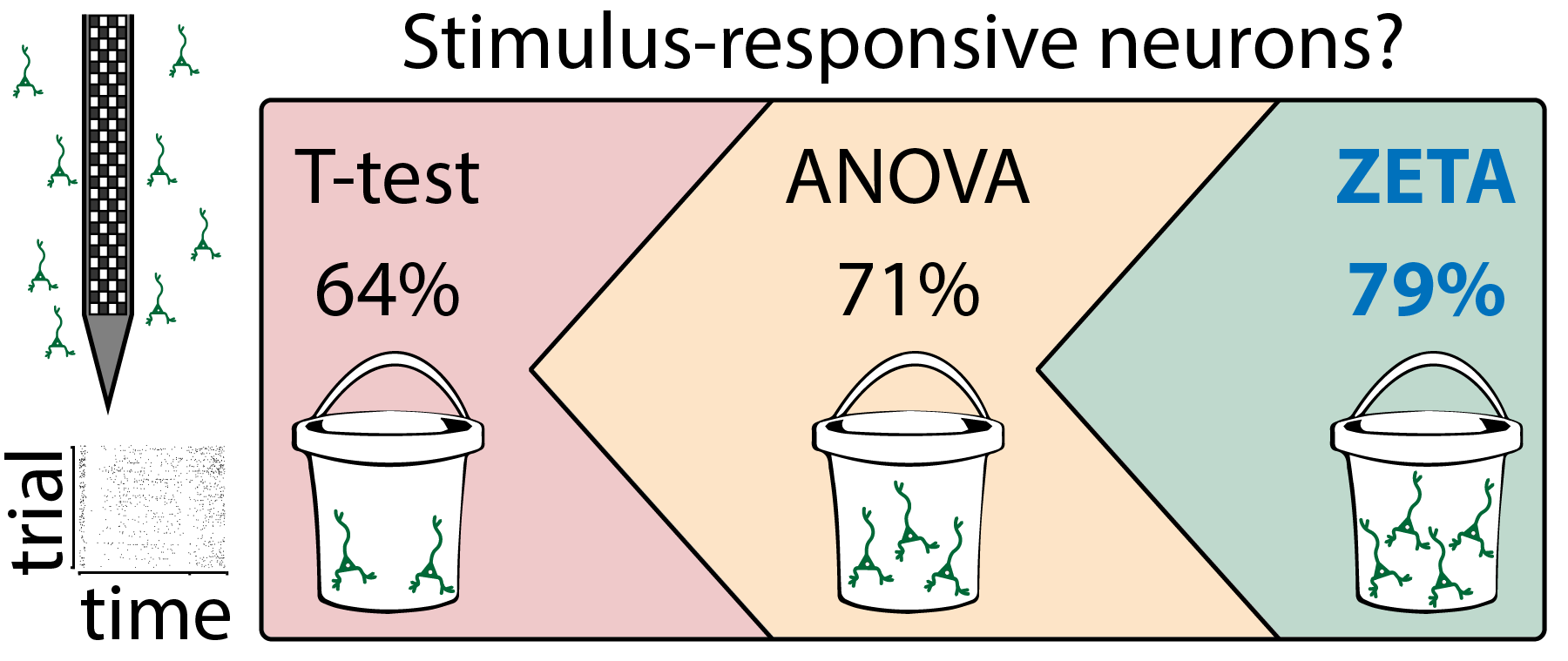
Neurophysiological studies depend on a reliable quantification of whether and when a neuron responds to stimulation, be it sensory, optogenetically or otherwise. However, current statistical analysis methods to determine a neuron’s responsiveness require arbitrary parameter choices, such as a binning size. This choice can change the results of the analysis, which invites bad statistical practice and reduces the replicability of analyses. Moreover, many methods, such as bin-wise t-tests, only detect classically mean-rate modulated cells. Especially with advent of techniques that yield increasingly large numbers of cells, such as Neuropixels recordings or two-photon calcium imaging, it is important to use tests for cell-inclusion that require no manual curation. Here, we present a new family of statistical tests for responses in point-event and time-series data for one- and two-sample comparisons: the family of ZETA-tests. As shown in our papers, they outperform approaches such as optimally-binned ANOVAs, t-tests and model-based approaches, in the sense that it includes more cells in real neurophysiological data at a similar false-positive rate.
Latency
For computing the latency of a response, we recommend to use the LatenZy test (https://github.com/Herseninstituut/latenZy), based on the zeta-test.


Release files for zetapy 4.1
For a detailed explanation of source distributions (sdists) and built distributions (wheels), please see the package formats documentation.
Source distribution (sdist)
| File | Size | Uploaded | |
|---|---|---|---|
| zetapy-4.1.tar.gz | 42.8 kB | Details |
Built distribution (wheel)
| File | Interpreter | ABI | Platform | Reset |
|---|---|---|---|---|
| zetapy-4.1-py3-none-any.whl | Python 3 | none | any | Details |
Total release size: 87.0 kB
Release files / zetapy-4.1.tar.gz
| Download URL | zetapy-4.1.tar.gz |
|---|---|
| Size | 42.8 kB |
| Tags | Source |
|
SHA-256 checksum How to use checksums |
30cc715f5edb23c7a64eb6fe41b480a1a392fa19d0e27cc881520de03f0d87aa
|
|
BLAKE2b-256 checksum How to use checksums |
98b8df0e0a509d30089d857c99b17f7d6cf5d761b9fd92bf7c2bf6034c8f2513
|
| Upload date | |
|
Uploaded using Trusted Publishing? What is trusted publishing? |
No |
| Uploaded via |
twine/6.1.0 CPython/3.10.18
|
Release files / zetapy-4.1-py3-none-any.whl
| Download URL | zetapy-4.1-py3-none-any.whl |
|---|---|
| Size | 44.2 kB |
| Tags | Python 3 |
|
SHA-256 checksum How to use checksums |
99a38fc1818cbfa5ba1dcc52c37c3b3b5212855eb30165d57f5068c826a5352e
|
|
BLAKE2b-256 checksum How to use checksums |
c4819b0d99a0709bb36702742f898500f656e3446da8dc465ab379218fa5ca1a
|
| Upload date | |
|
Uploaded using Trusted Publishing? What is trusted publishing? |
No |
| Uploaded via |
twine/6.1.0 CPython/3.10.18
|














