

SimPEG









Simulation and Parameter Estimation in Geophysics - A python package for simulation and gradient based parameter estimation in the context of geophysical applications.
The vision is to create a package for finite volume simulation with applications to geophysical imaging and subsurface flow. To enable the understanding of the many different components, this package has the following features:
modular with respect to the spacial discretization, optimization routine, and geophysical problem
built with the inverse problem in mind
provides a framework for geophysical and hydrogeologic problems
supports 1D, 2D and 3D problems
designed for large-scale inversions
You are welcome to join our forum and engage with people who use and develop SimPEG at: https://simpeg.discourse.group/.
Weekly meetings are open to all. They are generally held on Wednesdays at 3:00 PM Pacific Time. Please see the calendar (GCAL, ICAL) for information on the next meeting.
Overview Video
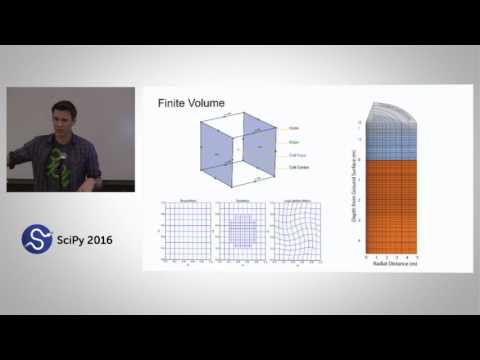
Working towards all the Geophysics, but Backwards - SciPy 2016
Citing SimPEG
There is a paper about SimPEG!
Cockett, R., Kang, S., Heagy, L. J., Pidlisecky, A., & Oldenburg, D. W. (2015). SimPEG: An open source framework for simulation and gradient based parameter estimation in geophysical applications. Computers & Geosciences.
BibTex:
@article{cockett2015simpeg,
  title={SimPEG: An open source framework for simulation and gradient based parameter estimation in geophysical applications},
  author={Cockett, Rowan and Kang, Seogi and Heagy, Lindsey J and Pidlisecky, Adam and Oldenburg, Douglas W},
  journal={Computers \& Geosciences},
  year={2015},
  publisher={Elsevier}
}
Electromagnetics
If you are using the electromagnetics module of SimPEG, please cite:
Lindsey J. Heagy, Rowan Cockett, Seogi Kang, Gudni K. Rosenkjaer, Douglas W. Oldenburg, A framework for simulation and inversion in electromagnetics, Computers & Geosciences, Volume 107, 2017, Pages 1-19, ISSN 0098-3004, http://dx.doi.org/10.1016/j.cageo.2017.06.018.
BibTex:
@article{heagy2017,
    title= "A framework for simulation and inversion in electromagnetics",
    author= "Lindsey J. Heagy and Rowan Cockett and Seogi Kang and Gudni K. Rosenkjaer and Douglas W. Oldenburg",
    journal= "Computers & Geosciences",
    volume = "107",
    pages = "1 - 19",
    year = "2017",
    note = "",
    issn = "0098-3004",
    doi = "http://dx.doi.org/10.1016/j.cageo.2017.06.018"
}
Questions
If you have a question regarding a specific use of SimPEG, the fastest way to get a response is by posting on our Discourse discussion forum: https://simpeg.discourse.group/. Alternatively, if you prefer real-time chat, you can join our Mattermost Team at https://mattermost.softwareunderground.org/simpeg. Please do not create an issue to ask a question.
Meetings
SimPEG hosts weekly meetings for users to interact with each other, for developers to discuss upcoming changes to the code base, and for discussing topics related to geophysics in general. Currently our meetings are held every Wednesday at 3:00 PM Pacific Time. Find more info on our Mattermost.
Links
Website: https://simpeg.xyz
Forums: https://simpeg.discourse.group/
Mattermost (real time chat): https://mattermost.softwareunderground.org/simpeg
Documentation: https://docs.simpeg.xyz
Code: https://github.com/simpeg/simpeg
Tests: https://dev.azure.com/simpeg/simpeg/_build
Bugs & Issues: https://github.com/simpeg/simpeg/issues
Contributing
We always welcome contributions towards SimPEG whether they are adding new code, suggesting improvements to existing codes, identifying bugs, providing examples, or anything that will improve SimPEG. Please checkout the contributing guide for more information on how to contribute.
4 maintainers


Metadata
4 maintainers
Release files for simpeg 0.26.0
For a detailed explanation of source distributions (sdists) and built distributions (wheels), please see the package formats documentation.
Source distribution (sdist)
| File | Size | Uploaded | Provenance | Actions |
|---|---|---|---|---|
| simpeg-0.26.0.tar.gz | 540.1 kB | Without provenance | Details for simpeg-0.26.0.tar.gz |
Release files / simpeg-0.26.0.tar.gz
| Download URL | simpeg-0.26.0.tar.gz |
|---|---|
| Size | 540.1 kB |
| Tags | Source |
|
SHA-256 checksum How to use checksums |
5b089c6bc15b17a00a1470541c750b162e7235ce7e241fcf5627ffa12f5c6137
|
|
BLAKE2b-256 checksum How to use checksums |
677a70a6b9990c04477a9d21346c3734062581d0e6decfbcf67b9eb383280fa5
|
| Upload date | |
|
Uploaded using Trusted Publishing? What is trusted publishing? |
No |
| Uploaded via |
twine/7.0.0 CPython/3.12.15
|
Security for simpeg 0.26.0
Provenance
Provenance describes where a file came from. On PyPI, provenance is shared via attestations, which provide a verifiable record of the build or publishing details. View details, limitations and caveats.
No provenance found
None of the files in this release were uploaded with provenance metadata.
A note on package security
PyPI is a repository for distributing packages, not a service for auditing them. While third-party security researchers and our staff do their best to detect and remove malicious packages, PyPI cannot guarantee the quality, security or suitability of any given package.
To learn more about protecting yourself from malicious actors, visit our package security documentation.














