
flux-data-qaqc





flux-data-qaqc is a Python package for energy balance closure correction and post-processing of eddy covariance flux data. It starts from processed half-hourly, hourly, or daily station data, such as AmeriFlux and FLUXNET files, and produces daily and monthly time series of the surface energy balance components and evapotranspiration (ET) with quality control, gap filling, and energy balance closure corrections, along with interactive plots. Applications include hydrologic and atmospheric model validation, evaluation of satellite-based ET, and irrigation and water use studies.
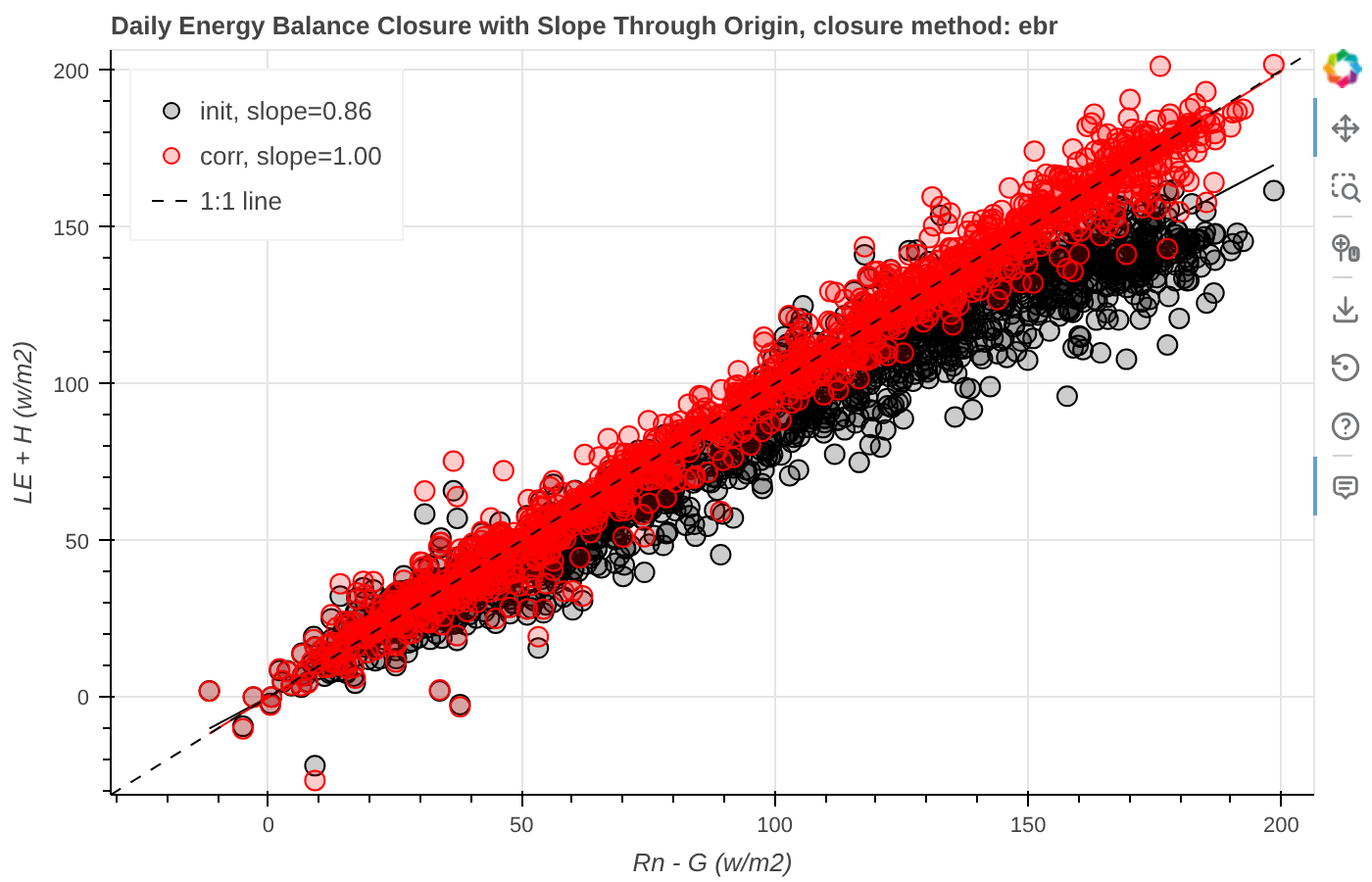
Daily energy balance closure at the US-Tw3 AmeriFlux site before (init) and after (corr) the Energy Balance Ratio correction, one of the plots made by QaQc.plot. Click the figure to open all of the interactive plots for this site, or see the tutorial.
Key functionalities and tools include:
reading sub-daily or daily station data (e.g. AmeriFlux, FLUXNET, or other CSV and Excel files) with a config file that holds the site metadata and column names
quality control with QC flags, averaging of multiple sensors, and a filter for days with too many sub-daily gaps
daily and monthly aggregation, with interpolation of short sub-daily gaps
energy balance closure corrections (energy balance ratio, Bowen ratio, and linear regression), optionally with photosynthetic energy storage removed from Rn - G
download of gridMET data and gap filling of daily ET with the gridMET reference ET fraction (ETrF)
partitioning of NEE into GPP and ecosystem respiration
ASCE reference ET and other meteorological calculations
interactive plots, unit conversions, and writing config files for batches of sites
Used in
The eddy covariance ET benchmark dataset for 194 stations in the conterminous U.S. (Volk et al., 2023; data), used to assess the accuracy of OpenET (Volk et al., 2024).
Many others
Documentation
Installation
Using PIP:
pip install fluxdataqaqcPIP should install the necessary dependencies however it is recommended to use conda and first install the provided virtual environment. This is useful to avoid changing your local Python environment. Note, flux-data-qaqc requires Python 3.9 or newer and is tested with Python 3.9, 3.11, and 3.13.
First make sure you have the fluxdataqaqc environment file, you can download it here. Next to install run,
conda env create -f environment.ymlTo activate the environment before using the flux-data-qaqc package run,
conda activate fluxdataqaqcNow install using PIP:
pip install fluxdataqaqcNow all package modules and tools should be available in your Python environment PATH and able to be imported. Note if you did not install the Conda virtual environment above, PIP should install dependencies automatically but be sure to be using a version of Python above or equal to 3.9. To test that everything has installed correctly by opening a Python interpreter or IDE and run the following:
import fluxdataqaqcand
from fluxdataqaqc import Data, QaQc, PlotIf everything has been installed correctly you should get no errors.
How to cite
Volk et al., (2021). flux-data-qaqc: A Python Package for Energy Balance Closure and Post-Processing of Eddy Flux Data. Journal of Open Source Software, 6(66), 3418, https://doi.org/10.21105/joss.03418
1 maintainer

Metadata
1 maintainer
Release files for fluxdataqaqc 0.6.0
For a detailed explanation of source distributions (sdists) and built distributions (wheels), please see the package formats documentation.
Source distribution (sdist)
| File | Size | Uploaded | Provenance | |
|---|---|---|---|---|
| fluxdataqaqc-0.6.0.tar.gz | 29.4 MB | Without provenance | Details |
Built distribution (wheel)
| File | Interpreter | ABI | Platform | Reset |
|---|---|---|---|---|
| fluxdataqaqc-0.6.0-py3-none-any.whl | Python 3 | none | any | Details |
Total release size: 29.5 MB
Release files / fluxdataqaqc-0.6.0.tar.gz
| Download URL | fluxdataqaqc-0.6.0.tar.gz |
|---|---|
| Size | 29.4 MB |
| Tags | Source |
|
SHA-256 checksum How to use checksums |
f04bee420b0135a6efc6ca95204485d2c7c0145a5112f37c270ec4a4ad59020a
|
|
BLAKE2b-256 checksum How to use checksums |
5eb34dc66f9638847c3a81976b0539f75357a8aa0021c52153bde5c4721cfc8f
|
| Upload date | |
|
Uploaded using Trusted Publishing? What is trusted publishing? |
No |
| Uploaded via |
twine/7.0.0 CPython/3.13.5
|
Release files / fluxdataqaqc-0.6.0-py3-none-any.whl
| Download URL | fluxdataqaqc-0.6.0-py3-none-any.whl |
|---|---|
| Size | 74.9 kB |
| Tags | Python 3 |
|
SHA-256 checksum How to use checksums |
e5c22fe331a7221009011590d7e1302a5ec4e4a9c41ff4a60c5c7712136cdcfc
|
|
BLAKE2b-256 checksum How to use checksums |
46e2cb598dd8dc3f8392b314c16bb7ba3fd62f8ed8881d7907205fedb553da35
|
| Upload date | |
|
Uploaded using Trusted Publishing? What is trusted publishing? |
No |
| Uploaded via |
twine/7.0.0 CPython/3.13.5
|
Security for fluxdataqaqc 0.6.0
Provenance
Provenance describes where a file came from. On PyPI, provenance is shared via attestations, which provide a verifiable record of the build or publishing details. View details, limitations and caveats.
No provenance found
None of the files in this release were uploaded with provenance metadata.
A note on package security
PyPI is a repository for distributing packages, not a service for auditing them. While third-party security researchers and our staff do their best to detect and remove malicious packages, PyPI cannot guarantee the quality, security or suitability of any given package.














