
gwent




Gravitational Wave dEtector desigN Toolkit.
Generates strain sensitivity curves and Waterfall plots for various gravitational wave detector designs.
Free software: MIT license
Documentation: https://gwent.readthedocs.io.
Features
Calculates the sensitivity curves for various designs of pulsar timing arrays, space-based detectors, and ground-based detectors. This includes:
NANOGrav
SKA
LISA
aLIGO
Voyager
and more!
Calculates the strain from coalescing black hole binaries. It contains functionality for different source descriptions:
Slowly-evolving sources, ie. BHBs early in their inspiral where they appear to not change in frequency.
Rapidly-evolving sources, ie. BHBs in the final stages of coalescence.
Uses a fully Pythonic implementation of the phenomenological model IMRPhenomD to accurately represent the inspiral, merger, and ringdown of the BHB.
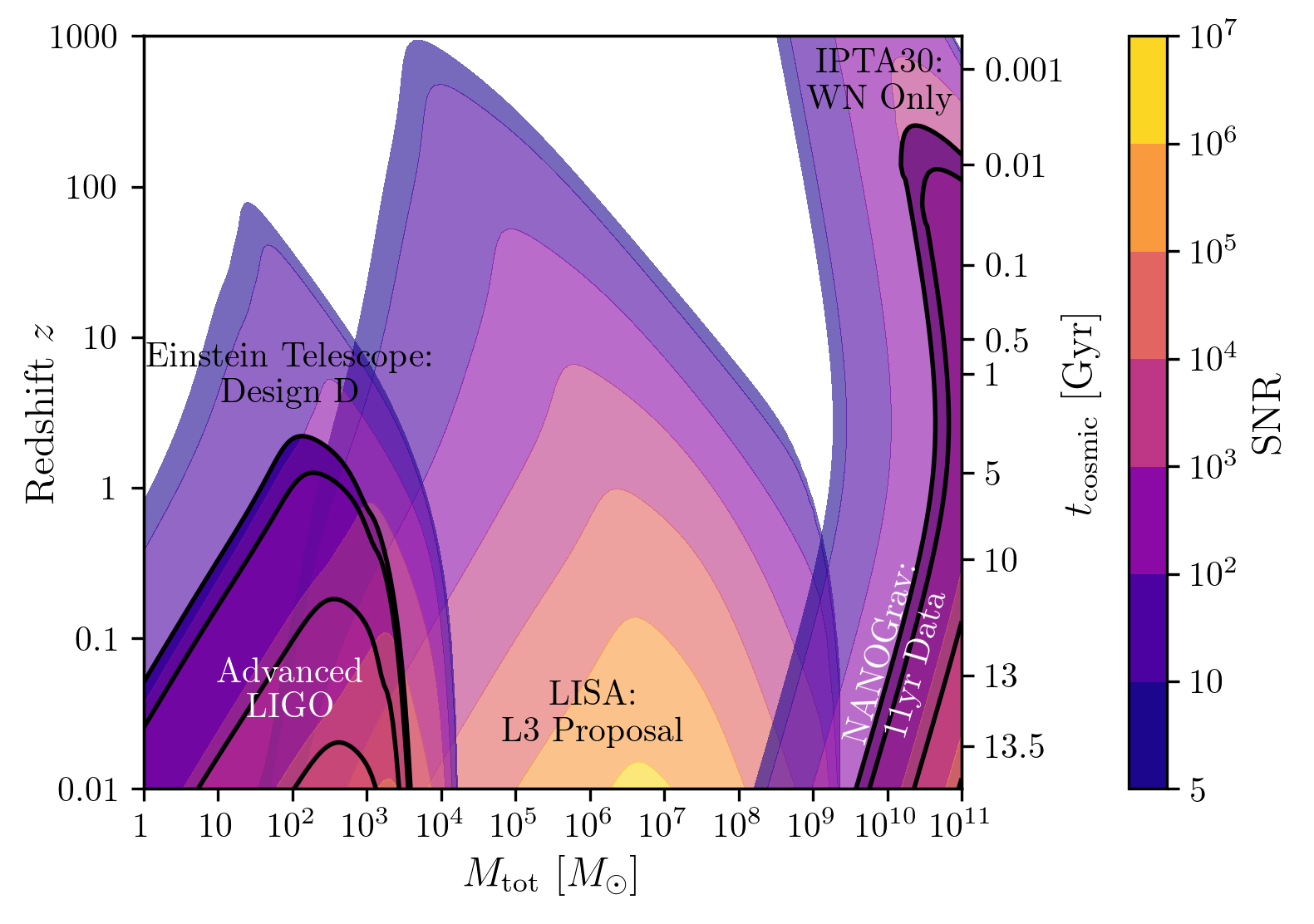
Calculates the matched-filtered signal-to-noise ratio (SNR) to help assess the detectability of any BHB source configuration by any represented gravitational wave detector.
Includes robust plotting methods to represent these SNRs.
Getting Started
gwent is available on the Python Package Inventory, so the preferred method to install gwent is to install it with pip, as it will always install the most recent stable release.
$ pip install gwentREADME Figure and Data
If you are looking for quick data, we conveniently place the figure above in the data folder on the Github repo. There you can also find the raw data used for this figure in .npz format. To load this data, simply use np.load(filename), and the data can be accessed by the kwargs 'mass', 'redshift', and 'snr'. E.g.,
import numpy as np
import gwent
from gwent.snrplot import Plot_SNR
loaded_file = np.load(filename)
Plot_SNR('M',load_file['mass'],'z',load_file['redshift'],load_file['snr'])
Publication
This work and methodology is available on arXiv. If you use gwent, please cite this work using the following:
@ARTICLE{Kaiser:2021,
  doi = {10.1088/1361-6382/abd4f6},
  url = {https://doi.org/10.1088/1361-6382/abd4f6},
  year = 2021,
  month = {jan},
  publisher = {{IOP} Publishing},
  volume = {38},
  number = {5},
  pages = {055009},
  author = {A R Kaiser and S T McWilliams},
  title = {Sensitivity of present and future detectors across the black-hole binary gravitational wave spectrum},
  journal = {Classical and Quantum Gravity},
  eprint = {2010.02135},
  adsurl = {https://ui.adsabs.harvard.edu/abs/2020arXiv201002135K},
  adsnote = {Provided by the SAO/NASA Astrophysics Data System}
}
Credits
We utilize and include within the package a specific commit of pygwinc found at https://git.ligo.org/gwinc/pygwinc to create many of the ground-based gravitational wave detector sensitivity curves. At the time of creation, there is no pygwinc availability on PyPI, so we explicitly include the necessary portions of the code within.
This package was created with Cookiecutter and the audreyr/cookiecutter-pypackage project template.
1 maintainer

Metadata
1 maintainer
Release files for gwent 0.5.0
For a detailed explanation of source distributions (sdists) and built distributions (wheels), please see the package formats documentation.
Built distribution (wheel)
| File | Interpreter | ABI | Platform | Actions Reset |
|---|---|---|---|---|
| gwent-0.5.0-py2.py3-none-any.whl | Python 3, Python 2 | none | any | Details for gwent-0.5.0-py2.py3-none-any.whl |
Release files / gwent-0.5.0-py2.py3-none-any.whl
| Download URL | gwent-0.5.0-py2.py3-none-any.whl |
|---|---|
| Size | 3.5 MB |
| Tags | Python 2 Python 3 |
|
SHA-256 checksum How to use checksums |
04ae3da574d8c33aada72c9dd6162d61d07888a7656e817e566f75f2ea5ef20a
|
|
BLAKE2b-256 checksum How to use checksums |
bedc770530f90b7bd3529841531f473c694225978d5a01135ce3638df3065fbb
|
| Upload date | |
|
Uploaded using Trusted Publishing? What is trusted publishing? |
No |
| Uploaded via |
twine/4.0.2 CPython/3.9.15
|
Security for gwent 0.5.0
Provenance
Provenance describes where a file came from. On PyPI, provenance is shared via attestations, which provide a verifiable record of the build or publishing details. View details, limitations and caveats.
No provenance found
None of the files in this release were uploaded with provenance metadata.
A note on package security
PyPI is a repository for distributing packages, not a service for auditing them. While third-party security researchers and our staff do their best to detect and remove malicious packages, PyPI cannot guarantee the quality, security or suitability of any given package.
To learn more about protecting yourself from malicious actors, visit our package security documentation.














