
PS-Tree


An open source python library for non-linear piecewise symbolic regression based on Genetic Programming
Free software: MIT license
Documentation: https://pstree.readthedocs.io.
Introduction
Piece-wise non-linear regression is a long-standing problem in the machine learning domain that has long plagued machine learning researchers. It is extremely difficult for users to determine the correct partition scheme and non-linear model when there is no prior information. To address this issue, we proposed piece-wise non-linear regression tree (PS-Tree), an automated piece-wise non-linear regression method based on decision tree and genetic programming techniques. Based on such an algorithm framework, our method can produce an explainable model with high accuracy in a short period of time.
Installation
pip install -U pstreeFeatures
A fully automated piece-wise non-linear regression tool
A fast genetic programming based symbolic regression tool
Example
An example of usage:
X, y = load_diabetes(return_X_y=True)
x_train, x_test, y_train, y_test = train_test_split(X, y, test_size=0.2, random_state=0)
r = PSTreeRegressor(regr_class=GPRegressor, tree_class=DecisionTreeRegressor,
                    height_limit=6, n_pop=25, n_gen=100,
                    basic_primitive='optimal', size_objective=True)
r.fit(x_train, y_train)
print(r2_score(y_test, r.predict(x_test)))
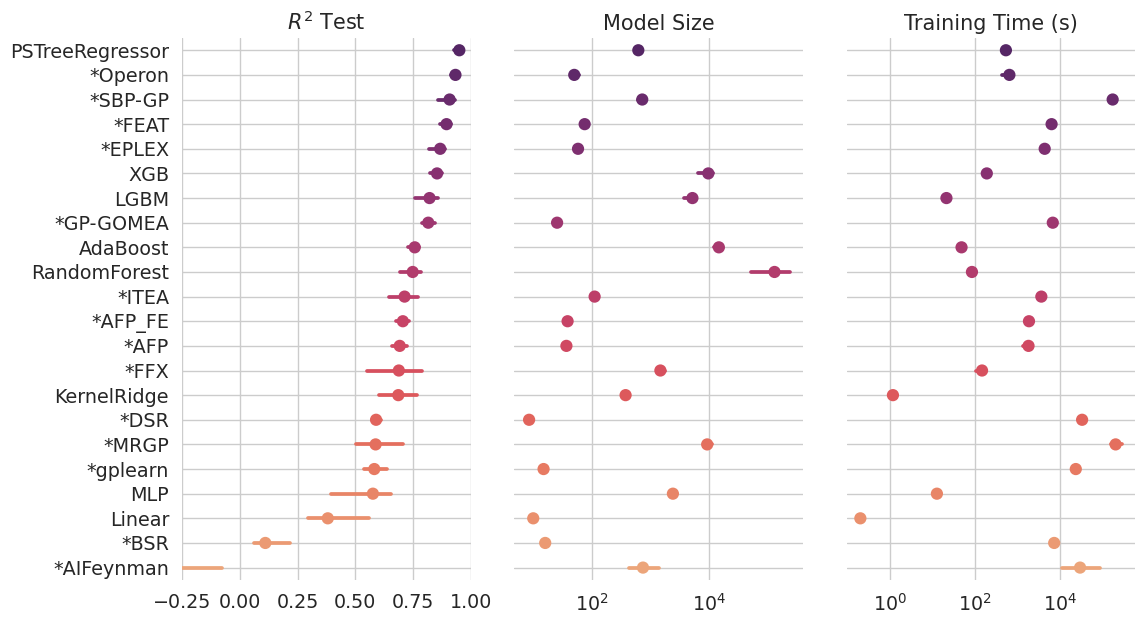
Experimental results on SRBench:
Citation
@article{zhang2022ps,
    title={PS-Tree: A piecewise symbolic regression tree},
    author={Zhang, Hengzhe and Zhou, Aimin and Qian, Hong and Zhang, Hu},
    journal={Swarm and Evolutionary Computation},
    volume={71},
    pages={101061},
    year={2022},
    publisher={Elsevier}
}
By the way, I would like to express my gratitude to Qi-Hao Huang from Guangzhou University for pointing out that the “minimize” in formula (4) of the paper should be “maximize”, corresponding to the code. (https://github.com/hengzhe-zhang/PS-Tree/blob/master/pstree/cluster_gp_sklearn.py#L320-L346)
Credits
This package was created with Cookiecutter and the audreyr/cookiecutter-pypackage project template.
History
0.1.0 (2021-06-28)
First release on PyPI.
1 maintainer

Metadata
1 maintainer
Release files for pstree 0.1.2
For a detailed explanation of source distributions (sdists) and built distributions (wheels), please see the package formats documentation.
Source distribution (sdist)
| File | Size | Uploaded | Provenance | |
|---|---|---|---|---|
| pstree-0.1.2.tar.gz | 101.3 kB | Without provenance | Details |
Built distribution (wheel)
| File | Interpreter | ABI | Platform | Reset |
|---|---|---|---|---|
| pstree-0.1.2-py2.py3-none-any.whl | Python 2, Python 3 | none | any | Details |
Total release size: 127.6 kB
Release files / pstree-0.1.2.tar.gz
| Download URL | pstree-0.1.2.tar.gz |
|---|---|
| Size | 101.3 kB |
| Tags | Source |
|
SHA-256 checksum How to use checksums |
2441283a82c5d05da66b0167f67a3a7fb6c97ceb7e92e70db1593a3faeb40bc8
|
|
BLAKE2b-256 checksum How to use checksums |
b8439a196069b575e59102d9f830dbda8ef87701d5e4679405320b91f31cb3fa
|
| Upload date | |
|
Uploaded using Trusted Publishing? What is trusted publishing? |
No |
| Uploaded via |
twine/4.0.2 CPython/3.11.4
|
Release files / pstree-0.1.2-py2.py3-none-any.whl
| Download URL | pstree-0.1.2-py2.py3-none-any.whl |
|---|---|
| Size | 26.4 kB |
| Tags | Python 2 Python 3 |
|
SHA-256 checksum How to use checksums |
a53ce98b0e82dc793c49503b69fe6b560b1b15a932480262a5a4664dae966b89
|
|
BLAKE2b-256 checksum How to use checksums |
66ee6dbdd153cbadd241c7944b662b18e4e27be3c337bbdb7842c0fd76a67cdb
|
| Upload date | |
|
Uploaded using Trusted Publishing? What is trusted publishing? |
No |
| Uploaded via |
twine/4.0.2 CPython/3.11.4
|
Security for pstree 0.1.2
Provenance
Provenance describes where a file came from. On PyPI, provenance is shared via attestations, which provide a verifiable record of the build or publishing details. View details, limitations and caveats.
No provenance found
None of the files in this release were uploaded with provenance metadata.
A note on package security
PyPI is a repository for distributing packages, not a service for auditing them. While third-party security researchers and our staff do their best to detect and remove malicious packages, PyPI cannot guarantee the quality, security or suitability of any given package.
To learn more about protecting yourself from malicious actors, visit our package security documentation.














