
pySRU
Synchrotron Radiation Undulator emission in python
Main development website: https://github.com/oasys-kit/pySRU
A toolbox to calculate the emission of radiation by undulators in storage rings.
This software library implements formulas to calculate the emission of radiation by undulators in storage rings, and more generally, the emission of a relativistic electron in an arbitrary magnetic field.
The software is written in pure python, using standard packages as numpy and scipy. It uses matplotlib for plots, but it is not required for calculations.
License
This code is relased under the MIT license as detailed in the LICENSE file.
Installation
To build the library for python use, just use the pip install . in the pySRU directory. It is also available in http://pypi.python.org/pypi/pySRU/: pip install pySRU
Example
The file Simulations.py contains a number of simulations. For example the following code created the emission of an undulator like in fig 2.5 of the X-ray Data Booklet (http://xdb.lbl.gov/Section2/Sec_2-1.html)
This piece of Python code shows how the library can be used via its python binding.
from pySRU.ElectronBeam import ElectronBeam
from pySRU.MagneticStructureUndulatorPlane import MagneticStructureUndulatorPlane as Undulator
from pySRU.Simulation import create_simulation
from pySRU.TrajectoryFactory import TRAJECTORY_METHOD_ANALYTIC,TRAJECTORY_METHOD_ODE
from pySRU.RadiationFactory import RADIATION_METHOD_NEAR_FIELD, RADIATION_METHOD_APPROX_FARFIELD

print("======================================================================")
print("======      Undulator from X-ray data booklet                  =======")
print("====== fig 2.5 in  http://xdb.lbl.gov/Section2/Sec_2-1.html    =======")
print("======================================================================")

# note that the flux in the reference fig 2.6 is a factor 10 smaller than the calculated here.
# This factor comes from the units:
#     here: phot / s  / A / 0.1%bw / (mrad)^2
#     ref : phot / s  / A /   1%bw / (0.1 mrad)^2

undulator_test = Undulator(K=1.87, period_length=0.035, length=0.035 * 14)
electron_beam_test = ElectronBeam(Electron_energy=1.3, I_current=1.0)

simulation_test = create_simulation(magnetic_structure=undulator_test,electron_beam=electron_beam_test,
                    magnetic_field=None, photon_energy=None,
                    traj_method=TRAJECTORY_METHOD_ANALYTIC,Nb_pts_trajectory=None,
                    rad_method=RADIATION_METHOD_APPROX_FARFIELD, Nb_pts_radiation=101,
                    initial_condition=None, distance=None,XY_are_list=False,X=None,Y=None)


# simulation_test.print_parameters()

# simulation_test.trajectory.plot_3D(title="Electron Trajectory")

simulation_test.radiation.plot(title="Flux in far field vs angle")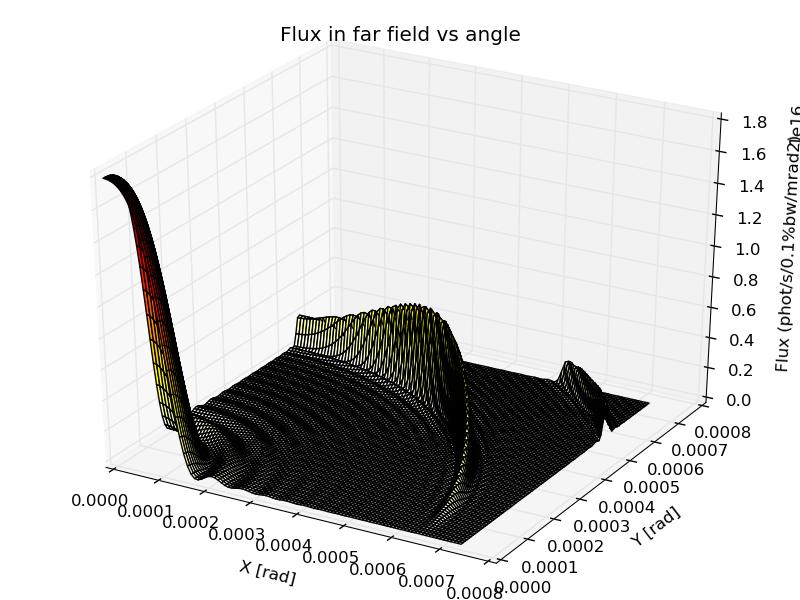
Result link: https://github.com/oasys-kit/pySRU/blob/master/doc/radiation_xraybooklet.jpeg
Documentation
For using pySRU, start with prepared simulations in Simulation.py
A comparison of the pySRU results with other codes can be found at: https://github.com/oasys-kit/pySRU/blob/master/doc/pySRU_comparison.pdf
A document including the formulas and algorithms used is: https://github.com/oasys-kit/pySRU/blob/master/doc/report_thery_m1.pdf
Testing
Run the test suite with:
./pySRU/tests/run_tests.sh
To do
Quicker calculation of intensity spectrum
Implement simplified formulas for calculating power density
Add electron emittance via convolutions
Implement the pi polarization
Extend to helical undulators
2 maintainers


Metadata
2 maintainers
Release files for pySRU 0.5.6
For a detailed explanation of source distributions (sdists) and built distributions (wheels), please see the package formats documentation.
Source distribution (sdist)
| File | Size | Uploaded | Provenance | Actions |
|---|---|---|---|---|
| pysru-0.5.6.tar.gz | 38.8 kB | Without provenance | Details for pysru-0.5.6.tar.gz |
Built distribution (wheel)
| File | Interpreter | ABI | Platform | Actions Reset |
|---|---|---|---|---|
| pysru-0.5.6-py3-none-any.whl | Python 3 | none | any | Details for pysru-0.5.6-py3-none-any.whl |
Total release size: 105.1 kB
Release files / pysru-0.5.6.tar.gz
| Download URL | pysru-0.5.6.tar.gz |
|---|---|
| Size | 38.8 kB |
| Tags | Source |
|
SHA-256 checksum How to use checksums |
556e374587902476300bd8fcf8c5333bad4746667dae74207293f48f447f5834
|
|
BLAKE2b-256 checksum How to use checksums |
8bc24244eb2670faf33625264fa3ec9d8610e7959f07c4ccd6b4666502569488
|
| Upload date | |
|
Uploaded using Trusted Publishing? What is trusted publishing? |
No |
| Uploaded via |
twine/6.2.0 CPython/3.12.3
|
Release files / pysru-0.5.6-py3-none-any.whl
| Download URL | pysru-0.5.6-py3-none-any.whl |
|---|---|
| Size | 66.3 kB |
| Tags | Python 3 |
|
SHA-256 checksum How to use checksums |
d87182820e73897c2ac28edd73ec781339ecb836a6173fa65de244880a5acc8a
|
|
BLAKE2b-256 checksum How to use checksums |
1ac327c0c33a4f2e4da6ea967c9fdf0be4a5487b383108920f95fbf977e2a6ed
|
| Upload date | |
|
Uploaded using Trusted Publishing? What is trusted publishing? |
No |
| Uploaded via |
twine/6.2.0 CPython/3.12.3
|
Security for pySRU 0.5.6
Provenance
Provenance describes where a file came from. On PyPI, provenance is shared via attestations, which provide a verifiable record of the build or publishing details. View details, limitations and caveats.
No provenance found
None of the files in this release were uploaded with provenance metadata.
A note on package security
PyPI is a repository for distributing packages, not a service for auditing them. While third-party security researchers and our staff do their best to detect and remove malicious packages, PyPI cannot guarantee the quality, security or suitability of any given package.
To learn more about protecting yourself from malicious actors, visit our package security documentation.















