


pyodeint provides a Python binding to odeint. Currently, the following steppers are exposed:
rosenbrock4: 4th order Rosenbrock (implicit multistep) stepper
dopri5: 5th order DOPRI5 (explicit runge-kutta)
bs: Bulirsch-Stoer stepper (modified midpoint rule).
The Rosenbrock4 stepper requires that the user provides a routine for calculating the Jacobian.
You may also want to know that you can use pyodeint from pyodesys which can e.g. derive the Jacobian analytically for you (pyodesys also provides plotting functions, C++ code-generation and more).
Documentation
Autogenerated API documentation for latest stable release is found here: https://bjodah.github.io/pyodeint/latest (and the development version for the current master branch are found here: http://hera.physchem.kth.se/~pyodeint/branches/master/html).
Installation
Simplest way to install is to use the conda package manager:
$ conda install -c conda-forge pyodeint pytest
$ python -m pytest --pyargs pyodeint
tests should pass.
Binary distribution is available here: https://anaconda.org/bjodah/pyodeint
Source distribution is available here: https://pypi.python.org/pypi/pyodeint
here is an example of how to build from source:
$ CPATH=/opt/boost_1_65_0/include python3 setup.py build_ext -i
Examples
The classic van der Pol oscillator (see examples/van_der_pol.py)
>>> from pyodeint import integrate_adaptive  # also: integrate_predefined
>>> mu = 1.0
>>> def f(t, y, dydt):
...     dydt[0] = y[1]
...     dydt[1] = -y[0] + mu*y[1]*(1 - y[0]**2)
...
>>> def j(t, y, Jmat, dfdt, fy=None):
...     Jmat[0, 0] = 0
...     Jmat[0, 1] = 1
...     Jmat[1, 0] = -1 -mu*2*y[1]*y[0]
...     Jmat[1, 1] = mu*(1 - y[0]**2)
...     dfdt[0] = 0
...     dfdt[1] = 0
...
>>> y0 = [1, 0]; tend=10.0; dt0=1e-8; t0=0.0; atol=1e-8; rtol=1e-8
>>> tout, yout, info = integrate_adaptive(f, j, y0, t0, tend, dt0, atol, rtol,
...                                       method='rosenbrock4', nsteps=1000)
>>> import matplotlib.pyplot as plt
>>> series = plt.plot(tout, yout)
>>> plt.show()  # doctest: +SKIP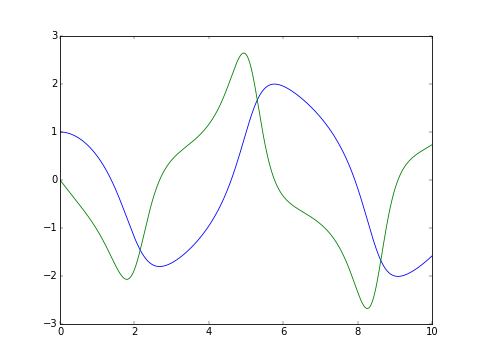
For more examples see examples/, and rendered jupyter notebooks here: http://hera.physchem.kth.se/~pyodeint/branches/master/examples
See also
pyodesys for how to automatically generate the jacobian callback function (and easily swtich to other solvers).
License
The source code is Open Source and is released under the very permissive “simplified (2-clause) BSD license”. See LICENSE for further details. Contributors are welcome to suggest improvements at https://github.com/bjodah/pyodeint
1 maintainer

Metadata
1 maintainer
Release files for pyodeint 0.10.10
For a detailed explanation of source distributions (sdists) and built distributions (wheels), please see the package formats documentation.
Source distribution (sdist)
| File | Size | Uploaded | Provenance | Actions |
|---|---|---|---|---|
| pyodeint-0.10.10.tar.gz | 220.5 kB | Without provenance | Details for pyodeint-0.10.10.tar.gz |
Release files / pyodeint-0.10.10.tar.gz
| Download URL | pyodeint-0.10.10.tar.gz |
|---|---|
| Size | 220.5 kB |
| Tags | Source |
|
SHA-256 checksum How to use checksums |
78fc9369d68e46ebf35d79cfde9d673f8dbe43b61e102397c3ff7e7d5d9f4781
|
|
BLAKE2b-256 checksum How to use checksums |
81f2222d8c50ab6727e55c034f958df20f5314b0e5903bd4ef5b5d35ae6d020d
|
| Upload date | |
|
Uploaded using Trusted Publishing? What is trusted publishing? |
No |
| Uploaded via |
twine/6.2.0 CPython/3.13.5
|
Security for pyodeint 0.10.10
Provenance
Provenance describes where a file came from. On PyPI, provenance is shared via attestations, which provide a verifiable record of the build or publishing details. View details, limitations and caveats.
No provenance found
None of the files in this release were uploaded with provenance metadata.
A note on package security
PyPI is a repository for distributing packages, not a service for auditing them. While third-party security researchers and our staff do their best to detect and remove malicious packages, PyPI cannot guarantee the quality, security or suitability of any given package.
To learn more about protecting yourself from malicious actors, visit our package security documentation.














